
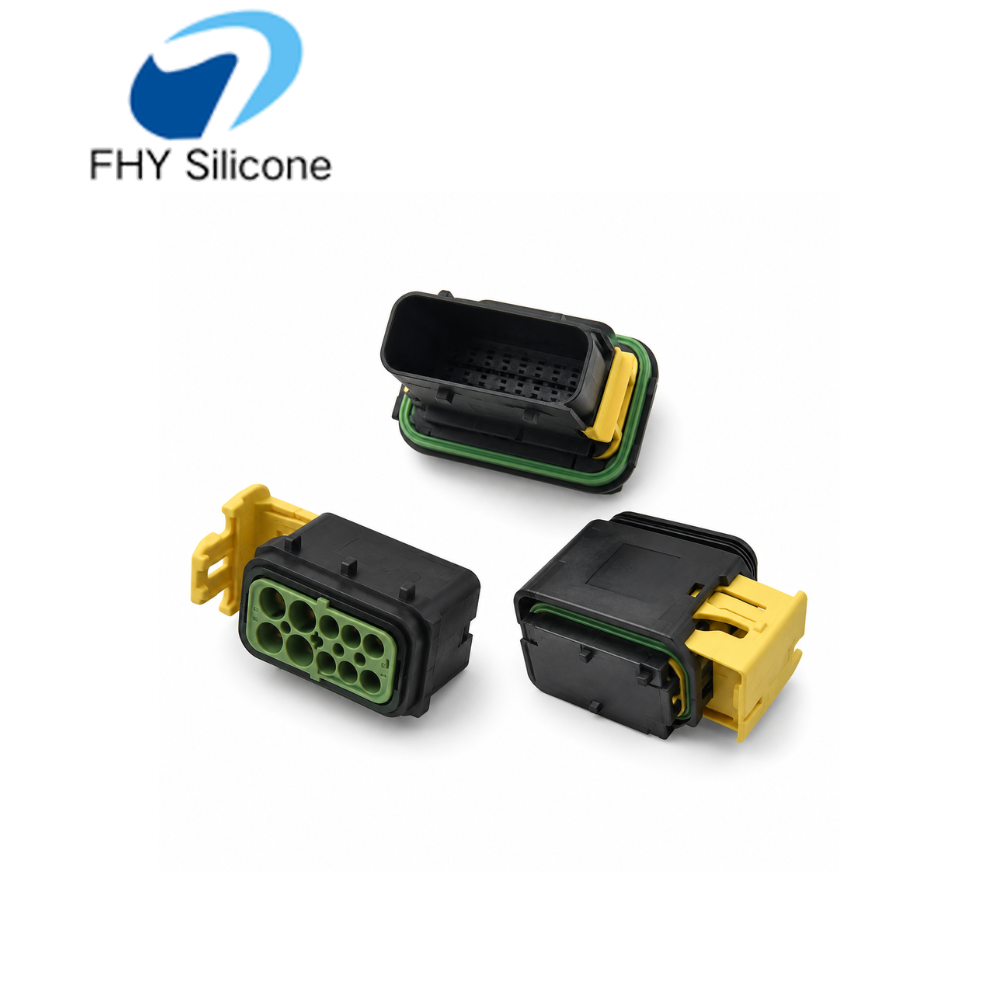
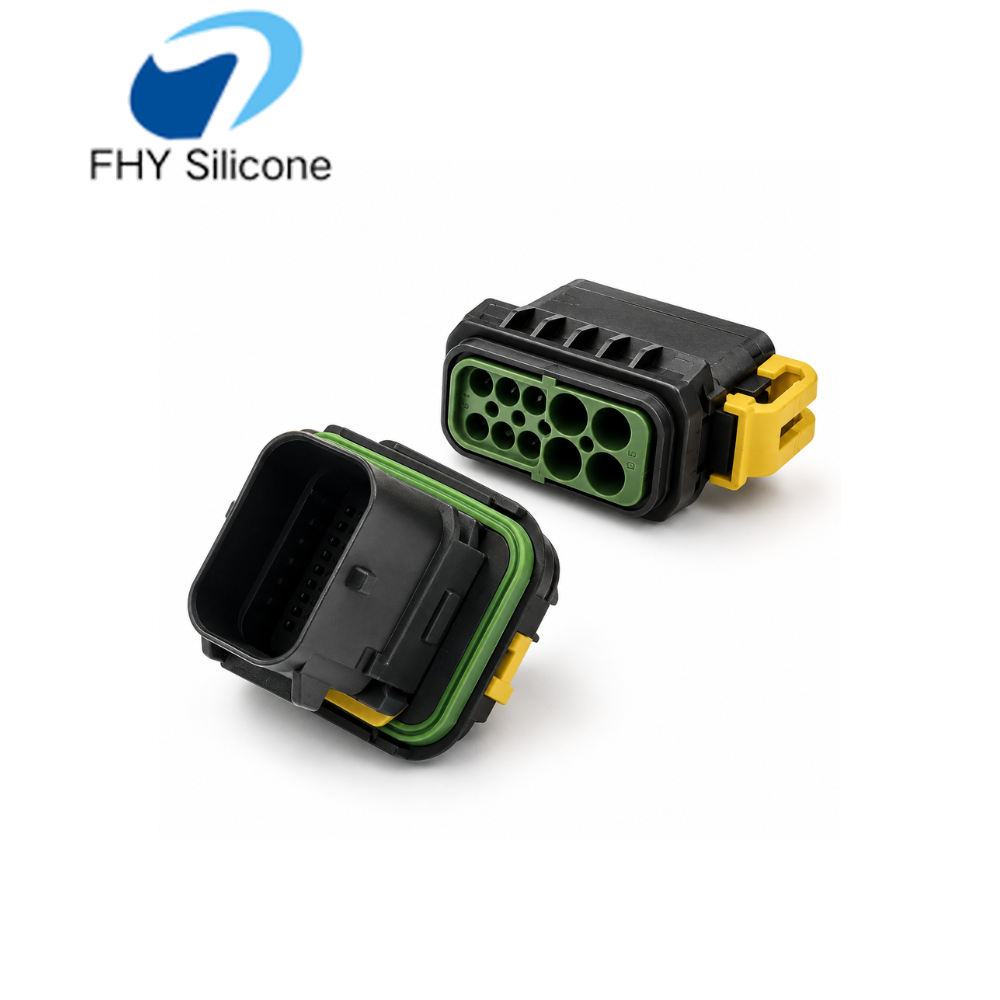
The Automotive LSR Overmolded Waterproof Connector Housing is a precision-molded connector component designed for automotive electrical and wiring harness systems. It combines rigid engineering plastic injection molding with integrated liquid silicone rubber overmolding to achieve reliable sealing, mechanical protection, vibration resistance, and long-term durability in harsh vehicle environments.
The plastic housing provides structural strength, terminal positioning, insulation, and assembly stability, while the overmolded LSR silicone sealing area forms a soft and elastic waterproof barrier. This integrated design helps improve sealing consistency, reduce separate assembly steps, and enhance product reliability compared with traditional assembled sealing rings.
This product is suitable for automotive wiring harness connectors, ECU connectors, sensor connectors, power control modules, lighting systems, and new energy vehicle electrical connection systems.
Product Features
Integrated LSR Overmolding Structure
The silicone sealing area is directly overmolded onto the plastic connector housing, creating a stable integrated structure. This helps reduce the risk of seal displacement, missing seals, or assembly errors.
Excellent Waterproof and Dustproof Performance
The LSR sealing structure provides flexible compression and close contact with the mating connector, helping protect the internal terminals from water, dust, moisture, and external contamination.
Automotive-Grade Engineering Plastic
The rigid housing can be made from automotive-grade materials such as PA66, PA66+GF, PBT, PPS, or other engineering plastics depending on the required temperature resistance, mechanical strength, and electrical insulation performance.
Reliable Locking and Assembly Design
The connector housing can be designed with locking clips, secondary locks, positioning structures, guide slots, and anti-misassembly features to ensure stable connection during vehicle operation.
Suitable for Harsh Automotive Environments
The product is designed for applications exposed to vibration, temperature change, humidity, dust, and long-term electrical system operation.
Product Specifications
| Item | Description |
|---|---|
| Product Name | Automotive LSR Overmolded Waterproof Connector Housing |
| Material | PA66, PA66+GF, PBT, PPS, LSR Silicone, Custom Materials |
| Process | Plastic Injection Molding + LSR Overmolding |
| Silicone Type | Liquid Silicone Rubber |
| Silicone Hardness | Customizable, commonly 30–70 Shore A |
| Color | Black, Yellow, Green, Gray, or Custom Colors |
| Structure | Connector Housing, Seal, Locking Part, Terminal Positioning Area |
| Application | Automotive Wiring Harness, ECU, Sensors, Lighting, EV Systems |
| Function | Waterproof, Dustproof, Insulation, Sealing, Locking, Protection |
| Customization | Available Based on Drawing, Sample, or 3D Design |
| Production Type | OEM / ODM Custom Manufacturing |
Typical Applications
This LSR overmolded connector housing can be used in:
Automotive wiring harness connectors
Engine compartment electrical connectors
ECU and control module connectors
Sensor connector assemblies
Automotive lighting connector systems
New energy vehicle electrical systems
Battery management system connectors
Motor controller and power module connectors
Waterproof electrical connector assemblies
Industrial vehicle electrical connection systems
Manufacturing Process
This product is manufactured through a precision two-material molding process.
First, the rigid plastic connector housing is produced by injection molding. The plastic insert is then placed into a dedicated LSR mold, where liquid silicone rubber is injected and vulcanized directly onto the selected sealing area of the plastic part.
Through this process, the soft silicone seal and hard plastic housing are combined into one integrated component. Compared with manually assembled sealing parts, LSR overmolding can improve product consistency, sealing reliability, production efficiency, and assembly stability.
Advantages of LSR Overmolding for Automotive Connectors
Automotive connectors often need to work under vibration, temperature cycling, moisture, dust, and repeated assembly conditions. Traditional separately assembled seals may shift, fall off, or be incorrectly installed during production or use.
LSR overmolding helps solve these problems by forming the sealing structure directly on the connector housing. The silicone seal is fixed in position and provides stable compression during mating. This design can reduce assembly risks and improve long-term sealing performance.
For automotive electrical systems, this is especially important in areas such as engine compartments, battery packs, sensors, lamps, and outdoor-exposed connection points.
Customization Options
We support customized development according to customer drawings, 3D files, samples, and functional requirements.
Customization options include:
Material selection
Connector structure design
LSR overmolding area design
Silicone hardness
Color matching
Waterproof sealing structure
Locking and positioning features
Terminal hole layout
Dimensional tolerance control
Mold design and production
OEM / ODM manufacturing
For better product development, customers can provide the working temperature, waterproof grade requirement, mating structure, terminal layout, assembly method, and application environment.
Quality Control
For automotive connector components, dimensional accuracy, sealing stability, appearance quality, bonding condition, and assembly fit are important control points.
Quality inspection can include:
Appearance inspection
Dimension measurement
Silicone bonding inspection
Assembly fit testing
Sealing performance testing
Material verification
Color and surface inspection
Functional structure inspection
Testing requirements can be customized according to customer project standards.
FAQ
1. Can the silicone seal be overmolded directly onto the plastic connector housing?
Yes. LSR can be directly overmolded onto suitable plastic materials to form an integrated sealing structure. Material compatibility should be confirmed during product development.
2. What plastic materials are commonly used for automotive connector housings?
Common materials include PA66, PA66+GF, PBT, PPS, and other automotive-grade engineering plastics. The final selection depends on temperature resistance, strength, insulation, and application environment.
3. Can this product be customized based on our connector design?
Yes. We can customize the connector housing, LSR sealing area, color, hardness, locking structure, and terminal layout based on drawings, samples, or 3D files.
 English
  Japanese
  Korean
  German
  French
  Italian
  Spanish
  Dutch
Dutch  Chinese
  Portuguese
  Polish
  Czech
Czech  Hungarian
  Swedish
  Finnish
  Vietnamese
  Thai
Thai  Turkish
  Arabic
  Russian
Reviews
There are no reviews yet.