
Silicone elastomers are widely considered for wearable products, patient-contact accessories, diagnostic equipment, medical connectors, tubing, seals, valves and other healthcare components. Their flexibility, temperature resistance and ability to form complex shapes make them useful across many medical and skin-contact applications.
However, selecting a silicone material for a medical component involves more than choosing a product described as “medical grade.”
Biocompatibility depends on the complete device, its intended use, the type and duration of body contact, the material formulation, manufacturing residues, processing conditions, cleaning procedures and sterilization method. A silicone raw material with supporting test data does not automatically prove that every finished component manufactured from it will be biologically safe.
ISO 10993-1:2025 establishes biological evaluation as a risk-management process rather than a fixed checklist applied identically to every device. FDA guidance similarly emphasizes evaluating the finished medical device according to its intended contact conditions and available biological-risk information.
This guide explains the main factors manufacturers and product developers should evaluate when selecting silicone for skin-contact and medical device components.
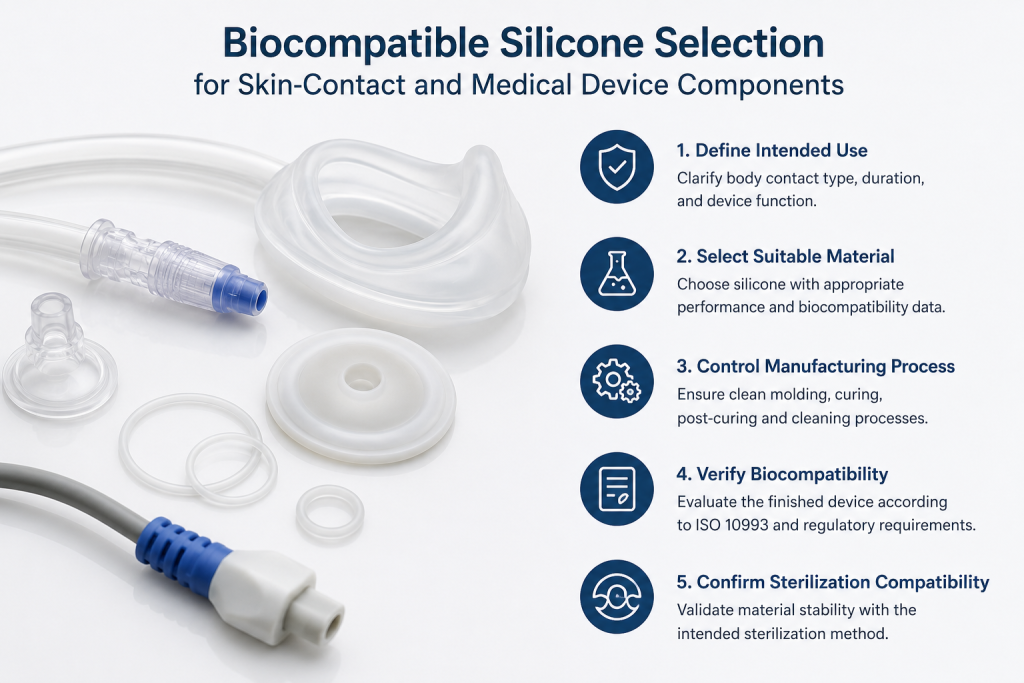
What Does Biocompatible Silicone Mean?
Biocompatibility describes whether a material or finished device can perform its intended function without creating unacceptable biological risks under its actual conditions of use.
It should not be interpreted as a universal material property.
The same silicone formulation may be suitable for one application but inappropriate for another. For example, a silicone component used externally for a few minutes presents a different biological-risk profile from a component that contacts damaged tissue, circulating blood or implanted tissue for an extended period.
Biocompatibility evaluation therefore depends on factors such as:
- Anatomical contact location
- Direct or indirect body contact
- Contact with intact skin, mucosal membranes, tissue or blood
- Kontaktens varaktighet
- Användningsfrekvens
- Patient population
- Device geometry and surface area
- Processing chemicals and residues
- Cleaning and sterilization methods
- Potential material degradation during use
FDA identifies the nature and duration of body contact as key factors in determining which biological endpoints may need to be evaluated.
Medical Grade Is Not the Same as Finished-Device Biocompatibility
The term “medical-grade silicone” is frequently used in product descriptions, but it must be interpreted carefully.
A material supplier may provide information such as:
- Raw-material formulation control
- Spårbarhet av partier
- Typical physical properties
- Biocompatibility test reports
- Regulatory support documents
- Extraction data
- Change-notification policies
- Manufacturing quality information
These records can support a biological evaluation, but they normally do not replace evaluation of the finished device.
The final component may differ from the supplier’s tested material because of:
- Pigments or color masterbatches
- Mold-release agents
- Adhesion primers
- Printing inks
- Plastic or metal inserts
- Post-curing conditions
- Rengöringsmedel
- Assembly lubricants
- Packaging materials
- Sterilization exposure
- Manufacturing contamination
FDA-recognized information concerning silicone biocompatibility notes that biological suitability ultimately has to be assessed in relation to the intended use and that data generated from the finished device are generally the most relevant.
Therefore, a manufacturer should avoid claiming that a component is automatically “ISO 10993 certified” merely because the raw silicone supplier has performed certain tests.
ISO develops standards but does not itself certify individual products. Biological evaluation should instead be documented within the device manufacturer’s risk-management and regulatory process.
Define the Contact Category Before Selecting the Material
Material selection should begin with a clearly defined intended use.
The development team should document:
- What the component does
- Whether it contacts the patient
- Which tissue it contacts
- Whether contact is direct or indirect
- How long each contact period lasts
- Whether use is repeated
- Whether the device is reusable
- Whether the component contacts medication or biological fluid
- Whether the product will be cleaned or sterilized
- Which markets the product will enter
A component touching intact skin may require a different evaluation from a fluid-path component that indirectly transfers substances into the body.
Similarly, a reusable medical seal exposed to repeated steam sterilization must be selected differently from a disposable external accessory used once.
The intended use should be finalized as early as possible because it affects material documentation, manufacturing controls, validation activities and potential testing costs.
Silicone Selection for Intact-Skin Contact
Intact-skin applications may include:
- Wearable sensor housings
- Medical monitoring straps
- Skin-contact pads
- Rehabilitation accessories
- Respiratory mask cushions
- Patient positioning components
- External device grips
- Skyddsöverdrag
- Medical adhesive interfaces
- Soft-touch equipment surfaces
For these applications, developers commonly consider:
Skin Sensitization and Irritation Risk
The base silicone polymer may not be the only concern. Pigments, catalysts, processing residues and cleaning chemicals can also affect the finished component.
Color systems should be selected carefully, especially for products worn for long periods or used by sensitive patient groups.
Surface Comfort
Hardness and surface finish influence comfort, pressure distribution and movement against the skin.
A very soft material may improve cushioning but may also create challenges involving:
- Dammansamling
- Surface tack
- Rivning
- Dimensional stability
- Assembly
- Rengöring
- Compression deformation
The material should therefore be selected according to both biological and mechanical requirements.
Moisture and Repeated Wear
Wearable products may trap perspiration between the silicone and skin. Product geometry should allow reasonable cleaning and drying, and sharp edges or narrow pressure points should be avoided.
Cleaning Resistance
Reusable skin-contact parts may be exposed repeatedly to soaps, alcohol-based cleaners or disinfectants. Testing should confirm that cleaning does not cause swelling, cracking, discoloration, tackiness or surface degradation.
Silicone Selection for Medical Device Components
Medical silicone components can perform sealing, fluid-control, insulation, protection and connection functions.
Common examples include:
- Silikonventiler
- Diaphragms
- Tätningsringar
- Tubing
- Catheter-related components
- Överformning av medicinska kablar
- Tätningar för kopplingar
- Pump components
- Delar till andningsutrustning
- Drug-delivery components
- Diagnostic equipment seals
- Needle-free access components
- Plastic-and-silicone assemblies
- Metal-insert silicone parts
For these products, the material must satisfy both biological and engineering requirements.
Important performance factors may include:
- Draghållfasthet
- Rivhållfasthet
- Förlängning
- Kompressionssättning
- Hårdhet
- Fatigue resistance
- Öppenhet
- Flow characteristics
- Dimensional stability
- Electrical insulation
- Kemikaliebeständighet
- Gas permeability
- Steriliseringsbeständighet
The most biocompatibility-supportive material is not necessarily the best functional material. A formulation with suitable biological data may still fail if it cannot maintain sealing pressure, dimensional accuracy or mechanical strength throughout the intended device life.
Material selection should therefore involve design, quality, regulatory and manufacturing teams rather than relying only on purchasing specifications.
Liquid Silicone Rubber Versus High-Consistency Silicone
Medical silicone components are commonly produced using liquid silicone rubber or high-consistency silicone rubber.
Flytande silikongummi
Liquid silicone rubber, or LSR, is normally processed by injection molding. It can be suitable for:
- High-volume production
- Thin-wall components
- Small precision parts
- Complex geometries
- Automated molding
- Multi-cavity tooling
- Plastic or metal overmolding
- Applications requiring consistent repeatability
LSR is supplied as a two-part system and mixed during processing. Precise control of mixing, injection, curing and mold temperature is important.
High-Consistency Silicone Rubber
High-consistency rubber, sometimes called HCR or solid silicone rubber, can be processed through compression molding, transfer molding or extrusion.
It may be suitable for:
- Tubes and profiles
- Larger molded components
- Lower-volume production
- Basic sealing parts
- Components with relatively simple structures
- Projects where compression tooling is economically preferable
The choice between LSR and HCR should depend on product geometry, tolerance, volume, automation level and regulatory-control requirements.
Neither process is automatically more biocompatible. Biological safety depends on the selected formulation and the complete manufacturing process.
Pay Attention to Additives, Pigments and Secondary Materials
A base silicone formulation may be only one part of the finished component.
Additional materials can include:
- Color pigments
- Radiopaque additives
- Conductive fillers
- Lubricating additives
- Adhesion promoters
- Primers
- Inks
- Surface coatings
- Plastic inserts
- Metallinsatser
- Adhesives
Each added material can alter the chemical and biological profile of the final product.
A transparent or naturally colored silicone may have a simpler formulation than a strongly pigmented version, but color alone does not determine safety. The complete formulation should be reviewed.
For overmolded components, the biological evaluation may need to consider not only the silicone but also the substrate, primer and interface between materials.
Examples include:
- LSR overmolded medical connectors
- Silicone overmolded power cables
- Plastic-supported valve components
- Metal-insert sealing parts
- Soft-touch medical device handles
The supplier should provide clear identification and traceability for all critical materials used in production.
Chemical Characterization and Extractables
Chemical characterization can help identify substances that may migrate, leach or be released from a medical device.
ISO 10993-18 provides a framework for identifying and, when necessary, quantifying device constituents as part of biological-risk assessment. The process may include documenting materials of construction and evaluating chemical constituents through a stepwise approach.
Potential sources of extractable substances in silicone components may include:
- Residual catalysts
- Low-molecular-weight siloxanes
- Pigment ingredients
- Processing aids
- Mold-release residues
- Cleaning-agent residues
- Adhesion primers
- Ink or coating components
- Sterilization-related degradation products
- Substances from packaging or assembly materials
Chemical characterization should be designed according to the device, contact type, duration, exposure route and regulatory strategy.
A supplier’s raw-material data can help identify known constituents, but the finished component may still require additional evaluation because molding, post-curing, washing, assembly and sterilization can change its chemical profile.
Why Post-Curing May Matter
Some silicone components undergo post-curing after initial molding.
Post-curing may be used to:
- Complete material curing
- Reduce certain volatile residues
- Stabilize physical properties
- Improve compression performance
- Prepare the component for its intended application
However, post-curing is not a universal solution and should not be added without validation.
Important process parameters include:
- Temperature
- Time
- Air circulation
- Oven cleanliness
- Part arrangement
- Cooling conditions
- Batch loading
- Kontamineringskontroll
Excessive post-curing may affect color, dimensions, hardness or surface properties. Insufficient post-curing may leave the component with unacceptable residual substances or unstable performance.
The selected material supplier’s processing recommendations should be considered, but the final process must be validated for the actual component.
Confirm Compatibility with Sterilization
A silicone component used in a sterile device may be exposed to methods such as:
- Etylenoxid
- Ånga
- Gammastrålning
- Elektronstrålning
- X-ray radiation
- Förångad väteperoxid
- Other validated sterilization processes
Silicone is often selected because it can tolerate demanding environments, but no material should be assumed to withstand every sterilization method without testing.
Sterilization can affect:
- Hårdhet
- Draghållfasthet
- Förlängning
- Rivhållfasthet
- Öppenhet
- Färg
- Kompressionssättning
- Ytans skick
- Chemical extractables
- Bond strength in overmolded parts
Repeated sterilization can be particularly important for reusable devices.
FDA-recognized sterilization compatibility guidance addresses qualification of polymeric and other materials across multiple sterilization modalities, including radiation, ethylene oxide, moist heat and vaporized hydrogen peroxide.
Testing should use the intended sterilization process and, where appropriate, the maximum expected number of cycles.
Evaluate the Finished Manufacturing Process
Biocompatibility begins with material selection but must continue through manufacturing.
Critical controls can include:
- Approved raw-material suppliers
- Spårbarhet av partier
- Material storage conditions
- Controlled mixing
- Color-batch identification
- Formens renhet
- Validated curing parameters
- Controlled post-curing
- Prevention of cross-contamination
- Cleaning validation
- Handling requirements
- Packaging controls
- Change management
- Produktionsstatistik
The factory should distinguish between ordinary industrial silicone production and medical-device manufacturing requirements.
A facility producing both industrial and healthcare components should have controls to prevent unintended material mixing or contamination.
Möjliga föroreningskällor är bland annat:
- Lubricants
- Rust-prevention oils
- Mold cleaners
- Damm
- Fibrer
- Latex
- Other elastomers
- Unauthorized pigments
- Operator handling
- Shared trimming or inspection equipment
The manufacturing environment required will depend on the component and its intended use. Not every skin-contact part requires cleanroom manufacturing, but environmental controls should match the identified risk.
Information to Request from a Silicone Supplier
Before approving a silicone formulation, the device manufacturer should request information relevant to the intended application.
Useful records may include:
- Technical data sheet
- Säkerhetsdatablad
- Materialidentifiering
- Lot-traceability information
- Typical physical properties
- Available biological test information
- Extraction or chemical-characterization information
- Recommended processing conditions
- Recommended post-curing conditions
- Sterilization compatibility information
- Shelf-life and storage requirements
- Pigment documentation
- Regulatory-support statement
- Change-notification policy
- Manufacturing-site information
The documentation should be reviewed for relevance.
For example, a test performed on a supplier’s standard transparent slab may not fully represent a finished colored, overmolded, cleaned and sterilized medical component.
Developers should confirm:
- Which exact formulation was tested
- Whether the tested material contains the same pigment
- How the test specimen was cured
- Whether it was post-cured
- Which extraction conditions were used
- Om uppgifterna fortfarande är aktuella
- Whether manufacturing changes have occurred
Common Silicone Selection Mistakes
Selecting Material Before Defining Intended Use
Without a clear contact type and duration, the team cannot determine what supporting information or evaluation may be required.
Treating “Medical Grade” as a Complete Approval
A supplier designation does not replace finished-device risk assessment.
Ignoring Pigments and Processing Aids
Colorants, primers, inks and release agents may affect the finished component’s chemical profile.
Testing Only the Raw Material
The final molded, cleaned, assembled and sterilized product is usually more representative of patient exposure.
Changing Suppliers Without Biological-Risk Review
Two silicone materials with similar hardness and appearance may use different catalysts, additives or processing recommendations.
Overlooking Sterilization Aging
A component may perform well before sterilization but change after radiation, steam or repeated processing.
Choosing Hardness Based Only on Touch
Hardness affects comfort, but also sealing force, assembly, tear resistance and dimensional stability.
Making Unsupported Regulatory Claims
Statements such as “FDA approved silicone,” “fully biocompatible” or “ISO certified material” should not be used unless they accurately describe the available evidence and regulatory status.
FDA evaluates medical devices and their supporting information; it does not provide a universal approval for every product made from a particular silicone raw material.
A Practical Silicone Selection Process
A structured selection process can reduce technical and regulatory risk.
Step 1: Define the Device
Document the intended use, users, contact location, contact duration and device life.
Step 2: Establish Performance Requirements
Define hardness, dimensions, temperature range, mechanical loading, sealing needs, transparency and chemical exposure.
Step 3: Identify Regulatory Markets
Determine whether the device will enter the United States, European Union or other markets.
Step 4: Compare Candidate Materials
Review technical performance, biological-support data, traceability and supplier change controls.
Step 5: Review the Manufacturing Process
Assess molding, coloring, post-curing, cleaning, assembly and packaging.
Step 6: Produce Representative Samples
Samples should use the intended material, pigment, molding process and finishing conditions.
Step 7: Evaluate Biological Risk
Use existing data, chemical characterization and testing as appropriate to the device.
Step 8: Validate Sterilization and Aging
Confirm that the material maintains required performance after intended processing and shelf life.
Step 9: Freeze the Approved Configuration
Control the material grade, color formula, supplier, process parameters and secondary materials.
Step 10: Manage Future Changes
Review material, supplier, process and sterilization changes before implementation.
FDA recommends a risk-based approach to biological evaluation and directs manufacturers to consider applicable device-specific guidance in addition to ISO 10993-1 principles.
Questions to Ask a Custom Silicone Manufacturer
Before beginning a medical or skin-contact silicone project, buyers should ask:
- Can you provide full traceability for the silicone material?
- Which exact silicone grade do you recommend?
- What biological test information is available for that formulation?
- Are pigments supported by relevant documentation?
- Do you use mold-release agents?
- Is post-curing required?
- How are post-curing parameters controlled?
- Can the part be produced without cross-contamination from industrial materials?
- What cleaning process is used?
- Can you manufacture representative samples for evaluation?
- Can the material tolerate the intended sterilization process?
- How are material or process changes communicated?
- Can plastic, metal, cable or connector inserts be overmolded?
- What dimensional and visual inspections are performed?
- Can batch production records be retained?
Clear answers can help distinguish a general silicone molder from a supplier capable of supporting controlled medical-device production.
Slutsats
Selecting biocompatible silicone for a skin-contact or medical device component requires a device-specific, risk-based approach.
The process should consider:
- Intended use
- Nature and duration of contact
- Materialsammansättning
- Pigments and additives
- Molding and curing
- Efterhärdning
- Rengöring
- Sterilisering
- Förpackning
- Finished-device evaluation
- Supplier and process controls
A material described as medical grade can be a useful starting point, but it does not independently establish the biological safety of the finished device.
The most reliable strategy is to define the application first, select a traceable material with relevant supporting information, manufacture representative finished samples and evaluate the complete component within the device’s biological-risk-management process.
Early cooperation between the device developer, silicone manufacturer, material supplier, testing laboratory and regulatory team can reduce redesign, avoid unsupported claims and create a more efficient path from prototype to validated production.
Vanliga frågor
Is all medical-grade silicone biocompatible?
Not automatically. Medical-grade material documentation can support the evaluation, but biological suitability depends on the finished device, intended contact, manufacturing process and other materials used.
Does ISO 10993 certify silicone materials?
ISO 10993 provides standards for biological evaluation. ISO itself does not certify an individual silicone material or finished component.
Should biological testing be performed on the raw silicone or finished component?
Existing raw-material data may be useful, but the finished component is generally more representative because molding, coloring, cleaning, assembly and sterilization may change its biological profile.
Can pigments affect biocompatibility?
Yes. Pigments introduce additional substances and should be included in material documentation and biological-risk evaluation.
Can biocompatible silicone be sterilized?
Many silicone formulations can tolerate common sterilization methods, but compatibility must be confirmed for the selected material, component design and number of sterilization cycles.
Is food-grade silicone suitable for medical devices?
Food-contact compliance does not automatically establish suitability for a medical device. Food and medical applications may involve different exposure routes, contact durations and evaluation requirements.
What information is needed for a custom silicone medical component quotation?
Useful information includes drawings, intended use, contact type, contact duration, material requirements, hardness, color, sterilization method, estimated volume, tolerance and documentation requirements.
Can LSR be overmolded onto medical cables or plastic connectors?
Yes. LSR can be overmolded onto suitable cables, plastics and metal inserts. The substrate, primer, bond design and full manufacturing process should be evaluated as part of the finished component.
 English
  Japanese
  Korean
  German
  French
  Italian
  Spanish
  Dutch
Dutch  Chinese
  Portuguese
  Polish
  Czech
Czech  Hungarian
  Swedish
  Finnish
  Vietnamese
  Thai
Thai  Turkish
  Arabic
  Russian