
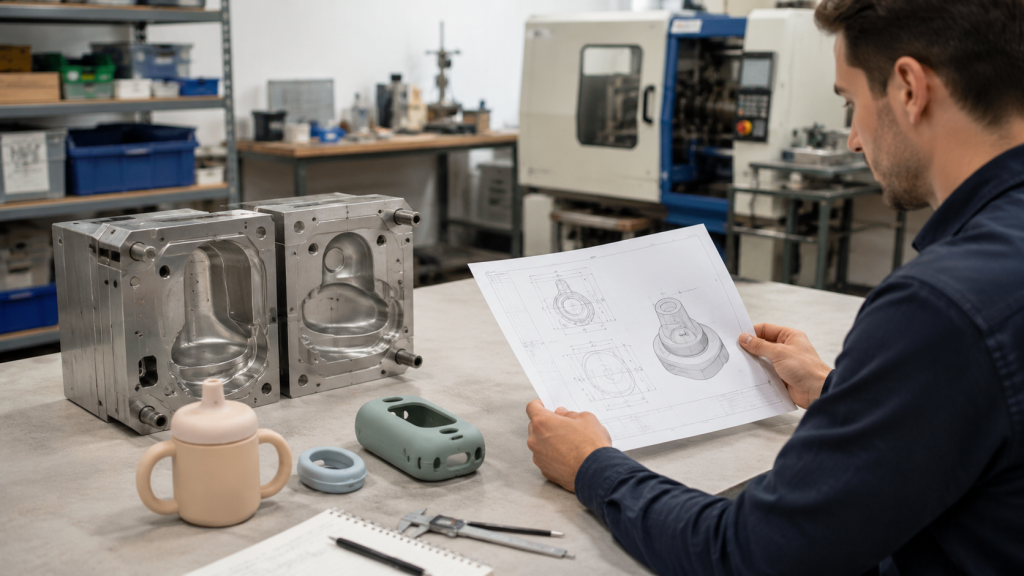
Developing a custom silicone product can be challenging for a startup. Unlike purchasing an existing item, a custom project may involve product design, material selection, mold development, prototyping, testing and production planning.
For a young brand with limited capital, the main concerns are usually clear:
- Can the factory accept a small initial order?
- How much will the mold cost?
- Can the design be tested before mass production?
- How can unnecessary tooling changes be avoided?
- Is it possible to scale production later?
With the right development strategy and manufacturing partner, startups can launch custom silicone products without committing to excessively large order quantities or uncontrolled tooling expenses.
Varför silikon är lämpligt för produktutveckling inom startup-företag
Silicone is widely used in baby products, kitchenware, healthcare accessories, consumer electronics, sports equipment, pet products and industrial components.
Its popularity comes from several useful properties:
- Flexible and elastic
- Resistant to heat and cold
- Available in different hardness levels
- Suitable for complex molded shapes
- Compatible with compression molding and liquid silicone rubber molding
- Available in food-contact, medical and industrial material grades
- Easy to customize in color, texture and surface finish
- Suitable for overmolding onto plastic or metal components
These characteristics allow startups to develop differentiated products rather than competing only with standard off-the-shelf items.
However, silicone manufacturing still requires careful planning. A visually attractive design may not always be easy or economical to mold. Early engineering review is therefore essential.
Start with a Clear Product Definition
Before requesting a quotation, the startup should define the product as clearly as possible.
A basic project brief should include:
- Produktanvändning
- Target users
- Approximate dimensions
- Expected silicone hardness
- Preferred color
- Beräknad orderkvantitet
- Required material grade
- Krav på förpackningar
- Målmarknad
- Expected launch date
- Available drawings, sketches or samples
A complete 3D drawing is helpful, but it is not always required at the beginning. Many projects start with a sketch, reference image, physical sample or basic concept.
The manufacturer can then evaluate whether the design is suitable for silicone molding and identify areas that may increase tooling costs.
Choose the Right Silicone Molding Process
The manufacturing process has a major influence on mold cost, unit price and minimum order quantity.
Formpressning
Compression molding is commonly used for solid silicone rubber products.
Typiska användningsområden är bland annat:
- Silikontätningar
- Baby feeding accessories
- Kitchen tools
- Skyddsöverdrag
- Sports and massage products
- Industrial silicone components
Compression molds are often less expensive than liquid silicone rubber injection molds. This can make compression molding suitable for startups with limited budgets or moderate production volumes.
However, cycle times may be longer, and some highly detailed or complex products may require additional trimming or finishing.
Liquid Silicone Rubber Molding
Liquid silicone rubber, also known as LSR, is processed through automated injection molding.
LSR molding is suitable for:
- High-precision parts
- Thin-wall components
- Medical components
- Sealing elements
- Overmolded parts
- High-volume production
- Products requiring consistent dimensions
LSR molds and production systems are usually more expensive than basic compression molds. For this reason, LSR may not always be the most economical option for a very small first order.
However, it can offer better automation, repeatability and scalability when production volume increases.
Överformning med silikon
Silicone can also be molded onto plastic, metal, cable or electronic components.
Common examples include:
- Medical cable assemblies
- Silicone-coated connectors
- Metal-insert sealing parts
- Soft-touch handles
- Electronic protective components
- Automotive sealing parts
Overmolding projects often require more engineering work because the silicone must bond mechanically or chemically to another material. Fixtures, insert positioning and adhesion testing may also be required.
How to Reduce Initial Tooling Costs
The mold is often the largest upfront expense in a custom silicone project. Tooling cost depends on product size, structure, cavity quantity, surface finish, tolerance and molding process.
Startups can control mold expenses through several practical methods.
Simplify the Initial Product Structure
Complex shapes increase machining time and mold difficulty.
Features that may increase tooling cost include:
- Djupa underskärningar
- Very thin walls
- Large differences in wall thickness
- Complicated internal cavities
- Multiple removable inserts
- Extremely fine surface textures
- Tight tolerance requirements
- Multi-material structures
The first product version should focus on essential functions. Decorative or complex features can be added in later versions after market validation.
Use a Single-Cavity Prototype Mold
A multi-cavity mold produces several parts during each molding cycle, reducing the long-term unit cost. However, it is more expensive to manufacture.
For early-stage projects, a single-cavity mold may offer a lower initial investment.
This approach allows the startup to:
- Test the product
- Verify market demand
- Collect customer feedback
- Improve packaging
- Confirm material performance
- Reduce financial risk
After sales volume increases, the project can move to a multi-cavity production mold.
Avoid Unnecessary Tight Tolerances
Not every dimension needs a very strict tolerance.
Tight tolerances increase mold precision requirements, inspection time and production difficulty. They should be applied only to dimensions that affect assembly, sealing, safety or product performance.
Decorative areas and non-critical dimensions can normally use standard commercial tolerances.
A tolerance review with the manufacturer can help reduce unnecessary costs.
Use Standard Colors and Materials During Testing
Custom color matching may require additional sampling and adjustment.
During early testing, startups can use a standard silicone color or an approximate color. Final color matching can be completed after the design and function are confirmed.
The same principle applies to material selection. Unless the application requires a special grade, it may be more economical to begin with a commonly available silicone material.
Confirm the Design Before Cutting the Mold
Design changes after mold manufacturing are one of the most common causes of unexpected cost.
Before tooling begins, the startup should carefully confirm:
- Totala mått
- Väggtjocklek
- Logo position
- Textur
- Delningslinje
- Product function
- Assembly method
- Packaging dimensions
- Color plan
- Regulatory requirements
A formal drawing approval process should be completed before the mold is manufactured.
Use Prototypes Before Production Tooling
Prototyping helps identify design problems before major tooling expenses are committed.
Depending on the product, prototypes may be made by:
- 3D printing
- CNC machining
- Hand-made silicone casting
- Soft tooling
- Prototype compression molds
- Prototype injection molds
A 3D-printed prototype cannot fully reproduce the elasticity, durability or surface finish of molded silicone. However, it is useful for checking:
- Produktstorlek
- Ergonomics
- Utseende
- Assembly
- Förpackning
- User interaction
For functional testing, a silicone prototype or sample mold may be required.
Prototyping is especially valuable for baby products, wearable products, sealing parts, medical accessories and components that must fit another product.
How Low-MOQ Silicone Production Works
The minimum order quantity depends on the product, molding process, material, color and production setup.
A manufacturer may accept a relatively small order, but the unit price is usually higher because fixed costs are divided across fewer products.
Typical fixed costs may include:
- Material preparation
- Färgmatchning
- Machine setup
- Mold installation
- First-piece inspection
- Rengöring
- Förberedelse av förpackningar
- Quality documentation
A low MOQ does not always mean the project has the lowest total cost. Startups should compare the total project investment rather than focusing only on the number of units.
A useful quotation should separate:
- Mold cost
- Sample cost
- Unit price
- Packaging cost
- Testing cost
- Shipping cost
- Possible design or engineering fees
This makes it easier to evaluate the real cost of launching the product.
Plan the Project in Development Stages
A staged development process reduces risk and gives the startup opportunities to review the product before increasing investment.
Stage 1: Concept Evaluation
The startup provides product ideas, drawings, reference samples and target requirements.
The manufacturer evaluates:
- Moldability
- Material options
- Possible production process
- Estimated tooling cost
- Expected unit price
- Design risks
Stage 2: Design for Manufacturing Review
The product structure is adjusted for silicone molding.
This may include changes to:
- Draft angles
- Väggtjocklek
- Parting lines
- Avluftning
- Underskärningar
- Logo depth
- Ytstruktur
- Assembly features
Stage 3: Prototype Development
A prototype is produced to check product dimensions, appearance and basic function.
Stage 4: Mold Manufacturing
After drawing approval, the mold is machined, assembled and tested.
Stage 5: First Samples
Initial molded samples are produced for evaluation.
The startup should inspect:
- Mått
- Hårdhet
- Färg
- Ytkvalitet
- Flash
- Funktion
- Odor
- Monteringsprestanda
Stage 6: Pilot Production
A small production batch is completed to verify the manufacturing process, packaging and quality-control procedures.
Stage 7: Mass Production
After market demand is confirmed, production quantities can be increased and the mold can be optimized or upgraded if necessary.
Select the Correct Silicone Material
Silicone material should be selected according to the final application rather than appearance alone.
Viktiga faktorer är bland annat:
- Driftstemperatur
- Product hardness
- Draghållfasthet
- Rivhållfasthet
- Kompressionssättning
- Öppenhet
- Kemikaliebeständighet
- Electrical properties
- Food-contact requirements
- Skin-contact requirements
- Sterilization requirements
- Outdoor exposure
For example, a silicone baby product may require a suitable food-contact material, while a medical component may require specific documentation and biocompatibility evaluation.
An industrial seal may prioritize temperature resistance and compression performance rather than color or transparency.
Startups should request relevant material information and confirm whether additional product testing is required in the destination market.
Protect the Product Design and Intellectual Property
Startups are often concerned that their product ideas may be copied or disclosed.
Before sharing detailed drawings, both parties can sign a non-disclosure agreement.
The manufacturing agreement should also clarify:
- Ownership of product drawings
- Ownership of mold tooling
- Rights to use the mold
- Restrictions on selling the product to other customers
- Storage and maintenance of the mold
- Conditions for transferring the mold
- Ownership of trademarks and packaging designs
These terms should be confirmed before tooling begins.
Do Not Ignore Packaging During Product Development
Packaging is often considered too late.
However, product dimensions, shape and surface finish can affect packaging costs. A large or irregular product may require a bigger box, increasing storage and shipping expenses.
Packaging should be reviewed during product development, especially for consumer products.
Viktiga aspekter att beakta är bland annat:
- Individual bag or retail box
- Product protection
- Barcode position
- Instruction manual
- Warning labels
- Brand information
- Carton quantity
- International shipping volume
A slightly smaller or more stackable product design may reduce long-term logistics costs.
Questions Startups Should Ask a Silicone Manufacturer
Before choosing a supplier, startups should ask:
- Which molding process is recommended for this product?
- Can the design be reviewed before tooling?
- What is included in the mold quotation?
- Who owns the mold after payment?
- Can a single-cavity mold be used initially?
- Vad är minsta beställningsmängd?
- Can small pilot orders be produced?
- Which silicone materials are available?
- Can material documents be provided?
- How many sample revisions are included?
- What quality inspections are performed?
- Can the factory support packaging and assembly?
- What happens if the design changes?
- Can production volume be increased later?
- Is an NDA available?
Clear answers to these questions can prevent misunderstandings during development.
Common Mistakes to Avoid
Ordering a Production Mold Too Early
A mold should not be manufactured until the product structure and key dimensions are confirmed.
Choosing the Cheapest Tooling Quote
An extremely low tooling price may exclude engineering support, mold testing, sample revisions or future maintenance.
Focusing Only on Unit Price
The lowest unit price may require an order quantity that creates excessive inventory risk.
Changing the Design Repeatedly
Frequent changes delay the project and increase mold modification costs.
Ignoring Compliance Requirements
Material and product testing requirements should be identified before production, not after the product is completed.
Selecting the Wrong Manufacturing Process
A product designed for high-volume LSR molding may not be economical for an initial order of only a few hundred units. The manufacturing method should match both the product structure and expected sales volume.
Balancing MOQ, Tooling Cost and Unit Price
There is always a relationship between tooling investment, order quantity and unit price.
A simple mold and low order quantity can reduce initial investment but may result in a higher unit price.
A multi-cavity automated mold requires more initial investment but can reduce unit costs for larger production volumes.
The best solution depends on the startup’s current stage.
For early market testing, the priority is often:
- Lower financial risk
- Faster design validation
- Flexible order quantity
- Controlled inventory
For a proven product, the priority may shift toward:
- Higher production efficiency
- Lower unit cost
- Automated manufacturing
- Greater consistency
- Faster delivery capacity
A good silicone manufacturer should provide a development path that supports both stages.
Slutsats
Startups do not need to begin with large silicone orders or expensive high-volume tooling.
By simplifying the first product version, selecting the right molding process, using prototypes, starting with a single-cavity mold and planning production in stages, companies can reduce development risk and keep tooling costs under control.
The most important step is to involve the manufacturer early. A design-for-manufacturing review can identify potential problems before the mold is made and help the startup balance product performance, appearance, MOQ and cost.
With a clear product brief and a structured development process, a custom silicone idea can move from concept to prototype, pilot production and scalable manufacturing more efficiently.
Vanliga frågor
Can a startup order a small quantity of custom silicone products?
Yes. Some manufacturers can support low-MOQ or pilot production. However, the unit price may be higher because setup and material preparation costs are divided across fewer products.
How much does a custom silicone mold cost?
The cost depends on product size, complexity, molding process, cavity quantity, tolerance and mold material. A simple compression mold generally costs less than a complex LSR injection mold.
Should a startup use compression molding or LSR molding?
Compression molding may be more economical for lower volumes and simpler products. LSR molding is often better for high-precision parts, complex structures and larger production volumes.
Can the mold be modified after the first sample?
Minor modifications may be possible, but major structural changes may require new mold components or a completely new mold. It is better to confirm the design before tooling.
Who owns the mold?
Mold ownership should be clearly stated in the quotation or manufacturing agreement. In many custom projects, the customer owns the mold after full payment, while the manufacturer stores and maintains it.
Can custom silicone products include a logo?
Yes. Logos can often be molded, engraved, printed or laser marked, depending on the product material, surface and intended appearance.
What information is required for a quotation?
Useful information includes drawings, product dimensions, application, material requirements, estimated order quantity, color, hardness, packaging and target market.
 English
  Japanese
  Korean
  German
  French
  Italian
  Spanish
  Dutch
Dutch  Chinese
  Portuguese
  Polish
  Czech
Czech  Hungarian
  Swedish
  Finnish
  Vietnamese
  Thai
Thai  Turkish
  Arabic
  Russian