
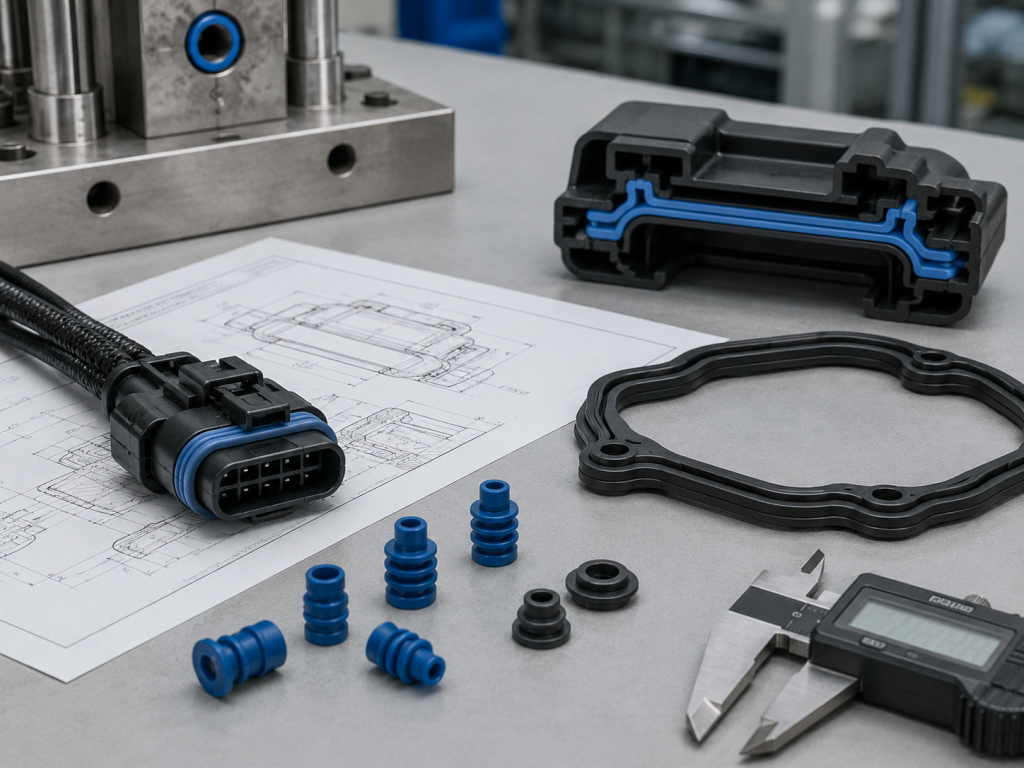
Flüssigsilikonkautschuk findet breite Anwendung in Automobilsteckverbindern, Kabelbäumen, Batteriesystemen, Sensoren, Elektronikgehäusen und anderen Bauteilen, die eine flexible Abdichtung bei schwankenden Temperaturen erfordern.
Aufgrund seiner Eignung zur Herstellung kleiner, komplexer und in hohem Maße reproduzierbarer Teile eignet sich LSR besonders für:
- Dichtungen für elektrische Steckverbinder
- Einadrige Dichtungen
- Mattendichtungen
- Radialdichtungen
- Randdichtungen
- Kabelverschraubungen
- Hohlraumstopfen
- Sensordichtungen
- Komponenten für Batterieanschlüsse
- Baugruppen aus Kunststoff und Silikon mit Überformung
Die Auswahl eines LSR-Typs für die Automobilindustrie ist jedoch nur der Anfang.
Ein erfolgreiches Silikonbauteil für die Automobilindustrie muss auch nach langanhaltender Kompression seine Dichtkraft beibehalten, Temperaturwechseln standhalten, gegen relevante Flüssigkeiten beständig sein, präzise in die umgebende Baugruppe passen und den Formungsprozess ohne Grate, Risse oder Schwachstellen überstehen.
Die Konstruktion muss daher als Gesamtsystem entwickelt werden, das das LSR-Material, die Dichtungsgeometrie, den Gegenkunststoff, den Formaufbau, die Verarbeitungsbedingungen und die endgültige Betriebsumgebung umfasst.
Warum LSR in Automobilkomponenten zum Einsatz kommt
Dichtungssysteme im Automobilbereich sind Bedingungen ausgesetzt, denen gewöhnliche Silikonbauteile für Endverbraucher möglicherweise niemals ausgesetzt sind.
Je nach ihrem Standort können bei den Komponenten folgende Auswirkungen auftreten:
- Höchst- und Tiefsttemperaturen
- Schnelle Temperaturschwankungen
- Vibration
- Mechanischer Stoß
- Feuchtigkeit
- Staub
- Streusalz
- Reinigungschemikalien
- Kfz-Öle und -Flüssigkeiten
- Wiederholte Montage
- Längere Phasen der Kompression
- Begrenzter Platz im Gehäuse
- Anforderungen an die elektrische Isolierung
LSR bietet flexible Dichtungs- und Dämpfungslösungen über einen breiten Temperaturbereich hinweg und eignet sich daher besonders für elektrische und elektronische Anwendungen in der Automobilindustrie. Momentive nennt als LSR-Anwendungen unter anderem Steckverbinderdichtungen, Kabeldichtungen, Kabelbaumdichtungen, Matten- und Radialdichtungen, während Dow LSR-Typen für die Automobilindustrie anbietet, die speziell für Steckverbinder-, Weather-Pack-, Radial- und Umfangsdichtungsanwendungen entwickelt wurden.
Das LSR-Spritzgießen eignet sich zudem für die automatisierte Fertigung, feine Details und Mehrfachformen. Diese Eigenschaften sind wichtig, wenn Automobilprojekte sowohl große Produktionsmengen als auch gleichbleibende Dichtungsabmessungen erfordern.
Das Material muss jedoch auf die jeweilige Anwendung abgestimmt sein. Ein Allzweck-LSR bietet möglicherweise nicht die erforderliche Druckverformungsrest, Medienbeständigkeit, Schmierfähigkeit oder Haftfestigkeit für ein anspruchsvolles Automobilbauteil.
Beginnen Sie mit der tatsächlichen Betriebsumgebung
Ein LSR-Bauteil für die Automobilindustrie sollte nicht allein anhand der Härte und der Abmessungen konstruiert werden.
Bevor ein Werkstoff ausgewählt oder die Dichtungsgeometrie erstellt wird, sollte das Entwicklungsteam Folgendes festlegen:
- Mindestbetriebstemperatur
- Maximale Dauertemperatur
- Kurzfristige Höchsttemperatur
- Anzahl der erwarteten Temperaturzyklen
- Kontakt mit Öl, Kraftstoff, Kühlmittel oder Reinigungsmitteln
- Einwirkung von Wasser, Feuchtigkeit und Streusalz
- Erforderliche Schutzart
- Kompressionsdauer
- Vibrationen und mechanische Beanspruchung
- Häufigkeit der Montage und Demontage
- Anforderungen an die elektrische Isolierung
- Erwartete Lebensdauer
- Einbauort im Fahrzeuginneren
- Nebeneinander liegende Kunststoff- und Metallmaterialien
An eine Steckverbinderdichtung im Fahrgastraum werden andere Anforderungen gestellt als an eine Dichtung in der Nähe des Antriebsstrangs, des Akkupakets oder eines Außensensors.
Unter Standard-Laborbedingungen ermittelte Materialdaten sollten nicht als Nachweis für die Leistungsfähigkeit des fertigen Bauteils gewertet werden. Bei der Validierung sollten repräsentative Bauteile, tatsächliche Gegenstücke und anwendungsspezifische Umgebungsbedingungen herangezogen werden.
Hitzebeständigkeit ist mehr als nur die Höchsttemperatur
Silikon wird häufig aufgrund seiner Fähigkeit ausgewählt, auch unter anspruchsvollen Temperaturbedingungen flexibel zu bleiben. Die Angabe einer maximalen Temperatur allein liefert jedoch keine ausreichenden Informationen für die Konstruktion von Automobilkomponenten.
Hitze kann im Laufe der Zeit verschiedene Eigenschaften beeinflussen:
- Härte
- Dehnung
- Zugfestigkeit
- Reißfestigkeit
- Druckverformungsrest
- Oberflächenschmierung
- Haftfestigkeit
- Farbe
- Abmessungen
- Anpresskraft
Ein Werkstoff kann zwar eine kurze Einwirkung hoher Temperaturen überstehen, verliert jedoch nach Hunderten oder Tausenden von Stunden unter Druck allmählich seine Dichtungsleistung.
Daher sollten Automobilingenieure zwischen folgenden Begriffen unterscheiden:
- Kurzzeitige Temperaturbeständigkeit
- Dauerbetriebstemperatur
- Verhalten bei thermischer Alterung
- Verhalten unter gleichzeitiger Wärmeeinwirkung und Druckbelastung
- Leistung nach Temperaturwechselbeanspruchung
- Verhalten im Kontakt mit Kunststoffen, Metallen oder Flüssigkeiten
Einige LSR-Typen für die Automobilindustrie wurden speziell für den langfristigen Einsatz unter Hitzeeinwirkung entwickelt. Momentive beschreibt Silopren LSR 3696/25 als einen Werkstoff, der für elektrische Anwendungen in der Automobilindustrie vorgesehen ist, die über längere Zeiträume höheren Temperaturen ausgesetzt sind, während Dow Typen für Steckverbinderabdichtungen anbietet, die so ausgelegt sind, dass sie im Kontakt mit flammhemmenden Thermoplasten einer Verformung durch Wärmealterung widerstehen.
Das jeweilige Material sollte noch in der vorgesehenen Bauteilgeometrie validiert werden, da dünne Dichtlippen, dicke Abschnitte und Klebeverbindungen während der Wärmealterung unterschiedlich reagieren können.
Temperaturwechsel und unterschiedliche Ausdehnung
Eine Dichtung im Automobilbereich ist selten einer konstanten Temperatur ausgesetzt.
Fahrzeuge dürfen sich zwischen folgenden Orten bewegen:
- Kaltes Wetter im Freien
- Schnelle elektrische Erwärmung
- Wärme vom Motor oder von der Batterie
- Parkbedingungen bei starker Sonneneinstrahlung
- Kühlung während des Betriebs
- Wiederkehrende tägliche Temperaturzyklen
LSR, thermoplastic substrates and metal inserts do not expand and contract at identical rates.
In a two-component assembly, this mismatch can create stress at the interface between materials. Possible consequences include:
- Bond separation
- Edge lifting
- Seal distortion
- Cracking of the rigid substrate
- Loss of compression
- Dimensional movement
- Leakage paths at corners
The overmolded interface should therefore be designed so that the bond does not carry unnecessary peeling stress.
A wide, well-supported bonding area is generally more reliable than a narrow edge subjected to repeated bending. Mechanical interlocks may also be used where appropriate, especially when chemical adhesion alone is insufficient.
For demanding bonded assemblies, thermal-cycle testing should be performed on complete molded parts rather than flat laboratory test specimens.
Compression Set and Long-Term Sealing
Compression set is one of the most important properties for automotive silicone seals.
A seal works by being compressed between two mating surfaces. This compression creates contact pressure that blocks moisture, dust and other contaminants.
Over time, an elastomer may lose part of its ability to return to its original shape. When this happens, sealing force can decrease even though the seal still appears visually intact.
Low compression set is especially important for:
- Steckverbinder-Dichtungen
- Long-term housing gaskets
- Battery sealing components
- Wire-entry seals
- Sensorgehäuse
- Components exposed to heat while compressed
Momentive describes Silopren LSR 3366/50 as an automotive connector-sealing material developed for ultra-low compression set at elevated temperatures. Dow similarly identifies low compression set as a key benefit of its automotive electrical connector-seal LSR grades.
However, compression-set data should not be used alone to predict seal performance.
The actual result also depends on:
- Initial compression percentage
- Dichtungsquerschnitt
- Nutabmessungen
- Betriebstemperatur
- Compression time
- Oberflächenbeschaffenheit
- Montagetoleranz
- Materialhärte
- Fluid exposure
- Temperaturwechselbeanspruchung
A low-compression-set material cannot correct an incorrectly designed seal groove or insufficient interference.
Designing the Correct Compression Level
A seal must be compressed enough to create reliable contact pressure, but excessive compression can also cause failure.
Insufficient compression may lead to:
- Low sealing force
- Leckage
- Uneven contact
- Sensitivity to dimensional variation
- Seal movement during assembly
Excessive compression may lead to:
- Hohe Montagekraft
- Dauerhafte Verformung
- Zerreißen
- Buckling
- Flash damage
- Excessive stress on the plastic housing
- Reduced long-term recovery
The correct compression depends on the seal design and material rather than a universal percentage.
Important tolerance conditions include:
- Maximum seal dimension with minimum groove space
- Minimum seal dimension with maximum groove space
- Plastic-part shrinkage
- Verformung des Gehäuses
- Mold-cavity variation
- Assembly misalignment
- Wärmeausdehnung
A tolerance-stack analysis should be completed before tooling.
The analysis should confirm that the seal remains functional under both minimum and maximum material conditions.
Seal Cross-Section Design
Automotive LSR seals can use many different geometries, including:
- Circular beads
- Rechteckige Dichtungen
- Radial sealing ribs
- Multiple-lip seals
- Bellows structures
- Mattendichtungen
- Individual wire seals
- Integrated housing seals
The geometry should provide controlled deformation rather than simply filling all available space.
Sealing Lips
Thin sealing lips can conform to surface variation using relatively low force. However, they may be vulnerable to tearing, folding or mold damage.
The transition between the lip and the main body should avoid abrupt thickness changes.
Mehrere Dichtungsrippen
Several smaller ribs can create multiple barriers against moisture. They may also accommodate dimensional variation more effectively than one very large rib.
However, each rib must contact the mating surface correctly. Adding more ribs does not improve performance when the assembly cannot compress them evenly.
Ecken
Sharp gasket corners can create uneven flow during molding and uneven deformation during assembly.
Rounded transitions can help reduce:
- Spannungskonzentration
- Air trapping
- Local tearing
- Poor material flow
- Inconsistent compression
Wandstärke
Large thickness changes can create uneven curing and dimensional variation.
The component should use reasonably balanced wall thickness where possible, especially near critical sealing surfaces.
Hardness Selection
Automotive LSR grades are available in different hardness levels. Softer silicone can deform easily and conform to irregular surfaces, while harder silicone can provide greater stability and resistance to extrusion.
A softer grade may offer:
- Geringere Montagekraft
- Bessere Oberflächenanpassung
- Easier compression
- Improved sealing against minor variation
Zu den möglichen Nachteilen zählen:
- Greater risk of tearing
- Higher deformation
- Difficult handling
- Seal rolling or folding
- Geringere Dimensionsstabilität
A harder grade may provide:
- Better handling
- More stable geometry
- Higher resistance to seal displacement
- Verbesserte Unterstützung für schmale Elemente
Zu den möglichen Nachteilen zählen:
- Higher assembly force
- Increased stress on the housing
- Verminderte Konformität
- Greater sensitivity to tolerance variation
Dow’s automotive connector-seal portfolio includes materials at different Shore A hardness levels, such as 30 and 50 Shore A, illustrating that hardness is selected according to the seal and assembly rather than through one standard value.
The final decision should be based on complete component testing, including assembly-force measurement, leakage testing and heat aging.
Self-Lubricating LSR for Connector Assembly
Automotive connector seals often create friction when terminals, wires or mating components pass through them.
High friction can cause:
- Difficult assembly
- Dichtungsverschiebung
- Torn sealing lips
- Wire damage
- Incomplete connector insertion
- High production-line force
- Inconsistent assembly
Self-lubricating LSR grades can reduce insertion forces and support automated assembly.
Dow offers oil-filled, self-lubricating automotive LSR materials for connector and radial seals, while Momentive describes self-lubricating LSR as useful for integrated automotive connector sealing and reduced assembly force.
The lubrication system must still be evaluated carefully.
Ingenieure sollten Folgendes berücksichtigen:
- Time required for lubrication to develop
- Amount of surface migration
- Langfristige Stabilität
- Compatibility with adjacent plastics
- Effect on electrical contacts
- Effect on bonding
- Staubanziehung
- Packaging and storage conditions
- Assembly-force consistency
A lubricant that improves insertion may create contamination concerns elsewhere in the connector. The complete assembly should therefore be tested rather than evaluating only the silicone part.
Resistance to Automotive Fluids
Standard silicone provides useful heat resistance and flexibility, but it may not be the best choice for prolonged exposure to every automotive fluid.
Possible exposure media include:
- Motoröl
- Getriebeöl
- Kraftstoff
- Kühlmittel
- Brake fluid
- Reinigungschemikalien
- Fett
- Battery-related fluids
- Road contaminants
Fluid exposure can cause:
- Schwellung
- Softening
- Härten
- Loss of tensile strength
- Dimensional change
- Reduced sealing pressure
- Bond degradation
For applications involving fuel, oils or aggressive chemicals, fluorosilicone or another specialized elastomer may be more appropriate.
Dow identifies fluoro-LSR grades designed for resistance to automotive fuels, oils and chemicals.
Material selection should be based on the exact fluid, temperature, concentration and exposure duration. A short splash test is not equivalent to long-term immersion at elevated temperature.
Why Overmolding Is Used
Traditional automotive sealing assemblies may require a rigid plastic component and a separately manufactured silicone seal.
The seal must then be:
- Produced
- Inspected
- Transported
- Stored
- Oriented
- Assembled
- Verified for correct placement
LSR overmolding can integrate the seal directly onto a plastic or metal component.
Potential benefits include:
- Fewer separate components
- Reduced assembly operations
- Lower risk of missing seals
- More consistent seal positioning
- Compact component design
- Automatisierte Fertigung
- Improved hard-soft integration
Momentive describes self-bonding LSR systems that allow sealing elements to be molded directly onto thermoplastic substrates, including PBT, potentially replacing separate seal assembly.
However, overmolding introduces additional challenges related to adhesion, substrate temperature, dimensional stability and mold design.
Chemical Adhesion Versus Mechanical Interlocking
An overmolded LSR component can be retained through:
- Chemical bonding
- Grundierungsgestützte Verklebung
- Plasma or surface treatment
- Mechanische Verriegelung
- A combination of these methods
Self-Bonding LSR
Self-bonding LSR can adhere to selected thermoplastics or metals during molding without a separately applied primer.
This can simplify production and reduce handling steps. However, “self-bonding” does not mean that the material bonds equally well to every plastic.
Momentive reports that selected self-bonding LSR grades can adhere to substrates such as PBT, polycarbonate and certain polyesters, but adhesion depends on the particular LSR and substrate system.
Primer-Assisted Bonding
A primer or adhesive can improve bonding where direct adhesion is insufficient.
Zu den möglichen Nachteilen zählen:
- Additional process steps
- Drying requirements
- Application variation
- Kontaminationsrisiko
- Restricted application areas
- Environmental-control needs
- Additional validation
Mechanical Interlocking
Mechanical features can physically retain the silicone.
Beispiele hierfür sind:
- Durchgangsbohrungen
- Undercut channels
- Retention slots
- Perforationen
- Encapsulated ribs
- Interlocking posts
Mechanical retention is useful when reliable chemical bonding cannot be achieved, but it may increase tool complexity and create difficult flow paths.
A well-designed component often uses mechanical retention as a backup without forcing the LSR through excessively thin or long channels.
Substrate Compatibility Challenges
Thermoplastic components used in automotive applications may contain:
- Glass fibers
- Flammschutzmittel
- Pigmente
- Mold-release additives
- Schmierstoffe
- Reinforcing fillers
- Anteil an recyceltem Material
- Other processing aids
These ingredients can influence LSR adhesion.
Even two plastics identified by the same general polymer name may produce different bonding results because their formulations and surface conditions differ.
Potential causes of weak bonding include:
- Incompatible resin formulation
- Mold-release residue
- Oberflächenverunreinigung
- Low substrate temperature
- Insufficient cure time
- Moisture in the plastic
- Excessive storage after molding
- Additive migration
- Incorrect LSR grade
- Inadequate bonding area
The actual production-grade thermoplastic should be used in adhesion trials. Testing only an unfilled laboratory-grade resin may not represent the final automotive substrate.
Changes in plastic supplier, color, filler system or flame-retardant package should also be reviewed before implementation.
Managing Heat During Overmolding
LSR normally requires a heated mold to cure, while many thermoplastics can soften, distort or shrink when exposed to heat.
This creates a process conflict.
The mold must be hot enough to cure the LSR efficiently but not so aggressive that it damages the insert.
Possible defects include:
- Warped plastic inserts
- Dimensional movement
- Surface marking
- Loss of flatness
- Verschiebung einfügen
- Reduced bond strength
- Excessive cycle time
The design team should consider:
- Plastic heat-deflection behavior
- Insert-wall thickness
- Formtemperatur
- LSR cure temperature
- Exposure time
- Standort des Tors
- Insert support
- Clamping pressure
- Cooling before ejection
Low-temperature-curing or fast-curing self-bonding LSR grades may help reduce thermal stress in selected overmolding applications. Momentive describes self-bonding LSR technology intended for one-step curing and relatively short molding cycles.
The actual process window must still be established through tooling trials.
Preventing Insert Movement and Deformation
During overmolding, liquid silicone enters the cavity under pressure. A thin or poorly supported plastic insert can move or bend.
This can create:
- Uneven silicone thickness
- Exposed substrate
- Flash
- Misaligned seals
- Variable bond lines
- Damaged inserts
The mold should locate the insert precisely without damaging functional surfaces.
Possible locating methods include:
- Datum surfaces
- Support pins
- Nesting features
- Vacuum retention
- Mechanical clamping
- Robotic placement fixtures
The insert design should include stable locating features from the beginning. Attempting to hold an irregular finished component without dedicated datums can create inconsistent production.
LSR Mold Design Challenges
LSR can reproduce very small surface details and can flow through narrow gaps. This is valuable for precision molding but makes flash control difficult.
Important tooling considerations include:
- Parting-line accuracy
- Entlüftung
- Torposition
- Cold-runner design
- Shutoff surfaces
- Einfügeposition
- Ejection strategy
- Oberflächenbeschaffenheit
- Vakuumunterstützung
- Thermal balance
Blitzsteuerung
Flash can form at parting lines, around inserts and near movable mold features.
Flash on a critical sealing lip may cause leakage or assembly problems.
The drawing should identify which areas require strict flash limits and which nonfunctional areas can accept minor residual flash.
Entlüftung
Air trapped inside the cavity can cause:
- Kurzschüsse
- Brandspuren
- Weak bond regions
- Incomplete sealing lips
- Oberflächenfehler
Vents must allow air to escape without creating unacceptable silicone flash.
Standort des Tors
The gate should support balanced filling and avoid damaging critical sealing surfaces.
Poor gate placement may create:
- Schweißnähte
- Luftblasen
- Uneven flow
- Jetting
- Visible gate marks
- Distortion of thin lips
Entformen
LSR is flexible, but delicate sealing features can still tear during demolding.
The part should have a controlled release path. Deep reverse features and unsupported thin lips should be minimized.
Aushärtungshemmung und Verunreinigung
Platinum-cured LSR can be sensitive to certain contaminants.
Contamination may interfere with curing and produce:
- Sticky surfaces
- Partially cured areas
- Poor mechanical strength
- Anleiheausfall
- Oberflächenfehler
Potential sources can include incompatible chemicals, residues from cleaning products, certain rubber compounds and substances transferred from gloves, tools or packaging.
For controlled automotive production, the manufacturer should manage:
- Raw-material storage
- Mischanlagen
- Mold cleaning
- Insert handling
- Auftragen der Grundierung
- Production-line segregation
- Tool maintenance
- Operator procedures
Any unexplained local curing defect should be investigated as a potential contamination issue rather than corrected only by increasing temperature or cure time.
Dimensional Tolerances and Shrinkage
Automotive connector components often have tight functional dimensions.
LSR dimensions can be influenced by:
- Materialzusammensetzung
- Formtemperatur
- Aushärtungszeit
- Cavity pressure
- Nachhärtung
- Teilegeometrie
- Demolding deformation
- Bewegung einfügen
- Lagerbedingungen
The drawing should separate:
- Critical sealing dimensions
- Assembly dimensions
- Cosmetic dimensions
- Reference dimensions
Applying an unnecessarily tight tolerance to every feature can increase mold cost and inspection difficulty without improving product performance.
For overmolded components, the plastic insert tolerance and LSR tolerance must be analyzed together.
Validation of Automotive LSR Components
A complete validation plan may include:
- Maßprüfung
- Härteprüfung
- Sichtprüfung
- Flash evaluation
- Tensile or tear testing
- Prüfung der Druckverformungsrest
- Dichtheitsprüfung
- Ingress testing
- Montage-Kraftmessung
- Pull or peel adhesion testing
- Thermische Alterung
- Temperaturwechselbeanspruchung
- Humidity exposure
- Schwingungsprüfung
- Flüssigkeitsimmersion
- Salt or environmental exposure
- Prüfung der elektrischen Isolierung
- Long-term storage evaluation
The specific test program should follow the component’s function, customer requirements and applicable automotive specifications.
Testing should use production-intent materials, molds, inserts and process conditions. Prototype samples made from a different material or process may be useful for initial design checks but should not replace final production validation.
Common Automotive LSR Design Mistakes
Selecting Material Only by Hardness
Two materials with the same Shore A hardness can have different compression-set, tear, lubrication, bonding and heat-aging performance.
Ignoring Tolerance Stack-Up
A nominally correct seal may fail when the smallest seal is assembled into the largest groove.
Using Extremely Thin Unsupported Lips
Thin lips can improve conformity but may fold, tear or become damaged during molding and assembly.
Assuming All Plastics Bond Equally
Plastic additives, fillers, pigments and processing history can significantly affect overmolding adhesion.
Placing the Bond Line Under Peel Stress
Interfaces are generally more reliable when loading is distributed across a broad area rather than concentrated at an exposed edge.
Ignoring Plastic Deformation During Molding
A thermoplastic insert may warp inside a heated LSR mold even when it was dimensionally correct before overmolding.
Using General-Purpose LSR Near Fuel or Oil
Fluid exposure may require a specialized oil-resistant or fluorosilicone grade.
Validating Only at Room Temperature
Automotive seals should be tested after relevant heat aging, thermal cycling and fluid exposure.
Allowing Flash on Functional Surfaces
Small flash may interfere with sealing, terminal insertion or connector assembly.
Changing Materials Without Revalidation
A change in LSR, pigment, plastic substrate or mold-release system can alter dimensions, curing or adhesion.
Practical Development Process
A structured process helps reduce tooling changes and validation failures.
Step 1: Define the Application
Confirm temperature, fluid exposure, sealing target, service life and assembly conditions.
Step 2: Select Candidate Materials
Compare hardness, compression set, heat-aging performance, lubrication, fluid resistance and bonding capability.
Step 3: Review the Seal Geometry
Evaluate compression, groove fill, sealing ribs, corners, wall thickness and assembly direction.
Step 4: Complete Tolerance Analysis
Calculate minimum and maximum compression using all LSR, plastic and housing tolerances.
Step 5: Test Substrate Compatibility
Use the actual production plastic grade, pigment and filler system for bonding trials.
Step 6: Design the Mold and Insert Location
Confirm gating, venting, parting lines, shutoffs, support points and demolding.
Step 7: Produce Representative Samples
Samples should use production-intent LSR, inserts and molding parameters.
Step 8: Conduct Functional Testing
Evaluate leakage, assembly force, adhesion and dimensions before environmental aging.
Step 9: Complete Environmental Validation
Test heat aging, thermal cycling, vibration and relevant fluid exposure.
Step 10: Freeze the Production Configuration
Control material grade, color, substrate, mold, process parameters and inspection standards.
Questions to Ask an Automotive LSR Manufacturer
Before starting an automotive silicone project, buyers should ask:
- Which LSR grade is recommended for the operating temperature?
- What compression-set data are available?
- Is the material self-lubricating?
- Is oil or fuel resistance required?
- Can the LSR bond to the selected plastic?
- Has the exact plastic grade been tested?
- Is a primer or plasma treatment required?
- Can mechanical retention be incorporated?
- How will the insert be located during molding?
- What flash limits can be maintained?
- How will critical sealing dimensions be inspected?
- Can assembly-force testing be performed?
- Can thermal-aging and fluid-exposure samples be supplied?
- How are material and process changes controlled?
- Can the process support automotive production volumes and traceability?
Fazit
Automotive LSR component design requires more than selecting a heat-resistant silicone.
Reliable performance depends on the relationship between:
- Material properties
- Druckverformungsrest
- Seal geometry
- Montagetoleranz
- Temperaturwechselbeanspruchung
- Fluid exposure
- Oberflächenschmierung
- Plastic-substrate compatibility
- Overmolding adhesion
- Formgenauigkeit
- Production control
For standalone seals, the main priority is maintaining contact pressure throughout the expected service life.
For overmolded components, the project must also control adhesion, insert stability, plastic deformation and stress at the hard-soft interface.
The best results are achieved when the automotive customer, component designer, material supplier, mold maker and LSR manufacturer review the application before tooling begins.
Early design-for-manufacturing analysis can reduce mold modifications, prevent bonding failures and help ensure that the finished component maintains sealing performance under real automotive operating conditions.
Häufig gestellte Fragen
Why is LSR used for automotive connector seals?
LSR can produce small, flexible and repeatable sealing components. Selected automotive grades also offer low compression set, self-lubrication and resistance to thermal aging.
What is the most important property for an automotive LSR seal?
There is no single property for every application. Compression set, hardness, heat resistance, tear strength, fluid resistance and dimensional stability should be evaluated together.
Does a softer LSR always provide better sealing?
No. Softer LSR can conform more easily but may also deform, tear or move during assembly. The hardness must match the seal geometry and compression level.
Can LSR be molded directly onto automotive plastic components?
Yes. Self-bonding or primer-assisted LSR can be overmolded onto selected thermoplastics. Compatibility must be verified using the exact production plastic grade.
Which plastics can bond with self-bonding LSR?
Selected self-bonding LSR materials may bond with plastics such as PBT, polycarbonate and certain polyesters. Results depend on the exact material formulation, surface condition and molding process.
Is standard LSR resistant to automotive fuel and oil?
Standard silicone may not provide sufficient resistance for prolonged contact with every fuel or oil. Specialized oil-resistant LSR or fluorosilicone may be required.
Why does an overmolded LSR seal separate from the plastic?
Possible causes include incompatible substrate material, contamination, insufficient substrate temperature, inadequate cure, low bonding area, excessive peel stress or changes in the plastic formulation.
How can flash be reduced on LSR sealing components?
Flash control depends on accurate mold shutoffs, stable insert positioning, suitable venting, controlled injection parameters and clearly defined flash limits on functional surfaces.
Should the finished component be tested after heat aging?
Yes. Automotive sealing performance should be evaluated after relevant thermal aging, thermal cycling and fluid exposure, not only at room temperature.
Welche Angaben werden für ein Angebot benötigt?
Useful information includes 2D and 3D drawings, intended application, temperature range, fluid exposure, sealing requirements, plastic or metal insert details, target hardness, annual quantity and testing requirements.
 English
  Japanese
  Korean
  German
  French
  Italian
  Spanish
  Dutch
Dutch  Chinese
  Portuguese
  Polish
  Czech
Czech  Hungarian
  Swedish
  Finnish
  Vietnamese
  Thai
Thai  Turkish
  Arabic
  Russian