
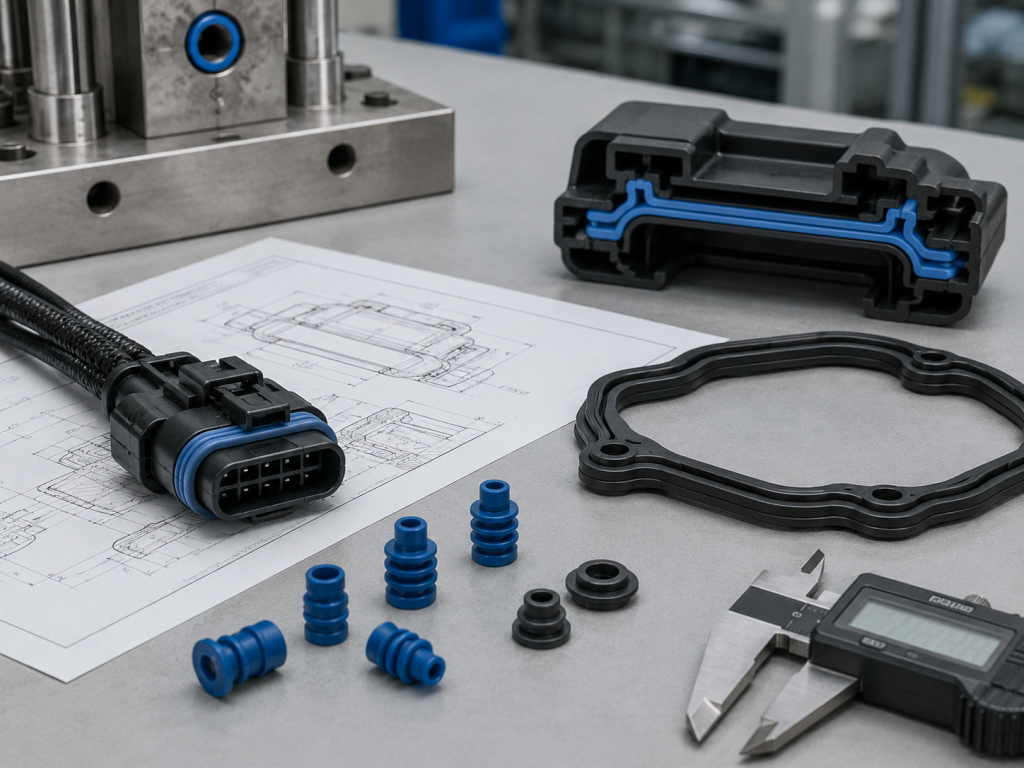
Liquid silicone rubber is widely used in automotive connectors, wire harnesses, battery systems, sensors, electronic housings and other components that require flexible sealing across changing temperatures.
Its ability to form small, complex and highly repeatable parts makes LSR particularly suitable for:
- Electrical connector seals
- Single-wire seals
- Miếng đệm cao su
- Radial seals
- Miếng đệm viền
- Phớt chống thấm tại vị trí đi dây
- Cavity plugs
- Phớt cảm biến
- Battery connector components
- Plastic-and-silicone overmolded assemblies
However, selecting an automotive LSR grade is only the beginning.
A successful automotive silicone component must maintain sealing force after long-term compression, tolerate thermal cycling, resist relevant fluids, fit accurately into the surrounding assembly and survive molding without flash, tearing or weak bonding.
The design must therefore be developed as a complete system involving the LSR material, seal geometry, mating plastic, mold structure, processing conditions and final operating environment.
Why LSR Is Used in Automotive Components
Automotive sealing systems are exposed to conditions that ordinary consumer silicone parts may never encounter.
Depending on their location, components may experience:
- Nhiệt độ cao và thấp
- Rapid temperature changes
- Vibration
- Mechanical shock
- Moisture
- Dust
- Road salt
- Cleaning chemicals
- Automotive oils and fluids
- Repeated assembly
- Long periods of compression
- Tight packaging space
- Electrical insulation requirements
LSR can provide flexible sealing and damping across a broad temperature range, which makes it useful for automotive electrical and electronic applications. Momentive identifies LSR applications including connector seals, cable seals, wire-harness seals, mat seals and radial seals, while Dow offers automotive LSR grades specifically designed for connector, weather-pack, radial and perimeter sealing applications.
LSR injection molding can also support automated production, small features and multi-cavity tooling. These characteristics are important when automotive programs require both large production volumes and consistent seal dimensions.
However, the material must be matched to the application. A general-purpose LSR may not provide the required compression set, fluid resistance, lubrication or bonding performance for a demanding automotive component.
Start with the Actual Operating Environment
An automotive LSR component should not be designed from hardness and dimensions alone.
Before selecting a material or creating the seal geometry, the development team should define:
- Minimum operating temperature
- Maximum continuous temperature
- Short-term peak temperature
- Number of expected thermal cycles
- Contact with oil, fuel, coolant or cleaning agents
- Exposure to water, humidity and road salt
- Required ingress-protection level
- Compression duration
- Vibration and mechanical loading
- Assembly and disassembly frequency
- Electrical insulation requirements
- Tuổi thọ dự kiến
- Location inside the vehicle
- Adjacent plastic and metal materials
A connector seal inside a passenger compartment has different requirements from a seal near a powertrain, battery pack or exterior sensor.
Material data generated under standard laboratory conditions should not be treated as proof of finished-component performance. Validation should use representative parts, actual mating components and application-specific environmental conditions.
Heat Resistance Is More Than Maximum Temperature
Silicone is commonly selected for its ability to remain flexible across demanding temperature conditions. However, quoting only a maximum temperature does not provide enough information for automotive design.
Heat can affect several properties over time:
- Độ cứng
- Độ giãn dài
- Độ bền kéo
- Khả năng chống rách
- Độ biến dạng vĩnh viễn do nén
- Surface lubrication
- Độ bám dính
- Màu sắc
- Kích thước
- Sealing force
A material may survive a short high-temperature exposure but gradually lose sealing performance after hundreds or thousands of hours under compression.
Therefore, automotive engineers should distinguish between:
- Short-term temperature resistance
- Continuous operating temperature
- Heat-aging performance
- Performance under simultaneous heat and compression
- Hiệu suất sau quá trình thay đổi nhiệt độ lặp đi lặp lại
- Performance in contact with plastics, metals or fluids
Some automotive LSR grades are developed specifically for long-term heat exposure. Momentive describes Silopren LSR 3696/25 as a material intended for automotive electrical applications exposed to higher temperatures for extended periods, while Dow offers connector-seal grades designed to resist heat-age deformation in contact with flame-retardant thermoplastics.
The exact material should still be validated in the intended component geometry because thin sealing lips, thick sections and bonded interfaces may respond differently during heat aging.
Thermal Cycling and Differential Expansion
An automotive seal is rarely exposed to a constant temperature.
Vehicles may move between:
- Cold outdoor conditions
- Rapid electrical heating
- Engine or battery heat
- Sun-loaded parking conditions
- Cooling during operation
- Repeated daily temperature cycles
LSR, thermoplastic substrates and metal inserts do not expand and contract at identical rates.
In a two-component assembly, this mismatch can create stress at the interface between materials. Possible consequences include:
- Bond separation
- Edge lifting
- Seal distortion
- Cracking of the rigid substrate
- Loss of compression
- Dimensional movement
- Leakage paths at corners
The overmolded interface should therefore be designed so that the bond does not carry unnecessary peeling stress.
A wide, well-supported bonding area is generally more reliable than a narrow edge subjected to repeated bending. Mechanical interlocks may also be used where appropriate, especially when chemical adhesion alone is insufficient.
For demanding bonded assemblies, thermal-cycle testing should be performed on complete molded parts rather than flat laboratory test specimens.
Compression Set and Long-Term Sealing
Compression set is one of the most important properties for automotive silicone seals.
A seal works by being compressed between two mating surfaces. This compression creates contact pressure that blocks moisture, dust and other contaminants.
Over time, an elastomer may lose part of its ability to return to its original shape. When this happens, sealing force can decrease even though the seal still appears visually intact.
Low compression set is especially important for:
- Phớt kín cho đầu nối
- Long-term housing gaskets
- Battery sealing components
- Wire-entry seals
- Vỏ cảm biến
- Components exposed to heat while compressed
Momentive describes Silopren LSR 3366/50 as an automotive connector-sealing material developed for ultra-low compression set at elevated temperatures. Dow similarly identifies low compression set as a key benefit of its automotive electrical connector-seal LSR grades.
However, compression-set data should not be used alone to predict seal performance.
The actual result also depends on:
- Initial compression percentage
- Seal cross-section
- Kích thước rãnh
- Nhiệt độ hoạt động
- Compression time
- Bề mặt hoàn thiện
- Dung sai lắp ráp
- Độ cứng của vật liệu
- Fluid exposure
- Chu kỳ nhiệt
A low-compression-set material cannot correct an incorrectly designed seal groove or insufficient interference.
Designing the Correct Compression Level
A seal must be compressed enough to create reliable contact pressure, but excessive compression can also cause failure.
Insufficient compression may lead to:
- Low sealing force
- Leakage
- Uneven contact
- Sensitivity to dimensional variation
- Seal movement during assembly
Excessive compression may lead to:
- Lực lắp ráp cao
- Biến dạng vĩnh viễn
- Tearing
- Buckling
- Flash damage
- Excessive stress on the plastic housing
- Reduced long-term recovery
The correct compression depends on the seal design and material rather than a universal percentage.
Important tolerance conditions include:
- Maximum seal dimension with minimum groove space
- Minimum seal dimension with maximum groove space
- Plastic-part shrinkage
- Sự cong vênh của nhà ở
- Mold-cavity variation
- Assembly misalignment
- Sự giãn nở nhiệt
A tolerance-stack analysis should be completed before tooling.
The analysis should confirm that the seal remains functional under both minimum and maximum material conditions.
Seal Cross-Section Design
Automotive LSR seals can use many different geometries, including:
- Circular beads
- Rectangular gaskets
- Radial sealing ribs
- Multiple-lip seals
- Bellows structures
- Miếng đệm cao su
- Individual wire seals
- Integrated housing seals
The geometry should provide controlled deformation rather than simply filling all available space.
Sealing Lips
Thin sealing lips can conform to surface variation using relatively low force. However, they may be vulnerable to tearing, folding or mold damage.
The transition between the lip and the main body should avoid abrupt thickness changes.
Multiple Sealing Ribs
Several smaller ribs can create multiple barriers against moisture. They may also accommodate dimensional variation more effectively than one very large rib.
However, each rib must contact the mating surface correctly. Adding more ribs does not improve performance when the assembly cannot compress them evenly.
Corners
Sharp gasket corners can create uneven flow during molding and uneven deformation during assembly.
Rounded transitions can help reduce:
- Điểm tập trung ứng suất
- Air trapping
- Local tearing
- Poor material flow
- Inconsistent compression
Độ dày thành
Large thickness changes can create uneven curing and dimensional variation.
The component should use reasonably balanced wall thickness where possible, especially near critical sealing surfaces.
Hardness Selection
Automotive LSR grades are available in different hardness levels. Softer silicone can deform easily and conform to irregular surfaces, while harder silicone can provide greater stability and resistance to extrusion.
A softer grade may offer:
- Lực lắp ráp thấp hơn
- Better surface conformity
- Easier compression
- Improved sealing against minor variation
Những nhược điểm có thể kể đến bao gồm:
- Greater risk of tearing
- Higher deformation
- Difficult handling
- Seal rolling or folding
- Ổn định ở chiều thấp hơn
A harder grade may provide:
- Better handling
- More stable geometry
- Higher resistance to seal displacement
- Tăng cường hỗ trợ cho các tính năng mỏng
Những nhược điểm có thể kể đến bao gồm:
- Higher assembly force
- Increased stress on the housing
- Mức độ tuân thủ giảm
- Greater sensitivity to tolerance variation
Dow’s automotive connector-seal portfolio includes materials at different Shore A hardness levels, such as 30 and 50 Shore A, illustrating that hardness is selected according to the seal and assembly rather than through one standard value.
The final decision should be based on complete component testing, including assembly-force measurement, leakage testing and heat aging.
Self-Lubricating LSR for Connector Assembly
Automotive connector seals often create friction when terminals, wires or mating components pass through them.
High friction can cause:
- Difficult assembly
- Seal displacement
- Torn sealing lips
- Wire damage
- Incomplete connector insertion
- High production-line force
- Inconsistent assembly
Self-lubricating LSR grades can reduce insertion forces and support automated assembly.
Dow offers oil-filled, self-lubricating automotive LSR materials for connector and radial seals, while Momentive describes self-lubricating LSR as useful for integrated automotive connector sealing and reduced assembly force.
The lubrication system must still be evaluated carefully.
Engineers should consider:
- Time required for lubrication to develop
- Amount of surface migration
- Long-term stability
- Compatibility with adjacent plastics
- Effect on electrical contacts
- Effect on bonding
- Dust attraction
- Packaging and storage conditions
- Assembly-force consistency
A lubricant that improves insertion may create contamination concerns elsewhere in the connector. The complete assembly should therefore be tested rather than evaluating only the silicone part.
Resistance to Automotive Fluids
Standard silicone provides useful heat resistance and flexibility, but it may not be the best choice for prolonged exposure to every automotive fluid.
Possible exposure media include:
- Engine oil
- Transmission fluid
- Fuel
- Coolant
- Brake fluid
- Cleaning chemicals
- Grease
- Battery-related fluids
- Road contaminants
Fluid exposure can cause:
- Swelling
- Softening
- Tăng cường độ bền
- Loss of tensile strength
- Dimensional change
- Reduced sealing pressure
- Bond degradation
For applications involving fuel, oils or aggressive chemicals, fluorosilicone or another specialized elastomer may be more appropriate.
Dow identifies fluoro-LSR grades designed for resistance to automotive fuels, oils and chemicals.
Material selection should be based on the exact fluid, temperature, concentration and exposure duration. A short splash test is not equivalent to long-term immersion at elevated temperature.
Why Overmolding Is Used
Traditional automotive sealing assemblies may require a rigid plastic component and a separately manufactured silicone seal.
The seal must then be:
- Produced
- Inspected
- Transported
- Stored
- Oriented
- Assembled
- Verified for correct placement
LSR overmolding can integrate the seal directly onto a plastic or metal component.
Potential benefits include:
- Fewer separate components
- Reduced assembly operations
- Lower risk of missing seals
- More consistent seal positioning
- Compact component design
- Automated production
- Improved hard-soft integration
Momentive describes self-bonding LSR systems that allow sealing elements to be molded directly onto thermoplastic substrates, including PBT, potentially replacing separate seal assembly.
However, overmolding introduces additional challenges related to adhesion, substrate temperature, dimensional stability and mold design.
Chemical Adhesion Versus Mechanical Interlocking
An overmolded LSR component can be retained through:
- Chemical bonding
- Primer-assisted bonding
- Plasma or surface treatment
- Mechanical interlocking
- A combination of these methods
Self-Bonding LSR
Self-bonding LSR can adhere to selected thermoplastics or metals during molding without a separately applied primer.
This can simplify production and reduce handling steps. However, “self-bonding” does not mean that the material bonds equally well to every plastic.
Momentive reports that selected self-bonding LSR grades can adhere to substrates such as PBT, polycarbonate and certain polyesters, but adhesion depends on the particular LSR and substrate system.
Primer-Assisted Bonding
A primer or adhesive can improve bonding where direct adhesion is insufficient.
Những nhược điểm có thể kể đến bao gồm:
- Additional process steps
- Drying requirements
- Application variation
- Contamination risk
- Restricted application areas
- Environmental-control needs
- Additional validation
Mechanical Interlocking
Mechanical features can physically retain the silicone.
Examples include:
- Through-holes
- Undercut channels
- Retention slots
- Perforations
- Encapsulated ribs
- Interlocking posts
Mechanical retention is useful when reliable chemical bonding cannot be achieved, but it may increase tool complexity and create difficult flow paths.
A well-designed component often uses mechanical retention as a backup without forcing the LSR through excessively thin or long channels.
Substrate Compatibility Challenges
Thermoplastic components used in automotive applications may contain:
- Glass fibers
- Flame retardants
- Chất màu
- Mold-release additives
- Lubricants
- Reinforcing fillers
- Recycled content
- Other processing aids
These ingredients can influence LSR adhesion.
Even two plastics identified by the same general polymer name may produce different bonding results because their formulations and surface conditions differ.
Potential causes of weak bonding include:
- Incompatible resin formulation
- Mold-release residue
- Ô nhiễm bề mặt
- Low substrate temperature
- Insufficient cure time
- Moisture in the plastic
- Excessive storage after molding
- Additive migration
- Incorrect LSR grade
- Inadequate bonding area
The actual production-grade thermoplastic should be used in adhesion trials. Testing only an unfilled laboratory-grade resin may not represent the final automotive substrate.
Changes in plastic supplier, color, filler system or flame-retardant package should also be reviewed before implementation.
Managing Heat During Overmolding
LSR normally requires a heated mold to cure, while many thermoplastics can soften, distort or shrink when exposed to heat.
This creates a process conflict.
The mold must be hot enough to cure the LSR efficiently but not so aggressive that it damages the insert.
Possible defects include:
- Warped plastic inserts
- Dimensional movement
- Surface marking
- Loss of flatness
- Insert displacement
- Reduced bond strength
- Excessive cycle time
The design team should consider:
- Plastic heat-deflection behavior
- Insert-wall thickness
- Nhiệt độ khuôn
- LSR cure temperature
- Exposure time
- Gate location
- Insert support
- Clamping pressure
- Cooling before ejection
Low-temperature-curing or fast-curing self-bonding LSR grades may help reduce thermal stress in selected overmolding applications. Momentive describes self-bonding LSR technology intended for one-step curing and relatively short molding cycles.
The actual process window must still be established through tooling trials.
Preventing Insert Movement and Deformation
During overmolding, liquid silicone enters the cavity under pressure. A thin or poorly supported plastic insert can move or bend.
This can create:
- Uneven silicone thickness
- Exposed substrate
- Flash
- Misaligned seals
- Variable bond lines
- Damaged inserts
The mold should locate the insert precisely without damaging functional surfaces.
Possible locating methods include:
- Datum surfaces
- Support pins
- Nesting features
- Vacuum retention
- Mechanical clamping
- Robotic placement fixtures
The insert design should include stable locating features from the beginning. Attempting to hold an irregular finished component without dedicated datums can create inconsistent production.
LSR Mold Design Challenges
LSR can reproduce very small surface details and can flow through narrow gaps. This is valuable for precision molding but makes flash control difficult.
Important tooling considerations include:
- Parting-line accuracy
- Xả hơi
- Gate position
- Cold-runner design
- Shutoff surfaces
- Insert location
- Ejection strategy
- Bề mặt hoàn thiện
- Vacuum assistance
- Thermal balance
Flash Control
Flash can form at parting lines, around inserts and near movable mold features.
Flash on a critical sealing lip may cause leakage or assembly problems.
The drawing should identify which areas require strict flash limits and which nonfunctional areas can accept minor residual flash.
Xả hơi
Air trapped inside the cavity can cause:
- Short shots
- Burn marks
- Weak bond regions
- Incomplete sealing lips
- Các khuyết tật bề mặt
Vents must allow air to escape without creating unacceptable silicone flash.
Gate Location
The gate should support balanced filling and avoid damaging critical sealing surfaces.
Poor gate placement may create:
- Đường hàn
- Air traps
- Uneven flow
- Jetting
- Visible gate marks
- Distortion of thin lips
Demolding
LSR is flexible, but delicate sealing features can still tear during demolding.
The part should have a controlled release path. Deep reverse features and unsupported thin lips should be minimized.
Cure Inhibition and Contamination
Platinum-cured LSR can be sensitive to certain contaminants.
Contamination may interfere with curing and produce:
- Sticky surfaces
- Partially cured areas
- Poor mechanical strength
- Bond failure
- Các khuyết tật bề mặt
Potential sources can include incompatible chemicals, residues from cleaning products, certain rubber compounds and substances transferred from gloves, tools or packaging.
For controlled automotive production, the manufacturer should manage:
- Raw-material storage
- Mixing equipment
- Mold cleaning
- Insert handling
- Primer application
- Production-line segregation
- Tool maintenance
- Operator procedures
Any unexplained local curing defect should be investigated as a potential contamination issue rather than corrected only by increasing temperature or cure time.
Dimensional Tolerances and Shrinkage
Automotive connector components often have tight functional dimensions.
LSR dimensions can be influenced by:
- Công thức nguyên liệu
- Nhiệt độ khuôn
- Cure time
- Cavity pressure
- Quá trình xử lý sau khi đóng rắn
- Part geometry
- Demolding deformation
- Insert movement
- Storage conditions
The drawing should separate:
- Critical sealing dimensions
- Assembly dimensions
- Cosmetic dimensions
- Reference dimensions
Applying an unnecessarily tight tolerance to every feature can increase mold cost and inspection difficulty without improving product performance.
For overmolded components, the plastic insert tolerance and LSR tolerance must be analyzed together.
Validation of Automotive LSR Components
A complete validation plan may include:
- Kiểm tra kích thước
- Thử nghiệm độ cứng
- Kiểm tra bằng mắt thường
- Flash evaluation
- Tensile or tear testing
- Compression-set testing
- Kiểm tra rò rỉ
- Ingress testing
- Assembly-force measurement
- Pull or peel adhesion testing
- Thermal aging
- Chu kỳ nhiệt
- Humidity exposure
- Vibration testing
- Fluid immersion
- Salt or environmental exposure
- Electrical insulation testing
- Long-term storage evaluation
The specific test program should follow the component’s function, customer requirements and applicable automotive specifications.
Testing should use production-intent materials, molds, inserts and process conditions. Prototype samples made from a different material or process may be useful for initial design checks but should not replace final production validation.
Common Automotive LSR Design Mistakes
Selecting Material Only by Hardness
Two materials with the same Shore A hardness can have different compression-set, tear, lubrication, bonding and heat-aging performance.
Ignoring Tolerance Stack-Up
A nominally correct seal may fail when the smallest seal is assembled into the largest groove.
Using Extremely Thin Unsupported Lips
Thin lips can improve conformity but may fold, tear or become damaged during molding and assembly.
Assuming All Plastics Bond Equally
Plastic additives, fillers, pigments and processing history can significantly affect overmolding adhesion.
Placing the Bond Line Under Peel Stress
Interfaces are generally more reliable when loading is distributed across a broad area rather than concentrated at an exposed edge.
Ignoring Plastic Deformation During Molding
A thermoplastic insert may warp inside a heated LSR mold even when it was dimensionally correct before overmolding.
Using General-Purpose LSR Near Fuel or Oil
Fluid exposure may require a specialized oil-resistant or fluorosilicone grade.
Validating Only at Room Temperature
Automotive seals should be tested after relevant heat aging, thermal cycling and fluid exposure.
Allowing Flash on Functional Surfaces
Small flash may interfere with sealing, terminal insertion or connector assembly.
Changing Materials Without Revalidation
A change in LSR, pigment, plastic substrate or mold-release system can alter dimensions, curing or adhesion.
Practical Development Process
A structured process helps reduce tooling changes and validation failures.
Step 1: Define the Application
Confirm temperature, fluid exposure, sealing target, service life and assembly conditions.
Step 2: Select Candidate Materials
Compare hardness, compression set, heat-aging performance, lubrication, fluid resistance and bonding capability.
Step 3: Review the Seal Geometry
Evaluate compression, groove fill, sealing ribs, corners, wall thickness and assembly direction.
Step 4: Complete Tolerance Analysis
Calculate minimum and maximum compression using all LSR, plastic and housing tolerances.
Step 5: Test Substrate Compatibility
Use the actual production plastic grade, pigment and filler system for bonding trials.
Step 6: Design the Mold and Insert Location
Confirm gating, venting, parting lines, shutoffs, support points and demolding.
Step 7: Produce Representative Samples
Samples should use production-intent LSR, inserts and molding parameters.
Step 8: Conduct Functional Testing
Evaluate leakage, assembly force, adhesion and dimensions before environmental aging.
Step 9: Complete Environmental Validation
Test heat aging, thermal cycling, vibration and relevant fluid exposure.
Step 10: Freeze the Production Configuration
Control material grade, color, substrate, mold, process parameters and inspection standards.
Questions to Ask an Automotive LSR Manufacturer
Before starting an automotive silicone project, buyers should ask:
- Which LSR grade is recommended for the operating temperature?
- What compression-set data are available?
- Is the material self-lubricating?
- Is oil or fuel resistance required?
- Can the LSR bond to the selected plastic?
- Has the exact plastic grade been tested?
- Is a primer or plasma treatment required?
- Can mechanical retention be incorporated?
- How will the insert be located during molding?
- What flash limits can be maintained?
- How will critical sealing dimensions be inspected?
- Can assembly-force testing be performed?
- Can thermal-aging and fluid-exposure samples be supplied?
- How are material and process changes controlled?
- Can the process support automotive production volumes and traceability?
Kết luận
Automotive LSR component design requires more than selecting a heat-resistant silicone.
Reliable performance depends on the relationship between:
- Material properties
- Độ biến dạng vĩnh viễn do nén
- Seal geometry
- Dung sai lắp ráp
- Chu kỳ nhiệt
- Fluid exposure
- Surface lubrication
- Plastic-substrate compatibility
- Overmolding adhesion
- Mold accuracy
- Production control
For standalone seals, the main priority is maintaining contact pressure throughout the expected service life.
For overmolded components, the project must also control adhesion, insert stability, plastic deformation and stress at the hard-soft interface.
The best results are achieved when the automotive customer, component designer, material supplier, mold maker and LSR manufacturer review the application before tooling begins.
Early design-for-manufacturing analysis can reduce mold modifications, prevent bonding failures and help ensure that the finished component maintains sealing performance under real automotive operating conditions.
Các câu hỏi thường gặp
Why is LSR used for automotive connector seals?
LSR can produce small, flexible and repeatable sealing components. Selected automotive grades also offer low compression set, self-lubrication and resistance to thermal aging.
What is the most important property for an automotive LSR seal?
There is no single property for every application. Compression set, hardness, heat resistance, tear strength, fluid resistance and dimensional stability should be evaluated together.
Does a softer LSR always provide better sealing?
No. Softer LSR can conform more easily but may also deform, tear or move during assembly. The hardness must match the seal geometry and compression level.
Can LSR be molded directly onto automotive plastic components?
Yes. Self-bonding or primer-assisted LSR can be overmolded onto selected thermoplastics. Compatibility must be verified using the exact production plastic grade.
Which plastics can bond with self-bonding LSR?
Selected self-bonding LSR materials may bond with plastics such as PBT, polycarbonate and certain polyesters. Results depend on the exact material formulation, surface condition and molding process.
Is standard LSR resistant to automotive fuel and oil?
Standard silicone may not provide sufficient resistance for prolonged contact with every fuel or oil. Specialized oil-resistant LSR or fluorosilicone may be required.
Why does an overmolded LSR seal separate from the plastic?
Possible causes include incompatible substrate material, contamination, insufficient substrate temperature, inadequate cure, low bonding area, excessive peel stress or changes in the plastic formulation.
How can flash be reduced on LSR sealing components?
Flash control depends on accurate mold shutoffs, stable insert positioning, suitable venting, controlled injection parameters and clearly defined flash limits on functional surfaces.
Should the finished component be tested after heat aging?
Yes. Automotive sealing performance should be evaluated after relevant thermal aging, thermal cycling and fluid exposure, not only at room temperature.
What information is required for a quotation?
Useful information includes 2D and 3D drawings, intended application, temperature range, fluid exposure, sealing requirements, plastic or metal insert details, target hardness, annual quantity and testing requirements.
 English
  Japanese
  Korean
  German
  French
  Italian
  Spanish
  Dutch
Dutch  Chinese
  Portuguese
  Polish
  Czech
Czech  Hungarian
  Swedish
  Finnish
  Vietnamese
  Thai
Thai  Turkish
  Arabic
  Russian