
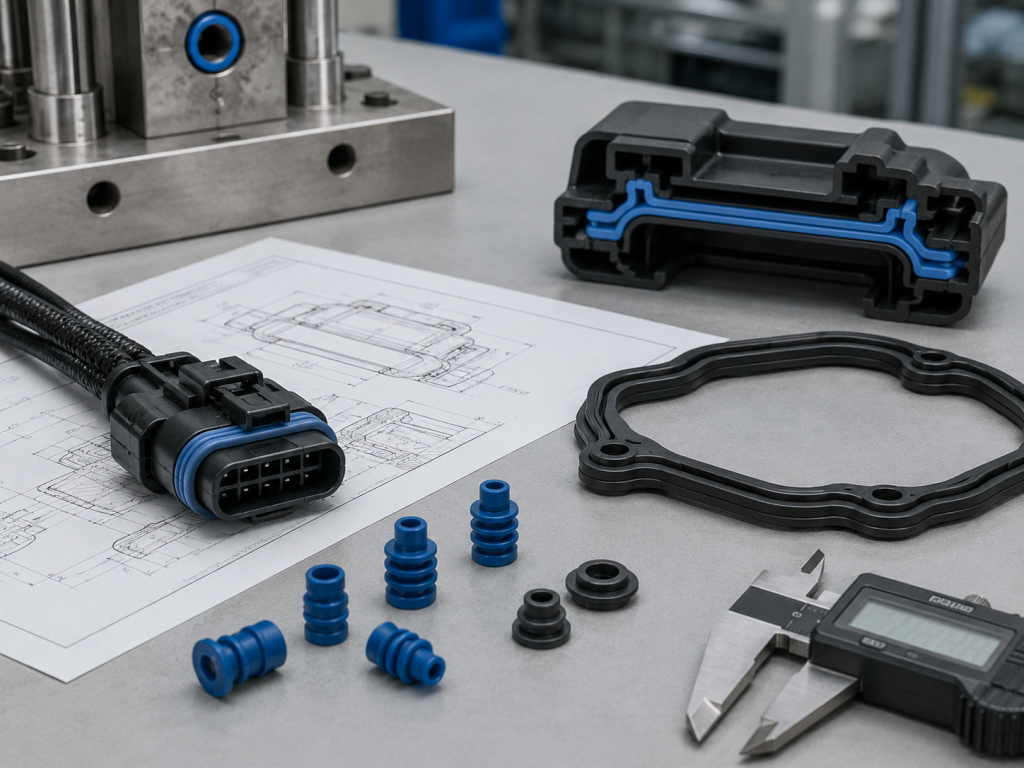
يُستخدم مطاط السيليكون السائل على نطاق واسع في موصلات السيارات، وحزم الأسلاك، وأنظمة البطاريات، وأجهزة الاستشعار، وعلب الأجهزة الإلكترونية، وغيرها من المكونات التي تتطلب إحكامًا مرنًا في ظل درجات حرارة متغيرة.
إن قدرة مادة LSR على تشكيل قطع صغيرة ومعقدة وقابلة للتكرار بدرجة عالية تجعلها مناسبة بشكل خاص لما يلي:
- أختام الموصلات الكهربائية
- الأختام أحادية السلك
- أختام مات
- الموانع الشدوية
- حشيات محيطية
- أختام مدخل الكابلات
- سدادات التجاويف
- أختام المستشعرات
- مكونات موصل البطارية
- مجموعات مصبوبة بطبقة خارجية من البلاستيك والسيليكون
ومع ذلك، فإن اختيار نوع من مطاط LSR المخصص للسيارات ليس سوى البداية.
يجب أن يحافظ مكون السيليكون الناجح المستخدم في صناعة السيارات على قوة الإحكام بعد التعرض للضغط لفترة طويلة، وأن يتحمل الدورات الحرارية، وأن يقاوم السوائل ذات الصلة، وأن يتناسب بدقة مع المجموعة المحيطة به، وأن يتحمل عملية القولبة دون ظهور حواف زائدة أو تمزق أو ضعف في الالتصاق.
لذلك، يجب تطوير التصميم كنظام متكامل يشمل مادة LSR، وهندسة الختم، والبلاستيك المقترن، وهيكل القالب، وظروف المعالجة، وبيئة التشغيل النهائية.
لماذا يُستخدم LSR في مكونات السيارات؟
تتعرض أنظمة مانعة التسرب المستخدمة في صناعة السيارات لظروف قد لا تواجهها أبدًا قطع السيليكون الاستهلاكية العادية.
قد تتعرض المكونات، حسب موقعها، إلى ما يلي:
- درجات الحرارة العالية والمنخفضة
- التغيرات السريعة في درجات الحرارة
- الاهتزاز
- الصدمة الميكانيكية
- الرطوبة
- الغبار
- ملح الطرق
- المواد الكيميائية المستخدمة في التنظيف
- زيوت وسوائل السيارات
- التجميع المتكرر
- فترات طويلة من الضغط
- مساحة تعبئة محدودة
- متطلبات العزل الكهربائي
يمكن أن يوفر مطاط السيليكون المرن (LSR) خصائص مانعة للتسرب وتخميد مرنة عبر نطاق واسع من درجات الحرارة، مما يجعله مفيدًا في التطبيقات الكهربائية والإلكترونية في قطاع السيارات. تحدد شركة «مومنتيف» تطبيقات مطاط السيليكون المرن (LSR)، بما في ذلك موانع التسرب الخاصة بالموصلات، وموانع التسرب الخاصة بالكابلات، وموانع التسرب الخاصة بحزم الأسلاك، وموانع التسرب على شكل حصيرة، وموانع التسرب الشعاعية؛ بينما تقدم شركة «داو» أنواعًا من مطاط السيليكون المرن (LSR) المخصصة لقطاع السيارات والمصممة خصيصًا لتطبيقات موانع التسرب الخاصة بالموصلات، وموانع التسرب المقاومة للعوامل الجوية، وموانع التسرب الشعاعية، وموانع التسرب المحيطية.
كما يمكن أن يدعم القولبة بالحقن باستخدام مادة LSR الإنتاج الآلي، والتفاصيل الصغيرة، والقوالب متعددة التجاويف. وتكتسب هذه الخصائص أهمية كبيرة عندما تتطلب مشاريع صناعة السيارات أحجام إنتاج كبيرة وأبعادًا ثابتة للموانع التسرب.
ومع ذلك، يجب أن تتناسب المادة مع الاستخدام المقصود. فقد لا يوفر مطاط السيليكون المرن (LSR) ذو الاستخدام العام مستوى الانضغاط الدائم المطلوب، أو مقاومة السوائل، أو أداء التشحيم، أو أداء الالتصاق اللازم لمكون سيارات يتطلب معايير صارمة.
ابدأ ببيئة التشغيل الفعلية
لا ينبغي تصميم مكون LSR المستخدم في صناعة السيارات بناءً على الصلابة والأبعاد وحدها.
قبل اختيار المادة أو إنشاء الشكل الهندسي للختم، يجب على فريق التطوير تحديد ما يلي:
- درجة الحرارة الدنيا للتشغيل
- أقصى درجة حرارة مستمرة
- أعلى درجة حرارة مسجلة على المدى القصير
- عدد الدورات الحرارية المتوقعة
- التلامس مع الزيت أو الوقود أو سائل التبريد أو مواد التنظيف
- التعرض للماء والرطوبة وأملاح الطرق
- مستوى الحماية المطلوب ضد دخول العوامل الخارجية
- مدة الضغط
- الاهتزازات والأحمال الميكانيكية
- وتيرة التجميع والتفكيك
- متطلبات العزل الكهربائي
- العمر التشغيلي المتوقع
- الموقع داخل السيارة
- المواد البلاستيكية والمعدنية المجاورة
تختلف متطلبات مانع التسرب الموجود داخل مقصورة الركاب عن متطلبات مانع التسرب الموجود بالقرب من مجموعة نقل الحركة أو حزمة البطارية أو المستشعر الخارجي.
لا ينبغي اعتبار البيانات المتعلقة بالمواد التي يتم الحصول عليها في ظل ظروف مختبرية قياسية دليلاً على أداء المكونات النهائية. وينبغي أن يتم التحقق من صحة هذه البيانات باستخدام قطع تمثيلية، ومكونات متوافقة فعليًّا، وظروف بيئية خاصة بالتطبيق المعني.
مقاومة الحرارة لا تقتصر على درجة الحرارة القصوى
يُختار السيليكون عادةً لقدرته على الحفاظ على مرونته في ظل ظروف درجات الحرارة القاسية. ومع ذلك، فإن الاكتفاء بذكر درجة الحرارة القصوى لا يوفر معلومات كافية لتصميم السيارات.
يمكن أن تؤثر الحرارة على العديد من الخصائص بمرور الوقت:
- الصلابة
- الاستطالة
- قوة الشد
- مقاومة التمزق
- مجموعة الضغط
- تزييت الأسطح
- قوة الالتصاق
- اللون
- الأبعاد
- قوة الإحكام
قد يتحمل مادة ما التعرض لدرجات حرارة عالية لفترة قصيرة، لكنها تفقد أداءها في الإحكام تدريجيًّا بعد مئات أو آلاف الساعات من التعرض للضغط.
لذلك، ينبغي لمهندسي السيارات التمييز بين:
- مقاومة درجات الحرارة على المدى القصير
- درجة حرارة التشغيل المستمر
- أداء الشيخوخة الحرارية
- الأداء في ظل التعرض المتزامن للحرارة والضغط
- الأداء بعد التعرض لدورات حرارية
- الأداء عند ملامسة المواد البلاستيكية أو المعادن أو السوائل
تم تطوير بعض أنواع مطاط السيليكون المرن (LSR) المخصصة لقطاع السيارات خصيصًا للتعرض للحرارة على المدى الطويل. تصف شركة «مومنتيف» مادة «سيلوبرين LSR 3696/25» بأنها مادة مخصصة للتطبيقات الكهربائية في السيارات التي تتعرض لدرجات حرارة أعلى لفترات طويلة، بينما تقدم شركة «داو» أنواعًا من مطاط السيليكون المرن (LSR) مخصصة لإحكام إغلاق الموصلات، مصممة لمقاومة التشوه الناتج عن الشيخوخة الحرارية عند ملامستها للبلاستيك الحراري المقاوم للهب.
لا يزال من الضروري التحقق من صلاحية المادة المحددة في الشكل الهندسي المقصود للمكون، لأن حواف الإحكام الرقيقة، والأجزاء السميكة، وواجهات الترابط قد تستجيب بشكل مختلف أثناء عملية الشيخوخة الحرارية.
الدورات الحرارية والتمدد التفاضلي
نادرًا ما يتعرض مانع التسرب المستخدم في السيارات لدرجة حرارة ثابتة.
يمكن للمركبات التنقل بين:
- الظروف الجوية الباردة في الهواء الطلق
- التسخين الكهربائي السريع
- حرارة المحرك أو البطارية
- ظروف مواقف السيارات المعرضة لأشعة الشمس
- التبريد أثناء التشغيل
- دورات درجات الحرارة اليومية المتكررة
لا تتوسع مادة LSR والركائز البلاستيكية الحرارية والإدخالات المعدنية ولا تنكمش بنفس المعدلات.
في التجميع المكون من عنصرين، قد يؤدي هذا التباين إلى حدوث إجهاد عند السطح الفاصل بين المواد. ومن بين العواقب المحتملة ما يلي:
- فصل السندات
- رفع الحواف
- تشوه الختم
- تشقق الركيزة الصلبة
- فقدان الضغط
- الحركة الأبعادية
- مسارات التسرب عند الزوايا
لذلك، ينبغي تصميم الواجهة المصبوبة فوقية بحيث لا يتحمل الارتباط إجهادًا غير ضروري قد يؤدي إلى تقشرها.
تُعد منطقة الالتصاق الواسعة والمدعمة جيدًا أكثر موثوقية عمومًا من الحافة الضيقة المعرضة للانثناء المتكرر. كما يمكن استخدام أدوات التثبيت الميكانيكية عند الاقتضاء، لا سيما عندما لا يكفي الالتصاق الكيميائي وحده.
بالنسبة للتركيبات الملصقة التي تتطلب معايير صارمة، ينبغي إجراء اختبار الدورات الحرارية على القطع المقولبة الكاملة بدلاً من عينات الاختبار المسطحة المستخدمة في المختبر.
الانضغاط الدائم والكفاءة في الإحكام على المدى الطويل
يُعد «الانضغاط الدائم» إحدى أهم الخصائص التي تتميز بها موانع التسرب المصنوعة من السيليكون المستخدمة في صناعة السيارات.
يعمل السدادة من خلال ضغطها بين سطحين متلاصقين. ويؤدي هذا الضغط إلى توليد ضغط تلامس يمنع دخول الرطوبة والغبار والملوثات الأخرى.
بمرور الوقت، قد يفقد المطاط الصناعي جزءًا من قدرته على العودة إلى شكله الأصلي. وعندما يحدث ذلك، قد تنخفض قوة الإحكام على الرغم من أن السدادة تبدو سليمة من الناحية البصرية.
يُعد انخفاض معدل الانضغاط أمرًا مهمًا بشكل خاص في الحالات التالية:
- أختام الموصلات
- حشيات الإسكان طويلة الأمد
- مكونات إحكام إغلاق البطارية
- أختام مدخل الأسلاك
- أغلفة أجهزة الاستشعار
- المكونات المعرضة للحرارة أثناء ضغطها
تصف شركة «مومنتيف» مادة «سيلوبرين LSR 3366/50» بأنها مادة مانعة للتسرب تُستخدم في الموصلات الكهربائية للسيارات، وقد تم تطويرها لتوفير معدل انكماش منخفض للغاية عند درجات الحرارة المرتفعة. وبالمثل، تحدد شركة «داو» معدل الانكماش المنخفض باعتباره إحدى المزايا الرئيسية لدرجات مادة LSR الخاصة بها والمخصصة لإحكام إغلاق الموصلات الكهربائية للسيارات.
ومع ذلك، لا ينبغي الاعتماد على بيانات الانضغاط الدائم وحدها للتنبؤ بأداء مانع التسرب.
كما تعتمد النتيجة الفعلية على:
- نسبة الضغط الأولي
- المقطع العرضي للختم
- أبعاد الأخدود
- درجة حرارة التشغيل
- مدة الضغط
- تشطيب السطح
- تفاوت التجميع
- صلابة المادة
- التعرض للسوائل
- الدورات الحرارية
لا يمكن للمادة ذات معدل الانضغاط المنخفض أن تعوض عن أخدود مانع التسرب المصمم بشكل خاطئ أو عن عدم كفاية التداخل.
تصميم مستوى الضغط المناسب
يجب ضغط الحشية بدرجة كافية لتوليد ضغط تلامس موثوق، لكن الضغط المفرط قد يؤدي أيضًا إلى حدوث عطل.
قد يؤدي عدم كفاية الضغط إلى:
- قوة إحكام منخفضة
- التسرب
- تلامس غير متساوٍ
- الحساسية تجاه التباين في الأبعاد
- حركة السدادة أثناء التجميع
قد يؤدي الضغط المفرط إلى:
- قوة تجميع عالية
- التشوه الدائم
- التمزق
- الانحناء
- الأضرار الناتجة عن الصواعق
- الضغط المفرط على الغلاف البلاستيكي
- انخفاض معدل التعافي على المدى الطويل
يعتمد الضغط الصحيح على تصميم المانع للتسرب والمادة المصنوع منها، وليس على نسبة مئوية عامة.
تشمل شروط التفاوت المسموح بها الهامة ما يلي:
- أقصى أبعاد للسدادة مع أقل مساحة ممكنة للأخدود
- أصغر أبعاد للختم مع أقصى مساحة للأخدود
- انكماش الأجزاء البلاستيكية
- تشوه المساكن
- التباين بين القالب والتجويف
- اختلال محاذاة التجميع
- التمدد الحراري
يجب إجراء تحليل تراكم التفاوتات قبل البدء في تصنيع القوالب.
ينبغي أن يؤكد التحليل أن الختم يظل فعالاً في ظل كل من الظروف الدنيا والقصوى للمادة.
تصميم المقطع العرضي للحشية
يمكن أن تتخذ أختام LSR المستخدمة في صناعة السيارات أشكالًا هندسية متنوعة، منها:
- خرزات دائرية
- حشيات مستطيلة الشكل
- أضلاع مانعة للتسرب شعاعية
- أختام متعددة الشفاه
- هياكل الخوار
- أختام مات
- أختام سلكية فردية
- أختام الإسكان المدمجة
يجب أن تتيح الهندسة تشوهًا متحكمًا فيه بدلاً من مجرد ملء كل المساحة المتاحة.
إحكام إغلاق الشفاه
يمكن للشفاه المانعة للتسرب الرقيقة أن تتكيف مع التباينات في السطح باستخدام قوة منخفضة نسبيًا. ومع ذلك، فقد تكون عرضة للتمزق أو الطي أو تلف القالب.
يجب أن يتم الانتقال بين الشفة والجسم الرئيسي دون حدوث تغيرات مفاجئة في السماكة.
Multiple Sealing Ribs
Several smaller ribs can create multiple barriers against moisture. They may also accommodate dimensional variation more effectively than one very large rib.
However, each rib must contact the mating surface correctly. Adding more ribs does not improve performance when the assembly cannot compress them evenly.
Corners
Sharp gasket corners can create uneven flow during molding and uneven deformation during assembly.
Rounded transitions can help reduce:
- Stress concentration
- Air trapping
- Local tearing
- Poor material flow
- Inconsistent compression
سماكة الجدار
Large thickness changes can create uneven curing and dimensional variation.
The component should use reasonably balanced wall thickness where possible, especially near critical sealing surfaces.
Hardness Selection
Automotive LSR grades are available in different hardness levels. Softer silicone can deform easily and conform to irregular surfaces, while harder silicone can provide greater stability and resistance to extrusion.
A softer grade may offer:
- Lower assembly force
- Better surface conformity
- Easier compression
- Improved sealing against minor variation
Possible disadvantages include:
- Greater risk of tearing
- Higher deformation
- Difficult handling
- Seal rolling or folding
- Lower dimensional stability
A harder grade may provide:
- Better handling
- More stable geometry
- Higher resistance to seal displacement
- Stronger support for thin features
Possible disadvantages include:
- Higher assembly force
- Increased stress on the housing
- Reduced conformity
- Greater sensitivity to tolerance variation
Dow’s automotive connector-seal portfolio includes materials at different Shore A hardness levels, such as 30 and 50 Shore A, illustrating that hardness is selected according to the seal and assembly rather than through one standard value.
The final decision should be based on complete component testing, including assembly-force measurement, leakage testing and heat aging.
Self-Lubricating LSR for Connector Assembly
Automotive connector seals often create friction when terminals, wires or mating components pass through them.
High friction can cause:
- Difficult assembly
- Seal displacement
- Torn sealing lips
- Wire damage
- Incomplete connector insertion
- High production-line force
- Inconsistent assembly
Self-lubricating LSR grades can reduce insertion forces and support automated assembly.
Dow offers oil-filled, self-lubricating automotive LSR materials for connector and radial seals, while Momentive describes self-lubricating LSR as useful for integrated automotive connector sealing and reduced assembly force.
The lubrication system must still be evaluated carefully.
Engineers should consider:
- Time required for lubrication to develop
- Amount of surface migration
- Long-term stability
- Compatibility with adjacent plastics
- Effect on electrical contacts
- Effect on bonding
- Dust attraction
- Packaging and storage conditions
- Assembly-force consistency
A lubricant that improves insertion may create contamination concerns elsewhere in the connector. The complete assembly should therefore be tested rather than evaluating only the silicone part.
Resistance to Automotive Fluids
Standard silicone provides useful heat resistance and flexibility, but it may not be the best choice for prolonged exposure to every automotive fluid.
Possible exposure media include:
- Engine oil
- Transmission fluid
- Fuel
- Coolant
- Brake fluid
- المواد الكيميائية المستخدمة في التنظيف
- Grease
- Battery-related fluids
- Road contaminants
Fluid exposure can cause:
- Swelling
- Softening
- Hardening
- Loss of tensile strength
- Dimensional change
- Reduced sealing pressure
- Bond degradation
For applications involving fuel, oils or aggressive chemicals, fluorosilicone or another specialized elastomer may be more appropriate.
Dow identifies fluoro-LSR grades designed for resistance to automotive fuels, oils and chemicals.
Material selection should be based on the exact fluid, temperature, concentration and exposure duration. A short splash test is not equivalent to long-term immersion at elevated temperature.
Why Overmolding Is Used
Traditional automotive sealing assemblies may require a rigid plastic component and a separately manufactured silicone seal.
The seal must then be:
- Produced
- Inspected
- Transported
- Stored
- Oriented
- Assembled
- Verified for correct placement
LSR overmolding can integrate the seal directly onto a plastic or metal component.
Potential benefits include:
- Fewer separate components
- Reduced assembly operations
- Lower risk of missing seals
- More consistent seal positioning
- Compact component design
- Automated production
- Improved hard-soft integration
Momentive describes self-bonding LSR systems that allow sealing elements to be molded directly onto thermoplastic substrates, including PBT, potentially replacing separate seal assembly.
However, overmolding introduces additional challenges related to adhesion, substrate temperature, dimensional stability and mold design.
Chemical Adhesion Versus Mechanical Interlocking
An overmolded LSR component can be retained through:
- Chemical bonding
- Primer-assisted bonding
- Plasma or surface treatment
- Mechanical interlocking
- A combination of these methods
Self-Bonding LSR
Self-bonding LSR can adhere to selected thermoplastics or metals during molding without a separately applied primer.
This can simplify production and reduce handling steps. However, “self-bonding” does not mean that the material bonds equally well to every plastic.
Momentive reports that selected self-bonding LSR grades can adhere to substrates such as PBT, polycarbonate and certain polyesters, but adhesion depends on the particular LSR and substrate system.
Primer-Assisted Bonding
A primer or adhesive can improve bonding where direct adhesion is insufficient.
Possible disadvantages include:
- Additional process steps
- Drying requirements
- Application variation
- Contamination risk
- Restricted application areas
- Environmental-control needs
- Additional validation
Mechanical Interlocking
Mechanical features can physically retain the silicone.
Examples include:
- Through-holes
- Undercut channels
- Retention slots
- Perforations
- Encapsulated ribs
- Interlocking posts
Mechanical retention is useful when reliable chemical bonding cannot be achieved, but it may increase tool complexity and create difficult flow paths.
A well-designed component often uses mechanical retention as a backup without forcing the LSR through excessively thin or long channels.
Substrate Compatibility Challenges
Thermoplastic components used in automotive applications may contain:
- Glass fibers
- Flame retardants
- Pigments
- Mold-release additives
- Lubricants
- Reinforcing fillers
- Recycled content
- Other processing aids
These ingredients can influence LSR adhesion.
Even two plastics identified by the same general polymer name may produce different bonding results because their formulations and surface conditions differ.
Potential causes of weak bonding include:
- Incompatible resin formulation
- Mold-release residue
- Surface contamination
- Low substrate temperature
- Insufficient cure time
- Moisture in the plastic
- Excessive storage after molding
- Additive migration
- Incorrect LSR grade
- Inadequate bonding area
The actual production-grade thermoplastic should be used in adhesion trials. Testing only an unfilled laboratory-grade resin may not represent the final automotive substrate.
Changes in plastic supplier, color, filler system or flame-retardant package should also be reviewed before implementation.
Managing Heat During Overmolding
LSR normally requires a heated mold to cure, while many thermoplastics can soften, distort or shrink when exposed to heat.
This creates a process conflict.
The mold must be hot enough to cure the LSR efficiently but not so aggressive that it damages the insert.
Possible defects include:
- Warped plastic inserts
- الحركة الأبعادية
- Surface marking
- Loss of flatness
- Insert displacement
- Reduced bond strength
- Excessive cycle time
The design team should consider:
- Plastic heat-deflection behavior
- Insert-wall thickness
- Mold temperature
- LSR cure temperature
- Exposure time
- Gate location
- Insert support
- Clamping pressure
- Cooling before ejection
Low-temperature-curing or fast-curing self-bonding LSR grades may help reduce thermal stress in selected overmolding applications. Momentive describes self-bonding LSR technology intended for one-step curing and relatively short molding cycles.
The actual process window must still be established through tooling trials.
Preventing Insert Movement and Deformation
During overmolding, liquid silicone enters the cavity under pressure. A thin or poorly supported plastic insert can move or bend.
This can create:
- Uneven silicone thickness
- Exposed substrate
- Flash
- Misaligned seals
- Variable bond lines
- Damaged inserts
The mold should locate the insert precisely without damaging functional surfaces.
Possible locating methods include:
- Datum surfaces
- Support pins
- Nesting features
- Vacuum retention
- Mechanical clamping
- Robotic placement fixtures
The insert design should include stable locating features from the beginning. Attempting to hold an irregular finished component without dedicated datums can create inconsistent production.
LSR Mold Design Challenges
LSR can reproduce very small surface details and can flow through narrow gaps. This is valuable for precision molding but makes flash control difficult.
Important tooling considerations include:
- Parting-line accuracy
- Venting
- Gate position
- Cold-runner design
- Shutoff surfaces
- Insert location
- Ejection strategy
- تشطيب السطح
- Vacuum assistance
- Thermal balance
Flash Control
Flash can form at parting lines, around inserts and near movable mold features.
Flash on a critical sealing lip may cause leakage or assembly problems.
The drawing should identify which areas require strict flash limits and which nonfunctional areas can accept minor residual flash.
Venting
Air trapped inside the cavity can cause:
- Short shots
- Burn marks
- Weak bond regions
- Incomplete sealing lips
- عيوب السطح
Vents must allow air to escape without creating unacceptable silicone flash.
Gate Location
The gate should support balanced filling and avoid damaging critical sealing surfaces.
Poor gate placement may create:
- Weld lines
- Air traps
- Uneven flow
- Jetting
- Visible gate marks
- Distortion of thin lips
Demolding
LSR is flexible, but delicate sealing features can still tear during demolding.
The part should have a controlled release path. Deep reverse features and unsupported thin lips should be minimized.
Cure Inhibition and Contamination
Platinum-cured LSR can be sensitive to certain contaminants.
Contamination may interfere with curing and produce:
- Sticky surfaces
- Partially cured areas
- Poor mechanical strength
- Bond failure
- عيوب السطح
Potential sources can include incompatible chemicals, residues from cleaning products, certain rubber compounds and substances transferred from gloves, tools or packaging.
For controlled automotive production, the manufacturer should manage:
- Raw-material storage
- Mixing equipment
- Mold cleaning
- Insert handling
- Primer application
- Production-line segregation
- Tool maintenance
- Operator procedures
Any unexplained local curing defect should be investigated as a potential contamination issue rather than corrected only by increasing temperature or cure time.
Dimensional Tolerances and Shrinkage
Automotive connector components often have tight functional dimensions.
LSR dimensions can be influenced by:
- Material formulation
- Mold temperature
- Cure time
- Cavity pressure
- المعالجة اللاحقة
- Part geometry
- Demolding deformation
- Insert movement
- Storage conditions
The drawing should separate:
- Critical sealing dimensions
- Assembly dimensions
- Cosmetic dimensions
- Reference dimensions
Applying an unnecessarily tight tolerance to every feature can increase mold cost and inspection difficulty without improving product performance.
For overmolded components, the plastic insert tolerance and LSR tolerance must be analyzed together.
Validation of Automotive LSR Components
A complete validation plan may include:
- فحص الأبعاد
- اختبار الصلابة
- الفحص البصري
- Flash evaluation
- Tensile or tear testing
- Compression-set testing
- اختبار التسرب
- Ingress testing
- Assembly-force measurement
- Pull or peel adhesion testing
- Thermal aging
- الدورات الحرارية
- Humidity exposure
- Vibration testing
- Fluid immersion
- Salt or environmental exposure
- Electrical insulation testing
- Long-term storage evaluation
The specific test program should follow the component’s function, customer requirements and applicable automotive specifications.
Testing should use production-intent materials, molds, inserts and process conditions. Prototype samples made from a different material or process may be useful for initial design checks but should not replace final production validation.
Common Automotive LSR Design Mistakes
Selecting Material Only by Hardness
Two materials with the same Shore A hardness can have different compression-set, tear, lubrication, bonding and heat-aging performance.
Ignoring Tolerance Stack-Up
A nominally correct seal may fail when the smallest seal is assembled into the largest groove.
Using Extremely Thin Unsupported Lips
Thin lips can improve conformity but may fold, tear or become damaged during molding and assembly.
Assuming All Plastics Bond Equally
Plastic additives, fillers, pigments and processing history can significantly affect overmolding adhesion.
Placing the Bond Line Under Peel Stress
Interfaces are generally more reliable when loading is distributed across a broad area rather than concentrated at an exposed edge.
Ignoring Plastic Deformation During Molding
A thermoplastic insert may warp inside a heated LSR mold even when it was dimensionally correct before overmolding.
Using General-Purpose LSR Near Fuel or Oil
Fluid exposure may require a specialized oil-resistant or fluorosilicone grade.
Validating Only at Room Temperature
Automotive seals should be tested after relevant heat aging, thermal cycling and fluid exposure.
Allowing Flash on Functional Surfaces
Small flash may interfere with sealing, terminal insertion or connector assembly.
Changing Materials Without Revalidation
A change in LSR, pigment, plastic substrate or mold-release system can alter dimensions, curing or adhesion.
Practical Development Process
A structured process helps reduce tooling changes and validation failures.
Step 1: Define the Application
Confirm temperature, fluid exposure, sealing target, service life and assembly conditions.
Step 2: Select Candidate Materials
Compare hardness, compression set, heat-aging performance, lubrication, fluid resistance and bonding capability.
Step 3: Review the Seal Geometry
Evaluate compression, groove fill, sealing ribs, corners, wall thickness and assembly direction.
Step 4: Complete Tolerance Analysis
Calculate minimum and maximum compression using all LSR, plastic and housing tolerances.
Step 5: Test Substrate Compatibility
Use the actual production plastic grade, pigment and filler system for bonding trials.
Step 6: Design the Mold and Insert Location
Confirm gating, venting, parting lines, shutoffs, support points and demolding.
Step 7: Produce Representative Samples
Samples should use production-intent LSR, inserts and molding parameters.
Step 8: Conduct Functional Testing
Evaluate leakage, assembly force, adhesion and dimensions before environmental aging.
Step 9: Complete Environmental Validation
Test heat aging, thermal cycling, vibration and relevant fluid exposure.
Step 10: Freeze the Production Configuration
Control material grade, color, substrate, mold, process parameters and inspection standards.
Questions to Ask an Automotive LSR Manufacturer
Before starting an automotive silicone project, buyers should ask:
- Which LSR grade is recommended for the operating temperature?
- What compression-set data are available?
- Is the material self-lubricating?
- Is oil or fuel resistance required?
- Can the LSR bond to the selected plastic?
- Has the exact plastic grade been tested?
- Is a primer or plasma treatment required?
- Can mechanical retention be incorporated?
- How will the insert be located during molding?
- What flash limits can be maintained?
- How will critical sealing dimensions be inspected?
- Can assembly-force testing be performed?
- Can thermal-aging and fluid-exposure samples be supplied?
- How are material and process changes controlled?
- Can the process support automotive production volumes and traceability?
الخلاصة
Automotive LSR component design requires more than selecting a heat-resistant silicone.
Reliable performance depends on the relationship between:
- Material properties
- مجموعة الضغط
- Seal geometry
- تفاوت التجميع
- الدورات الحرارية
- التعرض للسوائل
- تزييت الأسطح
- Plastic-substrate compatibility
- Overmolding adhesion
- Mold accuracy
- Production control
For standalone seals, the main priority is maintaining contact pressure throughout the expected service life.
For overmolded components, the project must also control adhesion, insert stability, plastic deformation and stress at the hard-soft interface.
The best results are achieved when the automotive customer, component designer, material supplier, mold maker and LSR manufacturer review the application before tooling begins.
Early design-for-manufacturing analysis can reduce mold modifications, prevent bonding failures and help ensure that the finished component maintains sealing performance under real automotive operating conditions.
الأسئلة الشائعة
Why is LSR used for automotive connector seals?
LSR can produce small, flexible and repeatable sealing components. Selected automotive grades also offer low compression set, self-lubrication and resistance to thermal aging.
What is the most important property for an automotive LSR seal?
There is no single property for every application. Compression set, hardness, heat resistance, tear strength, fluid resistance and dimensional stability should be evaluated together.
Does a softer LSR always provide better sealing?
No. Softer LSR can conform more easily but may also deform, tear or move during assembly. The hardness must match the seal geometry and compression level.
Can LSR be molded directly onto automotive plastic components?
Yes. Self-bonding or primer-assisted LSR can be overmolded onto selected thermoplastics. Compatibility must be verified using the exact production plastic grade.
Which plastics can bond with self-bonding LSR?
Selected self-bonding LSR materials may bond with plastics such as PBT, polycarbonate and certain polyesters. Results depend on the exact material formulation, surface condition and molding process.
Is standard LSR resistant to automotive fuel and oil?
Standard silicone may not provide sufficient resistance for prolonged contact with every fuel or oil. Specialized oil-resistant LSR or fluorosilicone may be required.
Why does an overmolded LSR seal separate from the plastic?
Possible causes include incompatible substrate material, contamination, insufficient substrate temperature, inadequate cure, low bonding area, excessive peel stress or changes in the plastic formulation.
How can flash be reduced on LSR sealing components?
Flash control depends on accurate mold shutoffs, stable insert positioning, suitable venting, controlled injection parameters and clearly defined flash limits on functional surfaces.
Should the finished component be tested after heat aging?
Yes. Automotive sealing performance should be evaluated after relevant thermal aging, thermal cycling and fluid exposure, not only at room temperature.
What information is required for a quotation?
Useful information includes 2D and 3D drawings, intended application, temperature range, fluid exposure, sealing requirements, plastic or metal insert details, target hardness, annual quantity and testing requirements.
 English
  Japanese
  Korean
  German
  French
  Italian
  Spanish
  Dutch
Dutch  Chinese
  Portuguese
  Polish
  Czech
Czech  Hungarian
  Swedish
  Finnish
  Vietnamese
  Thai
Thai  Turkish
  Arabic
  Russian