
A correspondência de cores para a borracha de silicone líquida de uso médico é mais complexa do que simplesmente selecionar um número Pantone e adicionar pigmento a uma LSR padrão.
O aspeto final de um componente de silicone médico pode ser influenciado pelo LSR de base, pela composição química do pigmento, pela concentração do pigmento, pela espessura da peça, pela translucidez, pelo acabamento do molde, pelas condições de cura, pela pós-cura, pela esterilização, pelo envelhecimento, pela iluminação e pelo método de medição.
Os corantes também podem alterar o perfil químico e biológico do sistema de materiais. Um LSR natural e uma versão colorida do mesmo silicone de base não devem ser automaticamente considerados equivalentes para efeitos de avaliação de dispositivos médicos.
Por este motivo, a correspondência de cores do LSR para uso médico deve responder a três objetivos em simultâneo:
- Obter a cor visual pretendida
- Manter a pureza do material e o desempenho funcional
- Estabelecimento de controlos regulamentares e de qualidade documentados
Este guia explica como os fabricantes de dispositivos médicos e os engenheiros de aquisição podem selecionar pigmentos, definir especificações de cor, controlar a produção e validar componentes de LSR coloridos.
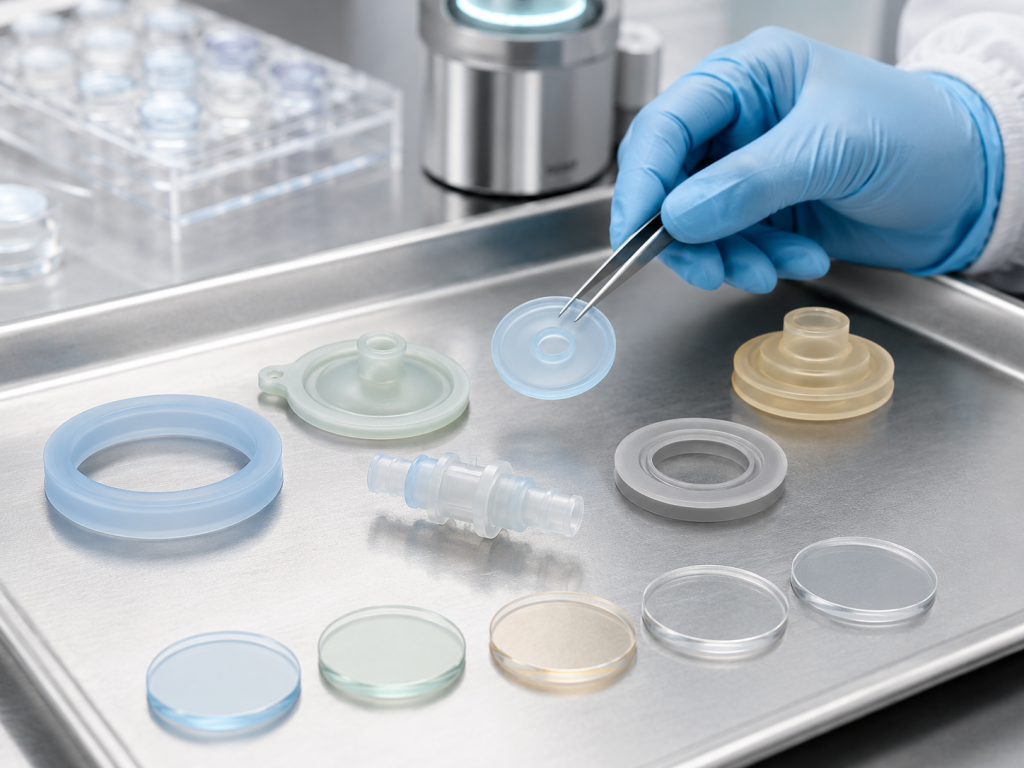
Por que razão a cor é importante nos componentes médicos em LSR
A cor pode parecer um requisito estético, mas pode desempenhar funções importantes num dispositivo médico.
Entre os objetivos comuns contam-se:
- Distinguir os tamanhos dos dispositivos
- Identificar as diferentes versões do produto
- Separação de componentes reutilizáveis e descartáveis
- Indicação dos percursos dos fluidos
- Garantir a montagem correta
- Identificação dos componentes esquerdo e direito
- Diferenciação das configurações de administração de medicamentos
- Melhorar a visibilidade durante a utilização clínica
- Corresponder a uma marca ou família de produtos
- Ocultar componentes internos
- Aumento do contraste para inspeção
- Apoio à conceção da interface do utilizador
Uma discrepância de cor pode, por conseguinte, representar mais do que um simples problema estético. Em algumas aplicações, pode contribuir para erros de montagem, erros na seleção de produtos, problemas de inspeção ou confusão durante a utilização.
A cor exigida deve ser considerada uma característica controlada do produto.
O que é a correspondência de cores do LSR médico?
A correspondência de cores em borracha de silicone líquida (LSR) para aplicações médicas é o processo de criar e controlar uma cor específica numa formulação de borracha de silicone líquida destinada a um componente para cuidados de saúde.
O sistema de cores inclui normalmente:
- O LSR de base aprovado
- Um ou mais pigmentos
- Um veículo compatível com silicone
- Uma concentração definida de pigmento
- Um método de dosagem controlada
- Condições de moldagem aprovadas
- Condições de pós-cura aprovadas
- Exposição definida à esterilização
- Um padrão físico de cor
- Limites de cor instrumental
- Critérios de aceitação visual
A alteração de qualquer um destes elementos pode afetar o resultado final.
Um pigmento que produz a cor correta num determinado tipo de LSR pode gerar um aspeto diferente noutro tipo, uma vez que os materiais de base podem diferir em termos de transparência, teor de enchimento, comportamento refrativo, química de cura e cor natural.
Comece pela aplicação médica pretendida
A escolha da cor deve partir da finalidade do dispositivo acabado, e não apenas da sua aparência.
Entre as questões importantes contam-se:
- O componente colorido entra em contacto com o doente?
- O contacto é direto ou indireto?
- Com que tecido ou fluido entra em contacto?
- Quanto tempo dura o contacto?
- A peça é utilizada no interior ou no exterior?
- É reutilizável ou de uso único?
- Será fornecido esterilizado?
- Que método de esterilização será utilizado?
- Vai entrar em contacto com medicamentos ou com fluidos de processo?
- Que mercados regulamentados irão receber o dispositivo?
- A cor é utilizada para transmitir informações de segurança?
- Uma alteração de cor pode afetar o funcionamento ou a inspeção do dispositivo?
O atual quadro normativo da norma ISO 10993-1:2025 avalia a segurança biológica no âmbito de um processo de gestão de riscos e tem em conta o dispositivo na sua totalidade, os seus materiais, o seu fabrico e o contacto previsto com o doente.
Quanto mais críticos forem o contacto com o doente e a função clínica, tanto mais cuidadosamente devem ser controlados o sistema de pigmentação e o processo de fabrico.
“Pigmento de qualidade médica” não constitui uma aprovação total
O termo “pigmento de qualidade médica” pode referir-se a um corante desenvolvido com base em documentação médica ou em ensaios biológicos, mas isso não significa que o componente colorido final seja automaticamente aprovado para todas as utilizações médicas.
A adequação depende de:
- Identidade exata do pigmento
- Concentração de pigmento
- Composição do portador
- LSR de base
- Processo de fabrico
- Categoria de contacto com o doente
- Duração do contacto
- Processo de esterilização
- Embalagem
- Mercado-alvo
- Avaliação biológica do dispositivo final
A FDA define a biocompatibilidade em relação a uma resposta adequada do hospedeiro numa aplicação específica. Isto significa que um material ou pigmento não pode ser descrito como universalmente biocompatível sem ter em conta a sua utilização efetiva.
A documentação do fornecedor pode servir de apoio à avaliação, mas o fabricante do dispositivo continua a ser responsável pela segurança e pela conformidade regulamentar do produto acabado.
Compreender o Sistema de Cores Completo
Um sistema de coloração à base de silicone médico não é composto apenas por pigmentos.
Pode conter:
- Pigmento orgânico ou inorgânico
- Suporte de silicone
- Polímero de silicone reativo
- Aditivos de dispersão
- Auxiliares de processamento
- Componentes estabilizadores
- Vários pigmentos misturados para criar uma tonalidade
As pastas de cor de silicone disponíveis no mercado podem utilizar pigmentos dispersos em polímeros de silicone reativos, de modo a que o veículo seja compatível com a matriz de silicone.
No caso de projetos médicos, as equipas de aquisições devem solicitar informações sobre o masterbatch completo — e não apenas o nome da cor.
Por que razão se preferem os corantes de silicone pré-dispersos
A adição direta de pigmento em pó seco ao LSR pode causar problemas de manuseamento, contaminação, dispersão e repetibilidade.
Uma pasta de cor de silicone pré-dispersa ou um masterbatch pode proporcionar:
- Distribuição mais uniforme do pigmento
- Dosagem automatizada mais fácil
- Redução do pó em suspensão no ar
- Menor risco de contaminação
- Melhor repetibilidade da cor
- Preparação mais rápida do material
- Melhoria da rastreabilidade
- Um controlo da produção mais estável
Estão disponíveis no mercado dispersões de corantes de silicone específicas para o setor da saúde, tanto para aplicações em LSR como em HCR, incluindo sistemas que cumprem os requisitos da Classe VI da USP e dispõem de documentação relativa ao setor da saúde.
No entanto, a documentação relativa ao corante deve ser analisada em conjunto com a documentação relativa ao LSR de base e ao componente final.
Fatores de seleção de pigmentos
O pigmento deve cumprir tanto os requisitos visuais como os técnicos.
Entre as propriedades importantes contam-se:
- Intensidade da cor
- Qualidade da dispersão
- Estabilidade térmica
- Resistência à luz
- Resistência química
- Estabilidade à esterilização
- Resistência ao desbotamento
- Resistência à migração
- Perfil de heavy metal
- Documentação biológica
- Perfil de substâncias extraíveis
- Compatibilidade com LSR vulcanizado com platina
- Consistência entre lotes
- Disponibilidade sujeita a controlo de alterações
Uma cor viva não é, por si só, adequada para um produto médico.
Alguns pigmentos que proporcionam uma excelente intensidade visual podem não dispor da documentação necessária, da estabilidade à esterilização ou da resistência química exigidas.
Pigmentos orgânicos e inorgânicos
Nos sistemas de coloração à base de silicone, podem ser utilizados tanto pigmentos orgânicos como inorgânicos.
Pigmentos orgânicos
Os pigmentos orgânicos podem proporcionar:
- Tons vivos
- Elevada intensidade de cor
- Uma vasta gama de cores
- Boa transparência em determinadas formulações
As possíveis preocupações podem incluir:
- Estabilidade térmica
- Resistência à luz
- Resistência química
- Alterações de cor induzidas pela radiação
- Consistência entre lotes
- Documentação regulamentar
Pigmentos inorgânicos
Os pigmentos inorgânicos podem proporcionar:
- Elevada estabilidade térmica
- Boa opacidade
- Cores sóbrias em tons terra ou neutras
- Forte resistência a determinados ambientes
As possíveis preocupações podem incluir:
- Composição de metais pesados
- Reduzir o brilho das cores
- Translucência reduzida
- Comportamento de sedimentação ou dispersão
- Gama limitada de tonalidades
O tipo de pigmento adequado depende da cor pretendida, dos requisitos do dispositivo, das condições de processamento e da avaliação regulamentar.
Considerações da FDA sobre os aditivos de cor para dispositivos médicos
Nos Estados Unidos, os corantes utilizados em determinados dispositivos médicos podem estar sujeitos às disposições da FDA relativas aos corantes. A FDA afirma que a utilização permitida depende da lista aplicável e da finalidade pretendida do dispositivo.
Um aditivo de cor autorizado para uma determinada utilização não deve ser automaticamente considerado aceitável para:
- A zona dos olhos
- Aplicações injetáveis
- Suturas cirúrgicas
- Contacto a longo prazo com os doentes
- Dispositivos implantáveis
- Outra categoria de contactos
A FDA mantém listas e restrições específicas de utilização para cada corante alimentar.
A equipa de regulamentação deve analisar a identidade exata do pigmento, a utilização prevista, a concentração, o contacto com o doente e os requisitos de mercado aplicáveis antes de aprovar a formulação da cor.
Avaliação biológica do LSR colorido
Adding a pigment creates a new material formulation from a risk-management perspective.
The biological evaluation should consider:
- Base silicone composition
- Pigment composition
- Pigment carrier
- Concentração de pigmento
- Auxiliares de processamento
- Pós-cura
- Esterilização
- Limpeza
- Embalagem
- Potential degradation products
- Extractable and leachable substances
ISO 10993-18 provides a framework for identifying and, where necessary, quantifying constituents of a medical device. ISO 10993-17 addresses toxicological risk assessment of identified constituents.
Available supplier information may reduce unnecessary testing, but the information must be relevant to the exact colored, processed, sterilized component.
Natural LSR and Colored LSR Are Not Automatically Equivalent
A natural or translucent LSR may already have biological test information. Adding a colorant can change:
- Chemical composition
- Perfil de substâncias extraíveis
- Aspecto da superfície
- Cure behavior
- Desempenho mecânico
- Sterilization response
- Optical properties
- Inspection capability
The previous biological evaluation may still provide useful supporting information, but the pigment addition should be documented and assessed.
The evaluation should determine whether the existing evidence remains applicable or whether additional chemical characterization, toxicological assessment, or biological testing is required.
Purity Risks in Medical LSR Color Matching
Potential purity risks include:
- Incorrect pigment
- Unapproved carrier material
- Industrial-grade colorant substitution
- Metallic contamination
- Contaminação por poeira
- Cross-contamination from another color
- Residue from mixing equipment
- Cleaning-agent residue
- Uncontrolled mold-release agents
- Recycled or reworked material
- Pigment agglomeration
- Incorrect dosing
- Unapproved supplier changes
A color may visually match the approved standard while still using the wrong chemical formulation.
For medical components, identity and traceability are as important as appearance.
Platinum-Cure Inhibition
Many medical LSR materials use platinum-catalyzed addition curing.
Certain contaminants can interfere with the cure reaction, causing:
- Tacky surfaces
- Incomplete curing
- Soft areas
- Reduced mechanical strength
- Poor dimensional stability
- Weak bonding
- Defeitos superficiais
Potential contamination sources may include unsuitable pigments, sulfur-containing materials, amines, lubricants, cleaning agents, gloves, adhesives, and residues from other rubber-processing operations.
The colorant should be specifically assessed for compatibility with the selected platinum-cured LSR.
Color Concentration
The pigment loading level affects both appearance and material behavior.
Insufficient colorant may produce:
- A shade that is too light
- High translucency
- Poor hiding power
- Strong variation with part thickness
- Visible internal components
- Greater batch-to-batch variation
Excessive colorant may contribute to:
- Darker-than-target color
- Poor dispersion
- Processing instability
- Changes in cure behavior
- Defeitos superficiais
- Increased extractables risk
- Changes in mechanical properties
- Higher material cost
The approved formulation should define the colorant concentration and acceptable dosing tolerance.
Operators should not adjust the shade during production by visually adding more pigment without documented approval.
Translucency and Part Thickness
LSR is frequently translucent, so the apparent color can change with material thickness.
A thin membrane may appear much lighter than a thick seal molded from the same compound.
Color appearance may also be affected by:
- Background color
- Internal components
- Textura da superfície
- Lighting
- Viewing angle
- Part curvature
- Air gaps
- Metal or plastic inserts
Color approval plaques should therefore represent the production part’s thickness, texture, and base material as closely as possible.
A thick, flat laboratory plaque may not accurately predict the appearance of a thin medical valve or transparent overmold.
Define the Color With Instrumental Values
A verbal description such as “medical blue” or “light gray” is not precise enough for production control.
The specification should use a measurable color system.
The CIE Lab* color space defines color through:
- L*: lightness
- a*: red-to-green direction
- b*: yellow-to-blue direction
ISO/CIE 11664-4:2019 defines the CIE 1976 Lab* color space.
Color difference can be evaluated using a defined Delta E method. ISO/CIE 11664-6:2022 specifies the CIEDE2000 color-difference formula.
The purchase specification should state which color-difference formula is required. A limit written only as “Delta E below 1.0” is incomplete unless the method, instrument settings, and measurement conditions are also defined.
What to Include in a Color Specification
A complete color specification may include:
- Target L*, a*, and b* values
- Allowed color difference
- Delta E formula
- Instrument type
- Measurement geometry
- Illuminant
- Observer angle
- Measurement aperture
- Specular-included or specular-excluded mode
- Sample thickness
- Textura da superfície
- Background color
- Number of readings
- Measurement locations
- Conditioning time
- Temperature and humidity
- Pre- or post-sterilization condition
These settings should be consistent between the customer, material supplier, colorant supplier, and molding factory.
Visual Approval Is Still Necessary
Instrumental color values are important, but they may not capture every visually significant difference.
Visual inspection can identify:
- Streaks
- Pigment spots
- Swirl marks
- Uneven dispersion
- Surface haze
- Local discoloration
- Transparency variation
- Contaminação
- Mold-related gloss differences
Visual approval should be performed under controlled lighting rather than beside a window or under mixed factory lighting.
The inspection procedure should define:
- Light source
- Viewing distance
- Viewing angle
- Background
- Inspection time
- Approved reference sample
- Inspector training
- Acceptance criteria
Instrumental measurement and visual evaluation should be used together.
Create a Physical Color Standard
A digital image, computer monitor, or printed Pantone page should not be the final production standard for a translucent silicone component.
The approved standard should ideally be a molded physical sample made with:
- The approved LSR
- The approved pigment system
- The target concentration
- Representative thickness
- Representative mold texture
- Approved curing conditions
- Approved post-curing
- Intended sterilization, when applicable
The standard should be identified, protected from light and contamination, and replaced according to a defined control procedure.
A master standard can be stored under controlled conditions, while working standards are used on the production floor.
Color Matching Development Process
Phase 1: Define the Target
Provide the color supplier with:
- Physical color reference
- Target L*, a*, and b* values
- Intended part thickness
- Textura da superfície
- Required opacity
- Base LSR grade
- Sterilization method
- Categoria de contacto com o doente
- Mercado-alvo
- Required documentation
Phase 2: Develop Laboratory Samples
Prepare several candidate shades using the approved base silicone.
Record:
- Pigment identities
- Mixing ratios
- Total loading
- Mixing method
- Condições de cura
- Sample thickness
- Color measurements
- Visual observations
Phase 3: Mold Production-Representative Samples
Laboratory mixing may not reproduce production appearance.
Samples should be molded using representative:
- Metering equipment
- Color dosing
- Mixer
- Temperatura do molde
- Tempo de cura
- Injection settings
- Tool surface
- Part thickness
- Post-curing conditions
Phase 4: Evaluate Functional Properties
Check whether the color system affects:
- Dureza
- Resistência à tração
- Alongamento
- Resistência ao rasgo
- Deformação permanente por compressão
- Valve performance
- Força de vedação
- Bonding
- Surface friction
- Optical inspection
- Dimensões
Phase 5: Apply Sterilization and Aging
Evaluate samples before and after:
- Ethylene oxide exposure
- Esterilização a vapor
- Gamma irradiation
- Electron-beam irradiation
- X-ray sterilization
- Vaporized hydrogen peroxide
- Accelerated aging
- Real-time aging
- Repeated cleaning or disinfection
The relevant methods depend on the finished device.
Certain medical LSR grades are marketed with compatibility data for steam, gamma, electron beam, and ethylene oxide sterilization, but performance remains grade- and application-specific.
Phase 6: Freeze the Formulation
After approval, lock:
- Base LSR grade
- Pigment grades
- Pigment suppliers
- Carrier
- Mixing ratio
- Color concentration
- Processing conditions
- Pós-cura
- Sterilization condition
- Inspection limits
The final formulation should receive a unique internal material code.
Sterilization-Related Color Change
Sterilization can affect the appearance of colored silicone.
Potential changes include:
- Amarelecimento
- Darkening
- Fading
- Loss of translucency
- Increased haze
- Shift in red, green, blue, or yellow tone
- Different color response after aging
The amount of change can depend on:
- LSR formulation
- Pigment chemistry
- Concentração de pigmento
- Sterilization method
- Radiation dose
- Steam temperature
- Number of cycles
- Oxygen exposure
- Embalagem
- Time after sterilization
- Condições de armazenamento
A color system should not be approved based only on unsterilized samples when the final product is supplied sterile.
Ethylene Oxide Validation
ISO 11135 specifies requirements for developing, validating, and routinely controlling ethylene oxide sterilization processes for medical devices.
For color validation, evaluate samples:
- Before EO exposure
- Immediately after aeration
- After a defined stabilization period
- After accelerated aging
- At the end of shelf life, where required
The acceptance criteria should distinguish between an acceptable predictable shift and an uncontrolled change.
Radiation Validation
Radiation testing should include the minimum and maximum expected dose rather than only the nominal dose.
Consider:
- Gamma radiation
- Electron beam
- X-ray
- Multiple exposures
- Dose mapping
- Post-irradiation aging
- Packaging atmosphere
The color may continue changing after radiation exposure, so measurement timing should be standardized.
Mechanical properties and color appearance should be evaluated separately. A component can remain mechanically functional while experiencing an unacceptable visual change.
Steam-Sterilization Validation
Reusable medical devices may undergo repeated steam cycles.
Evaluate color after:
- One cycle
- The expected routine number of cycles
- The maximum claimed number of cycles
- Drying
- Storage after cycling
Repeated heat and moisture exposure can also affect gloss, transparency, surface deposits, bonding, and dimensional stability.
Color Dosing and Mixing
LSR is commonly supplied as two components that are metered and mixed before injection.
The colorant may be introduced through a controlled dosing system.
Important process variables include:
- Dosing ratio
- Pump calibration
- Colorant viscosity
- Temperatura do material
- Mixing efficiency
- Mixer design
- Line pressure
- Startup purge
- Material residence time
- Color-change procedure
Insufficient mixing can produce streaks and local shade variation.
Excessive material residence time may create processing instability or cured deposits inside the system.
Preventing Cross-Contamination
Medical LSR color changes require controlled cleaning.
Residual pigment may remain in:
- Dosing pumps
- Hoses
- Static mixers
- Injection units
- Valves
- Mold runners
- Tool vents
- Material containers
- Handling equipment
A light color produced after a dark color is particularly sensitive to contamination.
The manufacturer should define:
- Production sequence
- Purge quantity
- Cleaning method
- Line-clearance inspection
- First-piece approval
- Acceptable transition scrap
- Equipment-dedication requirements
For highly sensitive applications, dedicated color equipment may be appropriate.
Mold Surface and Gloss
The same silicone formulation can appear different when molded against different tool finishes.
A polished surface may look:
- Darker
- More saturated
- More transparent
- Glossier
A textured surface may look:
- Lighter
- More diffuse
- Less transparent
- Lower in gloss
Color plaques should use the same or a representative mold finish.
Tool maintenance can also change surface appearance over time, so gloss and texture should be monitored where they are critical.
Post-Curing Effects
Post-curing may be used to reduce selected volatile residues or stabilize material properties.
It may also affect:
- Cor
- Transparência
- Odor
- Aspecto da superfície
- Mechanical properties
The approved color should be evaluated after the complete post-curing cycle.
Post-curing variables should include:
- Temperature
- Time
- Air circulation
- Oven loading
- Part arrangement
- Cooling method
- Delay before measurement
Changing the post-curing cycle can invalidate the approved color result.
Production Color-Control Plan
A practical production plan may include:
Incoming Inspection
Verify:
- Base LSR identity
- Base LSR lot
- Pigment identity
- Pigment lot
- Certificate of analysis
- Shelf life
- Storage condition
- Packaging integrity
- Approved supplier status
Startup Approval
Check:
- Correct material code
- Dosing-system setup
- Mixing ratio
- Purge completion
- Temperatura do molde
- Tempo de cura
- First-piece color
- Defeitos superficiais
In-Process Inspection
Monitor:
- L*, a*, and b* values
- Delta E
- Streaks
- Pigment spots
- Contaminação
- Gloss
- Transparência
- Part thickness
- Dosing alarms
- Parâmetros do processo
Inspeção Final
Confirm:
- Color compliance
- Visual appearance
- Dimensões
- Functional properties
- Lot traceability
- Embalagem
- Required documentation
Sampling Frequency
Color variation can occur during startup, material changes, pigment-lot changes, and process interruptions.
Sampling should therefore consider:
- Beginning of batch
- Middle of batch
- End of batch
- Each cavity
- Each pigment lot
- Each LSR lot
- Equipment restart
- Extended shutdown
- Process adjustment
- Mold maintenance
A single first-piece measurement may not adequately represent a long production run.
Cavity-to-Cavity Variation
In multi-cavity molds, apparent color can differ because of:
- Thickness differences
- Temperature variation
- Fill pattern
- Cure variation
- Desabafo
- Mold texture
- Dimensional variation
Color qualification should include all cavities.
When possible, each cavity should be traceable so recurring differences can be investigated.
Documentation to Request
The pigment or masterbatch supplier may be asked to provide:
- Technical data sheet
- Safety data sheet
- Certificate of analysis
- Pigment identity information
- Carrier information
- Biological test summary
- USP Class VI information
- Regulatory statements
- Heavy-metal declaration
- Restricted-substance declaration
- Sterilization information
- Lightfastness data
- Heat-stability data
- Chemical-resistance information
- Shelf life
- Condições de armazenamento
- Change-notification policy
- Lot-traceability information
The exact documentation depends on the device and regulatory market.
Quality-System Controls
ISO 13485:2016 specifies quality-management-system requirements intended for organizations involved in medical-device design and manufacturing.
Relevant controls for medical LSR color production include:
- Approved suppliers
- Documented formulations
- Incoming-material control
- Equipment calibration
- Validação do processo
- Lot traceability
- Nonconforming-material control
- Controlo de alterações
- Record retention
- Corrective action
- Complaint investigation
A quality-system certificate supports supplier qualification but does not approve a specific pigment or molded component.
Change Control
Color systems are highly sensitive to changes.
The supplier should notify the customer before changing:
- Pigment manufacturer
- Pigment chemistry
- Pigment manufacturing site
- Composição do portador
- Colorant formulation
- Base LSR grade
- Base LSR supplier
- LSR manufacturing site
- Dosing equipment
- Equipamento de mistura
- Mold location
- Mold surface
- Post-curing process
- Cleaning agents
- Sterilization method
- Packaging materials
A change should be assessed for potential impact on:
- Cor
- Biological safety
- Chemical characterization
- Mechanical properties
- Estabilidade à esterilização
- Regulatory submissions
- Shelf life
Recommended Validation Matrix
A robust validation plan may compare:
- Minimum pigment concentration
- Nominal pigment concentration
- Maximum pigment concentration
- Multiple pigment lots
- Multiple LSR lots
- Minimum cure temperature
- Nominal cure temperature
- Maximum cure temperature
- Minimum cure time
- Maximum cure time
- Each mold cavity
- Before post-curing
- After post-curing
- Before sterilization
- After maximum sterilization exposure
- After accelerated aging
- After chemical exposure
The objective is to demonstrate that the color remains acceptable throughout the validated manufacturing and use conditions.
Common Color-Matching Problems
The Part Is Too Light
Possible causes include:
- Low colorant concentration
- Thin wall
- Incorrect background
- Poor dosing
- Excessive translucency
- Wrong base LSR
- Incomplete mixing
The Part Is Too Dark
Possible causes include:
- Excess colorant
- Thick wall
- Incorrect pigment
- Longer cure exposure
- Surface gloss difference
- Contamination from a darker color
The Color Is Uneven
Possible causes include:
- Poor mixing
- Pigment agglomeration
- Dosing instability
- Flow-related variation
- Temperature imbalance
- Incomplete purging
- Contaminação
The Color Changes After Sterilization
Possible causes include:
- Pigment instability
- Base LSR response
- Excess radiation dose
- Repeated steam exposure
- Packaging interaction
- Post-sterilization oxidation
- Measurement performed too soon
Instrumental Results Pass but the Part Looks Wrong
Possible causes include:
- Gloss difference
- Texture difference
- Metamerism
- Local streaks
- Transparency variation
- Thickness variation
- Measurement location
- Background difference
The First Batch Passes but Later Batches Fail
Possible causes include:
- Pigment lot variation
- LSR lot variation
- Pump drift
- Equipment wear
- Mold-temperature change
- Purging inconsistency
- Supplier formulation change
- Reference-standard aging
Information to Include in an RFQ
To request a quotation for a colored medical LSR component, provide:
- Two-dimensional drawing
- Three-dimensional model
- Exact base LSR requirement
- Categoria de contacto com o doente
- Duração do contacto
- Target regulatory markets
- Physical color reference
- Target L*, a*, and b* values
- Required Delta E method and limit
- Part thickness
- Textura da superfície
- Transparency or opacity requirement
- Sterilization method
- Maximum sterilization exposure
- Post-curing requirement
- Biological evaluation requirements
- Colorant documentation requirements
- Mechanical-property requirements
- Annual quantity
- Prototype quantity
- Cleanroom requirements
- Traceability requirements
- Requisitos de embalagem
- Change-notification requirements
Do not request only “medical blue silicone.” The supplier needs measurable color, application, processing, and regulatory requirements.
Supplier Qualification Questions
Ask the LSR molding supplier:
- Which healthcare colorant systems do you use?
- Are pigments pre-dispersed in a silicone-compatible carrier?
- Can the pigment lot be traced to each production batch?
- Is the color dosing system calibrated?
- How is dosing accuracy monitored?
- How are color changes cleaned and verified?
- Is dedicated equipment available?
- How are reference standards controlled?
- Which color-measurement system is used?
- Are all mold cavities measured?
- Can sterilized samples be evaluated?
- How are pigment changes communicated?
- Can the supplier provide production-equivalent validation samples?
- Are regrind or recycled materials prohibited?
- Can the supplier support chemical and biological documentation?
Conclusão
Medical LSR color matching is a controlled material-development and validation activity—not only a cosmetic adjustment.
A reliable color system requires:
- An approved base LSR
- A controlled healthcare pigment system
- A compatible silicone carrier
- Defined pigment concentration
- Instrumental color specifications
- Physical reference samples
- Controlled molding and post-curing
- Sterilization validation
- Biological and chemical assessment
- Lot traceability
- Supplier change control
The natural and colored versions of an LSR should not automatically be treated as equivalent.
The safest approach is to develop the color using the exact production material, mold representative components, apply the intended post-curing and sterilization processes, and validate both appearance and functional performance under the expected lifecycle conditions.
Perguntas frequentes
Can standard industrial silicone pigment be used in a medical LSR component?
It should not be used without a documented assessment. The pigment, carrier, concentration, patient contact, sterilization method, and applicable regulatory requirements must be reviewed.
Does a USP Class VI pigment make the final component compliant?
No. Supplier testing can support the evaluation, but the finished colored, processed, and sterilized component must be assessed for its intended use.
Should a natural LSR and a colored LSR be considered the same material?
Not automatically. Adding pigment changes the formulation and may affect chemical characterization, biological evaluation, sterilization response, and mechanical properties.
What is the best way to define an LSR color?
Use an approved physical molded sample together with target L*, a*, and b* values, a defined Delta E formula, and controlled measurement conditions.
Why does the same color look different in thin and thick silicone parts?
Translucent silicone allows light to pass through the material. Apparent color therefore changes with thickness, background, surface texture, and internal components.
Should color be measured before or after sterilization?
Both may be required. The final acceptance condition should represent the product as supplied for use, including sterilization and aging when relevant.
Can gamma radiation change the color of medical LSR?
The response depends on the base LSR, pigment, dose, packaging, and post-irradiation aging. The exact colored formulation should be tested at the validated minimum and maximum exposure.
Can the pigment affect LSR curing?
Yes. An incompatible pigment, carrier, or contaminant may interfere with platinum curing. The complete color system should be qualified with the selected LSR.
What causes color streaks in injection-molded LSR?
Common causes include inadequate mixing, unstable pigment dosing, incomplete purging, pigment agglomeration, temperature variation, and contamination from a previous color.
How should pigment substitutions be controlled?
Any change in pigment grade, supplier, carrier, formulation, concentration, or manufacturing site should require documented notification and technical assessment before use.
SEO Information
SEO Title: Medical LSR Color Matching: Pigments, Purity & Validation
Meta Description: Learn how to control medical LSR color matching through healthcare pigments, purity assessment, CIELAB measurement, sterilization testing and production validation.
URL Slug: /medical-lsr-color-matching-pigments-purity-validation/
TAGS: medical LSR color matching,medical silicone pigments,LSR color masterbatch,medical grade silicone colorant,LSR color validation,medical silicone purity,CIELAB silicone color,Delta E color matching,sterilization color change,colored medical silicone,medical LSR molding,healthcare silicone components
 English
  Japanese
  Korean
  German
  French
  Italian
  Spanish
  Dutch
Dutch  Chinese
  Portuguese
  Polish
  Czech
Czech  Hungarian
  Swedish
  Finnish
  Vietnamese
  Thai
Thai  Turkish
  Arabic
  Russian