
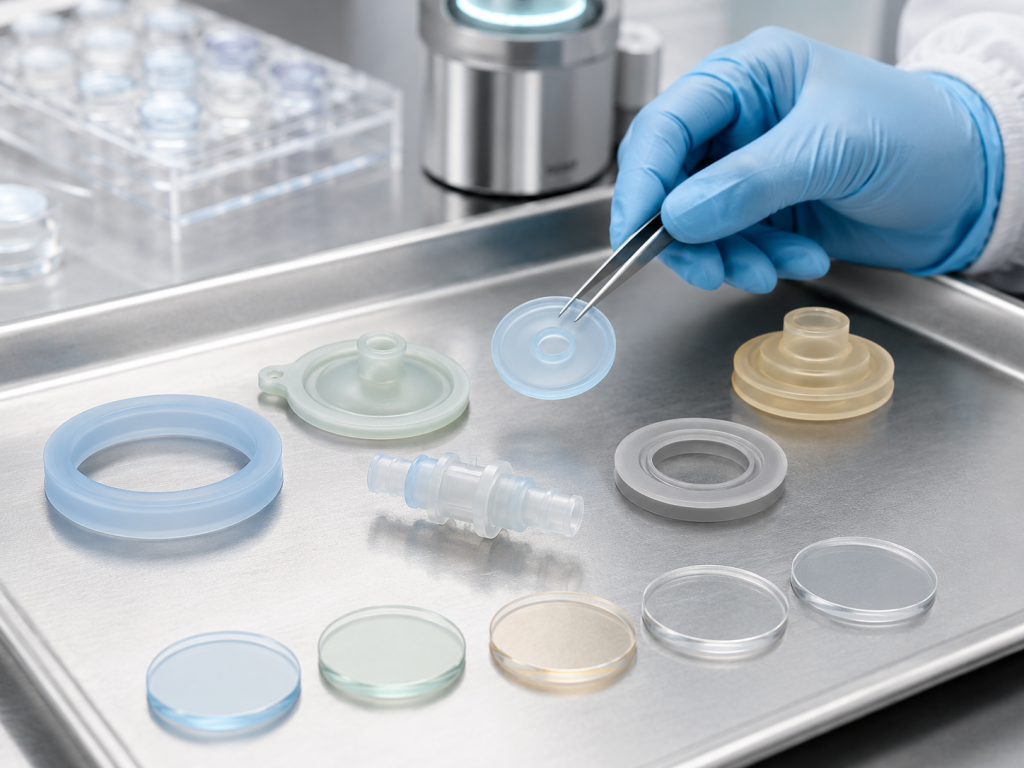
Color matching for medical liquid silicone rubber is more complex than selecting a Pantone number and adding pigment to a standard LSR.
The final appearance of a medical silicone component can be affected by the base LSR, pigment chemistry, pigment concentration, part thickness, translucency, mold finish, curing conditions, post-curing, sterilization, aging, lighting, and measurement method.
Colorants may also change the chemical and biological profile of the material system. A natural LSR and a colored version of the same base silicone should not automatically be treated as equivalent for medical-device evaluation.
For this reason, medical LSR color matching must address three objectives simultaneously:
- Achieving the required visual color
- Maintaining material purity and functional performance
- Establishing documented regulatory and quality controls
This guide explains how medical-device manufacturers and procurement engineers can select pigments, define color specifications, control production, and validate colored LSR components.
Why Color Matters in Medical LSR Components
Color may appear to be a cosmetic requirement, but it can perform important functions in a medical device.
Common purposes include:
- Distinguishing device sizes
- Identifying different product versions
- Separating reusable and disposable components
- Indicating fluid paths
- Supporting correct assembly
- Identifying left and right components
- Differentiating drug-delivery configurations
- Improving visibility during clinical use
- Matching a brand or product family
- Concealing internal components
- Increasing contrast for inspection
- Supporting user-interface design
A color mismatch may therefore create more than an appearance complaint. In some applications, it can contribute to assembly mistakes, product-selection errors, inspection problems, or confusion during use.
The required color should be treated as a controlled product characteristic.
What Is Medical LSR Color Matching?
Medical LSR color matching is the process of creating and controlling a specific color in a liquid silicone rubber formulation intended for a healthcare component.
The color system normally includes:
- The approved base LSR
- One or more pigments
- A silicone-compatible carrier
- A defined pigment concentration
- A controlled dosing method
- Approved molding conditions
- Approved post-curing conditions
- Defined sterilization exposure
- A physical color standard
- Instrumental color limits
- Visual acceptance criteria
Changing any of these elements may affect the final result.
A pigment that produces the correct color in one LSR grade may generate a different appearance in another grade because the base materials can differ in transparency, filler content, refractive behavior, cure chemistry, and natural color.
Start With the Intended Medical Application
Color selection should begin with the finished device’s intended use rather than with appearance alone.
Important questions include:
- Does the colored component contact the patient?
- Is the contact direct or indirect?
- What tissue or fluid does it contact?
- How long does contact last?
- Is the part used internally or externally?
- Is it reusable or single-use?
- Will it be supplied sterile?
- Which sterilization method will be used?
- Will it contact medication or process fluid?
- Which regulatory markets will receive the device?
- Is the color used to communicate safety information?
- Can a color change affect device function or inspection?
The current ISO 10993-1:2025 framework evaluates biological safety within a risk-management process and considers the complete device, its materials, manufacturing, and intended patient contact.
The more critical the patient contact and clinical function, the more carefully the pigment system and manufacturing process should be controlled.
“Medical-Grade Pigment” Is Not a Complete Approval
The term “medical-grade pigment” can describe a colorant developed with healthcare documentation or biological testing, but it does not automatically approve the final colored component for every medical use.
Suitability depends on:
- Exact pigment identity
- Pigment concentration
- Carrier composition
- Base LSR
- Manufacturing process
- Patient-contact category
- Contact duration
- Sterilization process
- Packaging
- Target market
- Final-device biological evaluation
FDA defines biocompatibility in relation to an appropriate host response in a specific application. This means a material or pigment cannot be described as universally biocompatible without considering its actual use.
Supplier documentation can support the evaluation, but the device manufacturer remains responsible for the safety and regulatory suitability of the finished product.
Understanding the Complete Color System
A medical silicone color system is not made from pigment alone.
It may contain:
- Organic or inorganic pigment
- Silicone carrier
- Reactive silicone polymer
- Dispersion aids
- Processing aids
- Stabilizing components
- Multiple pigments blended to create one shade
Commercial silicone color pastes may use pigments dispersed in reactive silicone polymers so that the carrier is compatible with the silicone matrix.
For medical projects, procurement teams should request information about the complete masterbatch—not only the color name.
Why Pre-Dispersed Silicone Colorants Are Preferred
Adding dry pigment powder directly to LSR can create handling, contamination, dispersion, and repeatability problems.
A pre-dispersed silicone color paste or masterbatch can provide:
- More consistent pigment distribution
- Easier automated dosing
- Reduced airborne powder
- Lower contamination risk
- Better color repeatability
- Faster material preparation
- Improved traceability
- More stable production control
Healthcare-specific silicone color dispersions are commercially available for both LSR and HCR applications, including systems supported by USP Class VI information and healthcare documentation.
However, the documentation for the colorant must be reviewed together with the documentation for the base LSR and final component.
Pigment Selection Factors
The pigment must satisfy both visual and technical requirements.
Important properties include:
- Color strength
- Dispersion quality
- Heat stability
- Lightfastness
- Chemical resistance
- Sterilization stability
- Resistance to fading
- Resistance to migration
- Heavy-metal profile
- Biological documentation
- Extractables profile
- Compatibility with platinum-cured LSR
- Lot-to-lot consistency
- Availability under change control
A bright color is not automatically suitable for a medical product.
Some pigments that provide excellent visual intensity may not offer the required documentation, sterilization stability, or chemical resistance.
Organic and Inorganic Pigments
Both organic and inorganic pigments may be used in silicone color systems.
Organic Pigments
Organic pigments can provide:
- Bright shades
- High color strength
- A broad color range
- Good transparency in selected formulations
Potential concerns may include:
- Heat stability
- Lightfastness
- Chemical resistance
- Radiation-induced color changes
- Batch consistency
- Regulatory documentation
Inorganic Pigments
Inorganic pigments may provide:
- High heat stability
- Good opacity
- Stable earth-tone or neutral colors
- Strong resistance to selected environments
Potential concerns may include:
- Heavy-metal composition
- Lower color brightness
- Reduced translucency
- Settling or dispersion behavior
- Limited shade range
The correct pigment type depends on the color target, device requirements, processing conditions, and regulatory assessment.
FDA Considerations for Medical-Device Color Additives
In the United States, color additives used in certain medical devices can be subject to FDA color-additive provisions. FDA states that the permitted use depends on the applicable listing and the intended device application.
A color additive permitted for one use should not automatically be assumed acceptable for:
- The eye area
- Injectable applications
- Surgical sutures
- Long-term patient contact
- Implantable devices
- Another contact category
FDA maintains use-specific listings and restrictions for individual color additives.
The regulatory team should review the exact pigment identity, intended use, concentration, patient contact, and applicable market requirements before approving the color formulation.
Biological Evaluation of Colored LSR
Adding a pigment creates a new material formulation from a risk-management perspective.
The biological evaluation should consider:
- Base silicone composition
- Pigment composition
- Pigment carrier
- Pigment concentration
- Processing aids
- Post-curing
- Sterilization
- Cleaning
- Packaging
- Potential degradation products
- Extractable and leachable substances
ISO 10993-18 provides a framework for identifying and, where necessary, quantifying constituents of a medical device. ISO 10993-17 addresses toxicological risk assessment of identified constituents.
Available supplier information may reduce unnecessary testing, but the information must be relevant to the exact colored, processed, sterilized component.
Natural LSR and Colored LSR Are Not Automatically Equivalent
A natural or translucent LSR may already have biological test information. Adding a colorant can change:
- Chemical composition
- Extractables profile
- Surface appearance
- Cure behavior
- Mechanical performance
- Sterilization response
- Optical properties
- Inspection capability
The previous biological evaluation may still provide useful supporting information, but the pigment addition should be documented and assessed.
The evaluation should determine whether the existing evidence remains applicable or whether additional chemical characterization, toxicological assessment, or biological testing is required.
Purity Risks in Medical LSR Color Matching
Potential purity risks include:
- Incorrect pigment
- Unapproved carrier material
- Industrial-grade colorant substitution
- Metallic contamination
- Dust contamination
- Cross-contamination from another color
- Residue from mixing equipment
- Cleaning-agent residue
- Uncontrolled mold-release agents
- Recycled or reworked material
- Pigment agglomeration
- Incorrect dosing
- Unapproved supplier changes
A color may visually match the approved standard while still using the wrong chemical formulation.
For medical components, identity and traceability are as important as appearance.
Platinum-Cure Inhibition
Many medical LSR materials use platinum-catalyzed addition curing.
Certain contaminants can interfere with the cure reaction, causing:
- Tacky surfaces
- Incomplete curing
- Soft areas
- Reduced mechanical strength
- Poor dimensional stability
- Weak bonding
- Surface defects
Potential contamination sources may include unsuitable pigments, sulfur-containing materials, amines, lubricants, cleaning agents, gloves, adhesives, and residues from other rubber-processing operations.
The colorant should be specifically assessed for compatibility with the selected platinum-cured LSR.
Color Concentration
The pigment loading level affects both appearance and material behavior.
Insufficient colorant may produce:
- A shade that is too light
- High translucency
- Poor hiding power
- Strong variation with part thickness
- Visible internal components
- Greater batch-to-batch variation
Excessive colorant may contribute to:
- Darker-than-target color
- Poor dispersion
- Processing instability
- Changes in cure behavior
- Surface defects
- Increased extractables risk
- Changes in mechanical properties
- Higher material cost
The approved formulation should define the colorant concentration and acceptable dosing tolerance.
Operators should not adjust the shade during production by visually adding more pigment without documented approval.
Translucency and Part Thickness
LSR is frequently translucent, so the apparent color can change with material thickness.
A thin membrane may appear much lighter than a thick seal molded from the same compound.
Color appearance may also be affected by:
- Background color
- Internal components
- Surface texture
- Lighting
- Viewing angle
- Part curvature
- Air gaps
- Metal or plastic inserts
Color approval plaques should therefore represent the production part’s thickness, texture, and base material as closely as possible.
A thick, flat laboratory plaque may not accurately predict the appearance of a thin medical valve or transparent overmold.
Define the Color With Instrumental Values
A verbal description such as “medical blue” or “light gray” is not precise enough for production control.
The specification should use a measurable color system.
The CIE Lab* color space defines color through:
- L*: lightness
- a*: red-to-green direction
- b*: yellow-to-blue direction
ISO/CIE 11664-4:2019 defines the CIE 1976 Lab* color space.
Color difference can be evaluated using a defined Delta E method. ISO/CIE 11664-6:2022 specifies the CIEDE2000 color-difference formula.
The purchase specification should state which color-difference formula is required. A limit written only as “Delta E below 1.0” is incomplete unless the method, instrument settings, and measurement conditions are also defined.
What to Include in a Color Specification
A complete color specification may include:
- Target L*, a*, and b* values
- Allowed color difference
- Delta E formula
- Instrument type
- Measurement geometry
- Illuminant
- Observer angle
- Measurement aperture
- Specular-included or specular-excluded mode
- Sample thickness
- Surface texture
- Background color
- Number of readings
- Measurement locations
- Conditioning time
- Temperature and humidity
- Pre- or post-sterilization condition
These settings should be consistent between the customer, material supplier, colorant supplier, and molding factory.
Visual Approval Is Still Necessary
Instrumental color values are important, but they may not capture every visually significant difference.
Visual inspection can identify:
- Streaks
- Pigment spots
- Swirl marks
- Uneven dispersion
- Surface haze
- Local discoloration
- Transparency variation
- Contamination
- Mold-related gloss differences
Visual approval should be performed under controlled lighting rather than beside a window or under mixed factory lighting.
The inspection procedure should define:
- Light source
- Viewing distance
- Viewing angle
- Background
- Inspection time
- Approved reference sample
- Inspector training
- Acceptance criteria
Instrumental measurement and visual evaluation should be used together.
Create a Physical Color Standard
A digital image, computer monitor, or printed Pantone page should not be the final production standard for a translucent silicone component.
The approved standard should ideally be a molded physical sample made with:
- The approved LSR
- The approved pigment system
- The target concentration
- Representative thickness
- Representative mold texture
- Approved curing conditions
- Approved post-curing
- Intended sterilization, when applicable
The standard should be identified, protected from light and contamination, and replaced according to a defined control procedure.
A master standard can be stored under controlled conditions, while working standards are used on the production floor.
Color Matching Development Process
Phase 1: Define the Target
Provide the color supplier with:
- Physical color reference
- Target L*, a*, and b* values
- Intended part thickness
- Surface texture
- Required opacity
- Base LSR grade
- Sterilization method
- Patient-contact category
- Target market
- Required documentation
Phase 2: Develop Laboratory Samples
Prepare several candidate shades using the approved base silicone.
Record:
- Pigment identities
- Mixing ratios
- Total loading
- Mixing method
- Cure conditions
- Sample thickness
- Color measurements
- Visual observations
Phase 3: Mold Production-Representative Samples
Laboratory mixing may not reproduce production appearance.
Samples should be molded using representative:
- Metering equipment
- Color dosing
- Mixer
- Mold temperature
- Cure time
- Injection settings
- Tool surface
- Part thickness
- Post-curing conditions
Phase 4: Evaluate Functional Properties
Check whether the color system affects:
- Hardness
- Tensile strength
- Elongation
- Tear resistance
- Compression set
- Valve performance
- Sealing force
- Bonding
- Surface friction
- Optical inspection
- Dimensions
Phase 5: Apply Sterilization and Aging
Evaluate samples before and after:
- Ethylene oxide exposure
- Steam sterilization
- Gamma irradiation
- Electron-beam irradiation
- X-ray sterilization
- Vaporized hydrogen peroxide
- Accelerated aging
- Real-time aging
- Repeated cleaning or disinfection
The relevant methods depend on the finished device.
Certain medical LSR grades are marketed with compatibility data for steam, gamma, electron beam, and ethylene oxide sterilization, but performance remains grade- and application-specific.
Phase 6: Freeze the Formulation
After approval, lock:
- Base LSR grade
- Pigment grades
- Pigment suppliers
- Carrier
- Mixing ratio
- Color concentration
- Processing conditions
- Post-curing
- Sterilization condition
- Inspection limits
The final formulation should receive a unique internal material code.
Sterilization-Related Color Change
Sterilization can affect the appearance of colored silicone.
Potential changes include:
- Yellowing
- Darkening
- Fading
- Loss of translucency
- Increased haze
- Shift in red, green, blue, or yellow tone
- Different color response after aging
The amount of change can depend on:
- LSR formulation
- Pigment chemistry
- Pigment concentration
- Sterilization method
- Radiation dose
- Steam temperature
- Number of cycles
- Oxygen exposure
- Packaging
- Time after sterilization
- Storage conditions
A color system should not be approved based only on unsterilized samples when the final product is supplied sterile.
Ethylene Oxide Validation
ISO 11135 specifies requirements for developing, validating, and routinely controlling ethylene oxide sterilization processes for medical devices.
For color validation, evaluate samples:
- Before EO exposure
- Immediately after aeration
- After a defined stabilization period
- After accelerated aging
- At the end of shelf life, where required
The acceptance criteria should distinguish between an acceptable predictable shift and an uncontrolled change.
Radiation Validation
Radiation testing should include the minimum and maximum expected dose rather than only the nominal dose.
Consider:
- Gamma radiation
- Electron beam
- X-ray
- Multiple exposures
- Dose mapping
- Post-irradiation aging
- Packaging atmosphere
The color may continue changing after radiation exposure, so measurement timing should be standardized.
Mechanical properties and color appearance should be evaluated separately. A component can remain mechanically functional while experiencing an unacceptable visual change.
Steam-Sterilization Validation
Reusable medical devices may undergo repeated steam cycles.
Evaluate color after:
- One cycle
- The expected routine number of cycles
- The maximum claimed number of cycles
- Drying
- Storage after cycling
Repeated heat and moisture exposure can also affect gloss, transparency, surface deposits, bonding, and dimensional stability.
Color Dosing and Mixing
LSR is commonly supplied as two components that are metered and mixed before injection.
The colorant may be introduced through a controlled dosing system.
Important process variables include:
- Dosing ratio
- Pump calibration
- Colorant viscosity
- Material temperature
- Mixing efficiency
- Mixer design
- Line pressure
- Startup purge
- Material residence time
- Color-change procedure
Insufficient mixing can produce streaks and local shade variation.
Excessive material residence time may create processing instability or cured deposits inside the system.
Preventing Cross-Contamination
Medical LSR color changes require controlled cleaning.
Residual pigment may remain in:
- Dosing pumps
- Hoses
- Static mixers
- Injection units
- Valves
- Mold runners
- Tool vents
- Material containers
- Handling equipment
A light color produced after a dark color is particularly sensitive to contamination.
The manufacturer should define:
- Production sequence
- Purge quantity
- Cleaning method
- Line-clearance inspection
- First-piece approval
- Acceptable transition scrap
- Equipment-dedication requirements
For highly sensitive applications, dedicated color equipment may be appropriate.
Mold Surface and Gloss
The same silicone formulation can appear different when molded against different tool finishes.
A polished surface may look:
- Darker
- More saturated
- More transparent
- Glossier
A textured surface may look:
- Lighter
- More diffuse
- Less transparent
- Lower in gloss
Color plaques should use the same or a representative mold finish.
Tool maintenance can also change surface appearance over time, so gloss and texture should be monitored where they are critical.
Post-Curing Effects
Post-curing may be used to reduce selected volatile residues or stabilize material properties.
It may also affect:
- Color
- Transparency
- Odor
- Surface appearance
- Mechanical properties
The approved color should be evaluated after the complete post-curing cycle.
Post-curing variables should include:
- Temperature
- Time
- Air circulation
- Oven loading
- Part arrangement
- Cooling method
- Delay before measurement
Changing the post-curing cycle can invalidate the approved color result.
Production Color-Control Plan
A practical production plan may include:
Incoming Inspection
Verify:
- Base LSR identity
- Base LSR lot
- Pigment identity
- Pigment lot
- Certificate of analysis
- Shelf life
- Storage condition
- Packaging integrity
- Approved supplier status
Startup Approval
Check:
- Correct material code
- Dosing-system setup
- Mixing ratio
- Purge completion
- Mold temperature
- Cure time
- First-piece color
- Surface defects
In-Process Inspection
Monitor:
- L*, a*, and b* values
- Delta E
- Streaks
- Pigment spots
- Contamination
- Gloss
- Transparency
- Part thickness
- Dosing alarms
- Process parameters
Final Inspection
Confirm:
- Color compliance
- Visual appearance
- Dimensions
- Functional properties
- Lot traceability
- Packaging
- Required documentation
Sampling Frequency
Color variation can occur during startup, material changes, pigment-lot changes, and process interruptions.
Sampling should therefore consider:
- Beginning of batch
- Middle of batch
- End of batch
- Each cavity
- Each pigment lot
- Each LSR lot
- Equipment restart
- Extended shutdown
- Process adjustment
- Mold maintenance
A single first-piece measurement may not adequately represent a long production run.
Cavity-to-Cavity Variation
In multi-cavity molds, apparent color can differ because of:
- Thickness differences
- Temperature variation
- Fill pattern
- Cure variation
- Venting
- Mold texture
- Dimensional variation
Color qualification should include all cavities.
When possible, each cavity should be traceable so recurring differences can be investigated.
Documentation to Request
The pigment or masterbatch supplier may be asked to provide:
- Technical data sheet
- Safety data sheet
- Certificate of analysis
- Pigment identity information
- Carrier information
- Biological test summary
- USP Class VI information
- Regulatory statements
- Heavy-metal declaration
- Restricted-substance declaration
- Sterilization information
- Lightfastness data
- Heat-stability data
- Chemical-resistance information
- Shelf life
- Storage conditions
- Change-notification policy
- Lot-traceability information
The exact documentation depends on the device and regulatory market.
Quality-System Controls
ISO 13485:2016 specifies quality-management-system requirements intended for organizations involved in medical-device design and manufacturing.
Relevant controls for medical LSR color production include:
- Approved suppliers
- Documented formulations
- Incoming-material control
- Equipment calibration
- Process validation
- Lot traceability
- Nonconforming-material control
- Change control
- Record retention
- Corrective action
- Complaint investigation
A quality-system certificate supports supplier qualification but does not approve a specific pigment or molded component.
Change Control
Color systems are highly sensitive to changes.
The supplier should notify the customer before changing:
- Pigment manufacturer
- Pigment chemistry
- Pigment manufacturing site
- Carrier composition
- Colorant formulation
- Base LSR grade
- Base LSR supplier
- LSR manufacturing site
- Dosing equipment
- Mixing equipment
- Mold location
- Mold surface
- Post-curing process
- Cleaning agents
- Sterilization method
- Packaging materials
A change should be assessed for potential impact on:
- Color
- Biological safety
- Chemical characterization
- Mechanical properties
- Sterilization stability
- Regulatory submissions
- Shelf life
Recommended Validation Matrix
A robust validation plan may compare:
- Minimum pigment concentration
- Nominal pigment concentration
- Maximum pigment concentration
- Multiple pigment lots
- Multiple LSR lots
- Minimum cure temperature
- Nominal cure temperature
- Maximum cure temperature
- Minimum cure time
- Maximum cure time
- Each mold cavity
- Before post-curing
- After post-curing
- Before sterilization
- After maximum sterilization exposure
- After accelerated aging
- After chemical exposure
The objective is to demonstrate that the color remains acceptable throughout the validated manufacturing and use conditions.
Common Color-Matching Problems
The Part Is Too Light
Possible causes include:
- Low colorant concentration
- Thin wall
- Incorrect background
- Poor dosing
- Excessive translucency
- Wrong base LSR
- Incomplete mixing
The Part Is Too Dark
Possible causes include:
- Excess colorant
- Thick wall
- Incorrect pigment
- Longer cure exposure
- Surface gloss difference
- Contamination from a darker color
The Color Is Uneven
Possible causes include:
- Poor mixing
- Pigment agglomeration
- Dosing instability
- Flow-related variation
- Temperature imbalance
- Incomplete purging
- Contamination
The Color Changes After Sterilization
Possible causes include:
- Pigment instability
- Base LSR response
- Excess radiation dose
- Repeated steam exposure
- Packaging interaction
- Post-sterilization oxidation
- Measurement performed too soon
Instrumental Results Pass but the Part Looks Wrong
Possible causes include:
- Gloss difference
- Texture difference
- Metamerism
- Local streaks
- Transparency variation
- Thickness variation
- Measurement location
- Background difference
The First Batch Passes but Later Batches Fail
Possible causes include:
- Pigment lot variation
- LSR lot variation
- Pump drift
- Equipment wear
- Mold-temperature change
- Purging inconsistency
- Supplier formulation change
- Reference-standard aging
Information to Include in an RFQ
To request a quotation for a colored medical LSR component, provide:
- Two-dimensional drawing
- Three-dimensional model
- Exact base LSR requirement
- Patient-contact category
- Contact duration
- Target regulatory markets
- Physical color reference
- Target L*, a*, and b* values
- Required Delta E method and limit
- Part thickness
- Surface texture
- Transparency or opacity requirement
- Sterilization method
- Maximum sterilization exposure
- Post-curing requirement
- Biological evaluation requirements
- Colorant documentation requirements
- Mechanical-property requirements
- Annual quantity
- Prototype quantity
- Cleanroom requirements
- Traceability requirements
- Packaging requirements
- Change-notification requirements
Do not request only “medical blue silicone.” The supplier needs measurable color, application, processing, and regulatory requirements.
Supplier Qualification Questions
Ask the LSR molding supplier:
- Which healthcare colorant systems do you use?
- Are pigments pre-dispersed in a silicone-compatible carrier?
- Can the pigment lot be traced to each production batch?
- Is the color dosing system calibrated?
- How is dosing accuracy monitored?
- How are color changes cleaned and verified?
- Is dedicated equipment available?
- How are reference standards controlled?
- Which color-measurement system is used?
- Are all mold cavities measured?
- Can sterilized samples be evaluated?
- How are pigment changes communicated?
- Can the supplier provide production-equivalent validation samples?
- Are regrind or recycled materials prohibited?
- Can the supplier support chemical and biological documentation?
Conclusion
Medical LSR color matching is a controlled material-development and validation activity—not only a cosmetic adjustment.
A reliable color system requires:
- An approved base LSR
- A controlled healthcare pigment system
- A compatible silicone carrier
- Defined pigment concentration
- Instrumental color specifications
- Physical reference samples
- Controlled molding and post-curing
- Sterilization validation
- Biological and chemical assessment
- Lot traceability
- Supplier change control
The natural and colored versions of an LSR should not automatically be treated as equivalent.
The safest approach is to develop the color using the exact production material, mold representative components, apply the intended post-curing and sterilization processes, and validate both appearance and functional performance under the expected lifecycle conditions.
Frequently Asked Questions
Can standard industrial silicone pigment be used in a medical LSR component?
It should not be used without a documented assessment. The pigment, carrier, concentration, patient contact, sterilization method, and applicable regulatory requirements must be reviewed.
Does a USP Class VI pigment make the final component compliant?
No. Supplier testing can support the evaluation, but the finished colored, processed, and sterilized component must be assessed for its intended use.
Should a natural LSR and a colored LSR be considered the same material?
Not automatically. Adding pigment changes the formulation and may affect chemical characterization, biological evaluation, sterilization response, and mechanical properties.
What is the best way to define an LSR color?
Use an approved physical molded sample together with target L*, a*, and b* values, a defined Delta E formula, and controlled measurement conditions.
Why does the same color look different in thin and thick silicone parts?
Translucent silicone allows light to pass through the material. Apparent color therefore changes with thickness, background, surface texture, and internal components.
Should color be measured before or after sterilization?
Both may be required. The final acceptance condition should represent the product as supplied for use, including sterilization and aging when relevant.
Can gamma radiation change the color of medical LSR?
The response depends on the base LSR, pigment, dose, packaging, and post-irradiation aging. The exact colored formulation should be tested at the validated minimum and maximum exposure.
Can the pigment affect LSR curing?
Yes. An incompatible pigment, carrier, or contaminant may interfere with platinum curing. The complete color system should be qualified with the selected LSR.
What causes color streaks in injection-molded LSR?
Common causes include inadequate mixing, unstable pigment dosing, incomplete purging, pigment agglomeration, temperature variation, and contamination from a previous color.
How should pigment substitutions be controlled?
Any change in pigment grade, supplier, carrier, formulation, concentration, or manufacturing site should require documented notification and technical assessment before use.
SEO Information
SEO Title: Medical LSR Color Matching: Pigments, Purity & Validation
Meta Description: Learn how to control medical LSR color matching through healthcare pigments, purity assessment, CIELAB measurement, sterilization testing and production validation.
URL Slug: /medical-lsr-color-matching-pigments-purity-validation/
TAGS: medical LSR color matching,medical silicone pigments,LSR color masterbatch,medical grade silicone colorant,LSR color validation,medical silicone purity,CIELAB silicone color,Delta E color matching,sterilization color change,colored medical silicone,medical LSR molding,healthcare silicone components
 English
  Japanese
  Korean
  German
  French
  Italian
  Spanish
  Dutch
Dutch  Chinese
  Portuguese
  Polish
  Czech
Czech  Hungarian
  Swedish
  Finnish
  Vietnamese
  Thai
Thai  Turkish
  Arabic
  Russian