
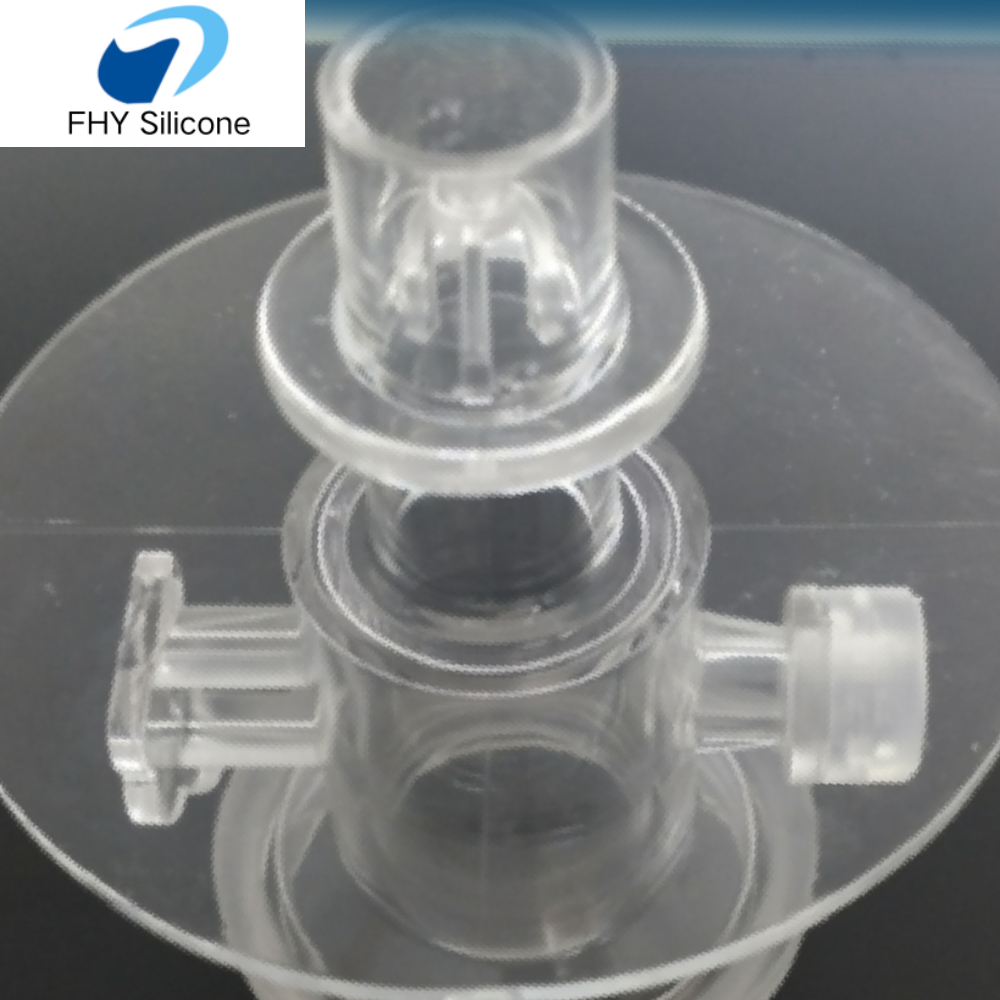
This product is a medical-grade nebulizer cup designed for respiratory and inhalation therapy equipment. It is manufactured using advanced LSR (Liquid Silicone Rubber) overmolding on PC (Polycarbonate) technology, combining rigid structural performance with flexible sealing functionality in a single integrated component.
The design enables high transparency, excellent sealing performance, and long-term durability under repeated sterilization conditions, making it suitable for critical medical respiratory applications.
Key Advantages of LSR Overmolding Technology
Medical Grade Liquid Silicone Rubber (LSR)
The overmolded silicone material is specially formulated for medical applications. It offers excellent biocompatibility and is suitable for inhalation-related environments.
- ISO 10993 biocompatibility compliant
- USP Class VI certified material
- Odorless, non-toxic, and stable under long-term use
- Suitable for direct or indirect patient contact
Superior Sealing Performance
The LSR is permanently bonded to the PC substrate through precision injection molding, forming a seamless sealing interface.
- Eliminates traditional O-rings and manual assembly
- No leakage risk from joint gaps
- Stable sealing under long-term cyclic use
High Temperature and Sterilization Resistance
Designed for repeated medical sterilization processes.
- Steam sterilization resistance: 121°C to 134°C
- Compatible with EO and gamma sterilization
- No deformation, cracking, or discoloration after repeated cycles
High Transparency PC Structure
The PC housing provides excellent optical clarity and mechanical strength.
- Clear visibility of liquid level and flow status
- High impact resistance
- Dimensional stability under thermal stress
Integrated One-Piece Structure
LSR overmolding enables a fully integrated soft-hard design.
- Reduced assembly steps
- Improved production consistency
- Lower risk of human assembly error
- Enhanced product reliability
Manufacturing Process
The product is produced through a precision two-step injection molding process:
- PC Injection Molding
Medical-grade polycarbonate is molded into the structural base, forming the rigid housing and internal flow channels. - LSR Overmolding
Liquid silicone rubber is injected onto the PC substrate, forming soft sealing structures and functional interfaces. - Permanent Bonding Formation
Under controlled temperature and pressure, LSR chemically or mechanically bonds with PC, forming a durable integrated structure.
Technical Specifications
| Item | Description |
|---|---|
| Product Name | LSR Overmolded PC Nebulizer Cup |
| Material System | Liquid Silicone Rubber + Polycarbonate |
| Process | Two-Shot Injection Molding (LSR Over PC) |
| Base Material | Medical Grade PC |
| Overmold Material | Medical Grade LSR |
| Transparency | High optical clarity |
| Temperature Resistance | -40°C to 134°C |
| Sterilization Methods | Autoclave, EO, Gamma |
| Biocompatibility | ISO 10993 / USP Class VI |
| Structure Type | Soft-hard integrated sealing component |
| Reusability | Designed for repeated use |
Applications
- Medical nebulizer systems
- Respiratory therapy devices
- Inhalation drug delivery equipment
- ICU respiratory support systems
- Home healthcare nebulization devices
- Medical gas and fluid control systems
Engineering Challenges and Solutions
LSR to PC Bonding Stability
Silicone rubber has natural chemical inertness, making adhesion to PC challenging. This is solved through:
- Self-bonding medical-grade LSR formulations
- Surface activation or primer treatment on PC
- Controlled mold temperature for optimal chemical bonding
Thermal Processing Balance
PC and LSR have different thermal requirements.
- PC has a limited heat deflection temperature range
- LSR requires high curing temperature for vulcanization
- Requires optimized mold temperature and high-heat PC materials
Precision Flash Control
Due to the very low viscosity of LSR:
- Mold tolerance must be controlled at micron level
- High-precision tooling is required to prevent flash formation
- Critical for medical-grade surface quality
Frequently Asked Questions
What is the benefit of LSR overmolding compared to traditional assembly?
LSR overmolding eliminates separate sealing components such as O-rings, reducing leakage risk and improving long-term stability.
Is the product suitable for repeated sterilization?
Yes, it is designed for repeated autoclave sterilization between 121°C and 134°C without performance degradation.
Does the silicone become hard or degrade over time?
Medical-grade LSR maintains elasticity and mechanical stability under long-term use.
Can the design be customized?
Yes, customization is available for geometry, hardness, color, and sealing structure based on application requirements.
 English
  Japanese
  Korean
  German
  French
  Italian
  Spanish
  Dutch
Dutch  Chinese
  Portuguese
  Polish
  Czech
Czech  Hungarian
  Swedish
  Finnish
  Vietnamese
  Thai
Thai  Turkish
  Arabic
  Russian
Reviews
There are no reviews yet.