
Flüssigsilikonkautschuk ist in vielen verschiedenen Formulierungen erhältlich, die zwar ähnlich erscheinen mögen, sich jedoch in der Produktion und bei der Endanwendung sehr unterschiedlich verhalten.
Zwei LSR-Typen mit derselben Shore-A-Härte können sich in folgenden Punkten unterscheiden:
- Reißfestigkeit
- Dehnung
- Druckverformungsrest
- Transparenz
- Selbstschmierung
- Wärmebeständigkeit
- Chemikalienbeständigkeit
- Haftung auf Kunststoffen oder Metallen
- Unterlagen zur biologischen Unterstützung
- Status hinsichtlich des Kontakts mit Lebensmitteln
- Aushärtungsgeschwindigkeit und Formverhalten
Aus diesem Grund sollte die Auswahl einer LSR-Sorte niemals ausschließlich auf der Grundlage von Härte, Farbe oder Preis erfolgen.
Das geeignete Material muss drei Gruppen von Anforderungen erfüllen:
- Produktleistung: Wie muss sich das fertige Bauteil verhalten?
- Einhaltung von Anwendungsvorschriften: Welche Anforderungen gelten in Bezug auf Kontakt, Sicherheit und Dokumentation?
- Kompatibilität bei der Fertigung: Lässt sich der Werkstoff im Rahmen des vorgesehenen Fertigungsprozesses konsistent in der gewünschten Geometrie formen?
LSR wird in der Regel als Zweikomponentenmaterial geliefert, das während des Spritzgussprozesses dosiert, gemischt und schnell thermisch ausgehärtet wird. Dank seiner Verarbeitungseigenschaften eignet es sich für die automatisierte Fertigung, dünne Wandstärken, komplexe Geometrien und die Serienfertigung. Kommerzielle LSR-Produktportfolios decken Anwendungen in den Bereichen Automobil, Gesundheitswesen, Elektrotechnik, Lebensmittelkontakt sowie allgemeine Konsumgüter ab.
In diesem Leitfaden wird erläutert, wie man einen geeigneten LSR-Typ für Medizinprodukte, Automobilprodukte und Konsumgüter auswählt.
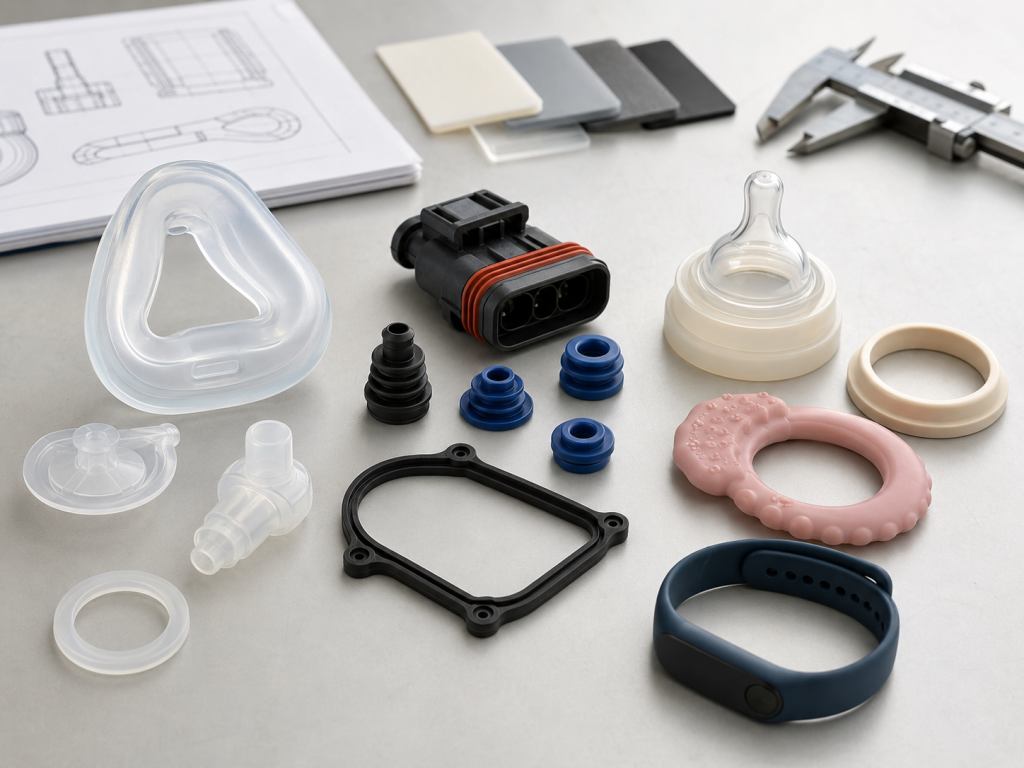
Beginnen Sie mit der Anwendung, nicht mit dem Materialdatenblatt
Ein Werkstoffdatenblatt ist erst dann von Nutzen, wenn die Anwendungsanforderungen definiert wurden.
Bevor Sie die LSR-Qualitätsstufen vergleichen, halten Sie Folgendes fest:
- Vorgesehene Produktfunktion
- Art des Benutzerkontakts
- Kontaktdauer
- Betriebstemperaturbereich
- Kontakt mit Wasser, Ölen, Kraftstoffen oder Reinigungsmitteln
- Erforderliche Flexibilität
- Erforderlicher Dichtungsdruck
- Erwartete Lebensdauer des Produkts
- Anzahl der Kompressions- oder Betätigungszyklen
- Sterilisations- oder Reinigungsverfahren
- Anforderungen an Transparenz und Farbe
- Kunststoff-, Metall- oder Kabeleinsätze
- Produktionsvolumen
- Zielmarkt
- Erforderliche Compliance-Unterlagen
Ein medizinisches Ventil, eine Dichtung für Automobilsteckverbinder und ein Trinkzubehör für Endverbraucher können zwar alle im LSR-Spritzgussverfahren hergestellt werden, sollten jedoch nicht automatisch dieselbe Rezeptur verwenden.
Die gewählte Güteklasse muss dem tatsächlichen Risiko- und Leistungsprofil des Bauteils entsprechen.
Die wichtigsten Auswahlkriterien für LSR verstehen
Shore-A-Härte
Die Härte beeinflusst, wie leicht sich ein LSR-Bauteil unter Druck verformt.
Weichere Sorten können Folgendes bieten:
- Geringere Druckkraft
- Bessere Anpassung an unebene Oberflächen
- Bessere Dämpfung
- Eine weiche Haptik
- Leichtere Verformung bei Ventilen und Membranen
Allerdings können auch sehr weiche Materialien folgende Eigenschaften aufweisen:
- Geringere Dimensionsstabilität
- Erhöhtes Risiko des Abrollens der Dichtung
- Kompliziertere automatisierte Handhabung
- Erhöhte Staubanziehung
- Stärkere Verformung beim Entformen
- Geringerer Extrusionswiderstand
Schwierigere Stufen können Folgendes bieten:
- Stabilere Abmessungen
- Einfachere Handhabung
- Verbesserte Unterstützung für schmale Elemente
- Höhere Verschiebungsfestigkeit
- Ein deutlich spürbares Feedback
Möglicherweise erfordern sie auch eine höhere Montage- oder Betätigungskraft.
Die Härte sollte daher unter Berücksichtigung der Wandstärke, der Dichtungsgeometrie und der zu erwartenden Druckbelastung ausgewählt werden.
Zugfestigkeit und Dehnung
Die Zugfestigkeit gibt an, wie viel Zugspannung das ausgehärtete Material aushalten kann, während die Dehnung beschreibt, wie weit es sich vor dem Bruch dehnen lässt.
Diese Eigenschaften sind wichtig für:
- Dünne Membranen
- Dehnbare Komponenten
- Tragebänder
- Ventilelemente
- Entformen von Teilen mit Hinterschneidungen
- Produkte, die wiederholt gebogen wurden
- Auf starren Elementen montierte Bauteile
Eine hohe Dehnung ist zwar von Vorteil, sollte jedoch nicht als einziges Kriterium herangezogen werden. Ein Material mit hoher Dehnbarkeit kann an einer scharfen Kante oder einer geformten Kerbe dennoch leicht reißen.
Reißfestigkeit
Tear strength is particularly important when a component includes:
- Dünne Dichtlippen
- Slits
- Stellenangebote
- Snap-over assembly features
- Narrow wall sections
- Tiefe Hinterschneidungen
- Repeated bending points
LSR parts often fail from a small cut or edge defect rather than uniform tensile loading.
A product that must be stretched during installation should be designed with rounded transitions and sufficient tear resistance.
Druckverformungsrest
Compression set measures how much permanent deformation remains after an elastomer has been compressed for a defined time and temperature.
It is especially important for:
- Dichtungen für Steckverbinder in der Automobilindustrie
- Randdichtungen
- Medizinische Dichtungen
- Long-term housing seals
- O-Ringe
- Kabelverschraubungen
Low compression set helps a seal retain contact pressure during prolonged use.
Automotive-specific LSR grades may be formulated for low compression set, self-lubrication and resistance to thermal aging. For example, published supplier portfolios identify specialized materials for cable seals, mat seals, grommets and connector gaskets rather than treating general-purpose LSR as interchangeable with automotive sealing grades.
Modul
Modulus describes the resistance of the material to deformation.
Two grades with the same Shore hardness may have different force-deflection behavior.
Modulus affects:
- Valve-opening pressure
- Button-actuation force
- Seal compression
- Diaphragm movement
- Assembly force
- Haptik des Produkts
For functional parts, force testing on the actual geometry is often more useful than relying only on Shore hardness.
Transparenz
Optically clear or translucent LSR may be required for:
- Medical fluid-path components
- Diagnostic products
- Babyartikel
- Lighting parts
- Optical interfaces
- Consumer products where cleanliness must be visible
Transparency can be influenced by:
- Materialzusammensetzung
- Pigmente
- Oberflächenbeschaffenheit der Form
- Wandstärke
- Aushärtungsbedingungen
- Nachhärtung
- Verunreinigung
- Sterilization or aging
A “clear” grade should be evaluated using the intended part thickness and surface finish.
Viskosität und Fließverhalten
Material viscosity affects mold filling.
Lower-viscosity LSR may be advantageous for:
- Thin walls
- Long flow paths
- Small sealing ribs
- Microfeatures
- Mehrfachformen
However, highly fluid LSR can also increase the risk of flash at parting lines and around inserts.
The correct grade must be matched with:
- Gate size
- Runner system
- Anordnung der Kavitäten
- Entlüftung
- Einspritzdruck
- Mold shutoff accuracy
Cure Speed
Fast-curing grades can shorten cycle time and improve production efficiency.
However, very rapid curing may reduce the available filling time for:
- Große Bauteile
- Long flow paths
- Multi-material parts
- Complex insert-molding projects
A material that cures quickly in a simple test mold may behave differently in a large production tool.
Post-Curing Requirements
Some applications or material grades may require post-curing to stabilize properties or reduce certain volatile residues.
Post-curing can affect:
- Abmessungen
- Härte
- Farbe
- Druckverformungsrest
- Volatile content
- Production cost
- Delivery time
The need for post-curing should be established before the quotation because it adds equipment, energy, handling and inspection requirements.
Choosing LSR for Medical Components
Medical LSR selection begins with the intended device use and the nature and duration of patient contact.
FDA’s biological-evaluation framework categorizes contact duration as limited, prolonged or long-term and considers the nature of body contact when identifying relevant biological endpoints. The biological suitability of silicone ultimately has to be assessed for its intended use, and data from the finished device are generally more relevant than data from uncured raw material alone.
Define the Contact Type
Determine whether the finished product contacts:
- Intact skin
- Mucosal membranes
- Compromised surfaces
- Tissue
- Blood
- A fluid path that indirectly contacts the patient
- No patient-contact area
A medical equipment handle touching intact skin is not evaluated in the same way as an implanted component or fluid-delivery valve.
Review Available Biological-Support Information
A candidate medical LSR grade may be supported by:
- Biocompatibility test information
- Chemical-characterization information
- Werkstoffkennzeichnung
- Rückverfolgbarkeit von Chargen
- Processing recommendations
- Supplier change-control policies
Selected commercial LSR grades are marketed for healthcare applications such as valves, IV components, sealing elements, respiratory products and other precision medical components. However, the finished-device manufacturer remains responsible for determining whether the complete product is suitable for its intended use.
The review should confirm:
- The exact grade tested
- Whether the same pigment was included
- The curing and post-curing conditions
- Whether testing represents the final component
- Ob die Daten aktuell bleiben
- Whether additional device-specific evaluation is required
Evaluate Sterilization Compatibility
Medical components may be exposed to:
- Ethylenoxid
- Dampf
- Gammastrahlung
- Elektronenstrahlung
- X-ray processing
- Verdampftes Wasserstoffperoxid
- Repeated disinfection
Sterilization can change:
- Farbe
- Transparenz
- Härte
- Dehnung
- Reißfestigkeit
- Druckverformungsrest
- Oberflächenbeschaffenheit
- Haftfestigkeit
- Extrahierbare Stoffe
Testing should use the intended sterilization process and the maximum expected number of cycles.
Consider Cleanliness and Manufacturing Controls
Medical products may require controls for:
- Cross-contamination
- Rückverfolgbarkeit von Materialien
- Reinheit der Form
- Nachhärtung
- Particle levels
- Handling
- Washing
- Verpackung
- Produktionsaufzeichnungen
- Wesentliche Änderungen
Not every medical-related silicone part requires the same production environment, but the factory controls should be appropriate for the identified risk.
Select Mechanical Properties for the Function
Medical applications may prioritize different properties:
| Medical component | Important LSR characteristics |
|---|---|
| Valve or diaphragm | Controlled modulus, fatigue resistance, consistent dimensions |
| Respiratory mask seal | Softness, tear resistance, skin comfort, low compression set |
| Connector seal | Dimensional stability, sealing performance, traceability |
| Umspritzung von medizinischen Kabeln | Adhesion, flexibility, strain relief and tear resistance |
| Transparent fluid component | Clarity, cleanliness and representative biological evaluation |
| Wearable skin-contact part | Comfort, cleaning resistance and pigmentation control |
“Medical grade” should not replace a detailed mechanical specification.
Choosing LSR for Automotive Components
Automotive LSR parts may be exposed to long-term heat, thermal cycling, vibration, humidity, oils, fuels and continuous compression.
Zu den typischen Anwendungsbereichen gehören:
- Steckverbinder-Dichtungen
- Wire seals
- Mattendichtungen
- Randdichtungen
- Sensordichtungen
- Kabelverschraubungen
- Battery-system seals
- Plastic-and-LSR overmolded housings
Supplier product portfolios include automotive-specific LSR grades for connector seals, radial seals, weather-pack seals, grommets and wire-harness components, including self-lubricating and low-compression-set formulations.
Prioritize Heat-Aging Performance
Do not select an automotive grade using only its short-term maximum temperature.
Request information about:
- Continuous-use temperature
- Heat aging
- Property change after aging
- Compression set at elevated temperature
- Leistung nach Temperaturwechselbeanspruchung
- Compatibility with adjacent thermoplastics
A seal may remain visually intact but lose sufficient recovery force to prevent moisture ingress.
Define Fluid Exposure
Standard dimethyl LSR may be suitable for many electrical and environmental sealing applications, but it is not automatically suitable for continuous exposure to every fuel, oil or solvent.
For aggressive hydrocarbon exposure, fluoro-LSR may be considered. Commercial F-LSR materials are designed to combine silicone-like temperature flexibility with improved resistance to non-polar fuels, oils and solvents.
Material testing should use the actual:
- Fluid
- Konzentration
- Temperatur
- Expositionsdauer
- Mechanical condition
Evaluate Self-Lubricating Grades
Automotive connector seals can generate high friction when wires or terminals are inserted.
A self-lubricating grade may help reduce:
- Einführkraft
- Seal tearing
- Dichtungsverschiebung
- Assembly variation
Published automotive grades include different internal oil levels for connector and radial-sealing applications.
The complete connector should still be evaluated for:
- Lubricant migration
- Staubanziehung
- Contact contamination
- Long-term consistency
- Storage effects
Consider Overmolding Adhesion
Automotive components frequently combine LSR with PBT, polyamide or other engineering thermoplastics.
Self-adhesive LSR can reduce the need for primer and separate assembly, but adhesion is substrate-specific. Dow describes selective-adhesion LSR grades for two-component molding with thermoplastics including PBT and polyamide.
The actual production plastic should be tested because adhesion can be affected by:
- Glass-fiber content
- Pigmente
- Flammschutzmittel
- Mold-release additives
- Feuchtigkeit
- Oberflächenverunreinigung
- Temperatur eingeben
- Storage time
Match Hardness to the Seal Geometry
A softer grade may reduce insertion or compression force, while a harder grade may improve dimensional stability.
The final selection should be verified through:
- Tolerance analysis
- Assembly-force testing
- Dichtheitsprüfung
- Heat aging
- Temperaturwechselbeanspruchung
- Schwingungsprüfung
- Fluid exposure
Choosing LSR for Consumer Products
Consumer LSR applications can include:
- Zubehör für die Babynahrung
- Küchenzubehör
- Drinkware components
- Tragbare Produkte
- Personal-care products
- Sports accessories
- Schutzhüllen
- Dichtungen für Haushaltsgeräte
- Buttons and keypads
- Household products
General-purpose LSR portfolios include grades designed for cooking products, gaskets, seals, sports equipment and other consumer goods.
Confirm the Contact Requirement
Consumer products may require different documentation depending on whether they contact:
- Food
- Drinking water
- Haut
- A child’s mouth
- Elektronik
- Household chemicals
- No regulated contact area
A food-contact statement does not automatically establish suitability for a medical device. Similarly, a general consumer grade should not be presented as suitable for infant feeding without the relevant material and finished-product evaluation.
Balance Softness and Durability
Soft-touch consumer products are often designed using low-hardness LSR, but excessive softness may create:
- Geringe Maßhaltigkeit
- Difficult assembly
- Oberflächenhaftung
- Staubanziehung
- Weak thin sections
- Slow elastic recovery
For teethers, valves, buttons and wearable parts, the final selection should reflect both tactile preference and functional durability.
Evaluate Color and Appearance
Consumer products frequently require customized colors.
The pigment system should be reviewed for:
- Intended contact application
- Farbkonsistenz
- Light stability
- Hitzebeständigkeit
- Migration or extraction requirements
- Effect on transparency
- Effect on curing
Strong colors may require more pigment, which can change appearance and, in some formulations, processing behavior.
Consider Odor and Volatile Requirements
Products used near food, the face or infant-care applications may require strict odor control.
Odor can be influenced by:
- Materialzusammensetzung
- Aushärten
- Nachhärtung
- Lagerung
- Verpackung
- Reinigung
- Verunreinigung
The customer should evaluate finished packaged products rather than only newly molded samples.
Choose for the Actual User Experience
Consumer components may be evaluated through:
- Grip comfort
- Button force
- Oberflächenstruktur
- Flexibilität
- Produktgewicht
- Ease of cleaning
- Stain resistance
- Geruch
- Staubanziehung
- Optisches Erscheinungsbild
A technically acceptable LSR grade can still fail commercially if the finished product feels sticky, attracts dust or is difficult to clean.
Standard, Self-Lubricating, Self-Bonding and Fluoro-LSR Grades
Different LSR families solve different problems.
General-Purpose LSR
Suitable for many basic molded products where special adhesion, fluid resistance or biological documentation is not required.
Zu den typischen Anwendungsbereichen gehören:
- Consumer goods
- Grommets
- Basic seals
- Sports products
- Household components
Medical-Support LSR
Selected for healthcare components requiring controlled formulation, traceability and relevant biological-support information.
The finished medical device still requires a risk-based evaluation.
Self-Lubricating LSR
Designed to develop a lower-friction surface.
Zu den typischen Anwendungsbereichen gehören:
- Steckverbinder-Dichtungen
- Gleitkomponenten
- Medical components requiring low surface friction
- Automated assembly applications
Momentive has described self-lubricating LSR formulations for healthcare applications requiring a high-slip surface.
Self-Bonding LSR
Designed to bond directly to selected plastic or metal substrates during molding.
Zu den typischen Anwendungsbereichen gehören:
- Plastic-LSR housings
- Overmolded medical connectors
- Dichtungen für Steckverbinder in der Automobilindustrie
- Soft-touch consumer assemblies
Compatibility must be verified using the exact substrate.
Fluoro-LSR
Selected where improved resistance to fuels, oils and non-polar solvents is required.
It may be useful in:
- Automotive fluid-exposure components
- Industriedichtungen
- Specialized electrical parts
F-LSR generally costs more than standard LSR, so it should be used where the exposure justifies the additional material cost.
Conductive LSR
Selected for:
- Antistatic components
- EMI shielding
- Leitfähige Dichtungen
- Steuerung des elektrischen Feldes
- Flexible contacts
Electrical resistivity and test conditions must be specified separately from mechanical properties.
Overmolding Requirements
LSR can be molded onto plastic, metal, cable or electronic inserts.
Before selecting an overmolding grade, define:
- Insert material
- Insert geometry
- Bonding requirement
- Mechanical interlocks
- Insert temperature resistance
- Primer or surface-treatment needs
- Peel and pull requirements
- Fluid exposure
- Sterilization or aging conditions
LSR suppliers offer self-bonding grades formulated for selected thermoplastics and metals, but no grade should be assumed to adhere equally to every substrate.
A reliable overmolding evaluation should use:
- Production-grade inserts
- Actual pigments and fillers
- Production-intent mold temperature
- Representative cure time
- Finished-part aging
- Pull, peel or functional testing
Why Datasheet Values May Not Predict Finished-Part Performance
Technical data sheets are useful for comparing candidate materials, but the values are usually generated under defined laboratory conditions.
The finished component may behave differently because of:
- Wandstärke
- Formtemperatur
- Aushärtungszeit
- Standort des Tors
- Flow orientation
- Schweißnähte
- Nachhärtung
- Pigmente
- Demolding strain
- Insert interaction
- Sterilisation
- Environmental aging
For example, a standard compression-set specimen does not reproduce every automotive gasket geometry. A biological test performed on a supplier specimen does not automatically represent a finished colored and sterilized medical component.
Use datasheet values to shortlist materials, then validate the final molded product.
Questions to Ask an LSR Material Supplier
Before approving a grade, request clear answers to the following questions:
- What is the exact grade designation?
- What is the recommended application?
- Which hardness levels are available?
- Ist eine Nachhärtung erforderlich?
- What are the recommended molding conditions?
- What biological-support data are available?
- Is the grade suitable for the intended food-contact market?
- How does it perform after heat aging?
- What compression-set data are available?
- Is it self-lubricating?
- Is it self-bonding?
- Which substrates have been evaluated?
- Is it compatible with the intended sterilization method?
- Is a fluoro-LSR version available?
- What is the supplier’s change-notification policy?
- What shelf life and storage conditions apply?
- Can the material be pigmented?
- Can production-lot traceability be provided?
Questions to Ask an LSR Molding Manufacturer
The molder should also be able to explain:
- Whether the selected grade can fill the proposed geometry
- Whether the mold requires vacuum assistance
- Where gates and parting lines will be located
- What flash limits can be maintained
- Whether delicate features can be demolded without tearing
- How inserts will be positioned
- Whether primer or plasma treatment is required
- How curing and post-curing are controlled
- How critical dimensions will be inspected
- How material and pigment batches are traced
- Whether pilot production can be completed
- Which functional tests can be supported
A material recommendation without a design-for-manufacturing review may overlook significant tooling or production risks.
A Practical LSR Grade Selection Process
Step 1: Define the Product Category
Determine whether the component is medical, automotive, food-contact, skin-contact, electrical or general consumer.
Step 2: Document the Service Environment
Define temperature, fluids, cleaning, sterilization, UV, humidity and expected life.
Step 3: Establish Mechanical Requirements
Specify hardness, compression, tensile strength, tear strength, elongation and fatigue requirements.
Step 4: Identify Special Functions
Confirm whether the project requires:
- Selbstschmierung
- Self-bonding
- Optical clarity
- Conductivity
- Flame resistance
- Fuel resistance
- Geringer Druckverformungsrest
- Medical-support documentation
Step 5: Shortlist Candidate Grades
Compare supplier data and eliminate materials that do not meet the basic application requirements.
Step 6: Review Moldability
Evaluate viscosity, flow length, wall thickness, gates, venting, inserts and demolding.
Step 7: Produce Representative Samples
Use the intended:
- LSR-Typ
- Pigment
- Insert
- Aushärtungsprozess
- Nachhärtungsprozess
Step 8: Test the Finished Component
Perform dimensional, mechanical, functional and contact-related evaluation.
Step 9: Complete Environmental Validation
Test after representative heat, sterilization, fluids, humidity, compression or repeated use.
Step 10: Freeze the Approved Material and Process
Control:
- Material manufacturer
- Exact grade
- Pigment formula
- Supplier
- Mischungsverhältnis
- Cure parameters
- Nachhärtung
- Insert material
- Prüfverfahren
Future substitutions should be reviewed and, where necessary, revalidated.
Quick Comparison by Application
| Selection factor | Medical products | Automotive products | Konsumgüter |
| Primary concern | Biological risk and controlled manufacturing | Long-term sealing and environmental durability | Safety, function, appearance and user experience |
| Key documentation | Biological-support and traceability information | Heat-aging, compression and fluid-resistance data | Relevant food-, skin- or consumer-contact documents |
| Important mechanical properties | Tear strength, modulus, fatigue and cleanliness | Compression set, thermal stability and fluid resistance | Softness, durability, color and surface feel |
| Common special grades | Medical-support, transparent, self-lubricating or self-bonding | Low-compression-set, self-lubricating, self-bonding or F-LSR | General-purpose, food-contact, low-density or colored LSR |
| Typical validation | Finished-device biological and sterilization evaluation | Thermal cycling, leakage, vibration and fluid testing | Cleaning, odor, durability and user-function testing |
| Common error | Treating raw-material data as finished-device approval | Selecting by temperature or hardness alone | Prioritizing softness and color over durability |
Common LSR Selection Mistakes
Choosing Only by Shore Hardness
Hardness does not describe tear strength, compression set, adhesion, lubrication or biological-support documentation.
Using a General-Purpose Grade for Every Application
A material suitable for a kitchen accessory may not be suitable for an automotive fuel seal or medical fluid-path component.
Treating Medical Grade as Finished-Device Approval
The final product, processing residues, pigments, cleaning and sterilization must be considered.
Assuming Standard LSR Resists Every Automotive Fluid
Fuel, oil or solvent exposure may require fluoro-LSR or another specialized elastomer.
Ignoring Post-Curing
Post-curing can affect cost, dimensions, odor and product performance.
Selecting Self-Bonding LSR Without Testing the Substrate
Adhesion depends on the exact plastic formulation and process.
Approving Material from a Flat Test Slab
The final component geometry may produce different tear, compression and optical performance.
Changing Pigments Without Review
Pigments can affect appearance, contact documentation and processing.
Selecting the Cheapest Grade
A less expensive material can create higher costs through longer cycle times, poor yields, flash, tearing or product failure.
Fazit
Choosing the correct LSR grade requires more than selecting a hardness and color.
The decision should consider:
- Produktfunktion
- Kontaktart
- Temperatur
- Exposition gegenüber Chemikalien
- Compression
- Tear and fatigue requirements
- Sterilisation
- Transparenz
- Oberflächenreibung
- Overmolding adhesion
- Regulatory-support information
- Formbarkeit
- Production consistency
Medical products require a risk-based review of the complete finished device and its intended patient contact.
Automotive products typically prioritize low compression set, heat aging, fluid resistance, assembly performance and long-term sealing.
Consumer products require a balance of safety, tactile quality, durability, appearance, cleanliness and manufacturing cost.
The best LSR grade is not the material with the longest datasheet or the lowest unit price. It is the material that provides stable finished-part performance in the actual product, process and service environment.
Early cooperation between the product developer, material supplier, mold maker and LSR molding manufacturer can reduce material substitutions, mold modifications and validation failures before mass production begins.
Häufig gestellte Fragen
Can one LSR grade be used for medical, automotive and consumer products?
A grade may technically work in more than one application, but its documentation, environmental resistance and processing properties must be evaluated for each intended use.
Is a higher-hardness LSR more durable?
Not necessarily. Durability also depends on tear strength, elongation, geometry, aging and loading conditions.
Is medical-grade LSR automatically biocompatible?
No. Supplier data may support the biological evaluation, but the finished device and its intended contact conditions must still be assessed.
Which LSR is best for automotive connector seals?
Automotive connector applications often use low-compression-set and self-lubricating grades. The final choice depends on temperature, seal design, plastic compatibility and assembly force.
When should fluoro-LSR be used?
F-LSR should be considered where improved resistance to non-polar fuels, oils or solvents is required.
Can food-contact LSR be used for baby products?
It may be a suitable starting material, but the final product must also satisfy the relevant market, design and finished-product requirements.
What is self-bonding LSR?
Self-bonding LSR is formulated to adhere directly to selected plastic or metal substrates during molding, potentially eliminating a separate primer or assembly process.
Does self-bonding LSR adhere to every plastic?
No. Adhesion depends on the exact resin, additives, fillers, surface condition and molding process.
Is post-curing always required?
No. The requirement depends on the material grade, intended application and performance or contact requirements.
What information is needed for an LSR quotation?
Provide the 2D and 3D drawings, intended application, contact type, temperature, fluid exposure, hardness, color, insert material, annual quantity, compliance needs and required tests.
 English
  Japanese
  Korean
  German
  French
  Italian
  Spanish
  Dutch
Dutch  Chinese
  Portuguese
  Polish
  Czech
Czech  Hungarian
  Swedish
  Finnish
  Vietnamese
  Thai
Thai  Turkish
  Arabic
  Russian