
Cao su silicone lỏng có nhiều công thức khác nhau, trông có vẻ giống nhau nhưng lại cho hiệu quả rất khác nhau trong quá trình sản xuất và khi sử dụng thực tế.
Hai loại LSR có cùng độ cứng Shore A có thể khác nhau ở:
- Độ bền kéo
- Độ giãn dài
- Độ biến dạng vĩnh viễn do nén
- Tính minh bạch
- Tự bôi trơn
- Khả năng chịu lão hóa do nhiệt
- Khả năng chịu hóa chất
- Khả năng bám dính trên nhựa hoặc kim loại
- Tài liệu hỗ trợ về sinh học
- Tình trạng tiếp xúc với thực phẩm
- Tốc độ đóng rắn và tính chất đúc
Vì lý do này, việc lựa chọn loại LSR không bao giờ nên chỉ dựa vào độ cứng, màu sắc hay giá cả.
Vật liệu phù hợp phải đáp ứng ba nhóm yêu cầu sau:
- Hiệu suất sản phẩm: Thành phần đã hoàn thiện phải hoạt động như thế nào?
- Tuân thủ ứng dụng: Các yêu cầu về liên lạc, an toàn và hồ sơ nào được áp dụng?
- Khả năng tương thích trong sản xuất: Liệu loại vật liệu này có thể được đúc một cách nhất quán theo hình dạng dự kiến và quy trình sản xuất hay không?
LSR thường được cung cấp dưới dạng vật liệu hai thành phần, được định lượng, trộn đều và đóng rắn nhanh bằng nhiệt trong quá trình ép phun. Các đặc tính gia công của vật liệu này khiến nó phù hợp với sản xuất tự động, các chi tiết có thành mỏng, hình dạng phức tạp và sản xuất hàng loạt. Danh mục sản phẩm LSR thương mại bao gồm các ứng dụng trong lĩnh vực ô tô, y tế, điện tử, tiếp xúc với thực phẩm và các sản phẩm tiêu dùng nói chung.
Hướng dẫn này giải thích cách lựa chọn loại LSR phù hợp cho các sản phẩm y tế, ô tô và hàng tiêu dùng.
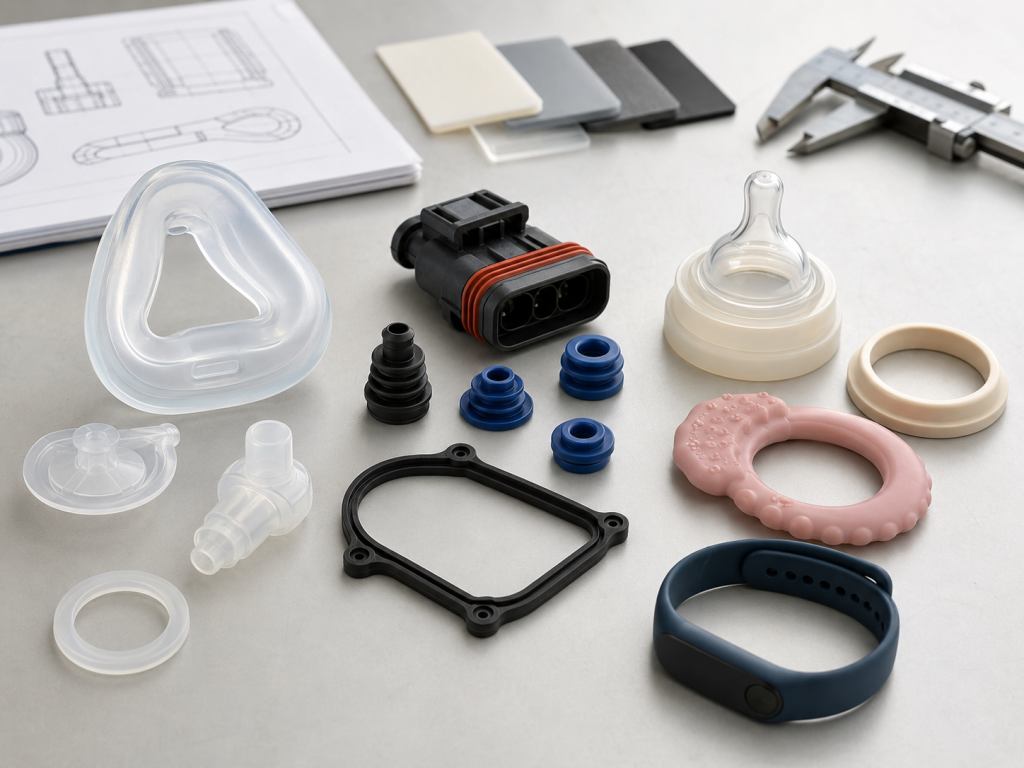
Hãy bắt đầu từ ứng dụng, chứ không phải từ bảng thông số kỹ thuật vật liệu
Bảng thông số kỹ thuật vật liệu chỉ thực sự hữu ích sau khi các yêu cầu ứng dụng đã được xác định.
Trước khi so sánh các cấp độ LSR, hãy ghi chép lại:
- Chức năng dự kiến của sản phẩm
- Loại hình liên hệ với người dùng
- Thời gian tiếp xúc
- Phạm vi nhiệt độ hoạt động
- Tiếp xúc với nước, dầu, nhiên liệu hoặc chất tẩy rửa
- Yêu cầu về tính linh hoạt
- Áp suất niêm phong yêu cầu
- Tuổi thọ dự kiến của sản phẩm
- Số chu kỳ nén hoặc kích hoạt
- Quy trình tiệt trùng hoặc làm sạch
- Yêu cầu về độ trong suốt và màu sắc
- Miếng lót bằng nhựa, kim loại hoặc dây cáp
- Khối lượng sản xuất
- Thị trường mục tiêu
- Các tài liệu tuân thủ bắt buộc
Một van y tế, miếng đệm kín cho đầu nối ô tô và phụ kiện uống nước dành cho người tiêu dùng đều có thể được sản xuất bằng phương pháp ép phun LSR, nhưng không nên tự động áp dụng cùng một công thức cho tất cả các sản phẩm này.
Loại được chọn phải phù hợp với mức độ rủi ro và đặc tính hiệu suất thực tế của bộ phận đó.
Hiểu rõ các tiêu chí lựa chọn LSR chính
Độ cứng Shore A
Độ cứng ảnh hưởng đến mức độ dễ biến dạng của một chi tiết LSR khi chịu áp lực.
Các loại có độ mềm cao hơn có thể mang lại:
- Lực nén thấp hơn
- Khả năng thích ứng tốt hơn với các bề mặt không bằng phẳng
- Khả năng giảm chấn tốt hơn
- Cảm giác mềm mại khi chạm vào
- Dễ bị biến dạng hơn ở các van và màng ngăn
Tuy nhiên, các vật liệu rất mềm cũng có thể có:
- Ổn định ở chiều thấp hơn
- Nguy cơ bị lật thuyền cao hơn
- Việc xử lý tự động phức tạp hơn
- Khả năng hút bụi tăng cao
- Biến dạng khi tháo khuôn lớn hơn
- Khả năng chống đùn kém hơn
Các cấp độ khó hơn có thể mang lại:
- Kích thước ổn định hơn
- Dễ dàng thao tác hơn
- Tăng cường hỗ trợ cho các tính năng mỏng
- Khả năng chống dịch chuyển cao hơn
- Cảm giác chạm chắc chắn hơn
Chúng cũng có thể đòi hỏi lực lắp ráp hoặc lực kích hoạt lớn hơn.
Do đó, độ cứng cần được lựa chọn dựa trên độ dày thành ống, hình dạng vòng đệm và lực nén dự kiến.
Độ bền kéo và độ giãn dài
Độ bền kéo cho biết vật liệu sau khi đông cứng có thể chịu được lực kéo lớn đến mức nào, trong khi độ giãn dài mô tả mức độ vật liệu có thể kéo giãn trước khi đứt.
Các đặc tính này rất quan trọng đối với:
- Màng mỏng
- Các thành phần có thể co giãn
- Dây đeo cho thiết bị đeo được
- Các bộ phận van
- Tháo khuôn các chi tiết có phần lõm
- Các sản phẩm đã qua nhiều lần uốn cong
- Các bộ phận được lắp ráp trên các chi tiết cứng
Độ giãn dài cao là một đặc tính hữu ích, nhưng không nên chỉ xem xét riêng yếu tố này. Một vật liệu có độ giãn dài cao vẫn có thể bị rách dễ dàng tại các góc nhọn hoặc các vết khía được đúc sẵn.
Độ bền kéo
Độ bền kéo đặc biệt quan trọng khi một bộ phận có các thành phần sau:
- Mép đệm mỏng
- Khe hở
- Các vị trí tuyển dụng
- Các đặc điểm của cụm lắp ráp kiểu khóa bấm
- Các đoạn tường hẹp
- Các rãnh cắt sâu
- Các điểm uốn lặp lại
Các chi tiết làm từ LSR thường bị hỏng do một vết cắt nhỏ hoặc khuyết tật ở mép, chứ không phải do tải trọng kéo đồng đều.
Một sản phẩm cần phải được kéo giãn trong quá trình lắp đặt nên được thiết kế với các đường chuyển tiếp bo tròn và có độ bền chống rách đủ cao.
Độ biến dạng vĩnh viễn do nén
Độ biến dạng vĩnh viễn do nén là đại lượng đo lường mức độ biến dạng vĩnh viễn còn lại sau khi vật liệu đàn hồi bị nén trong một khoảng thời gian và ở nhiệt độ nhất định.
Điều này đặc biệt quan trọng đối với:
- Phớt kín cho đầu nối ô tô
- Miếng đệm viền
- Tem y tế
- Phớt kín dùng lâu dài cho hệ thống cấp nước
- Vòng đệm O-ring
- Các bộ phận dẫn cáp
Độ biến dạng nén thấp giúp miếng đệm duy trì áp suất tiếp xúc trong quá trình sử dụng kéo dài.
Các loại LSR chuyên dụng cho ngành ô tô có thể được pha chế để đạt được độ biến dạng nén thấp, khả năng tự bôi trơn và khả năng chống lão hóa nhiệt. Ví dụ, các danh mục sản phẩm được công bố của các nhà cung cấp liệt kê các vật liệu chuyên dụng dành cho gioăng cáp, gioăng thảm, vòng đệm và gioăng đầu nối, thay vì coi LSR đa dụng là có thể thay thế cho các loại LSR chuyên dụng trong ngành ô tô.
Mô-đun
Mô-đun mô tả khả năng chống biến dạng của vật liệu.
Hai loại vật liệu có cùng độ cứng Shore có thể có đặc tính lực-biến dạng khác nhau.
Hệ số mô-đun ảnh hưởng đến:
- Áp suất mở van
- Lực nhấn nút
- Nén phớt
- Chuyển động của cơ hoành
- Lực lượng lắp ráp
- Cảm giác khi sử dụng sản phẩm
Đối với các bộ phận chức năng, việc thử nghiệm lực trên hình dạng thực tế thường hữu ích hơn so với việc chỉ dựa vào độ cứng Shore.
Tính minh bạch
LSR trong suốt hoặc mờ có thể được yêu cầu cho:
- Các bộ phận trong hệ thống dẫn lưu chất lỏng y tế
- Các sản phẩm chẩn đoán
- Sản phẩm dành cho trẻ sơ sinh
- Các bộ phận chiếu sáng
- Giao diện quang học
- Các sản phẩm tiêu dùng mà độ sạch phải được thể hiện rõ ràng
Tính minh bạch có thể bị ảnh hưởng bởi:
- Công thức nguyên liệu
- Chất màu
- Bề mặt mốc
- Độ dày thành
- Điều kiện ủ
- Quá trình xử lý sau khi đóng rắn
- Ô nhiễm
- Khử trùng hay lão hóa
Đánh giá mức độ “sạch” cần dựa trên độ dày dự kiến của chi tiết và độ nhẵn bề mặt.
Độ nhớt và dòng chảy
Độ nhớt của vật liệu ảnh hưởng đến quá trình đổ đầy khuôn.
LSR có độ nhớt thấp hơn có thể mang lại lợi thế trong các trường hợp sau:
- Tường mỏng
- Đường dẫn dòng chảy dài
- Các gân kín nhỏ
- Các đặc điểm vi mô
- Khuôn nhiều khoang
Tuy nhiên, LSR có độ lưu động cao cũng có thể làm tăng nguy cơ xuất hiện hiện tượng “flash” tại các đường phân chia và xung quanh các chi tiết chèn.
Phải chọn điểm số chính xác tương ứng với:
- Kích thước cổng
- Hệ thống đường chạy
- Bố trí khoang
- Xả hơi
- Áp suất phun
- Độ chính xác của van ngắt khuôn
Tốc độ hồi phục
Các loại vật liệu đóng rắn nhanh có thể rút ngắn thời gian chu kỳ và nâng cao hiệu quả sản xuất.
Tuy nhiên, quá trình đông cứng diễn ra quá nhanh có thể làm giảm thời gian trám răng có sẵn cho:
- Các bộ phận có kích thước lớn
- Đường dẫn dòng chảy dài
- Các chi tiết được chế tạo từ nhiều loại vật liệu
- Các dự án đúc chèn phức tạp
Một loại vật liệu có thể đông cứng nhanh trong khuôn thử nghiệm đơn giản có thể có hành vi khác biệt khi được sử dụng trong khuôn sản xuất quy mô lớn.
Yêu cầu sau khi đóng rắn
Một số ứng dụng hoặc loại vật liệu có thể cần phải trải qua quá trình xử lý sau để ổn định các tính chất hoặc giảm bớt một số tạp chất dễ bay hơi.
Quá trình xử lý sau đóng rắn có thể ảnh hưởng đến:
- Kích thước
- Độ cứng
- Màu sắc
- Độ biến dạng vĩnh viễn do nén
- Hàm lượng chất bay hơi
- Chi phí sản xuất
- Thời gian giao hàng
Cần xác định rõ nhu cầu xử lý sau khi đóng rắn trước khi lập báo giá, vì điều này sẽ dẫn đến các yêu cầu bổ sung về thiết bị, năng lượng, vận chuyển và kiểm tra.
Lựa chọn LSR cho các linh kiện y tế
Việc lựa chọn vật liệu LSR trong y tế bắt đầu từ mục đích sử dụng của thiết bị, cũng như tính chất và thời gian tiếp xúc với bệnh nhân.
Khung đánh giá sinh học của FDA phân loại thời gian tiếp xúc thành ba mức: hạn chế, kéo dài hoặc lâu dài, đồng thời xem xét bản chất của sự tiếp xúc với cơ thể khi xác định các chỉ số sinh học có liên quan. Tính phù hợp sinh học của silicone cuối cùng phải được đánh giá dựa trên mục đích sử dụng dự kiến, và dữ liệu từ thiết bị thành phẩm thường có tính liên quan cao hơn so với dữ liệu chỉ từ nguyên liệu thô chưa qua xử lý.
Xác định loại liên hệ
Xác định xem sản phẩm thành phẩm có tiếp xúc với:
- Da nguyên vẹn
- Màng nhầy
- Các bề mặt bị hư hỏng
- Mô
- Máu
- Một đường dẫn chất lỏng tiếp xúc gián tiếp với bệnh nhân
- Khu vực không tiếp xúc với bệnh nhân
Tay cầm của thiết bị y tế tiếp xúc với da lành lặn không được đánh giá theo cùng tiêu chí như một bộ phận cấy ghép hoặc van cấp dịch.
Xem xét các thông tin hỗ trợ sinh học hiện có
Một mức độ LSR y tế dự kiến có thể được xác định dựa trên các yếu tố sau:
- Thông tin về thử nghiệm tính tương thích sinh học
- Thông tin về đặc tính hóa học
- Xác định vật liệu
- Khả năng truy xuất nguồn gốc lô hàng
- Các khuyến nghị về xử lý
- Các chính sách kiểm soát thay đổi nhà cung cấp
Một số loại LSR thương mại được lựa chọn được đưa ra thị trường để ứng dụng trong lĩnh vực y tế, chẳng hạn như van, các bộ phận của ống truyền dịch, các bộ phận làm kín, các sản phẩm hô hấp và các bộ phận y tế chính xác khác. Tuy nhiên, nhà sản xuất thiết bị hoàn chỉnh vẫn phải chịu trách nhiệm xác định xem sản phẩm hoàn chỉnh có phù hợp với mục đích sử dụng dự kiến hay không.
Việc rà soát cần xác nhận:
- Cấp độ chính xác đã được kiểm tra
- Không rõ liệu sắc tố đó có được đưa vào hay không
- Các điều kiện đóng rắn và đóng rắn sau
- Việc kiểm tra có phải là thành phần cuối cùng hay không
- Dữ liệu có còn cập nhật hay không
- Liệu có cần tiến hành đánh giá bổ sung dành riêng cho thiết bị hay không
Đánh giá khả năng tương thích với quy trình tiệt trùng
Các bộ phận y tế có thể phải tiếp xúc với:
- Ethylene oxide
- Steam
- Bức xạ gamma
- Bức xạ chùm tia điện tử
- Xử lý ảnh X-quang
- Hydrogen peroxide ở dạng hơi
- Khử trùng lặp lại
Quá trình tiệt trùng có thể thay đổi:
- Màu sắc
- Tính minh bạch
- Độ cứng
- Độ giãn dài
- Độ bền kéo
- Độ biến dạng vĩnh viễn do nén
- Tình trạng bề mặt
- Độ bám dính
- Các chất có thể chiết xuất
Việc thử nghiệm phải áp dụng quy trình tiệt trùng dự kiến và số chu kỳ tối đa dự kiến.
Cần xem xét các yếu tố về vệ sinh và kiểm soát quy trình sản xuất
Các sản phẩm y tế có thể cần phải thực hiện các biện pháp kiểm soát đối với:
- Nhiễm chéo
- Khả năng truy xuất nguồn gốc vật liệu
- Mức độ sạch của khuôn
- Quá trình xử lý sau khi đóng rắn
- Mức độ hạt
- Xử lý
- Giặt giũ
- Bao bì
- Hồ sơ sản xuất
- Những thay đổi quan trọng
Không phải mọi bộ phận bằng silicone dùng trong y tế đều đòi hỏi cùng một môi trường sản xuất, nhưng các biện pháp kiểm soát tại nhà máy phải phù hợp với mức độ rủi ro đã được xác định.
Chọn các tính chất cơ học cho hàm
Các ứng dụng y tế có thể ưu tiên các đặc tính khác nhau:
| Thành phần y tế | Các đặc tính quan trọng của LSR |
|---|---|
| Van hoặc màng ngăn | Mô-đun đàn hồi được kiểm soát, khả năng chống mỏi, kích thước ổn định |
| Khả năng kín khí của khẩu trang | Độ mềm mại, khả năng chống rách, cảm giác thoải mái trên da, độ biến dạng vĩnh viễn thấp |
| Phớt kín đầu nối | Độ ổn định kích thước, hiệu suất làm kín, khả năng truy xuất nguồn gốc |
| Đúc phủ cho cáp y tế | Độ bám dính, độ linh hoạt, khả năng giảm căng và khả năng chống rách |
| Thành phần chất lỏng trong suốt | Tính rõ ràng, tính chính xác và đánh giá sinh học có tính đại diện |
| Bộ phận đeo được tiếp xúc với da | Sự thoải mái, khả năng chống bám bẩn và kiểm soát sắc tố |
“Thuật ngữ ”loại y tế” không nên thay thế cho một bản đặc điểm kỹ thuật cơ khí chi tiết.
Lựa chọn LSR cho các bộ phận ô tô
Các bộ phận LSR trong ngành ô tô có thể phải chịu tác động lâu dài của nhiệt độ cao, chu kỳ nhiệt, rung động, độ ẩm, dầu mỡ, nhiên liệu và lực nén liên tục.
Các ứng dụng điển hình bao gồm:
- Phớt kín cho đầu nối
- Phớt dây
- Miếng đệm cao su
- Miếng đệm viền
- Phớt cảm biến
- Các bộ phận dẫn cáp
- Phớt kín hệ thống ắc-quy
- Vỏ được đúc chồng bằng nhựa và LSR
Danh mục sản phẩm của các nhà cung cấp bao gồm các loại LSR chuyên dụng cho ngành ô tô dùng trong các sản phẩm như gioăng kết nối, gioăng hướng tâm, gioăng chống thời tiết, vòng đệm và các bộ phận của dây dẫn điện, bao gồm cả các công thức có tính tự bôi trơn và độ biến dạng nén thấp.
Ưu tiên hiệu suất lão hóa nhiệt
Không nên chọn loại vật liệu dành cho ngành ô tô chỉ dựa trên nhiệt độ tối đa trong ngắn hạn của nó.
Yêu cầu thông tin về:
- Nhiệt độ khi sử dụng liên tục
- Lão hóa nhiệt
- Sự thay đổi tính chất sau quá trình lão hóa
- Độ biến dạng vĩnh viễn do nén ở nhiệt độ cao
- Hiệu suất sau quá trình thay đổi nhiệt độ lặp đi lặp lại
- Khả năng tương thích với các loại nhựa nhiệt dẻo lân cận
Một miếng đệm có thể vẫn trông còn nguyên vẹn nhưng lại mất đi lực đàn hồi cần thiết để ngăn chặn hơi ẩm xâm nhập.
Định nghĩa “tiếp xúc với chất lỏng”
LSR dimethyl tiêu chuẩn có thể phù hợp với nhiều ứng dụng làm kín trong lĩnh vực điện và môi trường, nhưng không phải lúc nào cũng phù hợp để tiếp xúc liên tục với mọi loại nhiên liệu, dầu hoặc dung môi.
Trong trường hợp tiếp xúc mạnh với hydrocacbon, có thể xem xét sử dụng fluoro-LSR. Các vật liệu F-LSR thương mại được thiết kế để kết hợp tính linh hoạt về nhiệt độ tương tự như silicone với khả năng chống chịu tốt hơn đối với nhiên liệu, dầu và dung môi không phân cực.
Việc thử nghiệm vật liệu cần sử dụng chính xác:
- Chất lỏng
- Nồng độ
- Nhiệt độ
- Thời gian tiếp xúc
- Tình trạng cơ khí
Đánh giá các loại thép tự bôi trơn
Các vòng đệm của đầu nối ô tô có thể tạo ra ma sát lớn khi cắm dây hoặc đầu nối vào.
Loại vật liệu tự bôi trơn có thể giúp giảm thiểu:
- Lực lắp ghép
- Seal tearing
- Seal displacement
- Assembly variation
Published automotive grades include different internal oil levels for connector and radial-sealing applications.
The complete connector should still be evaluated for:
- Lubricant migration
- Dust attraction
- Contact contamination
- Long-term consistency
- Storage effects
Consider Overmolding Adhesion
Automotive components frequently combine LSR with PBT, polyamide or other engineering thermoplastics.
Self-adhesive LSR can reduce the need for primer and separate assembly, but adhesion is substrate-specific. Dow describes selective-adhesion LSR grades for two-component molding with thermoplastics including PBT and polyamide.
The actual production plastic should be tested because adhesion can be affected by:
- Glass-fiber content
- Chất màu
- Flame retardants
- Mold-release additives
- Moisture
- Ô nhiễm bề mặt
- Insert temperature
- Storage time
Match Hardness to the Seal Geometry
A softer grade may reduce insertion or compression force, while a harder grade may improve dimensional stability.
The final selection should be verified through:
- Tolerance analysis
- Assembly-force testing
- Kiểm tra rò rỉ
- Lão hóa nhiệt
- Chu kỳ nhiệt
- Vibration testing
- Fluid exposure
Choosing LSR for Consumer Products
Consumer LSR applications can include:
- Baby feeding accessories
- Kitchenware
- Drinkware components
- Wearable products
- Personal-care products
- Sports accessories
- Vỏ bảo vệ
- Appliance seals
- Buttons and keypads
- Household products
General-purpose LSR portfolios include grades designed for cooking products, gaskets, seals, sports equipment and other consumer goods.
Confirm the Contact Requirement
Consumer products may require different documentation depending on whether they contact:
- Food
- Drinking water
- Skin
- A child’s mouth
- Electronics
- Household chemicals
- No regulated contact area
A food-contact statement does not automatically establish suitability for a medical device. Similarly, a general consumer grade should not be presented as suitable for infant feeding without the relevant material and finished-product evaluation.
Balance Softness and Durability
Soft-touch consumer products are often designed using low-hardness LSR, but excessive softness may create:
- Poor dimensional stability
- Difficult assembly
- Surface tack
- Dust attraction
- Weak thin sections
- Slow elastic recovery
For teethers, valves, buttons and wearable parts, the final selection should reflect both tactile preference and functional durability.
Evaluate Color and Appearance
Consumer products frequently require customized colors.
The pigment system should be reviewed for:
- Intended contact application
- Độ đồng nhất về màu sắc
- Light stability
- Heat resistance
- Migration or extraction requirements
- Effect on transparency
- Effect on curing
Strong colors may require more pigment, which can change appearance and, in some formulations, processing behavior.
Consider Odor and Volatile Requirements
Products used near food, the face or infant-care applications may require strict odor control.
Odor can be influenced by:
- Công thức nguyên liệu
- Curing
- Quá trình xử lý sau khi đóng rắn
- Storage
- Bao bì
- Vệ sinh
- Ô nhiễm
The customer should evaluate finished packaged products rather than only newly molded samples.
Choose for the Actual User Experience
Consumer components may be evaluated through:
- Grip comfort
- Button force
- Kết cấu bề mặt
- Flexibility
- Product weight
- Ease of cleaning
- Stain resistance
- Odor
- Dust attraction
- Visual appearance
A technically acceptable LSR grade can still fail commercially if the finished product feels sticky, attracts dust or is difficult to clean.
Standard, Self-Lubricating, Self-Bonding and Fluoro-LSR Grades
Different LSR families solve different problems.
General-Purpose LSR
Suitable for many basic molded products where special adhesion, fluid resistance or biological documentation is not required.
Typical uses include:
- Consumer goods
- Grommets
- Basic seals
- Sports products
- Household components
Medical-Support LSR
Selected for healthcare components requiring controlled formulation, traceability and relevant biological-support information.
The finished medical device still requires a risk-based evaluation.
Self-Lubricating LSR
Designed to develop a lower-friction surface.
Typical uses include:
- Phớt kín cho đầu nối
- Sliding components
- Medical components requiring low surface friction
- Automated assembly applications
Momentive has described self-lubricating LSR formulations for healthcare applications requiring a high-slip surface.
Self-Bonding LSR
Designed to bond directly to selected plastic or metal substrates during molding.
Typical uses include:
- Plastic-LSR housings
- Overmolded medical connectors
- Phớt kín cho đầu nối ô tô
- Soft-touch consumer assemblies
Compatibility must be verified using the exact substrate.
Fluoro-LSR
Selected where improved resistance to fuels, oils and non-polar solvents is required.
It may be useful in:
- Automotive fluid-exposure components
- Industrial seals
- Specialized electrical parts
F-LSR generally costs more than standard LSR, so it should be used where the exposure justifies the additional material cost.
Conductive LSR
Selected for:
- Antistatic components
- EMI shielding
- Conductive seals
- Electrical field control
- Flexible contacts
Electrical resistivity and test conditions must be specified separately from mechanical properties.
Overmolding Requirements
LSR can be molded onto plastic, metal, cable or electronic inserts.
Before selecting an overmolding grade, define:
- Insert material
- Insert geometry
- Bonding requirement
- Mechanical interlocks
- Insert temperature resistance
- Primer or surface-treatment needs
- Peel and pull requirements
- Fluid exposure
- Sterilization or aging conditions
LSR suppliers offer self-bonding grades formulated for selected thermoplastics and metals, but no grade should be assumed to adhere equally to every substrate.
A reliable overmolding evaluation should use:
- Production-grade inserts
- Actual pigments and fillers
- Production-intent mold temperature
- Representative cure time
- Finished-part aging
- Pull, peel or functional testing
Why Datasheet Values May Not Predict Finished-Part Performance
Technical data sheets are useful for comparing candidate materials, but the values are usually generated under defined laboratory conditions.
The finished component may behave differently because of:
- Độ dày thành
- Nhiệt độ khuôn
- Cure time
- Gate location
- Flow orientation
- Đường hàn
- Quá trình xử lý sau khi đóng rắn
- Chất màu
- Demolding strain
- Insert interaction
- Sterilization
- Environmental aging
For example, a standard compression-set specimen does not reproduce every automotive gasket geometry. A biological test performed on a supplier specimen does not automatically represent a finished colored and sterilized medical component.
Use datasheet values to shortlist materials, then validate the final molded product.
Questions to Ask an LSR Material Supplier
Before approving a grade, request clear answers to the following questions:
- What is the exact grade designation?
- What is the recommended application?
- Which hardness levels are available?
- Is post-curing required?
- What are the recommended molding conditions?
- What biological-support data are available?
- Is the grade suitable for the intended food-contact market?
- How does it perform after heat aging?
- What compression-set data are available?
- Is it self-lubricating?
- Is it self-bonding?
- Which substrates have been evaluated?
- Is it compatible with the intended sterilization method?
- Is a fluoro-LSR version available?
- What is the supplier’s change-notification policy?
- What shelf life and storage conditions apply?
- Can the material be pigmented?
- Can production-lot traceability be provided?
Questions to Ask an LSR Molding Manufacturer
The molder should also be able to explain:
- Whether the selected grade can fill the proposed geometry
- Whether the mold requires vacuum assistance
- Where gates and parting lines will be located
- What flash limits can be maintained
- Whether delicate features can be demolded without tearing
- How inserts will be positioned
- Whether primer or plasma treatment is required
- How curing and post-curing are controlled
- How critical dimensions will be inspected
- How material and pigment batches are traced
- Whether pilot production can be completed
- Which functional tests can be supported
A material recommendation without a design-for-manufacturing review may overlook significant tooling or production risks.
A Practical LSR Grade Selection Process
Step 1: Define the Product Category
Determine whether the component is medical, automotive, food-contact, skin-contact, electrical or general consumer.
Step 2: Document the Service Environment
Define temperature, fluids, cleaning, sterilization, UV, humidity and expected life.
Step 3: Establish Mechanical Requirements
Specify hardness, compression, tensile strength, tear strength, elongation and fatigue requirements.
Step 4: Identify Special Functions
Confirm whether the project requires:
- Tự bôi trơn
- Self-bonding
- Optical clarity
- Conductivity
- Flame resistance
- Fuel resistance
- Low compression set
- Medical-support documentation
Step 5: Shortlist Candidate Grades
Compare supplier data and eliminate materials that do not meet the basic application requirements.
Step 6: Review Moldability
Evaluate viscosity, flow length, wall thickness, gates, venting, inserts and demolding.
Step 7: Produce Representative Samples
Use the intended:
- LSR grade
- Pigment
- Insert
- Cure process
- Post-curing process
Step 8: Test the Finished Component
Perform dimensional, mechanical, functional and contact-related evaluation.
Step 9: Complete Environmental Validation
Test after representative heat, sterilization, fluids, humidity, compression or repeated use.
Step 10: Freeze the Approved Material and Process
Control:
- Material manufacturer
- Exact grade
- Pigment formula
- Supplier
- Mixing ratio
- Cure parameters
- Quá trình xử lý sau khi đóng rắn
- Insert material
- Inspection method
Future substitutions should be reviewed and, where necessary, revalidated.
Quick Comparison by Application
| Selection factor | Medical products | Automotive products | Consumer products |
| Primary concern | Biological risk and controlled manufacturing | Long-term sealing and environmental durability | Safety, function, appearance and user experience |
| Key documentation | Biological-support and traceability information | Heat-aging, compression and fluid-resistance data | Relevant food-, skin- or consumer-contact documents |
| Important mechanical properties | Tear strength, modulus, fatigue and cleanliness | Compression set, thermal stability and fluid resistance | Softness, durability, color and surface feel |
| Common special grades | Medical-support, transparent, self-lubricating or self-bonding | Low-compression-set, self-lubricating, self-bonding or F-LSR | General-purpose, food-contact, low-density or colored LSR |
| Typical validation | Finished-device biological and sterilization evaluation | Thermal cycling, leakage, vibration and fluid testing | Cleaning, odor, durability and user-function testing |
| Common error | Treating raw-material data as finished-device approval | Selecting by temperature or hardness alone | Prioritizing softness and color over durability |
Common LSR Selection Mistakes
Choosing Only by Shore Hardness
Hardness does not describe tear strength, compression set, adhesion, lubrication or biological-support documentation.
Using a General-Purpose Grade for Every Application
A material suitable for a kitchen accessory may not be suitable for an automotive fuel seal or medical fluid-path component.
Treating Medical Grade as Finished-Device Approval
The final product, processing residues, pigments, cleaning and sterilization must be considered.
Assuming Standard LSR Resists Every Automotive Fluid
Fuel, oil or solvent exposure may require fluoro-LSR or another specialized elastomer.
Ignoring Post-Curing
Post-curing can affect cost, dimensions, odor and product performance.
Selecting Self-Bonding LSR Without Testing the Substrate
Adhesion depends on the exact plastic formulation and process.
Approving Material from a Flat Test Slab
The final component geometry may produce different tear, compression and optical performance.
Changing Pigments Without Review
Pigments can affect appearance, contact documentation and processing.
Selecting the Cheapest Grade
A less expensive material can create higher costs through longer cycle times, poor yields, flash, tearing or product failure.
Kết luận
Choosing the correct LSR grade requires more than selecting a hardness and color.
The decision should consider:
- Product function
- Contact type
- Nhiệt độ
- Tiếp xúc với hóa chất
- Compression
- Tear and fatigue requirements
- Sterilization
- Tính minh bạch
- Surface friction
- Overmolding adhesion
- Regulatory-support information
- Moldability
- Production consistency
Medical products require a risk-based review of the complete finished device and its intended patient contact.
Automotive products typically prioritize low compression set, heat aging, fluid resistance, assembly performance and long-term sealing.
Consumer products require a balance of safety, tactile quality, durability, appearance, cleanliness and manufacturing cost.
The best LSR grade is not the material with the longest datasheet or the lowest unit price. It is the material that provides stable finished-part performance in the actual product, process and service environment.
Early cooperation between the product developer, material supplier, mold maker and LSR molding manufacturer can reduce material substitutions, mold modifications and validation failures before mass production begins.
Các câu hỏi thường gặp
Can one LSR grade be used for medical, automotive and consumer products?
A grade may technically work in more than one application, but its documentation, environmental resistance and processing properties must be evaluated for each intended use.
Is a higher-hardness LSR more durable?
Not necessarily. Durability also depends on tear strength, elongation, geometry, aging and loading conditions.
Is medical-grade LSR automatically biocompatible?
No. Supplier data may support the biological evaluation, but the finished device and its intended contact conditions must still be assessed.
Which LSR is best for automotive connector seals?
Automotive connector applications often use low-compression-set and self-lubricating grades. The final choice depends on temperature, seal design, plastic compatibility and assembly force.
When should fluoro-LSR be used?
F-LSR should be considered where improved resistance to non-polar fuels, oils or solvents is required.
Can food-contact LSR be used for baby products?
It may be a suitable starting material, but the final product must also satisfy the relevant market, design and finished-product requirements.
What is self-bonding LSR?
Self-bonding LSR is formulated to adhere directly to selected plastic or metal substrates during molding, potentially eliminating a separate primer or assembly process.
Does self-bonding LSR adhere to every plastic?
No. Adhesion depends on the exact resin, additives, fillers, surface condition and molding process.
Is post-curing always required?
No. The requirement depends on the material grade, intended application and performance or contact requirements.
What information is needed for an LSR quotation?
Provide the 2D and 3D drawings, intended application, contact type, temperature, fluid exposure, hardness, color, insert material, annual quantity, compliance needs and required tests.
 English
  Japanese
  Korean
  German
  French
  Italian
  Spanish
  Dutch
Dutch  Chinese
  Portuguese
  Polish
  Czech
Czech  Hungarian
  Swedish
  Finnish
  Vietnamese
  Thai
Thai  Turkish
  Arabic
  Russian