
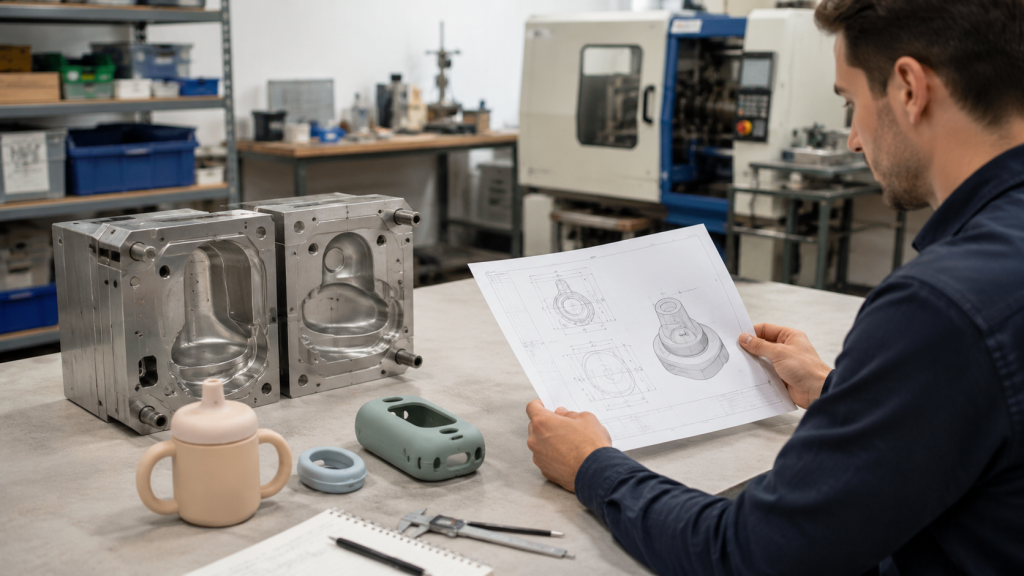
對於新創公司而言,開發客製化矽膠產品可能是一項挑戰。與購買現成產品不同,客製化專案可能涉及產品設計、材料選用、模具開發、原型製作、測試及生產規劃等環節。.
對於資金有限的新興品牌而言,主要考量通常很明確:
- 工廠能否接受小批量的首筆訂單?
- 模具要多少錢?
- 能否在量產前對該設計進行測試?
- 如何避免不必要的模具變更?
- 日後是否有可能擴大生產規模?
只要採用正確的開發策略並選擇合適的製造合作夥伴,新創公司便能推出客製化矽膠產品,無需承擔過大的訂購數量或難以掌控的模具費用。.
為何矽膠適合新創公司的產品開發
矽膠廣泛應用於嬰幼兒用品、廚房用具、醫療保健配件、消費性電子產品、運動器材、寵物用品及工業零組件。.
它的廣受歡迎源於幾項實用的特性:
- 柔韌且富有彈性
- 耐熱耐寒
- 提供不同硬度等級
- 適用於複雜的成型形狀
- 適用於壓縮成型及液態矽膠成型
- 提供適用於食品接觸、醫療及工業用途的各種材料等級
- 顏色、質地及表面處理皆可輕鬆客製化
- 適用於塑膠或金屬零件的包覆成型
這些特點使新創公司能夠開發出具差異化的產品,而非僅與標準的現成產品競爭。.
然而,矽膠製造仍需仔細規劃。外觀吸引人的設計,未必總是容易或經濟實惠地進行模具製作。因此,及早進行工程審查至關重要。.
從明確的產品定義開始
在提出報價請求之前,新創公司應盡可能明確地界定產品。.
一份基本的專案簡報應包含:
- 產品應用
- 目標使用者
- 大致尺寸
- 預期矽膠硬度
- 首選顏色
- 預估訂購數量
- 所需材料等級
- 包裝要求
- 目標市場
- 預計上市日期
- 現有的圖面、草圖或樣品
一份完整的 3D 圖面固然有幫助,但初期未必總是必需的。許多專案都是從草圖、參考圖片、實體樣品或基本概念開始的。.
製造商隨後可評估該設計是否適合矽膠成型,並找出可能導致模具成本增加的環節。.
選擇合適的矽膠成型工藝
製造流程對模具成本、單價及最低訂購量具有重大影響。.
壓縮成型
壓縮成型是製造實心矽膠製品時常用的工藝。.
常見的應用包括:
- 矽膠密封件
- 嬰幼兒餵食配件
- 廚房用具
- 保護套
- 運動與按摩產品
- 工業用矽膠元件
壓縮成型模具的成本通常比液態矽膠射出成型模具更低。這使得壓縮成型特別適合預算有限或產量適中的新創企業。.
然而,製程週期可能會較長,且部分細節極為精細或結構複雜的產品,可能需要進行額外的修邊或後處理。.
液態矽膠成型
液態矽膠(又稱 LSR)是透過自動化注塑成型工藝進行加工的。.
LSR 模塑適用於:
- 高精度零件
- 薄壁元件
- 醫療元件
- 密封元件
- 包覆成型零件
- 大規模生產
- 需要尺寸一致的產品
LSR 模具和生產系統的價格通常比基本的壓縮成型模具更高。因此,對於數量極少的首次訂單而言,LSR 未必總是最適合的經濟選擇。.
然而,當產量增加時,它能提供更佳的自動化程度、可重複性及可擴展性。.
矽膠包覆成型
矽膠也可模壓在塑膠、金屬、電纜或電子元件上。.
常見的例子包括:
- 醫療用線纜組件
- 矽膠塗層連接器
- 帶金屬嵌件的密封零件
- 觸感柔軟的把手
- 電子防護元件
- 汽車密封零件
包覆成型專案通常需要更多的工程工作,因為矽膠必須與另一種材料進行機械或化學結合。此外,可能還需要製作夾具、進行嵌件定位以及黏合測試。.
如何降低初期模具成本
在客製化矽膠專案中,模具費用通常是最大的前期支出。模具成本取決於產品尺寸、結構、型腔數量、表面處理、公差以及成型製程。.
新創公司可透過幾種實用的方法來控制模具成本。.
簡化初始產品結構
複雜的形狀會增加加工時間並提高模具製造的難度。.
可能導致模具成本增加的特性包括:
- 深銳的倒角
- 壁極薄
- 壁厚存在顯著差異
- 複雜的內部腔體
- 多個可拆卸內襯
- 極其細膩的表面紋理
- 嚴格的公差要求
- 多材料結構
首個產品版本應著重於核心功能。裝飾性或複雜的功能,可在市場驗證後於後續版本中加入。.
使用單腔原型模具
多腔模具能在每個成型週期中生產多個零件,從而降低長期單位成本。然而,其製造成本卻較高。.
對於初期階段的專案而言,單腔模具可能能降低初期投資成本。.
這種做法讓這家新創公司能夠:
- 測試產品
- 確認市場需求
- 蒐集客戶回饋
- 改善包裝
- 確認材料性能
- 降低財務風險
待銷量增加後,該專案即可轉為使用多腔生產模具。.
避免設定不必要的嚴格公差
並非每個尺寸都需要非常嚴格的公差。.
嚴格的公差會提高模具的精確度要求、增加檢驗時間並增加生產難度。因此,公差僅應適用於影響組裝、密封、安全或產品性能的尺寸。.
裝飾性區域及非關鍵尺寸通常可採用標準的商業公差。.
與製造商進行公差審查,有助於降低不必要的成本。.
測試時應使用標準顏色與材料
客製化配色可能需要額外的取樣與調整。.
在初期測試階段,新創公司可以使用標準的矽膠顏色或近似顏色。待設計與功能確認無誤後,即可進行最終的顏色匹配。.
此原則同樣適用於材料選擇。除非應用場合需要特殊等級的材料,否則從市面上常見的矽膠材料著手,可能更為經濟實惠。.
在切割模具前確認設計
模具製造完成後的設計變更,是導致意外成本的最常見原因之一。.
在開始製模之前,新創公司應仔細確認:
- 整體尺寸
- 壁厚
- 標誌位置
- 質感
- 分型線
- 產品功能
- 組裝方法
- 包裝尺寸
- 色彩規劃
- 監管要求
在模具製造之前,應完成正式的圖面核准程序。.
在製作量產模具之前,先使用原型
原型製作有助於在投入大筆模具費用之前,找出設計上的問題。.
視產品而定,原型可透過以下方式製作:
- 3D 列印
- CNC 加工
- 手工製作的矽膠鑄件
- 軟製模
- 原型壓縮模具
- 原型注塑模具
3D 列印的原型無法完全重現模製矽膠的彈性、耐用性或表面光潔度。然而,它對於檢查以下方面仍頗具實用價值:
- 產品尺寸
- 人體工學
- 外觀
- 組裝
- 包裝
- 使用者互動
進行功能測試時,可能需要矽膠原型或樣品模具。.
對於嬰幼兒產品、穿戴式產品、密封零件、醫療配件,以及必須與其他產品完美契合的零組件而言,原型製作尤為重要。.
小批量矽膠生產的運作方式
最低訂購量取決於產品、成型工藝、材料、顏色及生產設定。.
製造商可能會接受相對較小的訂單,但單價通常較高,因為固定成本需分攤在較少的產品上。.
典型的固定成本可能包括:
- 材料準備
- 色彩搭配
- 機器設定
- 模具安裝
- 首件檢驗
- 清潔
- 包裝準備
- 優質文件
最低起訂量(MOQ)並不一定代表該專案的總成本最低。新創公司應比較專案的總投資額,而非僅關注單元數量。.
一則有用的引文應區分:
- 模具成本
- 樣本成本
- 單價
- 包裝成本
- 測試費用
- 運費
- 可能產生的設計或工程費用
這使得評估產品上市的實際成本變得更加容易。.
在開發階段規劃專案
分階段的開發流程能降低風險,並讓新創公司有機會在增加投資之前審視產品。.
第一階段:概念評估
這家新創公司提供了產品構想、設計圖、參考樣品及目標規格。.
製造商評估:
- 可塑性
- 材質選項
- 可能的生產流程
- 預估模具成本
- 預期單價
- 設計風險
第二階段:製造設計審查
產品結構已針對矽膠成型進行調整。.
這可能包括對以下內容的變更:
- 草稿角度
- 壁厚
- 分型線
- 發洩
- 底切
- 標誌的深度
- 表面質地
- 組裝特點
第三階段:原型開發
製作原型以檢查產品的尺寸、外觀及基本功能。.
第四階段:模具製造
在獲得批准後,模具將進行機加工、組裝及測試。.
第五階段:首批樣品
先製作初步的注塑樣品以供評估。.
該新創公司應檢查:
- 尺寸
- 硬度
- 顏色
- 表面品質
- Flash
- 功能
- 氣味
- 組裝效能
第 6 階段:試產
已完成一小批試產,以驗證製造流程、包裝及品質控制程序。.
第 7 階段:量產
在確認市場需求後,即可增加產量,並視需要對模具進行優化或升級。.
選擇正確的矽膠材料
選擇矽膠材料時,應依據最終用途來決定,而非僅考量外觀。.
重要因素包括:
- 工作溫度
- 產品硬度
- 抗拉強度
- 抗撕裂性
- 壓縮永久變形
- 透明度
- 耐化學性
- 電學性質
- 食品接觸相關要求
- 與皮膚接觸的規定
- 滅菌要求
- 戶外暴露
舉例來說,矽膠嬰幼兒產品可能需要符合食品接觸標準的材料,而醫療器材組件則可能需要特定的文件及生物相容性評估。.
工業用密封件可能更重視耐溫性與抗壓縮性能,而非顏色或透明度。.
新創企業應索取相關重要資訊,並確認在目標市場是否需要進行額外的产品測試。.
保護產品設計與智慧財產權
Startups are often concerned that their product ideas may be copied or disclosed.
Before sharing detailed drawings, both parties can sign a non-disclosure agreement.
The manufacturing agreement should also clarify:
- Ownership of product drawings
- Ownership of mold tooling
- Rights to use the mold
- Restrictions on selling the product to other customers
- Storage and maintenance of the mold
- Conditions for transferring the mold
- Ownership of trademarks and packaging designs
These terms should be confirmed before tooling begins.
Do Not Ignore Packaging During Product Development
Packaging is often considered too late.
However, product dimensions, shape and surface finish can affect packaging costs. A large or irregular product may require a bigger box, increasing storage and shipping expenses.
Packaging should be reviewed during product development, especially for consumer products.
重要考量事項包括:
- Individual bag or retail box
- Product protection
- Barcode position
- Instruction manual
- Warning labels
- Brand information
- Carton quantity
- International shipping volume
A slightly smaller or more stackable product design may reduce long-term logistics costs.
Questions Startups Should Ask a Silicone Manufacturer
Before choosing a supplier, startups should ask:
- Which molding process is recommended for this product?
- Can the design be reviewed before tooling?
- What is included in the mold quotation?
- Who owns the mold after payment?
- Can a single-cavity mold be used initially?
- 最低訂購量是多少?
- Can small pilot orders be produced?
- Which silicone materials are available?
- Can material documents be provided?
- How many sample revisions are included?
- What quality inspections are performed?
- Can the factory support packaging and assembly?
- What happens if the design changes?
- Can production volume be increased later?
- Is an NDA available?
Clear answers to these questions can prevent misunderstandings during development.
Common Mistakes to Avoid
Ordering a Production Mold Too Early
A mold should not be manufactured until the product structure and key dimensions are confirmed.
Choosing the Cheapest Tooling Quote
An extremely low tooling price may exclude engineering support, mold testing, sample revisions or future maintenance.
Focusing Only on Unit Price
The lowest unit price may require an order quantity that creates excessive inventory risk.
Changing the Design Repeatedly
Frequent changes delay the project and increase mold modification costs.
Ignoring Compliance Requirements
Material and product testing requirements should be identified before production, not after the product is completed.
Selecting the Wrong Manufacturing Process
A product designed for high-volume LSR molding may not be economical for an initial order of only a few hundred units. The manufacturing method should match both the product structure and expected sales volume.
Balancing MOQ, Tooling Cost and Unit Price
There is always a relationship between tooling investment, order quantity and unit price.
A simple mold and low order quantity can reduce initial investment but may result in a higher unit price.
A multi-cavity automated mold requires more initial investment but can reduce unit costs for larger production volumes.
The best solution depends on the startup’s current stage.
For early market testing, the priority is often:
- Lower financial risk
- Faster design validation
- Flexible order quantity
- Controlled inventory
For a proven product, the priority may shift toward:
- 更高的生產效率
- 降低單位成本
- 自動化製造
- Greater consistency
- Faster delivery capacity
A good silicone manufacturer should provide a development path that supports both stages.
結論
Startups do not need to begin with large silicone orders or expensive high-volume tooling.
By simplifying the first product version, selecting the right molding process, using prototypes, starting with a single-cavity mold and planning production in stages, companies can reduce development risk and keep tooling costs under control.
The most important step is to involve the manufacturer early. A design-for-manufacturing review can identify potential problems before the mold is made and help the startup balance product performance, appearance, MOQ and cost.
With a clear product brief and a structured development process, a custom silicone idea can move from concept to prototype, pilot production and scalable manufacturing more efficiently.
常見問題
Can a startup order a small quantity of custom silicone products?
Yes. Some manufacturers can support low-MOQ or pilot production. However, the unit price may be higher because setup and material preparation costs are divided across fewer products.
How much does a custom silicone mold cost?
The cost depends on product size, complexity, molding process, cavity quantity, tolerance and mold material. A simple compression mold generally costs less than a complex LSR injection mold.
Should a startup use compression molding or LSR molding?
Compression molding may be more economical for lower volumes and simpler products. LSR molding is often better for high-precision parts, complex structures and larger production volumes.
Can the mold be modified after the first sample?
Minor modifications may be possible, but major structural changes may require new mold components or a completely new mold. It is better to confirm the design before tooling.
Who owns the mold?
Mold ownership should be clearly stated in the quotation or manufacturing agreement. In many custom projects, the customer owns the mold after full payment, while the manufacturer stores and maintains it.
Can custom silicone products include a logo?
Yes. Logos can often be molded, engraved, printed or laser marked, depending on the product material, surface and intended appearance.
What information is required for a quotation?
Useful information includes drawings, product dimensions, application, material requirements, estimated order quantity, color, hardness, packaging and target market.
 English
  Japanese
  Korean
  German
  French
  Italian
  Spanish
  Dutch
Dutch  Chinese
  Portuguese
  Polish
  Czech
Czech  Hungarian
  Swedish
  Finnish
  Vietnamese
  Thai
Thai  Turkish
  Arabic
  Russian