
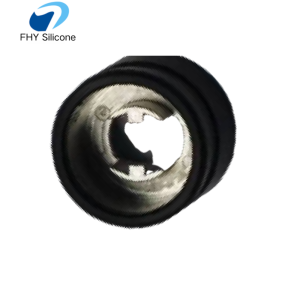
This product is a high-performance sealing and structural component manufactured using fluorosilicone (FVMQ) overmolding on SUS304 stainless steel.
It combines the mechanical strength of SUS304 stainless steel with the superior chemical resistance and flexibility of fluorosilicone rubber, making it suitable for demanding environments involving fuel, oil, chemicals, and extreme temperatures.
The overmolding process creates a strong mechanical and partial chemical bond between the fluorosilicone elastomer and the metal substrate, ensuring long-term sealing stability and structural reliability.
Key Advantages of Fluorosilicone Over SUS304
Excellent Chemical and Fuel Resistance
Fluorosilicone rubber offers outstanding resistance to aggressive media compared to standard silicone rubber.
- Resistant to fuels such as gasoline, diesel, and aviation kerosene
- Excellent resistance to oils, hydraulic fluids, and lubricants
- Stable performance in chemical exposure environments
Strong Mechanical Structure from SUS304
The stainless steel core provides high strength and structural integrity.
- High corrosion resistance
- Excellent mechanical durability
- Suitable for high-pressure and load-bearing applications
Wide Temperature Resistance Range
The combination of fluorosilicone and SUS304 ensures stable performance under extreme conditions.
- Operating temperature: -60°C to 200°C
- Maintains elasticity at low temperatures
- No degradation under thermal cycling
Reliable Sealing Performance
Fluorosilicone overmolding provides long-term sealing reliability.
- Eliminates traditional gasket assembly
- Reduces leakage risk under vibration and pressure
- Maintains sealing integrity in harsh environments
Strong Adhesion to Metal Substrate
Advanced surface treatment ensures stable bonding between elastomer and metal.
- Chemical bonding and mechanical interlocking
- Prevents delamination under stress
- Suitable for long-term dynamic applications
Manufacturing Process
The product is manufactured using precision metal overmolding technology:
- SUS304 Metal Forming
Stainless steel components are precision machined or stamped. - Surface Treatment
Surface cleaning and activation improve bonding performance. - Fluorosilicone Injection Overmolding
FVMQ material is injected onto the metal surface under controlled temperature and pressure. - Curing and Bonding
The elastomer is thermally cured to form a durable bonded structure. - Quality Inspection
Sealing performance, adhesion strength, and dimensional accuracy are tested.
Technical Specifications
| Item | Description |
|---|---|
| Product Name | Fluorosilicone Overmolded SUS304 Component |
| Metal Base | SUS304 Stainless Steel |
| Elastomer Material | Fluorosilicone Rubber (FVMQ) |
| Process | Metal Overmolding Injection |
| Temperature Range | -60°C to 200°C |
| Chemical Resistance | Fuels, oils, hydraulic fluids, solvents |
| Corrosion Resistance | High (SUS304 base) |
| Sealing Type | Integrated elastomer-metal sealing |
| Structure | Rigid + flexible hybrid component |
Applications
- Automotive fuel system sealing parts
- Aerospace fuel and hydraulic components
- Industrial chemical equipment seals
- Oil and gas system connectors
- High-performance valve sealing components
- Precision instrumentation sealing structures
- Marine and offshore equipment components
Engineering Considerations
Metal to Fluorosilicone Bonding
Surface treatment is critical to ensure long-term adhesion between SUS304 and fluorosilicone, typically using:
- Plasma treatment
- Primer coating systems
- Mechanical interlocking design structures
Material Compatibility
Fluorosilicone is selected for environments where standard silicone fails, especially in:
- Fuel exposure systems
- High chemical aggression environments
- Wide temperature fluctuation conditions
Structural Optimization
SUS304 geometry is designed to improve:
- Stress distribution
- Bonding surface area
- Long-term fatigue resistance
Frequently Asked Questions
Why use fluorosilicone instead of standard silicone?
Fluorosilicone provides significantly better resistance to fuels, oils, and solvents compared to standard silicone rubber.
Can it be used in fuel systems?
Yes, it is widely used in automotive and aerospace fuel system sealing applications.
Does the rubber separate from the metal over time?
No, with proper surface treatment and molding process, the bonding is designed for long-term stability under dynamic conditions.
Is customization available?
Yes, SUS304 geometry, fluorosilicone hardness, and sealing structure can all be customized.
 English
  Japanese
  Korean
  German
  French
  Italian
  Spanish
  Dutch
Dutch  Chinese
  Portuguese
  Polish
  Czech
Czech  Hungarian
  Swedish
  Finnish
  Vietnamese
  Thai
Thai  Turkish
  Arabic
  Russian
Reviews
There are no reviews yet.