
Silicone seals are critical components in automotive and electronic systems. They help protect sensitive parts from water, dust, vibration, heat, chemicals, and environmental aging. In applications such as automotive connectors, sensor housings, battery systems, control modules, waterproof electronic devices, and wearable electronics, the reliability of a silicone seal directly affects product performance and service life.
Designing a reliable silicone seal requires more than selecting a soft rubber material. Engineers must consider material properties, compression behavior, sealing geometry, dimensional tolerance, environmental conditions, and manufacturing process stability.
This article explains the key design principles for developing high-performance silicone seals for automotive and electronic applications.
Why Silicone Is Used for Automotive and Electronic Sealing
Silicone is widely used in sealing systems because it offers a balanced combination of flexibility, durability, and environmental resistance.
Key advantages include:
- Excellent temperature resistance
- Good elasticity and compression recovery
- Strong aging and weather resistance
- Good electrical insulation
- Stable sealing performance under repeated compression
- Suitable for custom molding and LSR overmolding
- Good resistance to moisture, dust, and UV exposure
For automotive and electronics industries, silicone is especially valuable because components are often exposed to vibration, outdoor environments, thermal cycling, and long-term mechanical stress.
Common Applications of Silicone Seals
1. Automotive Waterproof Connectors
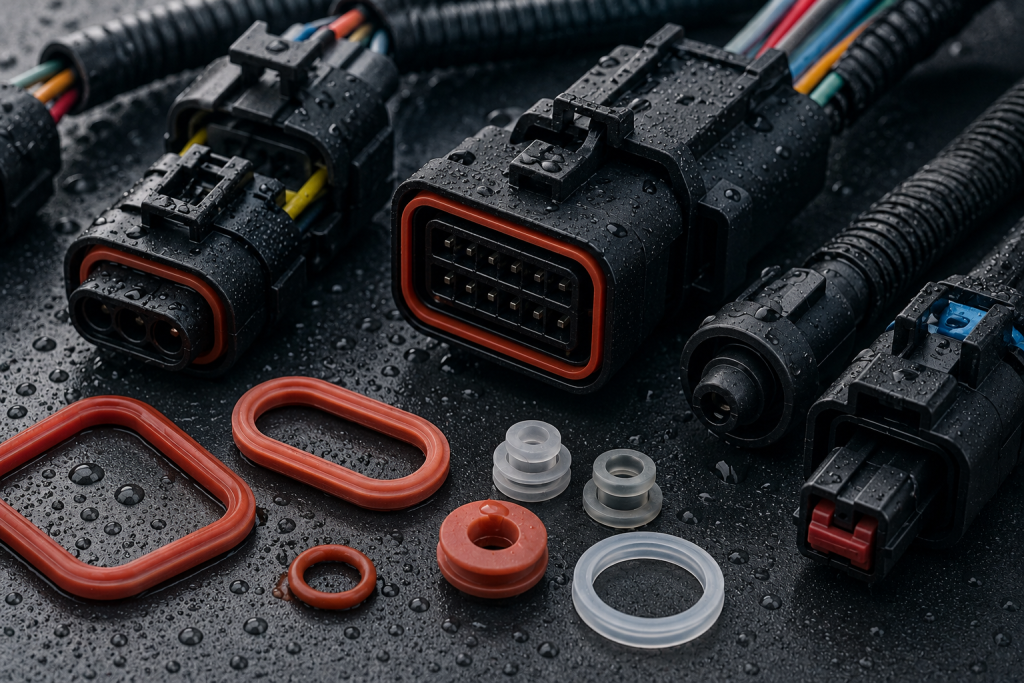
Silicone seals are used in automotive connectors to prevent water, dust, and oil from entering electrical terminals. They are commonly found in wire harness systems, sensors, lighting systems, battery modules, and control units.
2. Electronic Device Housings
Consumer electronics and industrial electronic products often use silicone gaskets or sealing rings to protect internal circuits from moisture and dust.
Typical applications include:
- Waterproof enclosures
- Smart wearable devices
- Control panels
- Outdoor electronic equipment
- Sensor housings
3. Sensor and Module Sealing
Automotive sensors and electronic modules require reliable sealing to maintain long-term performance. Silicone seals help protect against vibration, temperature changes, and environmental contamination.
4. Battery and Power System Sealing
Electric vehicles, energy storage systems, and electronic power modules require silicone seals with good temperature resistance, insulation, and compression stability.
Key Design Factors for Reliable Silicone Seals
1. Material Selection
Different applications require different silicone materials. Common options include:
| Material Type | Typical Use |
|---|---|
| General silicone rubber | Standard sealing and cushioning |
| LSR liquid silicone rubber | High-precision molded seals |
| Platinum-cured silicone | Medical, food-contact, and high-purity applications |
| High-temperature silicone | Heat-resistant automotive and industrial parts |
| Conductive silicone | EMI shielding and special electronic sealing |
For automotive and electronic systems, engineers should consider temperature range, chemical exposure, sealing pressure, aging resistance, and electrical insulation requirements.
2. Hardness Selection
Silicone hardness is usually measured by Shore A. The hardness affects sealing force, flexibility, and assembly performance.
Softer silicone provides better compression and sealing contact, while harder silicone provides stronger structural support and better wear resistance.
Typical ranges:
| Application | Suggested Hardness |
|---|---|
| Soft gasket sealing | 20–40 Shore A |
| Connector seals | 30–60 Shore A |
| Structural sealing parts | 50–70 Shore A |
| Protective caps and plugs | 40–70 Shore A |
The final hardness should be selected based on the actual compression ratio and assembly structure.
3. Compression Ratio
Compression is one of the most important factors in silicone seal design. If the compression is too low, the seal may leak. If the compression is too high, the material may deform, tear, or lose recovery over time.
A well-designed seal should maintain enough contact pressure without causing excessive stress.
Important considerations include:
- Sealing groove depth
- Seal cross-section size
- Assembly pressure
- Long-term compression set
- Thermal expansion and contraction
4. Cross-Section Geometry
Seal geometry directly affects sealing performance. Common silicone seal designs include:
- O-rings
- Flat gaskets
- Lip seals
- D-shaped seals
- Custom profile seals
- Multi-lip waterproof structures
For automotive connectors and electronic housings, multi-lip designs are often used to improve waterproof and dustproof performance.
5. Dimensional Tolerance
Silicone seals often work inside narrow grooves or complex housing structures. Small dimensional errors may cause leakage, difficult assembly, or unstable compression.
Precision mold design and process control are essential for:
- Stable seal thickness
- Consistent cross-section shape
- Accurate hole and groove matching
- Reliable assembly fit
For high-precision seals, LSR injection molding is often preferred because it provides better repeatability and stable mass production.
Environmental Requirements
Temperature Resistance
Automotive and electronic systems may experience high and low temperature cycles. Silicone can maintain flexibility over a wide temperature range, making it suitable for engine compartments, outdoor electronics, and power modules.
Water and Dust Protection
For waterproof electronic systems, silicone seals help support IP-rated protection designs such as IP67 or IP68. The final waterproof performance depends on both seal design and product assembly.
Chemical Resistance
Automotive seals may contact oils, coolants, cleaning agents, and road contaminants. Material formulation should be selected according to the actual working environment.
Vibration and Shock Resistance
Silicone’s elasticity helps absorb vibration and reduce mechanical stress on connectors, housings, and electronic modules.
Manufacturing Processes for Silicone Seals
Compression Molding
Compression molding is suitable for simple gaskets, O-rings, pads, and lower-volume production.
LSR Injection Molding
LSR injection molding is ideal for high-precision, complex, and high-volume silicone seals. It offers:
- Better dimensional consistency
- Shorter production cycle
- High repeatability
- Clean molding process
- Suitable for automated production
Silicone Overmolding
Silicone can be overmolded onto plastic, metal, or electronic components to create integrated sealing structures. This is widely used in automotive connectors, waterproof housings, and electronic device assemblies.
Quality Control for Silicone Seals
Reliable sealing components require strict quality inspection.
Common tests include:
- Dimensional measurement
- Hardness testing
- Compression set testing
- Tensile strength testing
- Tear resistance testing
- Visual inspection
- Leakage testing
- Pressure testing
- Aging resistance testing
For automotive and electronic applications, batch consistency is very important. Each production batch should be controlled for material, process parameters, mold conditions, and final inspection results.
OEM/ODM Custom Silicone Seal Solutions
A professional silicone manufacturer can support full custom development for automotive and electronic sealing parts.
Customization options include:
| Custom Item | Available Options |
|---|---|
| Material | Silicone, LSR, platinum silicone, high-temperature silicone |
| Hardness | Custom Shore A hardness |
| Shape | O-ring, gasket, plug, cap, custom profile seal |
| Color | Black, gray, red, transparent, custom colors |
| Process | Compression molding, LSR injection molding, overmolding |
| Function | Waterproof, dustproof, shock absorption, insulation |
| Application | Automotive, electronics, sensors, connectors, battery systems |
Conclusion
Reliable silicone seal design requires a complete understanding of material behavior, sealing structure, compression ratio, environmental conditions, and manufacturing process control.
For automotive and electronic systems, silicone seals provide excellent waterproofing, dust protection, vibration resistance, insulation, and long-term durability. By working with an experienced silicone OEM/ODM supplier, manufacturers can develop custom sealing components that meet demanding performance requirements from prototype to mass production.
 English
  Japanese
  Korean
  German
  French
  Italian
  Spanish
  Dutch
Dutch  Chinese
  Portuguese
  Polish
  Czech
Czech  Hungarian
  Swedish
  Finnish
  Vietnamese
  Thai
Thai  Turkish
  Arabic
  Russian