
Silicone sealing components play an important role in many industrial systems where reliable sealing, flexibility, temperature resistance, and long-term durability are required. From automotive assemblies and electronic devices to medical equipment, machinery, valves, and fluid control systems, silicone seals help prevent leakage, dust intrusion, vibration damage, and environmental contamination.
Compared with traditional rubber or plastic sealing materials, silicone offers excellent thermal stability, chemical resistance, compression recovery, and aging resistance. For manufacturers and equipment brands, custom silicone sealing components provide reliable solutions for demanding industrial applications.
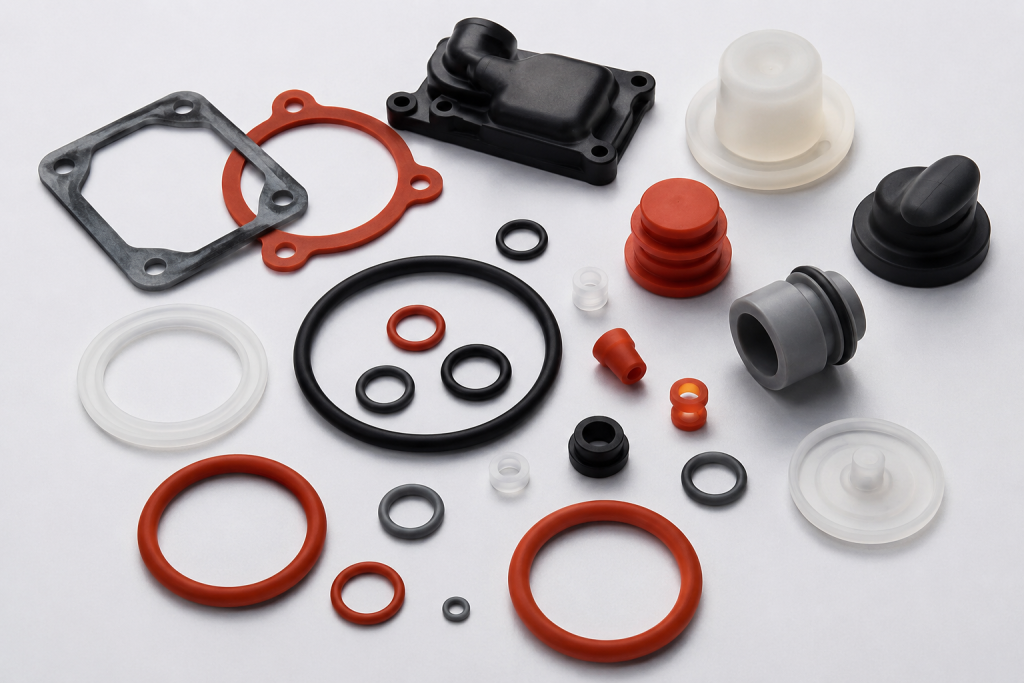
Why Silicone Is Used for Industrial Sealing
Industrial sealing parts are often exposed to heat, pressure, chemicals, moisture, dust, vibration, and repeated compression. Therefore, sealing materials must remain stable under different working conditions.
Silicone is widely used because it provides:
- Excellent elasticity and compression recovery
- Wide temperature resistance
- Good sealing performance
- Strong aging and weather resistance
- Soft and flexible structure
- Good electrical insulation
- Compatibility with custom molding and overmolding
These properties make silicone suitable for both static sealing and dynamic sealing applications.
Common Types of Silicone Sealing Components
1. Silicone Gaskets
Silicone gaskets are used between two surfaces to prevent leakage or contamination. They are commonly found in electrical housings, industrial equipment, medical devices, and automotive systems.
They can be customized in different shapes, thicknesses, hardness levels, and sealing structures.
2. Silicone O-Rings
Silicone O-rings are widely used in fluid systems, valves, pumps, connectors, and sealing assemblies. They provide excellent compression sealing and can be produced in standard or custom sizes.
For special applications, material hardness and formulation can be adjusted according to pressure, temperature, and chemical exposure.
3. Silicone Sealing Plugs and Caps
Silicone plugs and caps are used to protect holes, ports, connectors, and openings from dust, moisture, chemicals, or mechanical damage.
Typical applications include:
- Electronic connector protection
- Industrial port sealing
- Medical device sealing
- Automotive component protection
4. Silicone Valve and Diaphragm Components
Silicone valves and diaphragms are used in fluid control systems, pumps, respiratory devices, and dispensing equipment. They require high flexibility, fatigue resistance, and stable rebound performance.
5. Silicone Overmolded Sealing Parts
Silicone can be overmolded onto plastic, metal, or electronic components to create integrated sealing structures. This process is widely used in waterproof connectors, sensor housings, medical device interfaces, and automotive electronic components.
Key Performance Requirements
1. Temperature Resistance
Industrial silicone sealing parts often work in high or low temperature environments. Depending on the material grade, silicone can generally maintain flexibility and sealing performance across a wide temperature range.
This makes silicone suitable for automotive, electrical, outdoor, and thermal equipment applications.
2. Compression Set Resistance
Compression set is a critical factor for sealing performance. A good silicone seal must recover its original shape after long-term compression.
Low compression set helps ensure:
- Long-term sealing stability
- Reduced leakage risk
- Better assembly reliability
- Longer product service life
3. Chemical and Environmental Resistance
Industrial seals may contact oils, cleaning agents, disinfectants, water, dust, or outdoor environments. Silicone offers good resistance to many environmental factors and maintains stable physical properties over time.
For special chemical exposure, material formulation should be selected according to actual working conditions.
4. Dimensional Precision
Sealing components often need tight dimensional control. Small deviations may lead to assembly problems or leakage failure.
High-precision mold design and stable production control are essential for industrial silicone sealing parts.
Design Considerations for Silicone Seals
When developing custom silicone sealing components, engineers should consider:
| Design Factor | Importance |
|---|---|
| Hardness | Affects compression, flexibility, and sealing force |
| Cross-section design | Determines sealing contact area |
| Wall thickness | Influences deformation and recovery |
| Tolerance control | Ensures correct assembly fit |
| Surface finish | Affects sealing contact quality |
| Material grade | Determines temperature, aging, and chemical resistance |
| Application environment | Guides formulation and structural design |
For complex sealing structures, early DFM analysis can help reduce mold issues and improve mass production stability.
Manufacturing Processes
Silicone sealing components can be manufactured through several processes:
Compression Molding
Suitable for many standard gaskets, pads, plugs, and simple sealing components.
LSR Injection Molding
Suitable for high-precision, high-volume, and complex silicone sealing components.
LSR injection molding offers:
- High repeatability
- Stable dimensional control
- Short production cycle
- Good surface quality
- Suitable for automated production
Silicone Overmolding
Used for integrated sealing parts combining silicone with plastic, metal, or electronic components. It improves assembly efficiency and sealing reliability.
Quality Control
High-performance silicone sealing components require strict quality inspection.
Common inspection items include:
- Dimensional measurement
- Hardness testing
- Compression set testing
- Tensile strength testing
- Tear resistance testing
- Appearance inspection
- Leakage or pressure testing
- Aging resistance testing
For medical, food-contact, or automotive applications, materials can also be tested according to customer requirements such as FDA, LFGB, RoHS, REACH, ISO 10993, or other industry standards.
Industrial Applications
Silicone sealing components are widely used in:
- Automotive sealing systems
- Waterproof electronic housings
- Medical device components
- Industrial valves and pumps
- Consumer electronics
- Power tools and machinery
- Lighting systems
- Sensors and connectors
- Food and beverage equipment
- Outdoor protection systems
Different industries require different material grades, tolerance levels, and sealing structures.
OEM/ODM Customization Options
A professional silicone manufacturer can provide full custom sealing solutions, including:
- Custom size and shape
- Custom hardness
- Custom color
- Custom material formulation
- High-temperature silicone
- Food-grade silicone
- Medical-grade silicone
- Silicone + plastic overmolding
- Silicone + metal insert molding
- Logo and packaging customization
OEM service is suitable for customers with drawings or samples. ODM service is suitable for customers who need structural design, material selection, prototype development, and mold manufacturing support.
Conclusion
High-performance silicone sealing components are essential for industrial applications that require reliable sealing, durability, flexibility, and environmental resistance. With the right material selection, structural design, mold development, and process control, silicone seals can provide stable performance in demanding operating conditions.
For industrial brands and equipment manufacturers, working with an experienced silicone OEM/ODM supplier can help develop customized sealing solutions from concept design to mass production.
 English
  Japanese
  Korean
  German
  French
  Italian
  Spanish
  Dutch
Dutch  Chinese
  Portuguese
  Polish
  Czech
Czech  Hungarian
  Swedish
  Finnish
  Vietnamese
  Thai
Thai  Turkish
  Arabic
  Russian