
Liquid silicone rubber is widely used in healthcare products because it can be molded into flexible, precise, and complex components. Typical applications include seals, valves, membranes, wearable-device parts, respiratory components, diagnostic equipment, fluid-handling parts, connector seals, and silicone-overmolded assemblies.
However, selecting an LSR material for a healthcare application involves much more than specifying hardness and color.
The material must be evaluated according to its intended patient contact, exposure duration, sterilization method, manufacturing environment, chemical composition, extractables and leachables, documentation package, and applicable regulatory market.
A material described as “medical-grade silicone” is only a starting point. It does not automatically make the molded component or finished medical device biocompatible, sterile, or regulatory compliant.
This guide explains how healthcare product manufacturers and procurement engineers can evaluate LSR purity, sterilization compatibility, biological safety, documentation, and supplier capability.
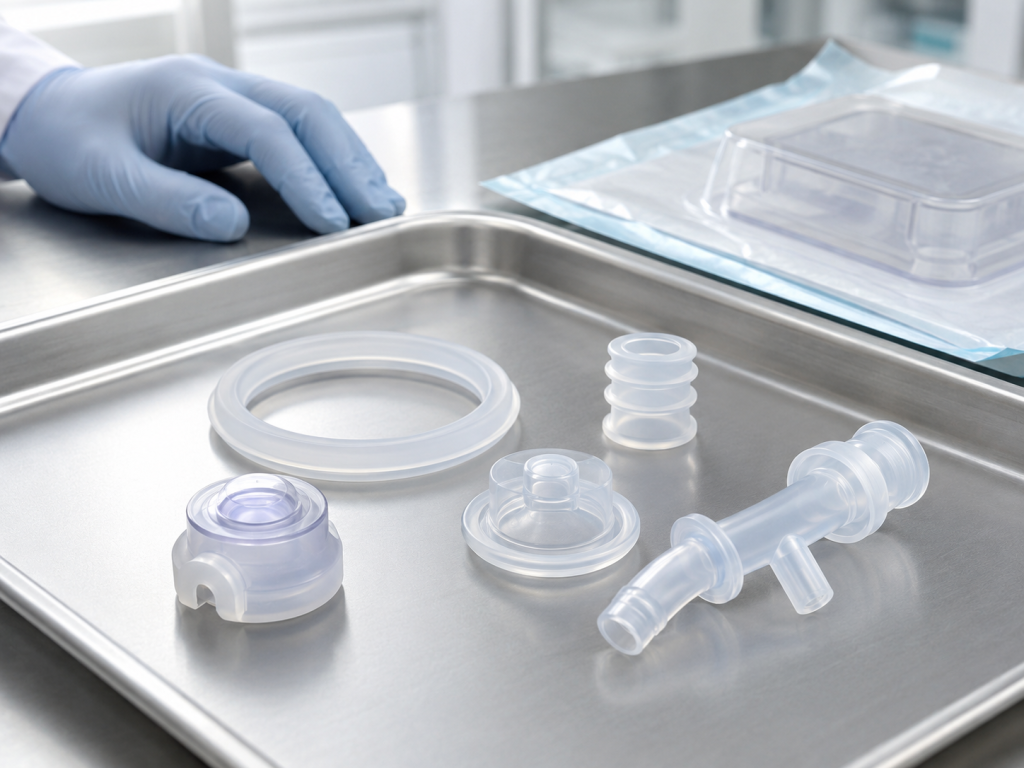
What Is Healthcare LSR?
Liquid silicone rubber, commonly abbreviated as LSR, is a two-component silicone elastomer processed through injection molding.
During manufacturing, the two liquid components are metered and mixed before entering a heated mold. The material cures into a flexible elastomeric component with the required geometry and mechanical properties.
LSR processing is suitable for healthcare components that require:
- Complex molded geometry
- Thin sealing lips
- Consistent dimensions
- High production volumes
- Automated molding
- Low-particulate handling
- Insert molding
- Plastic-to-silicone overmolding
- Metal-to-silicone overmolding
- Controlled flash
- Soft-touch surfaces
- Flexible membranes
- Integrated sealing functions
The selected LSR must still be evaluated as part of the complete device system.
Start With Intended Use, Not Material Name
Before requesting an LSR quotation, the device manufacturer should clearly define how the finished component will be used.
Biological evaluation is based on the finished device’s intended use, including the nature and duration of body contact. The current ISO 10993-1 framework treats biological evaluation as part of a broader risk-management process rather than as a fixed checklist applied equally to every material.
Important questions include:
- Does the component contact the patient?
- Is the contact direct or indirect?
- Does it contact intact skin, mucosal tissue, blood, tissue, or circulating fluid?
- Is contact temporary, prolonged, or permanent?
- Is the component implanted?
- Is it part of an external communicating device?
- Does fluid pass over the silicone before reaching the patient?
- Will the component be reused?
- Will it be cleaned or disinfected between uses?
- Will it be supplied sterile?
- Which countries or regions will receive the finished product?
These questions determine the required biological evaluation, chemical characterization, sterilization validation, manufacturing controls, and supplier documentation.
“Medical Grade” Is Not a Finished-Device Approval
The term “medical grade” is commonly used by raw-material suppliers, but buyers should not treat it as a universal regulatory approval.
A supplier may use the term to indicate that a material:
- Uses a controlled formulation
- Has supporting biological test data
- Is manufactured under controlled conditions
- Has documented lot traceability
- Is intended for selected healthcare applications
- Is subject to restricted formulation changes
However, biological suitability ultimately depends on the finished device, its processing history, patient-contact category, and intended use. FDA-recognized guidance for silicone materials notes that data from cured elastomers can be useful, but the most relevant biological information is generally associated with the finished device.
The device manufacturer remains responsible for determining whether the final product is safe and suitable for its intended application.
What Does LSR Purity Mean?
Purity is not represented by a single number.
For healthcare LSR, purity may involve control of:
- Base silicone polymer
- Reinforcing filler
- Catalyst system
- Crosslinking components
- Inhibitors
- Pigments
- Processing aids
- Mold-release agents
- Cleaning chemicals
- Post-curing conditions
- Volatile substances
- Particulate contamination
- Metallic contamination
- Organic contamination
- Extractable substances
- Leachable substances
- Manufacturing residues
A high-purity raw material can still be contaminated or chemically altered during molding, secondary processing, cleaning, printing, bonding, packaging, or sterilization.
Healthcare buyers should therefore evaluate both the raw material and the complete manufacturing process.
Raw-Material Formulation Control
The LSR supplier should be able to identify the exact material grade and provide a controlled technical documentation package.
Important information includes:
- Commercial material name
- Material grade number
- Hardness
- Color
- Cure system
- Mechanical properties
- Density
- Recommended processing conditions
- Shelf life
- Storage conditions
- Post-curing recommendations
- Sterilization compatibility information
- Applicable biological test reports
- Regulatory statements
- Restricted-substance declarations
- Change-notification policy
The purchasing specification should prohibit unapproved substitutions.
Two materials with the same hardness and similar mechanical properties may use different catalysts, fillers, pigments, stabilizers, or processing additives. These differences can affect biological evaluation, sterilization performance, appearance, odor, extractables, and long-term aging.
Platinum-Cured LSR
Many healthcare LSR systems use an addition-cure process commonly described as platinum curing.
These materials are often selected when manufacturers require:
- Controlled curing
- Stable processing
- Low levels of certain cure by-products
- High-volume injection molding
- Precision medical components
- Transparent or lightly colored parts
- Automated manufacturing
However, “platinum cured” does not automatically mean biocompatible, implantable, sterile, or suitable for every medical application.
The complete formulation, molded condition, post-cure process, pigment system, sterilization exposure, and intended patient contact must still be evaluated.
Pigments and Color Additives
Color can affect the compliance profile of an LSR component.
A natural or translucent silicone material and a colored version should not automatically be treated as biologically equivalent.
Pigment evaluation should consider:
- Pigment identity
- Supplier and grade
- Pigment concentration
- Carrier material
- Dispersion method
- Heavy-metal content
- Lot traceability
- Biological data
- Sterilization stability
- Color change after aging
- Potential extractables
- Change-control requirements
For healthcare projects, the pigment masterbatch should be approved as a controlled component of the material system.
The manufacturer should not use a general industrial silicone pigment without evaluating its effect on the final device.
Mold-Release Agents and Processing Aids
External mold-release sprays can introduce unwanted residues onto a healthcare component.
Where possible, the manufacturing process should be designed to avoid routine use of uncontrolled external release agents.
The procurement engineer should ask:
- Is external mold release used?
- Is the mold internally coated?
- Is the coating permanent or regularly reapplied?
- Are lubricants used on molding equipment?
- Are cleaning chemicals used on the mold?
- Can these substances contact the molded component?
- Are they included in the chemical risk assessment?
- Are cleaning and maintenance procedures documented?
Processing substances that do not appear on the raw-material technical data sheet may still affect the finished part.
Post-Curing
Post-curing exposes molded silicone components to controlled heat for a defined period.
Depending on the material and application, post-curing may be used to:
- Reduce volatile residues
- Complete selected curing reactions
- Stabilize physical properties
- Reduce odor
- Prepare the component for subsequent evaluation
- Improve consistency after molding
Post-curing requirements should be based on the raw-material supplier’s recommendations and the device manufacturer’s validation.
Important variables include:
- Temperature
- Time
- Air exchange
- Oven loading
- Part arrangement
- Cleanliness
- Cooling method
- Handling after post-cure
- Maximum delay before packaging
A change in post-curing conditions may alter the chemical profile or mechanical properties of the finished component and should be controlled.
Extractables and Leachables
Extractables are substances that can be removed from a material under defined laboratory conditions. Leachables are substances that may migrate from the finished device during actual use.
Potential sources include:
- Silicone oligomers
- Catalyst residues
- Pigments
- Processing aids
- Adhesives
- Primers
- Cleaning residues
- Mold-release agents
- Packaging materials
- Sterilization by-products
- Degradation products
ISO 10993-18 addresses chemical characterization of medical-device materials within a risk-management process, while ISO 10993-17 provides a framework for toxicological risk assessment of identified constituents.
The required chemical evaluation depends on the device configuration, patient contact, exposure duration, use environment, and available material information.
Raw-material supplier data may support the evaluation, but it may not replace chemical characterization of the final manufactured and sterilized device.
Evaluate the Final Manufacturing Condition
Biological and chemical evaluation should reflect the condition in which the product reaches the patient.
The final device may differ from the raw material because of:
- Heat history
- Mold-surface interaction
- Post-curing
- Pigment addition
- Printing
- Plasma treatment
- Primer application
- Adhesive bonding
- Lubrication
- Cleaning
- Sterilization
- Packaging
- Shelf aging
Testing only the uncured raw material or a generic silicone test sheet may fail to represent the final component.
When possible, test samples should use production-equivalent:
- Material lots
- Pigment concentration
- Mold conditions
- Post-curing conditions
- Cleaning processes
- Secondary operations
- Sterilization cycles
- Packaging
- Aging conditions
Selecting the Sterilization Method
Sterilization should be considered during material selection, not after the mold has already been built.
Common healthcare-device sterilization methods include:
- Ethylene oxide
- Gamma radiation
- Electron-beam radiation
- X-ray radiation
- Moist heat or steam
- Vaporized hydrogen peroxide
- Other validated low-temperature processes
The appropriate method depends on the complete device, not only on the silicone component.
Other materials in the assembly may include:
- Polycarbonate
- Polypropylene
- Polyamide
- ABS
- Adhesives
- Electronic components
- Metal inserts
- Coatings
- Printing inks
- Packaging films
Each part of the system must remain functional after the selected sterilization process.
Ethylene Oxide Sterilization
Ethylene oxide, or EO, is widely used for medical devices that contain temperature-sensitive polymers, complex geometries, multiple packaging layers, or difficult-to-reach internal spaces. FDA notes that EO may be the only effective method that does not damage some medical devices.
ISO 11135 specifies requirements for developing, validating, and routinely controlling an EO sterilization process for medical devices.
When evaluating an LSR component for EO sterilization, consider:
- Material-property changes
- Aeration requirements
- Residual EO
- Residual ethylene chlorohydrin
- Packaging permeability
- Component thickness
- Hollow spaces
- Device contact category
- Patient population
- Repeated sterilization exposure
- Odor after processing
ISO 10993-7 addresses allowable limits and measurement methods for EO and ethylene-chlorohydrin residuals in EO-sterilized medical devices. Residual limits can depend on contact duration, patient population, and device type.
EO compatibility should therefore include both material-performance testing and residual evaluation.
Radiation Sterilization
Gamma, electron-beam, and X-ray sterilization expose the product to ionizing radiation.
ISO 11137-1:2025 specifies requirements for the development, validation, and routine control of radiation sterilization processes for healthcare products.
Radiation exposure can potentially affect:
- Hardness
- Elongation
- Tensile strength
- Tear resistance
- Color
- Transparency
- Surface feel
- Compression set
- Long-term aging
- Bond strength
- Plastic-to-silicone adhesion
- Extractable profile
The effect depends on the exact LSR formulation, radiation type, dose range, atmosphere, pigment, part geometry, and storage period after sterilization.
A general supplier statement that silicone is “gamma compatible” should not replace testing on the finished component at the validated minimum and maximum process exposure.
Moist-Heat Sterilization
Moist-heat sterilization exposes the device to elevated temperature and moisture.
ISO 17665:2024 specifies requirements for the development, validation, and routine control of moist-heat sterilization processes for medical devices.
Silicone may tolerate elevated temperatures better than many common thermoplastics, but the complete assembly must be evaluated.
Important risks include:
- Change in hardness
- Loss of sealing force
- Compression set
- Dimensional change
- Bond degradation
- Plastic housing deformation
- Corrosion of inserts
- Moisture retention
- Surface changes
- Repeated-cycle fatigue
Reusable devices should be tested through the maximum claimed number of cleaning and sterilization cycles.
Testing only one new component after a single cycle is usually insufficient for a reusable product.
Vaporized Hydrogen Peroxide and Other Processes
Low-temperature sterilization methods may be considered for devices that cannot tolerate moist heat.
Compatibility may depend on:
- Device geometry
- Internal channels
- Absorption or retention
- Packaging
- Surface chemistry
- Adhesives
- Pigments
- Electronics
- Residual levels
- Process concentration
- Exposure time
The sterilization provider and device manufacturer should jointly review the process.
Material compatibility, sterility validation, functional performance, and residual risk are separate questions and should each be addressed.
Sterilization Can Change More Than Appearance
A component may look normal after sterilization while still experiencing meaningful changes.
Validation should examine relevant performance characteristics, such as:
- Tensile strength
- Elongation
- Tear strength
- Hardness
- Compression set
- Seal force
- Valve-opening pressure
- Membrane response
- Surface friction
- Transparency
- Color
- Adhesion
- Dimensional stability
- Extractables and leachables
- Particulate generation
- Functional life
Acceptance criteria should be defined before testing.
Biocompatibility Planning
Biocompatibility testing should not begin with a request for every test listed in a standard.
The evaluation should start with:
- Intended use
- Patient-contact category
- Contact duration
- Material composition
- Manufacturing process
- Existing information
- Chemical characterization
- Biological risks
- Data gaps
- Additional evaluation requirements
FDA’s biocompatibility guidance uses a risk-based approach and provides endpoint considerations according to device-contact category and duration.
Possible evaluation endpoints may include:
- Cytotoxicity
- Sensitization
- Irritation
- Acute systemic toxicity
- Material-mediated pyrogenicity
- Subacute toxicity
- Subchronic toxicity
- Genotoxicity
- Implantation
- Hemocompatibility
- Chronic toxicity
- Carcinogenicity
- Reproductive or developmental toxicity
- Degradation assessment
- Toxicokinetics
Not every endpoint applies to every device.
The biological evaluation plan should explain why each endpoint is addressed through testing, existing data, chemical characterization, scientific literature, or risk assessment.
USP Class VI and ISO 10993 Are Not Interchangeable
Some LSR suppliers provide USP Class VI test information.
This may be useful supporting information, but it should not automatically be treated as a complete biological evaluation of the finished medical device.
The applicable biological evaluation depends on:
- Device contact type
- Contact duration
- Finished-device processing
- Target market
- Device-specific guidance
- Chemical characterization
- Identified biological risks
Procurement teams should avoid using a single material certificate as the only basis for a compliance claim.
Quality-Management Requirements
ISO 13485:2016 remains the internationally recognized quality-management-system standard for organizations involved in the design and manufacture of medical devices. It was reviewed and confirmed as current in 2025.
When sourcing healthcare LSR components, relevant supplier controls may include:
- Document control
- Training
- Lot traceability
- Process validation
- Equipment maintenance
- Calibration
- Nonconforming-material control
- Corrective and preventive action
- Complaint handling
- Supplier management
- Change control
- Record retention
- Contamination control
ISO 13485 certification can support supplier qualification, but certification alone does not approve a specific material or component.
The buyer should audit the actual processes used for the project.
Cleanroom and Controlled Manufacturing
Not every healthcare silicone component requires cleanroom molding.
The required manufacturing environment depends on:
- Device classification
- Patient-contact type
- Sterility requirements
- Particulate limits
- Bioburden limits
- Packaging process
- Downstream cleaning
- Risk analysis
- Customer specification
ISO 14644-1 classifies cleanroom air cleanliness according to airborne-particle concentration.
When cleanroom production is required, buyers should confirm:
- Cleanroom classification
- Certification status
- Monitoring frequency
- Gowning procedures
- Material-entry controls
- Equipment-cleaning procedures
- Environmental monitoring
- Personnel training
- Packaging location
- Part-transfer method
- Bioburden controls
A molding machine located inside a cleanroom does not by itself guarantee a clean finished component. Every handling and packaging step must be reviewed.
Lot Traceability
Healthcare LSR components should be traceable through the relevant supply and production chain.
A traceability record may connect the finished component to:
- Raw-material lot
- Pigment lot
- Insert lot
- Molding date
- Machine
- Mold
- Cavity
- Operator
- Process parameters
- Post-cure batch
- Cleaning batch
- Inspection record
- Packaging lot
- Sterilization load
- Shipment
The required level of traceability should be agreed before production begins.
Change Control
Uncontrolled material or process changes can invalidate previous testing.
The supplier should notify the customer before changing:
- Raw-material formulation
- Raw-material manufacturing location
- Pigment
- Raw-material supplier
- Mold-release system
- Mold coating
- Manufacturing site
- Molding process
- Post-curing process
- Cleaning chemicals
- Packaging materials
- Sterilization site
- Sterilization method
- Inspection method
The customer should evaluate whether the change requires additional verification, validation, biological evaluation, or regulatory action.
Documents to Request From an LSR Supplier
A healthcare LSR documentation package may include:
- Technical data sheet
- Safety data sheet
- Certificate of analysis
- Material-composition statement
- Biological test summary
- Regulatory declarations
- Restricted-substance declaration
- Sterilization compatibility statement
- Extractables information
- Shelf-life information
- Storage requirements
- Lot-traceability procedure
- Change-notification agreement
- Quality-system certificate
- Cleanroom certificate, when applicable
- Post-curing recommendation
- Pigment documentation
- Certificate of conformity
- Inspection report
The exact documents required depend on the device and target market.
Supplier Qualification Questions
Before approving an LSR molding supplier, procurement teams should ask:
- Is the exact LSR grade approved and locked for the project?
- Can every production lot be traced to the raw-material batch?
- Are pigments controlled as separate raw materials?
- Is external mold release used?
- Are molding parameters documented?
- Is the process validated?
- Is post-curing performed?
- How is the post-cure oven monitored?
- Are parts cleaned after molding?
- Are cleaning agents controlled?
- Is production performed in a cleanroom?
- How are parts transferred to packaging?
- Are molds dedicated to medical projects?
- How is cross-contamination prevented?
- What inspection equipment is used?
- How are nonconforming parts controlled?
- What is the change-notification process?
- Can the supplier support sterilization validation?
- Can it provide production-equivalent samples?
- How long are quality records retained?
Mechanical Properties to Specify
Regulatory documentation should not replace functional engineering requirements.
Depending on the component, specify:
- Shore A hardness
- Tensile strength
- Elongation
- Tear strength
- Compression set
- Rebound
- Density
- Transparency
- Color tolerance
- Surface finish
- Coefficient of friction
- Valve-opening pressure
- Sealing force
- Membrane thickness
- Dimensional tolerance
- Flash limit
- Parting-line location
The properties should be evaluated after the intended sterilization and aging conditions where relevant.
Overmolded Healthcare LSR Components
LSR can be molded over plastic or metal substrates to combine sealing, cushioning, insulation, and assembly functions.
Healthcare overmolding applications may include:
- Connector seals
- Sensor housings
- Cable assemblies
- Handheld-device grips
- Fluid-control components
- Wearable-device housings
- Electronic interfaces
- Insert-reinforced valves
The overmolding design should address:
- Substrate compatibility
- Mechanical locking
- Chemical adhesion
- Primer use
- Surface preparation
- Molding temperature
- Insert contamination
- Bond-line geometry
- Sterilization effects
- Leak testing
- Peel or pull testing
A biocompatible silicone does not make an unassessed primer, adhesive, plastic, or ink biologically suitable.
All patient-contacting and indirectly contacting materials should be considered in the evaluation.
Recommended Development Process
A practical healthcare LSR development process may include:
Phase 1: Application Definition
Define:
- Intended use
- Patient contact
- Contact duration
- Sterilization method
- Regulatory markets
- Functional requirements
- Annual production volume
Phase 2: Material Screening
Compare candidate materials based on:
- Formulation control
- Biological data
- Mechanical properties
- Sterilization compatibility
- Chemical characterization
- Pigment availability
- Supplier documentation
- Processing requirements
Phase 3: Prototype Manufacturing
Produce prototypes using:
- Production-intent material
- Approved pigment
- Representative mold surfaces
- Planned post-cure conditions
- Intended secondary processes
Phase 4: Functional Testing
Test:
- Dimensions
- Sealing
- Valve performance
- Membrane response
- Bond strength
- Assembly force
- Mechanical durability
Phase 5: Sterilization and Aging
Evaluate samples after:
- Minimum sterilization exposure
- Maximum sterilization exposure
- Repeated sterilization, when applicable
- Accelerated aging
- Real-time aging, where required
Phase 6: Biological and Chemical Evaluation
Complete the risk-based biological evaluation using representative finished-device samples.
Phase 7: Process Validation
Validate:
- Material mixing
- Molding
- Curing
- Post-curing
- Cleaning
- Secondary processing
- Packaging
- Inspection
- Sterilization
Phase 8: Production Monitoring
Maintain:
- Lot traceability
- Incoming inspection
- Process records
- Change control
- Periodic testing
- Supplier review
- Complaint feedback
Information to Include in an RFQ
To receive an accurate quotation for a healthcare LSR component, provide:
- Two-dimensional drawing
- Three-dimensional model
- Intended application
- Patient-contact category
- Contact duration
- Required material grade
- Required hardness
- Color
- Sterilization method
- Number of sterilization cycles
- Operating temperature
- Chemical exposure
- Regulatory markets
- Biological evaluation requirements
- Cleanroom requirements
- Post-curing requirements
- Inspection requirements
- Annual quantity
- Prototype quantity
- Packaging requirements
- Traceability requirements
- Documentation requirements
- Change-notification requirements
- Target service life
Do not send only a drawing and request “medical silicone.” Application information is essential for responsible material selection.
Conclusion
Healthcare LSR selection requires coordination between material engineering, product design, quality, regulatory affairs, sterilization specialists, manufacturing, and procurement.
The raw-material designation is only one part of the decision.
A suitable LSR system should be evaluated according to:
- Intended patient contact
- Material formulation
- Purity controls
- Pigments and processing aids
- Finished-device chemistry
- Sterilization compatibility
- Mechanical performance
- Biological risks
- Manufacturing environment
- Supplier quality system
- Traceability
- Change control
The safest procurement approach is to define the final application first, select a controlled material system, manufacture representative components, apply the intended sterilization process, and evaluate the finished device through a documented risk-based program.
Frequently Asked Questions
Is medical-grade LSR automatically biocompatible?
No. Supplier biological data can support the evaluation, but suitability depends on the finished component, manufacturing process, patient contact, sterilization method, and intended use.
Is platinum-cured silicone always medical grade?
No. Platinum curing describes a curing system. It does not independently establish biological safety, sterility, or regulatory compliance.
Can the same LSR be used for skin-contact and implantable devices?
Not automatically. The biological risks and documentation requirements differ according to contact type and duration. Implantable applications require substantially more detailed evaluation.
Does a USP Class VI certificate replace ISO 10993 evaluation?
No. USP Class VI data may be useful supporting information, but it does not replace a device-specific biological evaluation based on intended use and patient contact.
Can LSR be sterilized with ethylene oxide?
Many LSR components may be compatible with EO, but the finished device must be validated. EO residuals, aeration, packaging, geometry, and patient-contact category must be considered.
Can LSR be sterilized with gamma radiation?
Some formulations may remain functional after radiation, while others may experience changes in color, hardness, elongation, tear strength, or long-term aging. Production-equivalent samples should be tested at the validated exposure range.
Is silicone suitable for steam sterilization?
Silicone can tolerate elevated temperatures, but performance depends on the formulation, component design, compression, number of cycles, and other materials in the assembly. Reusable devices should be tested through their claimed service life.
Is cleanroom molding always required?
No. The need for cleanroom molding depends on the device risk, cleanliness specification, sterility strategy, particulate requirements, bioburden limits, and manufacturing process.
Should biocompatibility testing be performed before or after sterilization?
Testing should represent the condition of the device supplied for use. When sterilization can affect the chemical or physical properties, sterilized production-equivalent samples may be required.
What is the most important supplier document?
There is no single most important document. Material identity, lot traceability, change control, biological data, manufacturing-process information, and final-component validation must be considered together.
 English
  Japanese
  Korean
  German
  French
  Italian
  Spanish
  Dutch
Dutch  Chinese
  Portuguese
  Polish
  Czech
Czech  Hungarian
  Swedish
  Finnish
  Vietnamese
  Thai
Thai  Turkish
  Arabic
  Russian