
Les joints d'étanchéité en silicone sont largement utilisés dans les équipements industriels, l'électronique, les systèmes de traitement des fluides, les produits d'éclairage, l'électroménager, les sous-ensembles automobiles et les dispositifs médicaux. Leur fonction principale est d'empêcher la pénétration ou la fuite de liquides, de gaz, de poussière, d'humidité et de contaminants entre deux surfaces en contact.
Cependant, le choix d'une bague d'étanchéité en silicone ne se limite pas au simple choix du diamètre approprié. Le profil de la bague, la qualité du silicone, la dureté, le niveau de compression, la température de fonctionnement, l'exposition aux produits chimiques, les tolérances dimensionnelles et le procédé de fabrication sont autant de facteurs susceptibles d'influencer les performances d'étanchéité.
Ce guide présente les facteurs clés que les ingénieurs en achats industriels doivent prendre en compte lors de l'approvisionnement en bagues d'étanchéité en silicone sur mesure.
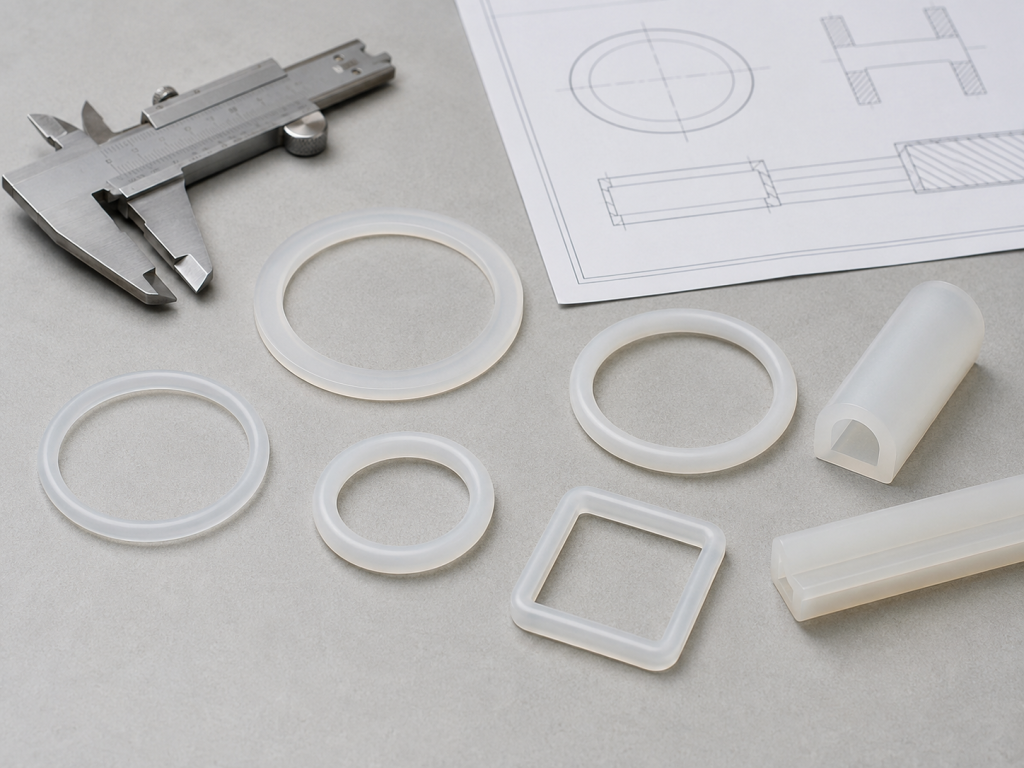
Qu'est-ce qu'une bague d'étanchéité en silicone ?
Une bague d'étanchéité en silicone est un composant en élastomère conçu pour assurer une étanchéité contrôlée entre des pièces assemblées. Lorsque la bague est comprimée à l'intérieur d'une rainure ou entre deux surfaces, elle comble les petits interstices et les irrégularités de surface qui, sans cela, pourraient entraîner des fuites.
Les bagues d'étanchéité en silicone peuvent être fabriquées sous les formes suivantes :
- Joints toriques standard
- Rondelles d'étanchéité plates
- Anneaux à section carrée
- Joints rectangulaires
- Joints en forme de D
- Joints en X
- Joints à lèvre
- Bagues d'étanchéité creuses
- Profilés moulés sur mesure
- Composants d'étanchéité surmoulés en silicone
Le profil approprié dépend de la géométrie de la rainure, du sens de la pression, de la méthode de compression, du procédé d'assemblage et des performances d'étanchéité requises.
Profils courants de bagues d'étanchéité en silicone
Joints toriques
Les joints toriques ont une section transversale circulaire et comptent parmi les composants d'étanchéité les plus courants. Ils conviennent aux applications d'étanchéité statiques et dynamiques lorsqu'ils sont installés dans une rainure correctement conçue.
Parmi les applications courantes, on peut citer :
- Ensembles de vannes
- Corps de pompe
- Armoires électriques
- Raccords de tuyauterie
- Boîtiers de capteurs
- Équipements destinés à l'industrie agroalimentaire
- Ensembles de batteries et de connecteurs
Les joints toriques sont faciles à choisir, mais la fiabilité de l'étanchéité dépend fortement des dimensions de la rainure, du taux de compression, de l'état de surface et du choix du matériau.
Bagues d'étanchéité plates
Les joints d'étanchéité plats en silicone sont souvent utilisés entre deux brides ou deux surfaces d'assemblage planes. Ils conviennent à l'étanchéité à basse pression, à la protection contre la poussière, à la résistance aux projections et à l'isolation contre les vibrations.
On trouve couramment des anneaux plats dans :
- Boîtiers d'éclairage
- Panneaux de commande
- Boîtiers électriques
- Housses pour appareils électroménagers
- Hublots d'inspection
- Couvercles de protection
Par rapport aux joints toriques, les joints plats offrent une surface de contact plus importante, mais peuvent nécessiter une force de serrage mieux maîtrisée.
Bagues carrées et rectangulaires
Les bagues d'étanchéité à section carrée ou rectangulaire permettent un positionnement stable à l'intérieur d'une rainure. Leurs surfaces d'étanchéité planes peuvent limiter le roulement ou la torsion lors de la mise en place.
On y a souvent recours lorsque :
- La rainure est large et peu profonde
- Le joint doit rester stable pendant le montage
- Une surface de contact plane est préférable
- L'application nécessite une compression prévisible
Careful corner-radius and flash-control requirements should be included in the drawing.
Joints en forme de D
D-shaped silicone seals have one flat side and one rounded side. The flat side helps position the seal, while the curved side provides controlled compression.
Ils sont souvent utilisés pour :
- Enclosure doors
- Equipment covers
- Lighting fixtures
- Access panels
- Protective housings
D-shaped profiles can be molded as closed rings or supplied as extruded profiles with bonded ends.
Joints à lèvre
Lip seals use a thin flexible sealing edge rather than a large compressed cross-section. The lip can respond to pressure and surface movement while maintaining contact with the mating surface.
Applications may include:
- Rotating shafts
- Sliding components
- Housses de protection
- Fluid containers
- Dust barriers
Lip geometry must be designed carefully because excessive compression can increase friction or permanently deform the sealing edge.
Hollow Sealing Rings
Hollow silicone sealing rings require less force to compress than solid seals. They are useful when the housing, cover, or mating component cannot withstand high clamping pressure.
Parmi les applications courantes, on peut citer :
- Portes pour gros équipements
- Feuilles de plastique fines
- Glass assemblies
- Sensitive electronic enclosures
- Lightweight housings
The wall thickness, internal cavity, joint design, and compression limit must be controlled to prevent collapse or uneven sealing.
Custom Molded Profiles
Custom sealing rings are used when standard O-rings or flat gaskets cannot meet the design requirements. Custom profiles may include multiple sealing lips, locating features, locking ribs, holes, tabs, or integrated assembly functions.
Custom seals are often preferred when engineers need to:
- Reduce the number of separate components
- Improve installation consistency
- Prevent incorrect assembly
- Combine sealing and cushioning functions
- Fit irregular housing geometry
- Improve automated assembly
How to Select Silicone Hardness
Silicone hardness is commonly specified using the Shore A scale. A lower Shore A value indicates a softer material, while a higher value indicates a firmer material.
Common silicone sealing ring hardness ranges include:
- 20–30 Shore A: very soft and highly compressible
- 40–50 Shore A: soft to medium, suitable for many low-pressure seals
- 60–70 Shore A: firmer, with greater dimensional stability
- 80 Shore A and above: hard silicone for specialized applications
Softer Silicone Seals
Softer silicone can conform more easily to uneven surfaces and may require less assembly force. It is often useful for plastic housings, glass interfaces, low-pressure covers, and surfaces with minor dimensional variation.
Potential disadvantages include:
- Greater risk of extrusion
- Reduced dimensional stability
- More difficult automated installation
- Higher sensitivity to stretching
- Risque accru de compression excessive
Harder Silicone Seals
Harder silicone provides better shape retention and may perform better in grooves with tight dimensional control. It can also resist deformation under higher loads.
Potential disadvantages include:
- Force de serrage plus élevée
- Reduced ability to compensate for uneven surfaces
- Greater dependence on accurate groove dimensions
- Possible leakage if compression is insufficient
For many industrial static sealing applications, 40 to 70 Shore A is a practical starting range. The final hardness should be confirmed through assembly testing and leak validation.
Silicone Material Options
Not all silicone materials provide the same performance. Procurement engineers should specify the required silicone type instead of requesting only “silicone rubber.”
General-Purpose Silicone Rubber
General-purpose silicone is suitable for many industrial seals exposed to moderate temperatures, moisture, air, and outdoor environments.
Typical uses include:
- Equipment covers
- Lighting assemblies
- Armoires électriques
- Appareils électroménagers
- General mechanical products
It provides good flexibility and weather resistance but may not be suitable for aggressive chemicals, fuels, or highly regulated applications.
Caoutchouc de silicone liquide
Liquid silicone rubber, commonly called LSR, is injection molded using a two-component liquid material system. LSR is suitable for high-volume production, complex geometries, thin sections, and precision sealing features.
Parmi les avantages, on peut citer :
- Good repeatability
- Procédé de moulage propre
- High design flexibility
- Stable mechanical performance
- Compatibility with automated production
- Ability to overmold plastics or metal inserts
LSR is often selected for medical devices, electronics, connectors, sensors, and high-volume industrial components.
Caoutchouc à haute consistance
High-consistency rubber, also called HCR or solid silicone rubber, can be compression molded, transfer molded, or extruded.
It is commonly used for:
- Grands joints d'étanchéité
- Extruded gaskets
- Low- to medium-volume parts
- Thick sealing sections
- Custom profiles
HCR tooling can be economical for certain part geometries and production quantities.
Fluorosilicone Rubber
Fluorosilicone combines silicone flexibility with improved resistance to fuels, oils, solvents, and certain chemicals.
It may be considered for:
- Automotive fuel systems
- Composants aérospatiaux
- Oil-exposed equipment
- Specialized industrial sealing
Fluorosilicone generally costs more than standard silicone, so it should be specified only when the chemical environment requires it.
Food-Contact Silicone
Food-contact silicone may be required for equipment, appliances, drinkware, food-processing systems, and kitchen products.
The buyer should define:
- Intended food-contact conditions
- Température de fonctionnement
- Durée du cours
- Marché cible
- Rapports d'essais requis
- Color and odor limitations
A statement such as “food-grade silicone” is not enough by itself. The exact compliance requirements should be included in the purchase specification.
Medical-Grade Silicone
Medical-grade silicone may be used in devices that require controlled biocompatibility, cleanliness, traceability, or sterilization performance.
Procurement documents should identify:
- Type and duration of body contact
- Required biocompatibility testing
- Méthode de stérilisation
- Exigences relatives aux salles blanches
- Traçabilité des lots
- Inspection and documentation requirements
Medical applications should be reviewed individually because the finished part, manufacturing process, additives, pigments, and post-processing steps can all affect compliance.
Temperature Performance
Silicone is widely selected for applications involving elevated or low temperatures. However, the usable temperature range depends on the exact formulation, hardness, exposure time, mechanical load, and surrounding environment.
Before approving a silicone sealing material, confirm:
- Continuous operating temperature
- Short-term peak temperature
- Minimum operating temperature
- Thermal cycling frequency
- Compression during heat exposure
- Contact with steam, oil, chemicals, or cleaning agents
A material that remains flexible at a certain temperature may still experience changes in compression set, tensile strength, elongation, or sealing force.
Compression and Groove Design
A silicone sealing ring must be compressed enough to create contact pressure, but not so much that the seal becomes permanently damaged.
Une compression insuffisante peut entraîner :
- Liquid leakage
- Gas leakage
- Dust entry
- Uneven sealing pressure
- Seal movement inside the groove
Une compression excessive peut entraîner :
- Déformation permanente
- Force d'assemblage élevée
- Premature compression set
- Extrusion de joints d'étanchéité
- Distorsion du marché du logement
- Cracking or tearing during installation
For static seals, engineers often begin with a moderate compression target and then adjust it according to hardness, cross-section, groove geometry, pressure, and application testing.
The design should also allow space for the silicone to expand sideways when compressed. A groove that is completely filled before compression may create excessive stress or prevent correct assembly.
Compression Set
Compression set measures a material’s ability to return toward its original thickness after being compressed for a specified time and temperature.
A low compression-set value is generally preferred for long-term sealing applications because the material can maintain sealing force more effectively.
Compression-set performance is especially important for:
- Heated enclosures
- Long-term static seals
- Systèmes automobiles
- Équipement de plein air
- Industrial ovens
- Produits d'éclairage
- Devices with long service intervals
The buyer should request test data under conditions that are relevant to the actual application, rather than comparing only room-temperature values.
Compatibilité chimique
Standard silicone performs well against water, air, ozone, weathering, and many general environmental conditions. However, it may not be suitable for continuous contact with certain fuels, solvents, acids, oils, or aggressive cleaning chemicals.
Before selecting the material, provide the supplier with:
- Chemical name
- Concentration
- Exposure temperature
- Durée d'exposition
- Pression
- Cleaning frequency
- Required service life
Material compatibility should be verified through testing when the seal is used in a critical application.
Dimensional Tolerances
Silicone is flexible, so dimensions must be measured using appropriate methods. Overly tight tolerances can increase tooling cost, inspection complexity, and rejection rates without improving sealing performance.
Critical dimensions may include:
- Diamètre intérieur
- Diamètre extérieur
- Épaisseur de la section transversale
- Hauteur totale
- Groove engagement
- Parting-line location
- Épaisseur du flash
- Gate location
- Joint dimensions
- Flatness
Procurement drawings should clearly identify which dimensions are critical to sealing and which dimensions are reference values.
For custom rings, it is also important to define the condition in which the part should be measured, such as relaxed, unstretched, or after a specified conditioning period.
Manufacturing Methods
Moulage par compression
Compression molding is commonly used for HCR silicone sealing rings. It is suitable for simple geometries, larger components, and low- to medium-volume production.
Les avantages peuvent inclure :
- Complexité réduite des outillages
- Flexibility for larger parts
- Suitability for thick cross-sections
However, cycle times may be longer than LSR injection molding, and flash control may require additional attention.
Moulage par injection de LSR
LSR injection molding is suitable for precision seals, complex features, thin walls, high production volumes, and automated manufacturing.
Les avantages comprennent :
- Haute répétabilité
- Shorter molding cycles
- Consistent material mixing
- Reduced manual handling
- Integration with inserts and plastic components
Tooling cost is generally higher, so expected annual volume should be considered.
Extrusion and Joint Bonding
Large sealing rings and door gaskets may be manufactured from extruded silicone profiles that are cut and joined into a closed loop.
The joint can become the weakest area of the seal, so the buyer should specify:
- Joint location
- Solidité des articulations
- Comparution conjointe
- Tolérance dimensionnelle
- Leak-testing requirements
- Maximum allowable mismatch
For critical sealing applications, molded closed-loop rings may provide more consistent performance than bonded extruded rings.
Quality Inspection Requirements
A silicone sealing ring should not be approved based only on appearance.
A practical inspection plan may include:
- Contrôle dimensionnel
- Essai de dureté Shore A
- Inspection visuelle
- Inspection rapide
- Tensile and elongation testing
- Essai de déformation rémanente après compression
- Identification des matériaux
- Contrôle d'étanchéité
- Essais de pression
- Essais de vieillissement
- Chemical-resistance testing
- Traçabilité des lots
Visual defects may include:
- Bulles
- Larmes
- Remplissage incomplet
- Contamination
- Traces d'écoulement
- Flash trop puissant
- Décalage de la ligne de joint
- Bosses superficielles
- Variation de couleur
- Damaged joints
For high-volume projects, procurement engineers should agree on an approved limit sample or defect acceptance standard before mass production.
Informations à inclure dans un appel d'offres
To receive an accurate quotation, provide the silicone sealing ring supplier with the following information:
- Dessin en 2D et modèle en 3D
- Seal profile and critical dimensions
- Required hardness
- Silicone material type
- Température de fonctionnement
- Contact chemicals or fluids
- Application statique ou dynamique
- Pression interne ou externe
- Required compression level
- Dimensions des rainures
- Exigences en matière de couleurs
- Exigences réglementaires
- Quantité commandée annuellement
- Initial sample quantity
- Exigences en matière d'inspection
- Exigences en matière d'emballage
- Durée de vie prévue
- Rapports d'essais requis
Providing complete application information can reduce unnecessary sampling rounds and prevent the use of an unsuitable material.
How to Choose a Silicone Sealing Ring Supplier
A qualified supplier should be able to support both manufacturing and application engineering.
Parmi les capacités importantes des fournisseurs, on peut citer :
- Choix du matériau en silicone
- Seal profile review
- Mold-flow and filling analysis
- Tooling design
- Fabrication de prototypes
- Moulage par injection de LSR
- Moulage par compression
- Extrusion de silicone
- Insert molding
- Surmoulage plastique-silicone
- Contrôle dimensionnel
- Contrôle d'étanchéité
- Traçabilité des matériaux
- Emballages sur mesure
For critical projects, ask the supplier to review the groove, compression ratio, parting line, flash location, and assembly method before tooling begins.
Conclusion
The performance of a silicone sealing ring depends on the interaction between profile geometry, hardness, material formulation, groove design, compression, temperature, chemical exposure, and manufacturing quality.
Industrial procurement engineers should avoid selecting a seal based only on diameter and price. A technically suitable sealing ring should be evaluated according to the actual working environment and validated in the final assembly.
When requesting a quotation for a custom silicone sealing ring, provide detailed drawings, operating conditions, material requirements, annual volume, and testing expectations. Early engineering review can reduce leakage risk, shorten development time, and improve long-term sealing reliability.
Foire aux questions
What hardness is best for a silicone sealing ring?
There is no single hardness suitable for every application. Softer silicone provides easier compression and better conformity, while harder silicone offers greater dimensional stability. Many industrial static seals use silicone within the 40–70 Shore A range, but the final choice should be validated in the actual assembly.
Are silicone sealing rings suitable for high temperatures?
Silicone generally performs well at elevated and low temperatures, but the allowable range depends on the formulation, exposure time, compression, and environment. Always confirm continuous and short-term temperature limits with the material supplier.
Can silicone sealing rings resist oil and fuel?
Standard silicone may have limited resistance to certain oils, fuels, and solvents. Fluorosilicone or another elastomer may be more suitable for chemical exposure. Compatibility testing is recommended for critical applications.
What is the difference between an O-ring and a flat silicone sealing ring?
An O-ring has a round cross-section and is normally installed inside a designed groove. A flat sealing ring has a wider contact surface and is often compressed between two flat mating components.
Can silicone sealing rings be custom molded?
Yes. Custom molded rings can include special profiles, lips, ribs, locating tabs, locking features, holes, and integrated functional structures.
Should a sealing ring completely fill the groove?
No. The groove normally requires space for the silicone to expand when compressed. Completely filling the groove may cause excessive stress, high assembly force, and seal damage.
What information is needed to quote a custom silicone seal?
The supplier normally needs a drawing, dimensions, hardness, material type, operating temperature, chemical exposure, annual quantity, application conditions, and inspection requirements.
 English
  Japanese
  Korean
  German
  French
  Italian
  Spanish
  Dutch
Dutch  Chinese
  Portuguese
  Polish
  Czech
Czech  Hungarian
  Swedish
  Finnish
  Vietnamese
  Thai
Thai  Turkish
  Arabic
  Russian