
Silicone sealing rings are widely used in industrial equipment, electronics, fluid-handling systems, lighting products, appliances, automotive assemblies, and medical devices. Their main purpose is to prevent the entry or leakage of liquids, gases, dust, moisture, and contaminants between two mating surfaces.
However, selecting a silicone sealing ring involves more than choosing the correct diameter. The seal profile, silicone grade, hardness, compression level, operating temperature, chemical exposure, dimensional tolerance, and manufacturing process can all affect sealing performance.
This guide explains the key factors industrial procurement engineers should evaluate when sourcing custom silicone sealing rings.
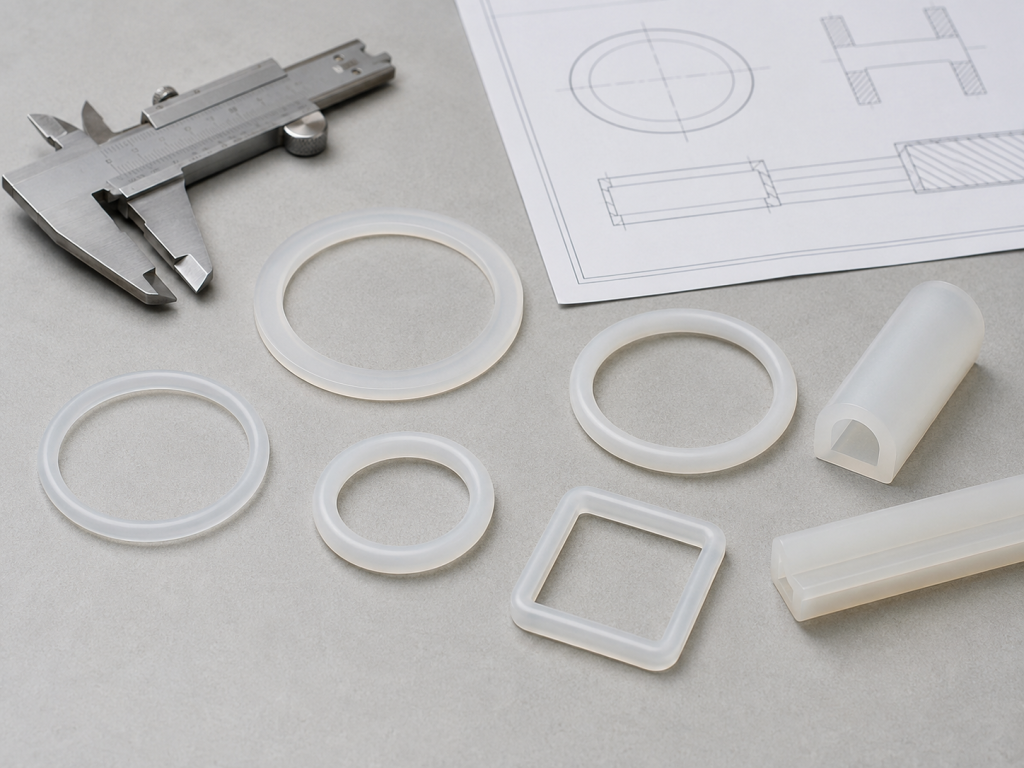
What Is a Silicone Sealing Ring?
A silicone sealing ring is an elastomeric component designed to create a controlled seal between assembled parts. When the ring is compressed inside a groove or between two surfaces, it fills small gaps and surface irregularities that could otherwise allow leakage.
Silicone sealing rings may be manufactured as:
- Vakiomalliset O-renkaat
- Flat sealing washers
- Square-section rings
- Rectangular gaskets
- D-muotoiset tiivisteet
- X-rings
- Huulitiivisteet
- Hollow sealing rings
- Custom molded profiles
- Silicone-overmolded sealing components
The correct profile depends on the groove geometry, pressure direction, compression method, assembly process, and required sealing performance.
Common Silicone Sealing Ring Profiles
O-Rings
O-rings have a round cross-section and are among the most common sealing components. They are suitable for static and dynamic sealing applications when installed in a properly designed groove.
Tyypillisiä käyttökohteita ovat:
- Venttiilikokoonpanot
- Pump housings
- Electrical enclosures
- Putkiliittimet
- Anturikotelot
- Food-processing equipment
- Battery and connector assemblies
O-rings are easy to specify, but sealing reliability depends heavily on groove dimensions, compression ratio, surface finish, and material selection.
Flat Sealing Rings
Flat silicone sealing rings are often used between two flanges or flat mating surfaces. They are suitable for low-pressure sealing, dust protection, splash resistance, and vibration isolation.
Flat rings are commonly found in:
- Valaistuskotelot
- Ohjauspaneelit
- Electrical boxes
- Kodinkoneiden suojukset
- Tarkastusikkunat
- Protective lids
Compared with O-rings, flat seals provide a larger contact area but may require more controlled clamping force.
Square and Rectangular Rings
Square-section and rectangular sealing rings can provide stable positioning inside a groove. Their flat sealing surfaces may reduce rolling or twisting during installation.
They are often selected when:
- The groove is wide and shallow
- The seal must remain stable during assembly
- A flat contact surface is preferred
- The application requires predictable compression
Careful corner-radius and flash-control requirements should be included in the drawing.
D-muotoiset tiivisteet
D-shaped silicone seals have one flat side and one rounded side. The flat side helps position the seal, while the curved side provides controlled compression.
Niitä käytetään usein seuraaviin tarkoituksiin:
- Enclosure doors
- Equipment covers
- Lighting fixtures
- Access panels
- Protective housings
D-shaped profiles can be molded as closed rings or supplied as extruded profiles with bonded ends.
Huulitiivisteet
Lip seals use a thin flexible sealing edge rather than a large compressed cross-section. The lip can respond to pressure and surface movement while maintaining contact with the mating surface.
Applications may include:
- Rotating shafts
- Sliding components
- Suojakannet
- Fluid containers
- Dust barriers
Lip geometry must be designed carefully because excessive compression can increase friction or permanently deform the sealing edge.
Hollow Sealing Rings
Hollow silicone sealing rings require less force to compress than solid seals. They are useful when the housing, cover, or mating component cannot withstand high clamping pressure.
Common applications include:
- Suurten laitteiden ovet
- Ohut muovisuojus
- Glass assemblies
- Sensitive electronic enclosures
- Lightweight housings
The wall thickness, internal cavity, joint design, and compression limit must be controlled to prevent collapse or uneven sealing.
Custom Molded Profiles
Custom sealing rings are used when standard O-rings or flat gaskets cannot meet the design requirements. Custom profiles may include multiple sealing lips, locating features, locking ribs, holes, tabs, or integrated assembly functions.
Custom seals are often preferred when engineers need to:
- Reduce the number of separate components
- Improve installation consistency
- Prevent incorrect assembly
- Combine sealing and cushioning functions
- Fit irregular housing geometry
- Improve automated assembly
How to Select Silicone Hardness
Silicone hardness is commonly specified using the Shore A scale. A lower Shore A value indicates a softer material, while a higher value indicates a firmer material.
Common silicone sealing ring hardness ranges include:
- 20–30 Shore A: very soft and highly compressible
- 40–50 Shore A: soft to medium, suitable for many low-pressure seals
- 60–70 Shore A: firmer, with greater dimensional stability
- 80 Shore A and above: hard silicone for specialized applications
Softer Silicone Seals
Softer silicone can conform more easily to uneven surfaces and may require less assembly force. It is often useful for plastic housings, glass interfaces, low-pressure covers, and surfaces with minor dimensional variation.
Potential disadvantages include:
- Greater risk of extrusion
- Reduced dimensional stability
- More difficult automated installation
- Higher sensitivity to stretching
- Lisääntynyt ylikompressioriski
Harder Silicone Seals
Harder silicone provides better shape retention and may perform better in grooves with tight dimensional control. It can also resist deformation under higher loads.
Potential disadvantages include:
- Suurempi kiristysvoima
- Reduced ability to compensate for uneven surfaces
- Greater dependence on accurate groove dimensions
- Possible leakage if compression is insufficient
For many industrial static sealing applications, 40 to 70 Shore A is a practical starting range. The final hardness should be confirmed through assembly testing and leak validation.
Silicone Material Options
Not all silicone materials provide the same performance. Procurement engineers should specify the required silicone type instead of requesting only “silicone rubber.”
General-Purpose Silicone Rubber
General-purpose silicone is suitable for many industrial seals exposed to moderate temperatures, moisture, air, and outdoor environments.
Typical uses include:
- Equipment covers
- Lighting assemblies
- Electrical enclosures
- Household appliances
- General mechanical products
It provides good flexibility and weather resistance but may not be suitable for aggressive chemicals, fuels, or highly regulated applications.
Nestemäinen silikonikumi
Liquid silicone rubber, commonly called LSR, is injection molded using a two-component liquid material system. LSR is suitable for high-volume production, complex geometries, thin sections, and precision sealing features.
Etuihin kuuluvat:
- Good repeatability
- Puhdas muovausprosessi
- High design flexibility
- Stable mechanical performance
- Compatibility with automated production
- Ability to overmold plastics or metal inserts
LSR is often selected for medical devices, electronics, connectors, sensors, and high-volume industrial components.
Erittäin tiheä kumi
High-consistency rubber, also called HCR or solid silicone rubber, can be compression molded, transfer molded, or extruded.
It is commonly used for:
- Large sealing rings
- Extruded gaskets
- Low- to medium-volume parts
- Thick sealing sections
- Custom profiles
HCR tooling can be economical for certain part geometries and production quantities.
Fluorosilicone Rubber
Fluorosilicone combines silicone flexibility with improved resistance to fuels, oils, solvents, and certain chemicals.
It may be considered for:
- Automotive fuel systems
- Aerospace components
- Oil-exposed equipment
- Specialized industrial sealing
Fluorosilicone generally costs more than standard silicone, so it should be specified only when the chemical environment requires it.
Food-Contact Silicone
Food-contact silicone may be required for equipment, appliances, drinkware, food-processing systems, and kitchen products.
The buyer should define:
- Intended food-contact conditions
- Käyttölämpötila
- Contact time
- Kohdemarkkina
- Vaaditut testiraportit
- Color and odor limitations
A statement such as “food-grade silicone” is not enough by itself. The exact compliance requirements should be included in the purchase specification.
Medical-Grade Silicone
Medical-grade silicone may be used in devices that require controlled biocompatibility, cleanliness, traceability, or sterilization performance.
Procurement documents should identify:
- Type and duration of body contact
- Required biocompatibility testing
- Sterilointimenetelmä
- Cleanroom requirements
- Erän jäljitettävyys
- Inspection and documentation requirements
Medical applications should be reviewed individually because the finished part, manufacturing process, additives, pigments, and post-processing steps can all affect compliance.
Temperature Performance
Silicone is widely selected for applications involving elevated or low temperatures. However, the usable temperature range depends on the exact formulation, hardness, exposure time, mechanical load, and surrounding environment.
Before approving a silicone sealing material, confirm:
- Continuous operating temperature
- Short-term peak temperature
- Minimum operating temperature
- Thermal cycling frequency
- Compression during heat exposure
- Contact with steam, oil, chemicals, or cleaning agents
A material that remains flexible at a certain temperature may still experience changes in compression set, tensile strength, elongation, or sealing force.
Compression and Groove Design
A silicone sealing ring must be compressed enough to create contact pressure, but not so much that the seal becomes permanently damaged.
Riittämätön puristus voi aiheuttaa:
- Liquid leakage
- Gas leakage
- Dust entry
- Uneven sealing pressure
- Seal movement inside the groove
Liiallinen puristus voi aiheuttaa:
- Pysyvä muodonmuutos
- Suuri kokoonpanovoima
- Premature compression set
- Tiivisteen suulakepuristus
- Asuntomarkkinoiden vääristymät
- Cracking or tearing during installation
For static seals, engineers often begin with a moderate compression target and then adjust it according to hardness, cross-section, groove geometry, pressure, and application testing.
The design should also allow space for the silicone to expand sideways when compressed. A groove that is completely filled before compression may create excessive stress or prevent correct assembly.
Puristumajäännös
Compression set measures a material’s ability to return toward its original thickness after being compressed for a specified time and temperature.
A low compression-set value is generally preferred for long-term sealing applications because the material can maintain sealing force more effectively.
Compression-set performance is especially important for:
- Heated enclosures
- Long-term static seals
- Autoteollisuuden järjestelmät
- Outdoor equipment
- Industrial ovens
- Lighting products
- Devices with long service intervals
The buyer should request test data under conditions that are relevant to the actual application, rather than comparing only room-temperature values.
Chemical Compatibility
Standard silicone performs well against water, air, ozone, weathering, and many general environmental conditions. However, it may not be suitable for continuous contact with certain fuels, solvents, acids, oils, or aggressive cleaning chemicals.
Before selecting the material, provide the supplier with:
- Chemical name
- Concentration
- Exposure temperature
- Exposure duration
- Paine
- Cleaning frequency
- Required service life
Material compatibility should be verified through testing when the seal is used in a critical application.
Dimensional Tolerances
Silicone is flexible, so dimensions must be measured using appropriate methods. Overly tight tolerances can increase tooling cost, inspection complexity, and rejection rates without improving sealing performance.
Critical dimensions may include:
- Sisähalkaisija
- Ulkoläpimitta
- Cross-sectional thickness
- Kokonaiskorkeus
- Groove engagement
- Parting-line location
- Välähdyksen kesto
- Gate location
- Joint dimensions
- Flatness
Procurement drawings should clearly identify which dimensions are critical to sealing and which dimensions are reference values.
For custom rings, it is also important to define the condition in which the part should be measured, such as relaxed, unstretched, or after a specified conditioning period.
Manufacturing Methods
Puristusmuovaus
Compression molding is commonly used for HCR silicone sealing rings. It is suitable for simple geometries, larger components, and low- to medium-volume production.
Etuja voivat olla esimerkiksi:
- Lower tooling complexity
- Flexibility for larger parts
- Suitability for thick cross-sections
However, cycle times may be longer than LSR injection molding, and flash control may require additional attention.
LSR-ruiskupuristus
LSR injection molding is suitable for precision seals, complex features, thin walls, high production volumes, and automated manufacturing.
Benefits include:
- Erinomainen toistettavuus
- Shorter molding cycles
- Consistent material mixing
- Reduced manual handling
- Integration with inserts and plastic components
Tooling cost is generally higher, so expected annual volume should be considered.
Extrusion and Joint Bonding
Large sealing rings and door gaskets may be manufactured from extruded silicone profiles that are cut and joined into a closed loop.
The joint can become the weakest area of the seal, so the buyer should specify:
- Joint location
- Joint strength
- Joint appearance
- Mitatoleranssi
- Leak-testing requirements
- Maximum allowable mismatch
For critical sealing applications, molded closed-loop rings may provide more consistent performance than bonded extruded rings.
Quality Inspection Requirements
A silicone sealing ring should not be approved based only on appearance.
A practical inspection plan may include:
- Mitatarkastus
- Shore A hardness testing
- Silmämääräinen tarkastus
- Flash inspection
- Tensile and elongation testing
- Compression-set testing
- Materiaalin tunnistaminen
- Leak testing
- Painekoe
- Aging testing
- Chemical-resistance testing
- Erän jäljitettävyys
Visual defects may include:
- Bubbles
- Tears
- Incomplete filling
- Saastuminen
- Flow marks
- Excessive flash
- Parting-line mismatch
- Surface dents
- Color variation
- Damaged joints
For high-volume projects, procurement engineers should agree on an approved limit sample or defect acceptance standard before mass production.
Information to Include in an RFQ
To receive an accurate quotation, provide the silicone sealing ring supplier with the following information:
- 2D drawing and 3D model
- Seal profile and critical dimensions
- Required hardness
- Silicone material type
- Käyttölämpötila
- Contact chemicals or fluids
- Staattinen vai dynaaminen sovellus
- Sisäinen tai ulkoinen paine
- Required compression level
- Uran mitat
- Color requirements
- Regulatory requirements
- Annual order quantity
- Initial sample quantity
- Inspection requirements
- Pakkausvaatimukset
- Tavoiteltu käyttöikä
- Vaaditut testiraportit
Providing complete application information can reduce unnecessary sampling rounds and prevent the use of an unsuitable material.
How to Choose a Silicone Sealing Ring Supplier
A qualified supplier should be able to support both manufacturing and application engineering.
Important supplier capabilities include:
- Silikonimateriaalin valinta
- Seal profile review
- Mold-flow and filling analysis
- Tooling design
- Prototype production
- LSR-ruiskupuristus
- Compression molding
- Silicone extrusion
- Insert molding
- Plastic-to-silicone overmolding
- Mitatarkastus
- Leak testing
- Materiaalien jäljitettävyys
- Räätälöidyt pakkaukset
For critical projects, ask the supplier to review the groove, compression ratio, parting line, flash location, and assembly method before tooling begins.
Johtopäätös
The performance of a silicone sealing ring depends on the interaction between profile geometry, hardness, material formulation, groove design, compression, temperature, chemical exposure, and manufacturing quality.
Industrial procurement engineers should avoid selecting a seal based only on diameter and price. A technically suitable sealing ring should be evaluated according to the actual working environment and validated in the final assembly.
When requesting a quotation for a custom silicone sealing ring, provide detailed drawings, operating conditions, material requirements, annual volume, and testing expectations. Early engineering review can reduce leakage risk, shorten development time, and improve long-term sealing reliability.
Usein kysyttyjä kysymyksiä
What hardness is best for a silicone sealing ring?
There is no single hardness suitable for every application. Softer silicone provides easier compression and better conformity, while harder silicone offers greater dimensional stability. Many industrial static seals use silicone within the 40–70 Shore A range, but the final choice should be validated in the actual assembly.
Are silicone sealing rings suitable for high temperatures?
Silicone generally performs well at elevated and low temperatures, but the allowable range depends on the formulation, exposure time, compression, and environment. Always confirm continuous and short-term temperature limits with the material supplier.
Can silicone sealing rings resist oil and fuel?
Standard silicone may have limited resistance to certain oils, fuels, and solvents. Fluorosilicone or another elastomer may be more suitable for chemical exposure. Compatibility testing is recommended for critical applications.
What is the difference between an O-ring and a flat silicone sealing ring?
An O-ring has a round cross-section and is normally installed inside a designed groove. A flat sealing ring has a wider contact surface and is often compressed between two flat mating components.
Can silicone sealing rings be custom molded?
Yes. Custom molded rings can include special profiles, lips, ribs, locating tabs, locking features, holes, and integrated functional structures.
Should a sealing ring completely fill the groove?
No. The groove normally requires space for the silicone to expand when compressed. Completely filling the groove may cause excessive stress, high assembly force, and seal damage.
What information is needed to quote a custom silicone seal?
The supplier normally needs a drawing, dimensions, hardness, material type, operating temperature, chemical exposure, annual quantity, application conditions, and inspection requirements.
 English
  Japanese
  Korean
  German
  French
  Italian
  Spanish
  Dutch
Dutch  Chinese
  Portuguese
  Polish
  Czech
Czech  Hungarian
  Swedish
  Finnish
  Vietnamese
  Thai
Thai  Turkish
  Arabic
  Russian