
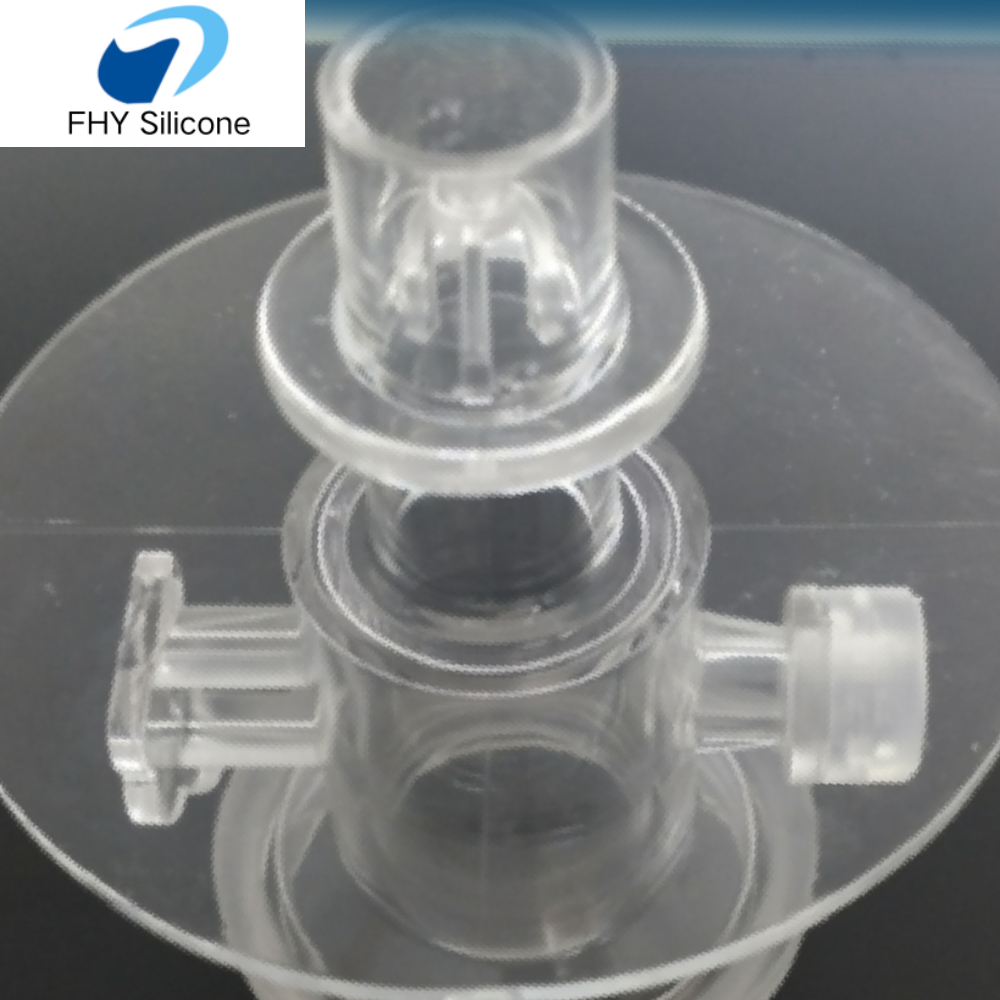
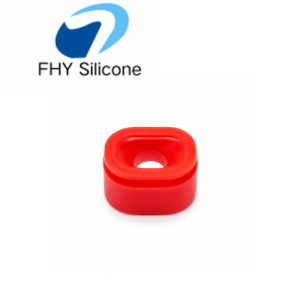
Ce produit est un godet de nébuliseur de qualité médicale conçu pour les appareils de thérapie respiratoire et d'inhalation. Il est fabriqué à l'aide de technologies de pointe Surmoulage en LSR (caoutchouc de silicone liquide) sur PC (polycarbonate) une technologie qui allie les performances structurelles d'un élément rigide à la fonctionnalité d'étanchéité d'un élément souple au sein d'un seul composant intégré.
Sa conception garantit une grande transparence, d'excellentes performances d'étanchéité et une durabilité à long terme dans des conditions de stérilisation répétées, ce qui la rend adaptée aux applications médicales respiratoires critiques.
Principaux avantages de la technologie de surmoulage LSR
Caoutchouc de silicone liquide (LSR) de qualité médicale
Le silicone surmoulé est spécialement conçu pour les applications médicales. Il offre une excellente biocompatibilité et convient aux environnements liés à l'inhalation.
- Conforme à la norme ISO 10993 relative à la biocompatibilité
- Matériau certifié USP Classe VI
- Inodore, non toxique et stable même en cas d'utilisation prolongée
- Convient pour un contact direct ou indirect avec le patient
Performances d'étanchéité supérieures
Le LSR est lié de manière permanente au substrat en PC grâce à un moulage par injection de précision, formant ainsi une interface d'étanchéité sans joint.
- Élimine les joints toriques traditionnels et le montage manuel
- Aucun risque de fuite au niveau des joints
- Étanchéité stable en cas d'utilisation cyclique à long terme
Résistance aux hautes températures et à la stérilisation
Conçu pour résister à des cycles répétés de stérilisation médicale.
- Résistance à la stérilisation à la vapeur : de 121 °C à 134 °C
- Compatible avec la stérilisation par EO et par rayons gamma
- Aucune déformation, fissure ou décoloration après des cycles répétés
Structure en PC à haute transparence
Le boîtier en PC offre une excellente transparence optique et une grande résistance mécanique.
- Visibilité claire du niveau de liquide et de l'état du débit
- Haute résistance aux chocs
- Dimensional stability under thermal stress
Integrated One-Piece Structure
LSR overmolding enables a fully integrated soft-hard design.
- Réduction du nombre d'étapes d'assemblage
- Amélioration de la régularité de la production
- Lower risk of human assembly error
- Enhanced product reliability
Processus de fabrication
The product is produced through a precision two-step injection molding process:
- PC Injection Molding
Medical-grade polycarbonate is molded into the structural base, forming the rigid housing and internal flow channels. - LSR Overmolding
Liquid silicone rubber is injected onto the PC substrate, forming soft sealing structures and functional interfaces. - Permanent Bonding Formation
Under controlled temperature and pressure, LSR chemically or mechanically bonds with PC, forming a durable integrated structure.
Caractéristiques techniques
| Article | Description |
|---|---|
| Nom du produit | LSR Overmolded PC Nebulizer Cup |
| Système de matériaux | Liquid Silicone Rubber + Polycarbonate |
| Processus | Two-Shot Injection Molding (LSR Over PC) |
| Matériau de base | Medical Grade PC |
| Matériau de surmoulage | LSR de qualité médicale |
| Transparence | High optical clarity |
| Résistance à la température | -40°C to 134°C |
| Sterilization Methods | Autoclave, EO, Gamma |
| Biocompatibilité | ISO 10993 / USP Class VI |
| Type de structure | Soft-hard integrated sealing component |
| Reusability | Designed for repeated use |
Applications
- Medical nebulizer systems
- Respiratory therapy devices
- Inhalation drug delivery equipment
- ICU respiratory support systems
- Home healthcare nebulization devices
- Medical gas and fluid control systems
Engineering Challenges and Solutions
LSR to PC Bonding Stability
Silicone rubber has natural chemical inertness, making adhesion to PC challenging. This is solved through:
- Self-bonding medical-grade LSR formulations
- Surface activation or primer treatment on PC
- Controlled mold temperature for optimal chemical bonding
Thermal Processing Balance
PC and LSR have different thermal requirements.
- PC has a limited heat deflection temperature range
- LSR requires high curing temperature for vulcanization
- Requires optimized mold temperature and high-heat PC materials
Precision Flash Control
Due to the very low viscosity of LSR:
- Mold tolerance must be controlled at micron level
- High-precision tooling is required to prevent flash formation
- Critical for medical-grade surface quality
Foire aux questions
What is the benefit of LSR overmolding compared to traditional assembly?
LSR overmolding eliminates separate sealing components such as O-rings, reducing leakage risk and improving long-term stability.
Is the product suitable for repeated sterilization?
Yes, it is designed for repeated autoclave sterilization between 121°C and 134°C without performance degradation.
Does the silicone become hard or degrade over time?
Medical-grade LSR maintains elasticity and mechanical stability under long-term use.
Le design peut-il être personnalisé ?
Yes, customization is available for geometry, hardness, color, and sealing structure based on application requirements.
 English
  Japanese
  Korean
  German
  French
  Italian
  Spanish
  Dutch
Dutch  Chinese
  Portuguese
  Polish
  Czech
Czech  Hungarian
  Swedish
  Finnish
  Vietnamese
  Thai
Thai  Turkish
  Arabic
  Russian
Avis
Il n’y a pas encore d’avis.