
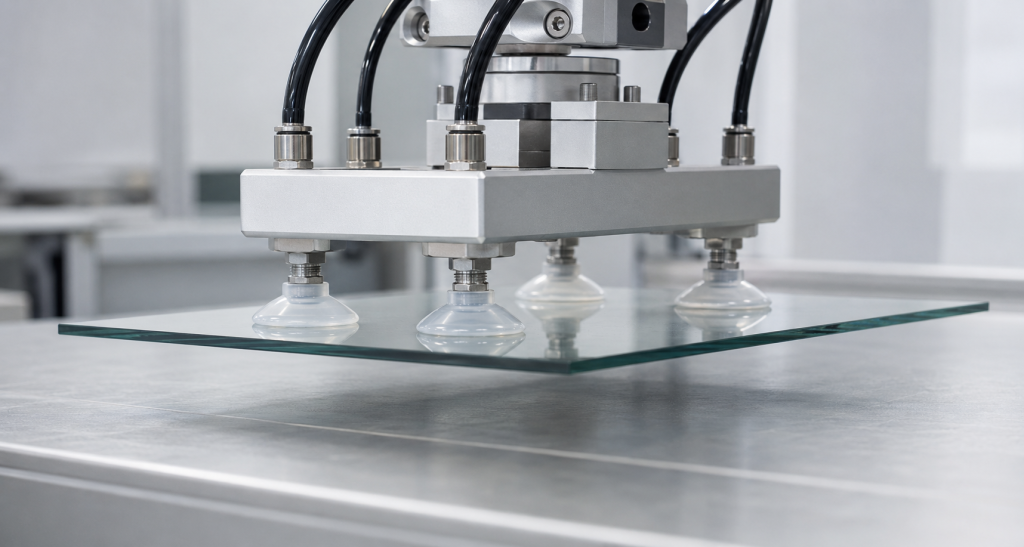
矽膠吸盤是利用吸盤內部與周圍大氣之間的壓力差,來抬起、定位、固定或暫時固定產品。.
應用範圍包括:
- 機器人拾放系統
- 食品與包裝設備
- 玻璃處理
- 電子元件組裝
- 醫療設備
- 塑膠零件的處理
- 鈑金轉移
- 家電製造
- 家用吸盤式支架
- 客製化真空夾具
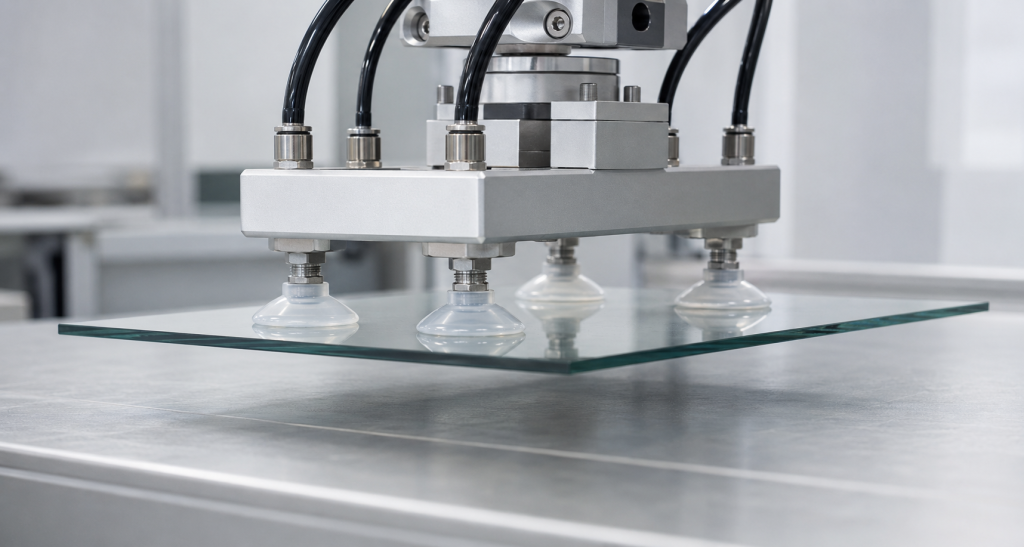
一個能在乾淨的實驗室玻璃上正常運作的吸盤,在油膩的金屬面板、帶紋理的塑膠外殼或多孔紙箱上可能無法發揮作用。其性能是否可靠,不僅取決於吸盤直徑或真空度。.
工程師必須協調:
- 有效吸力範圍
- 可用真空壓力
- 安全係數
- 加速度與載荷方向
- 工件表面
- 嘴唇的柔韌性
- 杯體幾何形狀
- 矽膠硬度
- 真空流量
- 洩漏率
- 使用溫度與環境
真空吸盤是如何產生吸附力的
當吸盤接觸到表面時,封閉空間內的空氣便會被抽走。此時,吸盤外側的大氣壓力便會將吸盤壓向工件。.
理論保持力為:
F = Δp × A
地點:
- F 是理論上的保持力
- Δp 即為環境壓力與杯內壓力之間的差值
- A 是指有效吸力面積
施馬爾茨(Schmalz)採用相同的關係式,並強調吸力與壓差及有效面積成正比。. 施馬爾茨真空吸盤的工作原理
有效面積不總是等於外徑
該杯子的名義外徑可能大於其實際密封面積。.
有效面積取決於:
- 密封唇的內徑
- 唇部變形
- 工件曲率
- 盃賽慘敗
- 內部支撐肋條
- 真空度
- 表面不平整
- 施加的預載力
如有供應商公布的有效面積,請採用該數值。若為客製化杯體,則應透過幾何分析及實體夾持力測試來確定有效面積。.
夾持力計算範例
假設有一個有效直徑為 50 毫米、在 60 kPa 壓差下運作的杯子。.
有效面積約為:
A = π × D² ÷ 4
A = 3.1416 × 0.05² ÷ 4 ≈ 0.00196 平方公尺
理論上的靜態保持力為:
F = 60,000 Pa × 0.00196 m² ≈ 118 N
這大致相當於作用於 12 公斤物體上的重力,但這並非安全工作負載額定值。.
若在計算其他損失之前先採用安全係數 2,則初步工作力約為:
118 N ÷ 2 = 59 N
動態加速度、側向載荷、表面滲漏、載荷分布以及軸承座磨損,都可能進一步降低允許載荷。.
為何理論持力並非工作負載
該理論公式假設:
- 完全氣密密封
- 均勻壓力
- 一個穩定的有效面積
- 無加速
- 無側向載荷
- 表面無污染
- 軟管或接頭無洩漏
- 杯體無變形
- 無磨損
實際的生產系統很少能完全符合這些假設。.
Schmalz 指出,計算出的夾持力僅為理論值,並建議針對實際應用進行驗證,因為吸盤的幾何形狀、表面粗糙度及工件變形都會影響性能。該公司亦建議採用安全係數,且針對旋轉載荷應採用較高的安全係數。. Schmalz 吸盤設計指南
最終的安全係數應依據機台的風險評估、適用法規、載荷方向以及零件掉落所造成的後果來決定。.
載荷方向
一般舉重
當吸盤從上方提起水平工件時,載荷的作用方向大致與密封面垂直。.
雖然仍須將加速度和力矩納入考量,但吸力會直接抵消該載荷。.
側向或剪切載荷
當吸盤夾持垂直面板時,重力作用方向與工件表面平行。此時,系統的穩定性取決於吸盤與工件之間的摩擦力。.
可用的側向力可近似計算如下:
Fₗₐₜₑᵣₐₗ = μ × Fₙₒᵣₘₐₗ
地點:
- μ 是摩擦係數
- Fₙₒᵣₘₐₗ 是正常的吸力嗎
必須在實際的矽膠與工件狀態下測量摩擦係數。.
施馬爾茨指出,由於表面粗糙度、濕度、油污、吸盤材質、唇緣幾何形狀及硬度都會影響結果,因此無法賦予一個通用的摩擦係數。. Schmalz 夾持力計算
傾斜與旋轉的負載
當工件傾斜或旋轉時,會產生剪切力與剝離力矩。載荷一側的杯狀結構所承受的力,可能遠大於其他側。.
請採用較高的安全裕度,並測試完整的運動曲線。.
動態荷載
對於一個運動系統而言,所需的作用力包含加速度。.
一個簡化的負載估算如下:
所需力 = 質量 × (重力 + 加速度)
該分析應包含:
- 垂直加速度
- 水平加速度
- 機器人緊急停止
- 方向逆轉
- 旋轉
- 工件振動
- 碰撞或衝擊
- 軟管作用力
一個能安全固定靜止部件的系統,在快速加速時可能會釋放該部件。.
重心與力矩
重心應始終保持在吸盤所形成的支撐範圍內。.
若負載發生偏移:
- 其中一個杯子可能裝得過滿。.
- 其中一側嘴唇可能會開始脫皮。.
- 工件可能會旋轉。.
- 其中一側可能出現真空洩漏。.
當工件產生較大的翻轉力矩時,請增加吸盤間距、重新調整吸盤位置,或使用剛性較高的支撐板。.
多個吸盤
使用多個杯子可以增加總容量和穩定性,但負載可能無法均勻分配。.
不均勻的載荷可能由以下原因造成:
- 工件翹曲
- 不同的杯身高度
- 安裝不平整
- 軟管壓力損失
- 表面變化
- 杯體磨損
- 偏移的重心
水平補償器或波紋管有助於使量杯能穩定地接觸表面。.
安全分析還應考量,若其中一個杯子失去密封性,將會發生什麼情況。.
矽膠吸盤的形狀
平底吸盤
平底杯具有良好的穩定性,且本身移動幅度有限。它們適用於相對平坦、光滑的表面。.
Piab 表示,其平坦矽膠吸盤設計適用於平坦物體,內部設有防滑齒,有助於防止薄型產品變形,並在平行受力時提升摩擦力。. Piab 平面矽膠吸盤
波紋管吸盤
波紋管杯可適應高度差異、曲面以及某些角度偏移。.
他們可以提供:
- 水平補償
- 更輕柔的接觸
- 短程提升動作
- 針對表面不平整的工件,適應性有所提升
可能的缺點包括:
- 更大的橫向移動幅度
- 定位精度降低
- 高真空狀態下的杯體崩塌
- 更複雜的成型
- 摺痕處的疲勞加劇
深吸盤
深型吸盤可貼合彎曲或凸起的物體。吸盤的輪廓必須與預期工件的曲率相符。.
橢圓形吸盤
橢圓形吸盤適用於長而窄的工件,因為在這種情況下,面積相等的圓形吸盤會超出可用寬度。.
應用範圍包括:
- 管子
- 個人檔案
- 窄型包裝
- 細長型電子元件
橢圓形杯體需要良好的防旋轉支撐。.
多唇吸盤
多重密封唇可提供額外的接觸線,並有助於改善在略有不平整表面上的密封效果。然而,必須考量到可能積聚的污染物以及較高的成型複雜度。.
密封唇設計
吸盤的邊緣是吸盤中最關鍵的部分。.
重要的變數包括:
- 嘴唇厚度
- 唇角
- 唇長
- 邊緣半徑
- 根半徑
- 內徑
- 外徑
- 表面處理
- 同心度
- 材料硬度
薄唇
薄唇能適應表面的小幅不平整,並在低預緊力下形成密封。.
潛在風險包括:
- 摺疊
- 皺褶
- 快速磨損
- 撕裂
- 對閃光燈的敏感度
- 搬運過程中的變形
厚嘴唇
較厚的唇緣雖然更穩定且耐磨,但可能需要更大的預緊力,且可能無法貼合帶紋理的表面。.
唇緣
密封邊緣應平滑且連續。.
應避免:
- 密封邊緣上的模具分型線
- Flash
- 城門遺跡
- 銳利的缺口
- 表面污染
- 局部厚度變化
某處的一個微小缺陷,便可能形成一條連續的洩漏路徑。.
內部卡榫與支撐肋條
內置防滑齒可:
- 防止薄工件被深深吸入杯中
- 維持有效的真空容積
- 增加摩擦
- 限制杯體塌陷
- 襯底薄膜與片材
防滑釘不應在產品上留下痕跡,亦不應阻礙杯身不同區域之間的氣流。.
真空接頭設計
真空接頭應能有效將吸盤抽空,同時避免將柔性材料吸入開口處。.
請考慮:
- 埠直徑
- 港口位置
- 濾網或網眼
- 內部流道
- 軟管直徑
- 安裝限制
- 工件卡住的風險
若開口過小,可能會延長疏散時間;若開口過大,則可能導致薄膜被吸入開口內。.
平整、光滑且無孔的表面
例如:
- 玻璃
- 拋光金屬
- 塗層板
- 光滑的塑膠
- 釉面陶瓷
這些表面通常洩漏量較低,但污染物仍可能降低其性能。.
檢查項目:
- 石油
- 灰塵
- 水膜
- 保護性塗層
- 刮痕
- 黴菌質地
- 表面曲率
粗糙或帶有紋理的表面
帶有紋理的塑膠、鑄造金屬及帶有圖案的產品,其密封唇下方含有微觀通道。.
可能的設計方案包括:
- 更柔軟的矽膠
- 較薄的嘴唇
- 更寬的密封區域
- 多重密封唇
- 更高的真空流量
- 較大的杯子
- 較低的操控加速度
僅靠增加真空深度,可能無法消除連續的洩漏路徑。.
多孔表面
紙板、木材、布料和泡棉可能會讓空氣穿過工件本身。.
對於多孔材料,真空源必須以足夠的流量持續抽除空氣。即使真空杯只能達到中等程度的真空度,只要流量足夠,仍能固定住工件。.
與傳統的密封杯相比,高流量或面積夾持系統可能更為合適。.
施馬爾茨指出,透過高氣流量進行洩漏補償,使某些真空系統能夠處理多孔工件。. 施馬爾茨(Schmalz)真空產生原理
油膩或潮濕的表面
油和水可能會影響:
- 摩擦
- 唇部密封
- 杯的移動
- 表面污染
- 矽膠相容性
- 釋放行為
潮濕的表面雖然在正常方向上能有效密封,但在側向摩擦方面卻非常微弱。.
在預期最嚴重的污染水平下,同時測試抓持力與抗滑性。.
曲面
杯體必須與表面沿其整個密封周緣緊密接觸。.
針對凸面零件:
- 唇緣需要具備足夠的柔韌性,才能緊密貼合曲面。.
- 在唇形密封圈起作用之前,杯體絕不能觸底。.
- 該配件應與工件保持一定距離。.
針對凹面部件:
- 杯緣可能會在表面上形成橋接。.
- 有效面積可能會有所變動。.
- 空氣可能會滯留在不規則的區域中。.
請在詢價單中註明表面半徑的最小值與最大值。.
軟性薄膜與袋子
薄膜可能會被吸入杯中、堵塞真空口,或產生永久性的皺褶。.
用途:
- 內部支撐卡榫
- 受控真空度
- 更大的接觸面積
- 纖薄且貼合的唇部
- 充足的氣流
- 輕柔地釋放壓力
Piab 提供專為盛裝液體、高黏度產品及冷凍食品的袋裝產品所設計的強化多波紋管矽膠吸盤,並說明吸盤的幾何形狀與強化結構必須如何配合工件的特性。. Piab 矽膠多波紋管吸盤
高溫與低溫工件
矽膠雖適用於廣泛的溫度範圍,但仍須對整個杯體組件進行評估。.
溫度會影響:
- 矽膠硬度
- 唇部修復
- 摩擦
- 真空軟管
- 金屬配件
- 黏合或嵌件接合
- 產品表面
- 循環壽命
請勿直接將矽膠化合物的最高溫度視為完成後吸盤的連續工作溫度上限。.
食品接觸應用
某些矽膠配方雖能符合食品接觸要求,但矽膠並不一定就是食品級的。.
請確認:
- 適用的食品接觸法規
- 顏料符合性
- 固化與後固化製程
- 清潔方法
- 可萃取物
- 可追溯性
- 最高溫度
- 接觸時間
Piab 列出部分透明矽膠吸盤符合 FDA 21 CFR 177.2600 及歐盟 1935/2004 規範。此項符合性僅適用於特定等級的產品,不應一概而論地套用至所有矽膠材料。. Piab 食品級矽膠吸盤
矽膠硬度
更柔軟的矽膠
潛在優勢:
- 更佳的表面貼合度
- 降低接觸預載
- 針對細微紋理的密封效果已獲得改善
- 輕柔處理易碎產品
可能的缺點:
- 杯體變形更嚴重
- 側向穩定性較低
- 嘴唇摺疊
- 磨損速度較快
- 更為困難的尺寸檢測
較硬的矽膠
潛在優勢:
- 更好的造型保持力
- 更佳的橫向穩定性
- 組裝過程中的操作便利性有所提升
- 降低坍塌風險
可能的缺點:
- 較高的預載力
- 符合性降低
- 在粗糙表面上發生滲漏的風險較高
- Greater marking pressure
Hardness must be selected together with lip thickness and cup geometry.
Chemical Compatibility
Suction cups may contact:
- Oils
- Grease
- 清潔劑
- Food fats
- Detergents
- Coolants
- Release agents
- Solvents
ASTM D471 provides comparative methods for evaluating changes in rubber after liquid exposure, including changes in mass, volume, hardness and tensile properties. ASTM D471-16a(2021)
Test the production silicone and complete suction cup after exposure to the actual process fluid.
Understanding Vacuum Leakage
Leakage is the airflow entering the vacuum system while the cup is attached.
It can occur through:
- The cup-to-workpiece sealing edge
- A porous workpiece
- Surface scratches
- 黴菌質地
- Cup cracks
- Fittings
- Hoses
- Valves
- Insert-to-silicone interfaces
- Molded flash or defects
A stable vacuum requires the vacuum source to remove air at least as quickly as it enters.
Vacuum Depth Versus Vacuum Flow
Vacuum depth and airflow are different parameters.
- Vacuum depth determines the available pressure difference.
- Vacuum flow determines how quickly the system evacuates and compensates for leakage.
For a smooth, sealed surface, a relatively low-flow source may maintain vacuum once the cup is evacuated.
For a porous or leaking surface, high flow may be more important than achieving deep vacuum.
Vacuum-Decay Testing
Vacuum-decay testing evaluates the sealing quality of the cup and workpiece interface.
A typical method includes:
- Place the cup on the production-representative surface.
- Apply a defined preload.
- Evacuate to the target vacuum level.
- Isolate the vacuum source.
- Record pressure change over a defined time.
- Repeat at the expected temperature and surface conditions.
請指定:
- Initial vacuum
- Stabilization time
- Test duration
- Maximum pressure rise
- Workpiece material
- 表面處理
- Cup conditioning
- Test temperature
- 施加的預載力
Leakage-Flow Testing
For continuously leaking surfaces, isolating the vacuum source may cause immediate release.
Instead, measure the airflow required to maintain a specified vacuum level.
This method is useful for:
- Porous cardboard
- Wood
- Textured plastic
- Fabric
- Foam
- Rough castings
The vacuum generator should provide sufficient flow with an appropriate safety margin.
Pull-Off Testing
A pull-off test measures the force required to separate the cup from the surface in the normal direction.
The test should define:
- 真空度
- Cup preload
- Dwell time
- Pulling speed
- Pull direction
- 工件表面
- 溫度
- Cup age
- Number of cycles
Peak pull-off force may include elastic adhesion and peeling effects. Do not use the maximum laboratory value directly as the machine’s safe working load.
Lateral Slip Testing
For vertical or angled surfaces, test the force required to initiate sliding.
Measure using:
- Actual silicone formulation
- Actual surface finish
- Dry condition
- Wet condition
- Oily condition
- Minimum and maximum temperature
The lowest repeatable value should be used in the design calculation with an appropriate safety factor.
Dynamic Holding Test
A production-representative test should reproduce:
- Robot acceleration
- Deceleration
- 旋轉
- Direction changes
- Expected cycle time
- Workpiece variation
- Hose movement
- Emergency-stop condition
Monitor the minimum vacuum level during the motion rather than only at the pickup position.
Release Behavior
Reliable pickup is only half of the process. The cup must release the workpiece predictably.
Release problems can result from:
- Soft lip adhesion
- Residual vacuum
- Static electricity
- Oily surfaces
- Sticky products
- Slow valve response
- Insufficient blow-off flow
Controlled positive-pressure blow-off can shorten release time, but excessive pressure may damage the lip or eject lightweight parts unpredictably.
Fatigue and Wear
Suction cups repeatedly flex during contact, evacuation and release.
Common wear locations include:
- Sealing edge
- Lip root
- Bellows folds
- Insert interface
- Areas contacting sharp product edges
A cycle-life test should include:
- Normal operating vacuum
- Actual preload
- Workpiece texture
- Handling frequency
- 溫度
- 清潔流程
- Release pressure
- Periodic leak and force measurements
Replacement intervals should be based on performance change rather than visible failure alone.
Fitting and Insert Design
Custom silicone cups may include:
- Metal threaded inserts
- Plastic snap-in fittings
- Hose barbs
- Filters
- Check valves
- Reinforcement rings
The insert must withstand:
- Axial pull
- Torque
- Vacuum cycling
- 溫度變化
- 清潔
- Hose loads
Possible attachment methods include:
- Mechanical locking
- Overmolding
- 黏合
- 卡環
Mechanical undercuts are generally more reliable than depending only on surface adhesion.
Manufacturing Considerations
Custom silicone suction cups may be produced by:
- Liquid silicone rubber injection molding
- 壓縮成型
- 轉注成型
- Silicone-to-metal overmolding
Critical tooling features include:
- Sealing-lip thickness
- Lip concentricity
- Parting-line position
- Port geometry
- Bellows wall thickness
- Insert location
- Gate position
- 發洩
Flash Control
Flash at the sealing edge can create leakage or inconsistent holding force.
Specify flash limits for:
- Outer lip
- Inner sealing edge
- Vacuum port
- Bellows folds
- Insert interface
The most critical sealing edge should not require uncontrolled manual trimming.
尺寸檢測
Possible inspection methods include:
- Optical measurement
- Vision inspection
- Non-contact profile measurement
- Controlled plug gauges
- Wall-thickness measurement
- Vacuum-decay testing
- Pull-off-force sampling
Soft silicone deforms during contact measurement, so inspection force and fixture design must be controlled.
Common Suction-Cup Failures
| Failure | Likely cause | Corrective direction |
|---|---|---|
| Cup will not seal | Surface texture, damaged lip or low preload | Use a more flexible lip and inspect the surface |
| Vacuum is reached slowly | Restricted port or excessive system volume | Review port, hose and generator flow |
| Vacuum cannot be maintained | Continuous leakage or porous workpiece | Increase flow or change gripping technology |
| Cup slides sideways | Low friction, oil or insufficient normal force | Test friction and revise cup layout |
| Workpiece drops during acceleration | Dynamic force exceeds working capacity | Increase effective area or reduce acceleration |
| Lip folds inward | Lip too soft, thin or overcompressed | Revise geometry and preload |
| Thin film blocks the port | Insufficient internal support | Add cleats or a filter screen |
| Workpiece is marked | Excessive preload, vacuum or local pressure | Use softer geometry and better support |
| Cup remains attached during release | Residual vacuum or material adhesion | Improve valve response and blow-off |
| Early lip cracking | Abrasive surface, sharp edge or fatigue | Improve material, geometry or replacement interval |
| Uneven multi-cup loading | Height variation or warped workpiece | Add level compensation and improve mounting |
| Insert pulls out | Weak bonding or insufficient mechanical lock | Add undercuts and validate pull/torque strength |
Prototype Validation Plan
1. Surface Review
Collect production samples representing:
- Smoothest surface
- Roughest surface
- Minimum and maximum curvature
- Dry condition
- Wet or oily condition
- Maximum porosity
- Temperature extremes
2. Geometry Prototypes
Compare:
- Cup diameter
- Flat versus bellows designs
- 嘴唇厚度
- 矽膠硬度
- Internal cleats
- Port size
3. Static Testing
Measure:
- 真空度
- Evacuation time
- 洩漏率
- Normal pull-off force
- Lateral slip force
4. Dynamic Testing
Run the actual movement profile with the maximum workpiece mass and worst center-of-gravity position.
5. Environmental Testing
Evaluate relevant:
- 溫度
- 化學品
- Cleaning cycles
- 紫外線照射
- Food-contact cleaning
- Abrasive contamination
6. Cycle-Life Testing
Monitor holding force and leakage at defined intervals until the replacement criterion or failure limit is reached.
7. Pilot Production
Check variation by:
- Mold cavity
- Material lot
- Insert lot
- 工件表面
- Test fixture
詢價單核對清單
Provide the following information when requesting a custom silicone suction cup quotation:
- 2D drawing and 3D model
- Workpiece material
- Surface finish and roughness
- 表面曲率
- Workpiece porosity
- Maximum weight
- Center-of-gravity location
- Load orientation
- Robot acceleration
- Number and spacing of cups
- Available vacuum level
- Vacuum-source flow
- Required evacuation time
- Maximum leakage rate
- 溫度範圍
- Oil, chemical or cleaning exposure
- 食品接觸相關要求
- 矽膠硬度
- Fitting type and thread
- Required cycle life
- Permitted surface marks
- 年產量
- Inspection and traceability requirements
If the suction-cup dimensions have not been finalized, provide samples of the workpiece and the complete handling motion. This allows prototype geometries to be tested under realistic conditions.
常見問題
How is suction-cup holding force calculated?
Theoretical holding force equals the pressure difference multiplied by the effective suction area. A safety factor, acceleration, load direction, friction, leakage and cup deformation must then be considered.
Is the outside diameter the effective suction diameter?
Not always. The effective area is normally determined by the inside sealing boundary and can change when the lip deforms.
Why does the cup hold glass but not textured plastic?
Glass is usually smooth and nonporous. Textured plastic creates leakage paths under the sealing lip and may require a softer lip, higher flow or a different cup geometry.
Does a deeper vacuum always improve performance?
No. A continuous leak may prevent deep vacuum, and some flexible cups can collapse or deform at excessive vacuum levels. Flow capacity may be more important on porous surfaces.
Are silicone suction cups suitable for oily surfaces?
They may seal, but oil can greatly reduce lateral friction and may affect the silicone over time. Holding, slip and compatibility tests are required.
Can silicone suction cups contact food?
Only when the specific silicone formulation, pigment, manufacturing process and finished component meet the applicable food-contact requirements.
Why does a suction cup fail during robot movement?
Acceleration, rotation or an offset center of gravity may create forces and moments higher than the static holding calculation.
How should vacuum leakage be tested?
Use vacuum-decay testing for sealed surfaces and leakage-flow testing for porous or continuously leaking surfaces. Define the vacuum level, preload, surface and test duration.
結論
Reliable silicone suction-cup design requires more than selecting a diameter and vacuum pressure. Effective area establishes the theoretical force, while surface condition, friction, acceleration, leakage and cup geometry determine the usable working load.
Prototype testing on actual workpieces is essential, especially for textured, porous, curved, oily or flexible products. Send your workpiece samples, surface information, load, motion profile and available vacuum data for a custom suction-cup DFM and performance evaluation.
 English
  Japanese
  Korean
  German
  French
  Italian
  Spanish
  Dutch
Dutch  Chinese
  Portuguese
  Polish
  Czech
Czech  Hungarian
  Swedish
  Finnish
  Vietnamese
  Thai
Thai  Turkish
  Arabic
  Russian