
Silicone products are widely used across modern industries due to their excellent flexibility, heat resistance, chemical stability, and electrical insulation properties. From consumer electronics and automotive systems to medical devices and household products, silicone materials have become an essential part of product design and manufacturing.
With the increasing demand for high-performance and safe materials, silicone has gradually replaced traditional rubber and plastic in many applications. But what exactly are silicone products, and why are they so widely used?
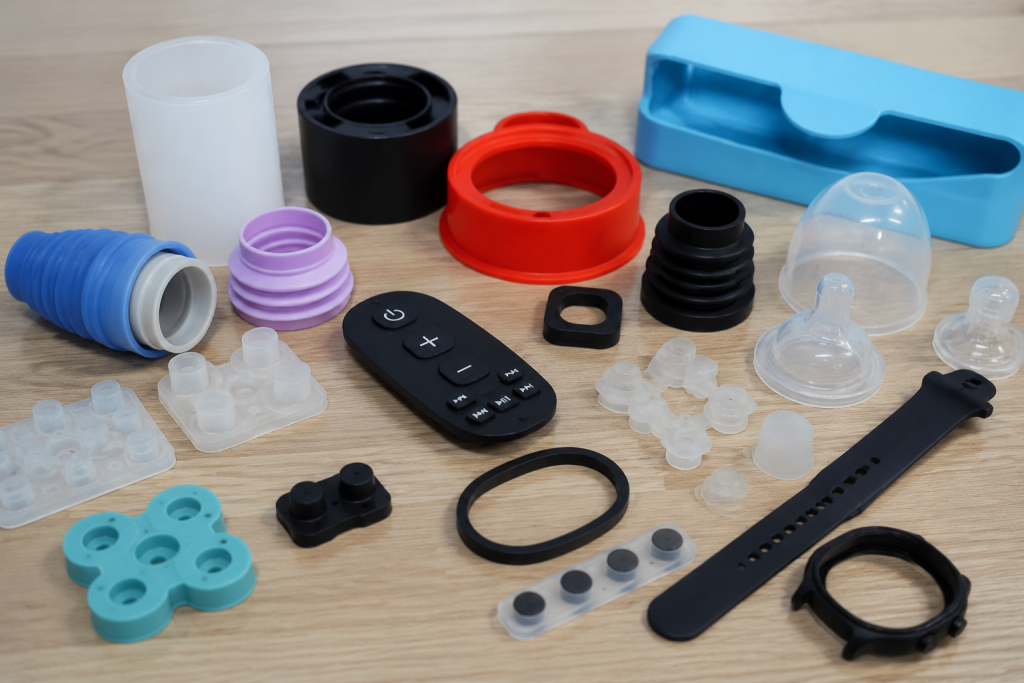
What Are Silicone Products?
Silicone products refer to manufactured items made primarily from silicone rubber materials. Silicone is a synthetic elastomer derived from silicon, oxygen, carbon, and hydrogen. It features a unique molecular structure that provides both rubber-like flexibility and excellent thermal stability.
Unlike traditional materials, silicone maintains stable performance under extreme conditions such as high temperatures, low temperatures, and long-term mechanical stress.
Key Properties of Silicone Materials
Silicone products are valued for the following characteristics:
- Excellent temperature resistance (-60°C to 250°C)
- High flexibility and elasticity
- Strong electrical insulation
- Chemical and UV resistance
- Non-toxic and odorless properties
- Biocompatibility (medical-grade materials)
These properties make silicone suitable for both industrial and consumer applications.
Main Types of Silicone Materials
1. Medical Grade Silicone
Used in healthcare applications requiring strict safety standards. It meets biocompatibility requirements such as ISO 10993.
Applications:
- Medical tubing
- Surgical accessories
- Healthcare device components
2. Food Grade Silicone
Complies with FDA and food safety regulations, designed for direct food contact applications.
Applications:
- Kitchenware
- Baby feeding products
- Food sealing components
3. Industrial Grade Silicone
Focused on durability and performance under harsh environments.
Applications:
- Automotive components
- Electronic sealing parts
- Industrial vibration pads
Common Manufacturing Processes
Silicone products are typically manufactured using advanced molding technologies, including:
- Compression molding
- Liquid Silicone Rubber (LSR) injection molding
- Silicone overmolding
- Extrusion molding
Among them, LSR injection molding is widely used for high-precision and high-volume production.
Applications of Silicone Products
Silicone materials are used in a wide range of industries:
Electronics Industry
Silicone is used in keypads, seals, protective covers, and insulation components due to its electrical insulation properties.
Medical Industry
Used in medical devices, tubing, and wearable healthcare products due to its biocompatibility and safety.
Automotive Industry
Applied in seals, gaskets, vibration dampers, and heat-resistant engine components.
Consumer Products
Found in kitchenware, baby products, wearable accessories, and household items.
Industrial Applications
Used for sealing, insulation, shock absorption, and protective components in machinery.
Advantages of Silicone Products
Silicone offers several key advantages over traditional materials:
- Long service life and durability
- Stable performance in extreme environments
- Safe for human contact applications
- High design flexibility for customization
- Suitable for mass production with consistent quality
Why Silicone Is Replacing Traditional Materials
Compared to rubber and plastic, silicone provides better thermal stability, chemical resistance, and environmental safety. This makes it a preferred material in industries where performance and safety are critical.
Conclusion
Silicone products play an important role in modern manufacturing across multiple industries. With their excellent physical and chemical properties, they provide reliable performance in demanding applications ranging from medical devices to industrial systems.
As product requirements continue to evolve, silicone materials will remain a key solution for high-performance and customized manufacturing needs.
 English
  Japanese
  Korean
  German
  French
  Italian
  Spanish
  Dutch
Dutch  Chinese
  Portuguese
  Polish
  Czech
Czech  Hungarian
  Swedish
  Finnish
  Vietnamese
  Thai
Thai  Turkish
  Arabic
  Russian