
In industries such as electronics, medical devices, home appliances, automotive systems, and wearable products, silicone materials have become an essential functional component due to their excellent thermal stability, electrical insulation, elasticity, and biocompatibility.
As product requirements continue to evolve, custom silicone manufacturing has become the preferred approach for achieving product differentiation and performance optimization. However, the customization process involves multiple technical considerations, including material selection, process control, and quality stability.
This guide provides a systematic overview of key factors in silicone product customization, helping manufacturers and buyers avoid common pitfalls and achieve reliable, high-quality results.
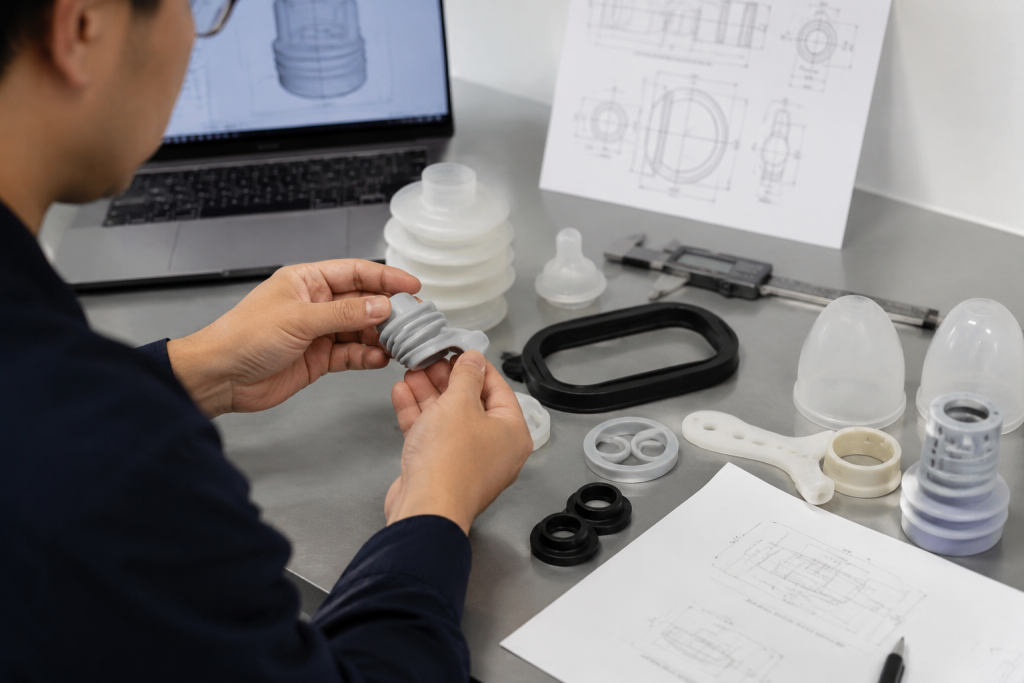
🧪 1. Core Principle of Silicone Customization: Application-Driven Material Selection
The essence of silicone customization lies in application-based material matching rather than standardized production.
Different use scenarios require different performance characteristics such as hardness, temperature resistance, chemical stability, and safety compliance.
🔹 Medical-Grade Silicone
Medical-grade silicone must comply with strict biocompatibility standards such as ISO 10993 testing. It is designed to be non-toxic, non-irritating, and resistant to biological fluids.
Typical applications:
- Surgical accessories
- Medical tubing and connectors
- Protective medical device components
- Implant-related auxiliary parts
🔹 Food-Grade Silicone
Food-grade silicone complies with regulations such as FDA and GB food safety standards. It is odorless, heat-resistant, and easy to clean.
Typical applications:
- Kitchen utensils
- Baby feeding products
- Food sealing components
- Beverage contact parts
🔹 Industrial-Grade Silicone
Industrial silicone focuses on durability and functional performance, including extreme temperature resistance, aging resistance, insulation, and flame retardancy.
Typical applications:
- Electronic sealing components
- Automotive engine parts
- Industrial vibration dampers
- Protective insulation parts
⚠️ Important Note:
Higher-grade materials are not always better. Material selection should always match the application requirements. Over-specification increases cost unnecessarily, while under-specification may lead to safety or compliance risks.
⚠️ 2. Hidden Risks in Low-Cost Customization
Price is often the first consideration in procurement, but overly low pricing may indicate hidden risks that impact long-term product performance and reliability.
🔻 Material Substitution Risks
Some low-cost suppliers may use recycled silicone materials, which can lead to:
- Yellowing over time
- Cracking or deformation
- Reduced elasticity
- Potential safety concerns
🔻 Simplified Processing Risks
Skipping formulation optimization or process testing may result in:
- Inconsistent hardness
- Poor sealing performance
- Dimensional instability
🔻 Lack of Quality Control
Without systematic inspection processes, products may suffer from:
- High dimensional deviation
- Batch inconsistency
- No after-sales support
Ultimately, these issues often lead to higher total cost due to rework, delays, or product failure in application.
⚙️ 3. Standard Silicone Manufacturing Process
A reliable silicone customization project typically follows a structured workflow:
1️⃣ Requirement Analysis
Engineers evaluate application scenarios, performance requirements, drawings, and expected production volume to ensure accurate technical understanding.
2️⃣ Material Formulation & Sampling
Based on requirements, appropriate silicone grades and additives are selected. Customized formulations are developed, followed by prototype sampling for performance validation.
3️⃣ Mass Production
Injection molding or compression molding processes are used, with precise control of temperature, pressure, and curing time to ensure consistency across batches.
4️⃣ Quality Inspection & Delivery
Finished products undergo dimensional checks, mechanical testing, and environmental compliance inspections before shipment. Quality assurance ensures long-term reliability.
🧠 4. Practical Risk Control Strategies
To minimize customization risks, the following strategies are highly recommended:
✔ Material Traceability
Ensure raw material sources are documented and supported by third-party testing reports.
✔ Manufacturing Capability Verification
Evaluate supplier capability through production scale, equipment, certifications, and real application cases.
✔ Contract-Based Specification Control
All technical requirements should be clearly defined in written agreements, including tolerances, materials, delivery time, and responsibility clauses.
💰 5. Key Factors Affecting Silicone Product Cost
Understanding cost structure helps optimize procurement strategies.
🔹 Material Grade
Medical-grade silicone can cost significantly more than industrial-grade materials due to stricter compliance requirements.
🔹 Order Quantity
Small batch orders generally have higher unit costs due to mold setup and production adjustment overhead.
💡 Optimization Tip:
Consolidating annual demand into larger production batches can significantly reduce unit cost and improve delivery efficiency.
🚀 6. Value of Professional Silicone Customization
High-quality silicone customization is not just about producing parts—it is a complete engineering solution.
A well-structured manufacturing partner can support:
- Early-stage design optimization
- Material selection guidance
- Cost reduction strategies
- Process engineering improvements
- Stable mass production delivery
Ultimately, successful silicone customization depends on precise alignment between application requirements, material properties, and manufacturing capability.
📌 Conclusion
Silicone product customization is a systematic engineering process. By focusing on material matching, process control, and supplier capability, businesses can significantly reduce risk while improving product performance and cost efficiency.
With the right technical approach and manufacturing strategy, silicone components become not just parts—but critical enablers of product innovation and competitive advantage.
 English
  Japanese
  Korean
  German
  French
  Italian
  Spanish
  Dutch
Dutch  Chinese
  Portuguese
  Polish
  Czech
Czech  Hungarian
  Swedish
  Finnish
  Vietnamese
  Thai
Thai  Turkish
  Arabic
  Russian