
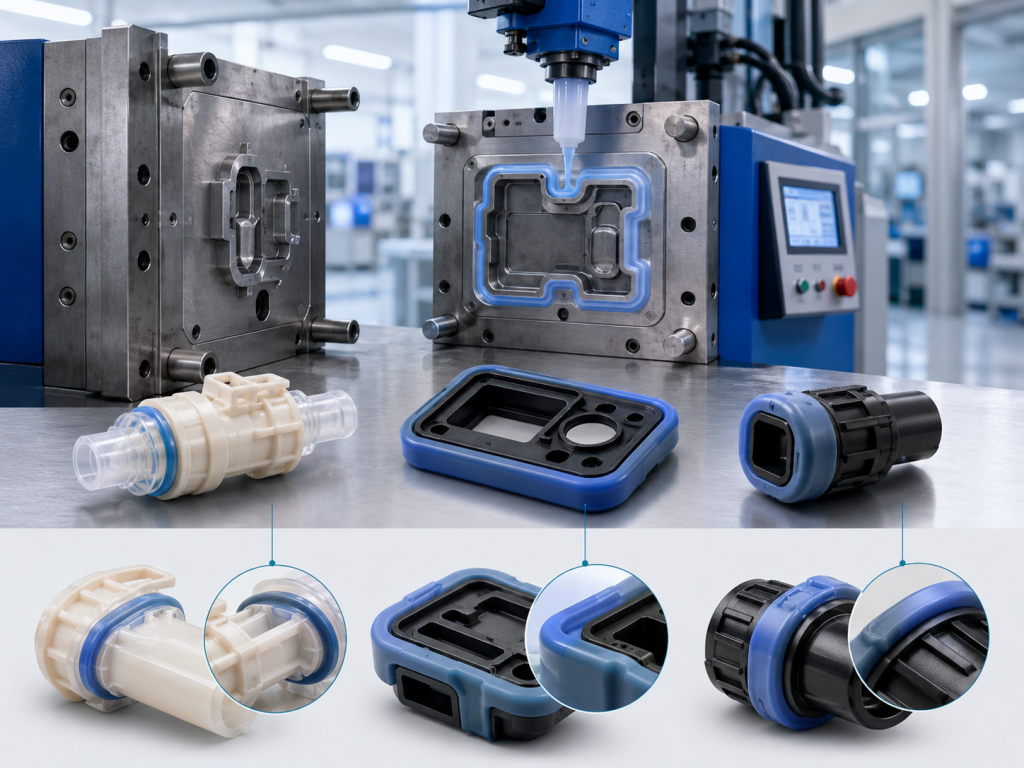
LSR overmolding on plastic is widely used in medical devices, baby products, electronic components, automotive connectors, waterproof assemblies, and industrial parts. By molding liquid silicone rubber directly onto a rigid plastic substrate, manufacturers can create a single integrated component with both hard and soft material functions.
The plastic part provides structure, strength, dimensional stability, or assembly features, while the silicone layer provides sealing, softness, waterproofing, grip, insulation, shock absorption, or biocompatible surface contact.
However, successful LSR overmolding is not only about injecting silicone onto plastic. Strong bonding depends on the correct plastic substrate, suitable LSR grade, mold design, surface condition, processing temperature, and product structure. Self-adhesive LSR grades are now widely used for multi-shot and overmolded applications, helping silicone bond with selected thermoplastics during the molding process.
What Is LSR Overmolding on Plastic?
LSR overmolding on plastic is a manufacturing process where liquid silicone rubber is molded over a plastic insert or plastic substrate. The process can be done by insert molding or two-shot molding.
In insert molding, the plastic part is produced first and then placed into an LSR mold. Liquid silicone is injected around or onto the plastic insert and cured inside the mold.
In two-shot molding, the plastic part and silicone part are molded in sequence using a multi-component molding system. This method is more suitable for higher-volume production and automated manufacturing.
LSR overmolding can combine the advantages of both materials:
| Plastic Substrate | LSR Silicone Layer |
|---|---|
| Rigid structure | Soft-touch surface |
| Dimensional support | Sealing function |
| Thread, clip, or assembly structure | Waterproof protection |
| Mechanical strength | Darbe emilimi |
| Heat-resistant engineering plastic | Flexible insulation |
| Molded housing or frame | Comfortable contact surface |
Why Use LSR Overmolding Instead of Separate Assembly?
Traditional product assembly may require glue, screws, clips, gaskets, or manual fitting. LSR overmolding can reduce the number of separate parts and improve product reliability.
Main advantages include:
- Better sealing performance
- Reduced assembly steps
- Improved waterproofing
- Stronger integration between soft and hard parts
- Better appearance and touch feeling
- More stable product dimensions
- Reduced risk of gasket displacement
- Otomatik üretime uygun
- Good for complex medical, electronic, and automotive components
For products that need reliable sealing or repeated use, overmolding can often provide better consistency than manually assembled silicone parts.
How Does Silicone Bond with Plastic?
Silicone bonding to plastic can happen through several mechanisms. The final bonding strength depends on both material chemistry and mechanical design.
Common bonding methods include:
- Chemical bonding through self-adhesive LSR
- Primer-assisted bonding
- Surface treatment before overmolding
- Mechanical locking through product structure
- Combined chemical and mechanical bonding
Technical sources describe three common approaches for bonding LSR to thermoplastic substrates: primers, self-bonding LSR materials, and newer technologies that help standard LSR achieve bonding performance.
1. Self-Adhesive LSR Bonding
Self-adhesive LSR is specially formulated to bond with selected thermoplastic substrates during molding. This can reduce or eliminate additional primer coating, plasma treatment, or other surface preparation steps.
Self-adhesive LSR is commonly considered for substrates such as:
- PC, polikarbonat
- PA, polyamide or nylon
- PBT
- PET
- PPS
- Some high-performance engineering plastics
- Selected metal or coated substrates, depending on the LSR grade
Self-adhesive LSR can simplify production, but it does not bond equally well to all plastics. The exact LSR grade, substrate grade, processing temperature, insert cleanliness, and mold design must be tested before mass production.
2. Primer-Assisted Bonding
Primer can be used when the silicone does not bond well directly to the plastic surface. A primer is applied to the plastic substrate before LSR molding. After drying or baking, the treated substrate is placed into the mold and overmolded with silicone.
Primer-assisted bonding can improve adhesion, but it adds extra steps:
- Surface cleaning
- Primer coating
- Drying or baking
- Handling control
- Storage time control
- Additional quality inspection
Primer may be useful for difficult substrates, small-batch production, or projects where self-bonding LSR does not provide enough adhesion.
3. Surface Treatment
Some plastic substrates need surface activation before overmolding. Surface treatment can improve surface energy and help silicone bond more effectively.
Common surface treatments include:
- Plasma treatment
- Corona treatment
- UV treatment
- Flame treatment
- Chemical treatment
- Light sanding or roughening
- Cleaning with suitable solvent
Surface treatment must be controlled carefully. If the treatment is too weak, bonding may fail. If it is too aggressive, it may damage the plastic substrate or affect appearance.
4. Mechanical Locking Design
For many overmolded parts, chemical bonding alone is not enough. Mechanical locking is often used to improve long-term reliability.
Mechanical locking features include:
- Delikler
- Slotlar
- Grooves
- Undercuts
- Ribs
- Anchoring points
- Wrap-around edges
- Through-holes filled with silicone
- Interlocking structures
Even if chemical bonding weakens over time, a good mechanical locking design can help prevent the silicone layer from peeling off.
Common Plastic Substrates for LSR Overmolding
Different plastic materials behave differently during LSR overmolding. Material selection should consider bonding ability, heat resistance, dimensional stability, moisture absorption, chemical resistance, and application requirements.
PC, Polycarbonate
PC is widely used in medical devices, electronics, housings, transparent components, and structural parts. It offers good toughness, dimensional stability, and impact resistance.
Advantages of PC for LSR Overmolding
- Good strength and toughness
- Suitable for precise molded components
- Commonly used in medical and electronic products
- Available in transparent and opaque grades
- Can be compatible with selected self-bonding LSR grades
Design Considerations for PC
PC must be evaluated for heat resistance during LSR curing. The molding temperature, cycle time, and insert deformation risk should be controlled. Surface cleanliness is also important because oil, release agent, dust, or moisture can reduce bonding strength.
Tipik kullanım alanları şunlardır:
- Medical device housings
- Solunum cihazı bileşenleri
- Transparent covers with soft seals
- Electronic protection parts
- Baby product hard-soft components
PA, Polyamide / Nylon
PA is commonly used for mechanical parts, automotive components, connector housings, and industrial products. It has good mechanical strength and wear resistance.
Advantages of PA for LSR Overmolding
- Good mechanical strength
- Suitable for automotive and industrial parts
- Good heat resistance in many grades
- Can be used for connector and structural components
- Compatible with selected LSR bonding systems
Design Considerations for PA
PA can absorb moisture, which may affect dimensional stability and bonding performance. Before overmolding, the PA substrate may need drying and proper storage control. Glass fiber reinforced PA may also require special attention because surface composition and fiber exposure can affect bonding.
Tipik kullanım alanları şunlardır:
- Automotive connector seals
- Wire harness components
- Industrial sealing parts
- Electrical insulation components
- Mechanical protection parts
PSU, Polysulfone
PSU is an engineering plastic often used in demanding applications that require heat resistance, dimensional stability, and chemical resistance. It is commonly considered for medical, laboratory, and high-performance technical parts.
Advantages of PSU for LSR Overmolding
- High heat resistance
- Good dimensional stability
- Suitable for sterilizable components
- Good strength for medical and technical assemblies
- Useful for parts requiring both rigid structure and soft silicone sealing
Design Considerations for PSU
PSU is generally more expensive than common plastics such as PC or PA, so it is usually selected for applications with higher performance requirements. Bonding performance should be verified with the selected LSR grade, surface treatment method, and molding conditions.
Tipik kullanım alanları şunlardır:
- Tıbbi cihaz bileşenleri
- Sterilizable assemblies
- Laboratory equipment parts
- High-performance sealing structures
- Rigid-soft technical components
PBT, PPS, PEEK, and Other Engineering Plastics
Other engineering plastics may also be used for LSR overmolding, depending on the application.
PBT is often used in electrical and automotive components. PPS offers high heat and chemical resistance. PEEK is a high-performance plastic used in demanding medical, industrial, and technical applications.
These materials may support strong overmolding performance when matched with suitable LSR grades and processing conditions. However, testing is always required before mass production.
Difficult Substrates: PP, PE, and Low Surface Energy Plastics
Not all plastics are easy to bond with LSR. Low surface energy plastics such as PP and PE are usually more difficult. Research on LSR and polypropylene composites notes that self-adhesive LSR types are available, but adhesion to commodity thermoplastics such as PP can be difficult without surface activation.
For PP or PE substrates, the manufacturer may need to consider:
- Surface activation
- Flame treatment
- Plasma treatment
- Primer system
- Mechanical locking structure
- Alternative substrate material
- Separate assembly instead of direct bonding
For critical parts, PP and PE should not be selected for LSR overmolding without bonding tests.
Key Design Tips for LSR Overmolded Plastic Parts
Good design is essential for stable bonding and mass production. The following design factors should be considered early.
1. Keep the Plastic Surface Clean
Contamination is one of the most common causes of bonding failure. Oil, dust, mold release agent, fingerprints, moisture, and storage contamination can all reduce adhesion.
Before overmolding, plastic inserts should be clean, dry, and handled properly.
2. Avoid Sharp Silicone Edges
Very thin silicone edges can tear, lift, or peel during use. A suitable edge thickness helps improve durability and bonding stability.
3. Add Mechanical Locking Features
Whenever possible, add holes, slots, grooves, or wrap-around structures. This is especially important for products exposed to pulling, bending, washing, vibration, or repeated assembly.
4. Control Wall Thickness
Uneven silicone thickness may cause curing problems, shrinkage differences, deformation, or weak areas. The silicone layer should be designed with reasonable and consistent thickness.
5. Consider Thermal Expansion Difference
Plastic and silicone expand differently under temperature changes. If the product is used in high-temperature or low-temperature environments, the design should consider stress caused by material expansion and contraction.
6. Choose the Right Plastic Grade
Even within the same plastic family, different grades may behave differently. Additives, fillers, glass fiber, flame retardants, colorants, and mold release agents can all affect bonding.
The selected substrate should be tested with the selected LSR grade before production.
7. Design for Mold Flow and Venting
LSR has good flowability, but the mold still needs proper gate position, venting, and cavity design. Poor mold flow can cause short shots, trapped air, bubbles, weld lines, or weak bonding areas.
Common Applications of LSR Overmolding on Plastic
LSR overmolding is used in many industries where soft and hard materials must work together.
Medical Device Components
Medical components often need soft-touch surfaces, sealing performance, flexibility, and clean production. LSR overmolding can be used for:
- Solunum cihazı parçaları
- Medical connector seals
- Valve components
- Device handles
- Tubing connectors
- Giyilebilir tıbbi bileşenler
Baby and Feeding Products
Baby products often require soft, safe, comfortable, and easy-to-clean structures. LSR overmolding can combine rigid support with soft silicone contact areas.
Uygulama alanları şunlardır:
- Baby bottle components
- Feeding accessories
- Teether components
- Yumuşak valfler
- Training cup parts
- Pacifier-related components
Tüketici Elektroniği
Electronic products need waterproofing, dust protection, shock absorption, and soft-touch functions.
Uygulama alanları şunlardır:
- Waterproof buttons
- Charging port seals
- Koruyucu kılıflar
- Wearable device parts
- Sensör sızdırmazlık bileşenleri
- Kablo gerilim azaltma parçaları
Automotive Connectors and Sealing Parts
Automotive applications require durability, temperature resistance, vibration resistance, and stable sealing.
Uygulama alanları şunlardır:
- Bağlantı elemanı contaları
- Wire harness sealing plugs
- Sensor sealing parts
- Waterproof electrical components
- Plastic housings with integrated silicone seals
Industrial and Household Products
LSR overmolding is also suitable for industrial tools, kitchen parts, sealing assemblies, and household products.
Uygulama alanları şunlardır:
- Soft grips
- Sealing lids
- Waterproof housings
- Protective caps
- Anti-slip components
- Custom gaskets integrated with plastic frames
Common Defects in LSR Overmolding
Several defects may appear if material, mold, or process control is not optimized.
| Kusur | Possible Cause |
| Yetersiz yapışma | Wrong LSR grade, contaminated insert, low surface energy, insufficient temperature |
| Silicone peeling | Weak chemical bond, poor mechanical locking, high stress at edge |
| Kabarcıklar | Trapped air, poor venting, moisture, improper injection parameters |
| Flash | Mold mismatch, high pressure, poor parting line design |
| Deformasyon | Plastic insert cannot withstand molding temperature or pressure |
| Short molding | Poor flow, blocked gate, insufficient material |
| Color difference | Unstable pigment mixing or material batch variation |
| Surface stain | Contamination during handling or molding |
| Weak sealing | Wrong hardness, poor geometry, tolerance mismatch |
Quality Testing for Overmolded LSR Parts
For functional components, quality inspection should include more than visual checking.
Common testing methods include:
- Görsel inceleme
- Boyutsal ölçüm
- Sertlik testi
- Peel test
- Pull test
- Compression test
- Leakage test
- Assembly test
- Aging test
- Thermal cycling test
- Water resistance test
- Functional life test
For sealing parts and medical components, testing should be planned based on actual working conditions.
What Buyers Should Provide Before Quotation
To evaluate an LSR overmolding project, buyers should prepare the following information:
- 2B çizim veya 3B dosya
- Plastic substrate material
- Plastic grade or material datasheet
- Silikon malzeme gereksinimi
- Kıyı sertliği şartı
- Product application
- Çalışma sıcaklığı
- Chemical contact environment
- Sealing or waterproof requirement
- Expected bonding strength
- Sipariş miktarı
- Test standardı
- Ambalaj gerekliliği
- Whether existing plastic inserts will be supplied by the customer
- Whether the project needs insert molding or two-shot molding
The more complete the information, the more accurate the mold design and quotation will be.
Sonuç
LSR overmolding on plastic is an effective way to combine rigid plastic structure with soft silicone performance. It is widely used in medical devices, baby products, electronics, automotive connectors, industrial sealing parts, and consumer products.
Successful bonding depends on the right combination of plastic substrate, LSR grade, surface condition, mold design, processing temperature, and mechanical structure. PC, PA, PSU, PBT, PPS, and other engineering plastics can be suitable for different overmolding applications, but each material must be tested with the selected LSR system.
For buyers, the best approach is to confirm product function, choose the correct substrate, design mechanical locking features, control surface cleanliness, and complete sample testing before mass production.
A professional silicone manufacturer can help review the drawing, recommend suitable materials, design the mold, produce samples, test bonding performance, and support stable mass production.
Sık Sorulan Sorular
1. Can LSR bond directly to plastic?
Yes, selected self-adhesive LSR grades can bond directly to certain plastic substrates during molding. However, bonding depends on the plastic type, surface condition, LSR grade, mold temperature, and process control.
2. Which plastics are commonly used for LSR overmolding?
Common substrates include PC, PA, PBT, PPS, PSU, PEEK, and other engineering plastics. The final material choice depends on product application, heat resistance, bonding requirement, and cost.
3. Does LSR bond well to PP or PE?
PP and PE are usually difficult to bond because they have low surface energy. Surface treatment, primer, or mechanical locking may be required. In some cases, changing the substrate material may be a better solution.
4. Is primer always needed for LSR overmolding?
No. Primer is not always required. Self-adhesive LSR may bond to selected plastics without primer, but primer can still be useful for difficult substrates or special applications.
5. How can bonding strength be improved?
Bonding strength can be improved by choosing a compatible LSR grade, cleaning the plastic surface, using surface treatment or primer if needed, optimizing mold temperature, and adding mechanical locking features such as grooves, holes, or undercuts.
 English
  Japanese
  Korean
  German
  French
  Italian
  Spanish
  Dutch
Dutch  Chinese
  Portuguese
  Polish
  Czech
Czech  Hungarian
  Swedish
  Finnish
  Vietnamese
  Thai
Thai  Turkish
  Arabic
  Russian