
Silicone parts can be manufactured through several molding processes, but compression molding and liquid silicone rubber injection molding are two of the most widely used methods.
Both processes can produce reliable silicone components, including seals, gaskets, valves, membranes, wearable parts, baby-care products, medical components, electronic parts, and industrial assemblies. However, they differ significantly in tooling, raw material, automation, dimensional consistency, production speed, part complexity, and total manufacturing cost.
Choosing the wrong process can lead to unnecessary tooling expense, long cycle times, excessive flash, unstable dimensions, or higher unit costs.
This guide compares silicone compression molding and LSR injection molding to help procurement engineers and product developers select the most appropriate process for a custom silicone project.
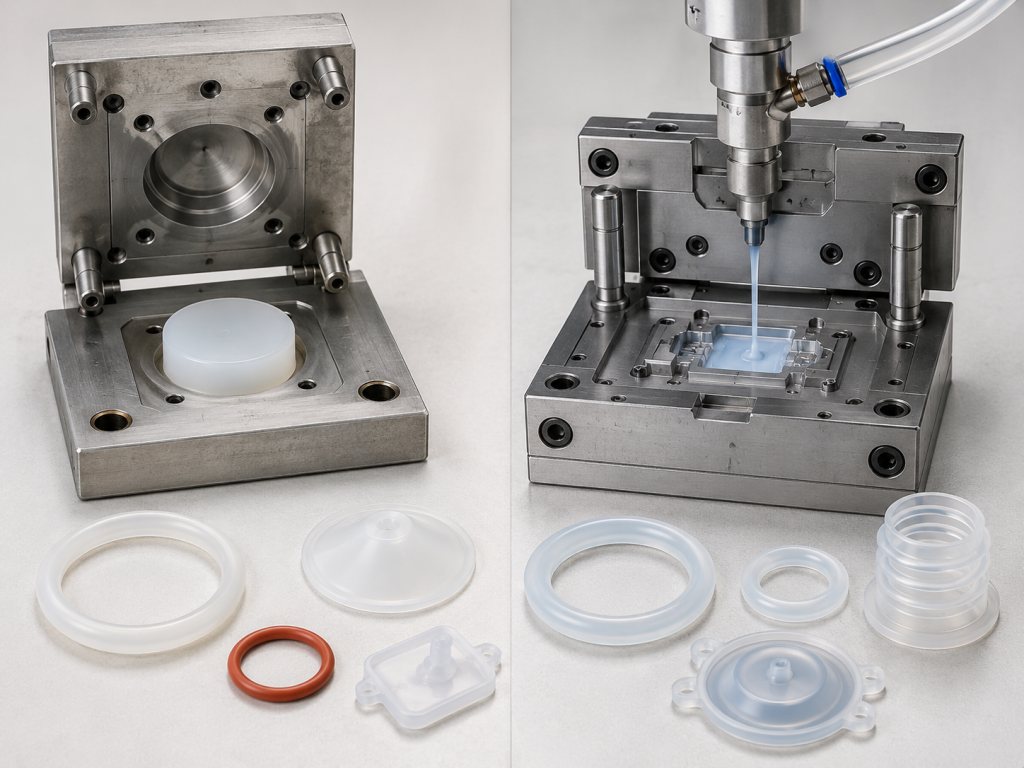
What Is Silicone Compression Molding?
Silicone compression molding uses a premeasured quantity of solid silicone rubber, commonly called high-consistency rubber or HCR.
The silicone material is prepared into a specific weight or shape and placed manually or automatically into an open heated mold. The mold closes and applies pressure, forcing the silicone to flow into the cavity.
Heat and pressure cure the material into the required part geometry.
A typical compression molding process includes:
- Mixing the silicone compound
- Adding pigment or required additives
- Cutting or preforming the material
- Loading the material into the mold
- Closing and heating the mold
- Curing the silicone
- Opening the mold
- Removing the molded part
- Trimming flash
- Inspecting and packaging the component
Compression molding is often selected for simple or moderately complex silicone components, especially when annual production volume does not justify a more expensive injection mold.
What Is LSR Injection Molding?
Liquid silicone rubber injection molding uses a two-component liquid silicone system.
The two components are stored separately and delivered to a metering system. The equipment measures, mixes, and injects them into a heated mold. The LSR cures rapidly inside the mold and is then automatically or manually removed.
A typical LSR injection molding process includes:
- Supplying the two LSR components
- Metering the components at the required ratio
- Adding pigment or additives
- Mixing the material
- Injecting it into a closed heated mold
- Curing the silicone
- Opening the mold
- Ejecting or removing the part
- Inspecting and packaging the component
LSR injection molding is particularly suitable for high-volume production, complex geometries, thin sections, precision sealing features, and automated manufacturing.
Main Difference Between Compression Molding and LSR Injection
The most important difference is the way the silicone enters the mold.
In compression molding, a preformed piece of solid silicone is placed directly into the mold cavity before the mold closes.
In LSR injection molding, liquid silicone is injected into a fully closed mold through a runner and gate system.
This difference affects:
- Tooling construction
- Materialflöde
- Cycle time
- Flash-kontroll
- Automation
- Dimensional repeatability
- Labor requirements
- Part complexity
- Produktionsvolym
- Unit cost
Neither process is universally better. The correct choice depends on the component design and commercial requirements.
Raw Material Comparison
Compression-Molded Silicone
Compression molding commonly uses HCR silicone.
HCR has a gum-like consistency and must be mixed, cut, or preformed before molding.
It is available in many formulations, including:
- Allround-silikon
- High-tear-strength silicone
- Högtemperatursilikon
- Electrically conductive silicone
- Flamskyddat silikon
- Silikon avsedd för kontakt med livsmedel
- Medical silicone
- Fluorsilikon
- Sponge silicone
- Colored silicone compounds
HCR can also be extruded or transfer molded, making it a flexible material platform for different manufacturing processes.
Flytande silikongummi
LSR is supplied as two liquid components that cure after controlled mixing and heating.
Common advantages of LSR materials include:
- Stable metering
- Good flow into thin features
- Consistent mixing
- High purity options
- Rapid curing
- Automated processing
- Good reproduction of fine details
- Suitability for insert molding
- Suitability for plastic overmolding
LSR is widely used in medical devices, automotive electronics, connectors, consumer electronics, baby products, and precision sealing components.
Tooling Cost
Compression Molding Tooling
Compression molds are generally simpler than LSR injection molds.
They may require:
- Mold cavities
- Heating channels
- Alignment features
- Flash grooves
- Avluftning
- Manual part-removal access
Compression molds often have lower initial tooling costs because they do not always require complex cold-runner systems, precision injection gates, or automated ejection.
This can make compression molding attractive for:
- Prototypes
- Low-volume production
- Medium-volume production
- Large silicone parts
- Simple gaskets
- Products with uncertain future demand
- Projects with limited tooling budgets
However, lower tooling cost does not automatically mean lower total project cost. Higher labor and longer cycles may make compression molding more expensive at larger volumes.
LSR Injection Tooling
LSR injection molds are generally more complex and require greater manufacturing precision.
They may include:
- Cold-runner systems
- Precision valve gates
- Heated cavities
- Vacuum systems
- Tight shutoff surfaces
- Automated ejection
- Robotic handling interfaces
- Insert-loading systems
- Advanced venting
- Low-flash parting lines
The initial tooling investment is usually higher, but the process can provide lower labor requirements and shorter cycles during mass production.
LSR tooling is often justified when:
- Annual demand is high
- The component is technically complex
- Tight consistency is required
- Automation is important
- The part has thin walls or small features
- Flash must be tightly controlled
- The product has a long commercial life
Production Volume
Production volume is one of the most important factors when choosing between the two processes.
Compression Molding for Lower Volumes
Compression molding is often more economical for projects with:
- Low annual quantities
- Irregular ordering schedules
- Multiple custom versions
- Short product lifecycles
- Large part dimensions
- Limited tooling budgets
The lower initial investment can reduce project risk during early product development.
LSR Injection for Higher Volumes
LSR injection molding is typically more competitive when production volume is high enough to spread the tooling cost across a large number of parts.
It is well suited for:
- Continuous mass production
- Automated manufacturing
- Multi-cavity tooling
- Stable long-term programs
- Products requiring consistent repeat orders
- High-output medical or consumer products
The break-even point depends on part size, cavity count, cycle time, labor content, material usage, tooling complexity, and expected product life.
Procurement teams should compare total project cost rather than selecting a process based only on tooling price.
Cycle Time
Compression Molding Cycle
Compression molding cycles are often longer because the operator must load the material before each cycle.
Additional time may be required for:
- Preforming the material
- Opening the mold
- Manual loading
- Removing the molded part
- Cleaning the mold surface
- Separating flash
- Trimming the component
The cure time can also increase for thick sections or large components.
LSR Injection Cycle
LSR injection molding usually offers shorter and more consistent cycles.
The material is injected directly into the closed mold, reducing manual loading time.
Cycle time can be improved through:
- Fast material injection
- Rapid curing
- Formar med flera hålrum
- Automated ejection
- Robotic handling
- Automated inspection
- Cold-runner systems
For high-volume projects, cycle-time reduction can significantly lower unit cost.
Labor and Automation
Formpressning
Compression molding often requires more manual labor.
Operators may need to:
- Cut and weigh material
- Load the mold
- Position inserts
- Remove parts
- Separate flash
- Trim edges
- Inspect each component
The amount of labor depends on mold design and production equipment.
Some compression molding operations can be automated, but full automation is generally more difficult than with LSR injection molding.
LSR-formsprutning
LSR injection molding can support a highly automated production process.
Automation may include:
- Material metering
- Pigment dosing
- Injection
- Insert loading
- Part removal
- Robotic transfer
- Camera inspection
- Post-processing
- Förpackning
Automation can reduce:
- Manual handling
- Contamination risk
- Labor variation
- Production inconsistency
- Long-term unit cost
This is especially important for medical, automotive, and high-volume electronic applications.
Part Complexity
Compression Molding Capabilities
Compression molding is suitable for many simple and moderately complex components.
Typical parts include:
- O-ringar
- Plana packningar
- Sealing washers
- Silicone pads
- Keypads
- Mats
- Covers
- Sleeves
- Large molded rings
- Simple diaphragms
- Thick molded parts
However, the process may be less suitable for:
- Very thin walls
- Djupa underskärningar
- Extremely small details
- Complex internal channels
- Very tight flash requirements
- Highly automated insert molding
Material movement inside the mold may be less controlled than injection molding, especially for difficult geometries.
LSR Injection Capabilities
LSR flows easily into small cavities and thin sections.
This makes it suitable for:
- Tunna membran
- Micro-sealing features
- Flexible valves
- Complex medical parts
- Tätningar för kopplingar
- Multi-lip gaskets
- Small precision components
- Overmolded plastic parts
- Overmolded metal inserts
- Multi-functional integrated components
LSR injection molding can reduce the number of separate components by combining sealing, cushioning, gripping, insulation, and positioning features into one molded part.
Dimensional Consistency
Compression-Molded Parts
Compression molding can produce reliable dimensions, but variation may be influenced by:
- Material weight
- Preform shape
- Loading position
- Formtemperatur
- Cure time
- Operator technique
- Flash thickness
- Metod för urformning
Large flexible components may also be difficult to measure consistently.
LSR Injection-Molded Parts
LSR injection molding generally provides better process repeatability because the material is automatically metered and injected.
Benefits may include:
- More consistent shot size
- Stable cavity filling
- Controlled injection pressure
- Controlled curing conditions
- Reduced operator influence
- Better multi-cavity consistency
- Improved repeatability of thin features
However, silicone remains a flexible elastomer. Tolerances must still reflect the material behavior and measurement method.
Overly tight tolerances can increase tooling cost and rejection rates without improving product function.
Flash Control
Flash is a thin layer of excess silicone that forms at the mold parting line or around inserts.
Compression Molding Flash
Compression molding often produces more flash because the preformed material is compressed between mold surfaces.
The mold may intentionally include flash grooves to collect excess material.
Parts may require:
- Manual trimming
- Mechanical trimming
- Cryogenic deflashing
- Die cutting
- Secondary inspection
For simple industrial components, a small amount of controlled flash may be acceptable.
LSR Injection Flash
LSR injection molds can be designed for very low flash.
Because the material is injected into a closed mold, the process can control material volume more precisely.
Low-flash results depend on:
- Mold precision
- Shutoff design
- Clamping force
- Insprutningstryck
- Avluftning
- Mold wear
- Material viscosity
- Process control
Low-flash tooling is particularly valuable for seals, valves, medical parts, and small precision components.
Material Waste
Compression Molding Waste
Compression molding may generate waste from:
- Excess preform material
- Flash
- Trimming
- Startup adjustment
- Rejected parts
Accurate material preforming can reduce waste, but some flash is often unavoidable.
LSR Injection Waste
LSR injection molding can provide efficient material usage, especially when cold-runner or valve-gate systems are used.
Potential waste sources include:
- Purging
- Startup material
- Gate remnants
- Rejected parts
- Material remaining in equipment during shutdown
A well-designed LSR process can produce little runner waste compared with conventional thermoplastic injection molding.
Surface Quality
Both processes can produce smooth silicone surfaces, but the final appearance depends on:
- Formfinish
- Materialsammansättning
- Cure conditions
- Avluftning
- Part geometry
- Pigment
- Formens renhet
Compression-Molded Surface
Compression molding can produce:
- Matte surfaces
- Polished surfaces
- Textured surfaces
- Molded logos
- Functional ribs
- Decorative patterns
Potential surface defects include:
- Flow marks
- Trapped air
- Incomplete filling
- Förorening
- Uneven color
- Flash
- Parting-line mismatch
LSR Injection Surface
LSR can reproduce fine mold details and surface textures.
It is often selected when the part requires:
- High cosmetic consistency
- Tunna tätningsläppar
- Optical transparency
- Controlled surface texture
- Fine microfeatures
- Consistent multi-cavity appearance
Mold venting and vacuum control are especially important for avoiding trapped air.
Insert Molding and Overmolding
Compression Insert Molding
Metal or plastic inserts can be placed into a compression mold before the silicone is loaded.
This may be suitable for:
- Simple metal insert parts
- Reinforced gaskets
- Low-volume assemblies
- Thick overmolded sections
However, manual insert positioning can increase labor and variation.
LSR Insert Molding
LSR injection molding is particularly suitable for automated insert molding and overmolding.
Common substrates include:
- Metal pins
- Stainless-steel parts
- Plastic housings
- Electrical connectors
- Cables
- Sensor components
- Electronic assemblies
Bonding may be achieved through:
- Mechanical locking
- Underskärningar
- Hål
- Ytstruktur
- Self-bonding LSR
- Primer
- Surface treatment
The substrate must tolerate the molding temperature and process conditions.
Bonding LSR to Plastic
LSR can be overmolded onto selected thermoplastics.
Common design considerations include:
- Plastic melting temperature
- Värmebeständighet
- Chemical compatibility
- Surface cleanliness
- Molded-in locking features
- Adhesion requirements
- Primer use
- Part deformation
- Shrinkage difference
- Sterilization effects
A strong bond should not be assumed based only on the general plastic family. The exact plastic grade, additives, colorants, and surface condition can affect adhesion.
Prototype bonding tests are recommended before production tooling is approved.
Suitable Applications for Compression Molding
Compression molding is often suitable for:
- Flat silicone gaskets
- Large sealing rings
- Silicone sheets and pads
- Industrial cushioning components
- Simple silicone covers
- Keypads
- Large custom O-rings
- Low-volume medical components
- Prototype silicone parts
- Sports and fitness products
- Household silicone products
- Thick silicone components
- Custom color parts
- Electrically conductive silicone pads
It is particularly attractive when the part is large, relatively simple, and produced in low or moderate quantities.
Suitable Applications for LSR Injection Molding
LSR injection molding is often suitable for:
- Medical valves
- Tunna membran
- Tätningar för kopplingar
- Waterproof electronic seals
- Automotive sensor seals
- Delar till nappflaskor
- Respiratory components
- Wearable-device parts
- Precision O-rings
- Multi-lip gaskets
- Micro-molded silicone components
- Plastic-to-silicone overmolding
- Metal-to-silicone insert molding
- High-volume food-contact components
- Automated medical production
It is especially valuable when the project requires high output, precise details, low flash, or automated handling.
Medical and Healthcare Considerations
Both HCR and LSR can be used for healthcare components when the material and process are properly selected and validated.
Viktiga faktorer är bland annat:
- Exact material grade
- Patient-contact type
- Kontaktens varaktighet
- Biocompatibility evaluation
- Steriliseringsmetod
- Efterhärdning
- Cleanroom requirements
- Spårbarhet av partier
- Mold-release control
- Kontamineringskontroll
- Förpackning
- Change notification
LSR injection molding is often preferred for high-volume medical components because it can reduce manual material handling and support controlled automated production.
Compression molding may still be suitable for lower-volume or larger healthcare silicone components.
The process should be selected according to risk, geometry, production requirements, and validation needs.
Food-Contact Applications
Both processes can produce food-contact silicone parts.
Typiska användningsområden är bland annat:
- Tätningsringar
- Beverage valves
- Kitchen gaskets
- Bottle components
- Appliance seals
- Silicone sleeves
- Food-processing equipment parts
The buyer should specify:
- Målmarknad
- Contact type
- Contact temperature
- Kontaktens varaktighet
- Required declarations
- Migration testing
- Color requirements
- Odor requirements
- Cleaning conditions
The manufacturing process should prevent contamination from unsuitable pigments, lubricants, release agents, and packaging materials.
Compression Set and Functional Performance
The molding method can influence the final properties of the silicone component through cure conditions and post-processing.
Important properties may include:
- Hårdhet
- Draghållfasthet
- Förlängning
- Rivhållfasthet
- Kompressionssättning
- Rebound
- Tätningskraft
- Fatigue resistance
- Surface friction
- Thermal aging
Material data sheets are typically based on standardized test samples. Actual molded parts may perform differently because of geometry, thickness, cure history, and operating conditions.
Functional testing should use production-equivalent components.
Mold Design Differences
Compression Mold Design
Compression molds must control:
- Material placement
- Cavity filling
- Flash direction
- Air release
- Parting lines
- Demolding
- Cavity balance
- Heat distribution
The preform shape and weight can strongly affect part quality.
LSR Injection Mold Design
LSR injection molds must control:
- Runner temperature
- Gate design
- Injection balance
- Vacuum
- Avluftning
- Cavity heating
- Shutoff accuracy
- Flash
- Ejection
- Insert position
Because uncured LSR can flow into extremely small gaps, mold precision is critical.
A small mismatch or damaged shutoff can create flash.
Prototype Development
Compression molding is often selected for early prototype production because the tooling can be simpler and less expensive.
However, a compression-molded prototype may not fully represent an LSR injection-molded production part.
Differences may occur in:
- Parting lines
- Gate marks
- Ytfinish
- Flash
- Materialflöde
- Cure conditions
- Mått
- Mechanical properties
When the final product will use LSR injection molding, prototype samples should eventually be produced using production-intent LSR and representative molding conditions.
Tool Life and Maintenance
Both mold types require regular maintenance.
Compression Mold Maintenance
Maintenance may include:
- Cleaning flash grooves
- Removing cured silicone
- Polishing cavities
- Checking alignment
- Repairing parting lines
- Inspecting heating systems
LSR Mold Maintenance
LSR molds may require more specialized maintenance because of their precision systems.
Maintenance may include:
- Cleaning valve gates
- Inspecting cold runners
- Checking vacuum channels
- Cleaning vents
- Checking shutoff surfaces
- Inspecting ejectors
- Verifying heating zones
- Monitoring mold wear
Tooling cost should include expected maintenance and spare components, not only the initial mold price.
Quality Inspection
A silicone part inspection plan may include:
- Dimensionell mätning
- Visuell besiktning
- Hårdhetsprovning
- Snabbkontroll
- Color verification
- Weight measurement
- Tensile testing
- Elongation testing
- Tear testing
- Compression-set testing
- Leak testing
- Bond-strength testing
- Funktionstestning
- Spårbarhet av partier
Critical dimensions and functional features should be identified on the drawing.
Because silicone is flexible, measurement method, fixture, temperature, and conditioning time can affect results.
Common Compression Molding Defects
Possible compression molding defects include:
- Excessive flash
- Kortformning
- Air bubbles
- Flow marks
- Uneven color
- Incorrect material loading
- Part distortion
- Ytförorening
- Parting-line mismatch
- Incomplete curing
- Over-curing
- Tearing during demolding
Many defects can be reduced through better preform design, material control, mold temperature, venting, and loading consistency.
Common LSR Injection Defects
Possible LSR injection defects include:
- Short shots
- Air traps
- Flash
- Gate marks
- Weld lines
- Material contamination
- Incorrect mixing ratio
- Incomplete curing
- Part sticking
- Insert movement
- Bonding failure
- Ytfel
- Dimensionell instabilitet
Process monitoring should include material pressure, injection parameters, mold temperature, curing time, and equipment condition.
Cost Comparison
The total cost of a silicone component includes more than the unit price.
A proper comparison should include:
- Tooling cost
- Material cost
- Labor
- Cycle time
- Cavity count
- Scrap
- Trimming
- Inspection
- Automation
- Mold maintenance
- Förpackning
- Annual quantity
- Project life
- Validation cost
- Tool-transfer risk
Compression Molding Cost Pattern
Compression molding usually has:
- Lower initial tooling cost
- Higher labor per part
- Longer cycle times
- More trimming
- Greater suitability for low volume
LSR Injection Cost Pattern
LSR injection molding usually has:
- Higher initial tooling cost
- Lower labor per part
- Faster cycles
- Better automation
- Greater suitability for high volume
A project with a low purchase price but high manual trimming cost may become expensive over its full life.
How to Choose the Right Process
Choose compression molding when:
- Annual volume is low or moderate
- The component is large
- Geometry is relatively simple
- Tooling budget is limited
- Product demand is uncertain
- The part has a thick cross-section
- Manual trimming is acceptable
- Multiple custom versions are required
Choose LSR injection molding when:
- Annual volume is high
- The part has thin walls
- The geometry is complex
- Tight repeatability is required
- Automation is important
- Flash must be minimized
- The project requires insert molding
- The part includes fine sealing features
- Contamination control is important
- The product has a long expected life
Decision Checklist for Procurement Engineers
Before selecting a manufacturing process, review the following questions:
- What is the expected annual quantity?
- How long will the product remain in production?
- What is the target unit cost?
- What tooling budget is available?
- Does the design contain thin sections?
- Are there deep undercuts or complex sealing lips?
- Is overmolding required?
- Are inserts required?
- What are the critical tolerances?
- What flash level is acceptable?
- Is automatic production required?
- Does the part require cleanroom manufacturing?
- What secondary processing is required?
- Is post-curing necessary?
- How much manual trimming is acceptable?
- Are multiple colors or material grades required?
- What inspection level is required?
- What regulatory documents are required?
- How quickly are prototypes needed?
- Can the design be simplified?
The manufacturing supplier should review the 3D model, drawing, annual quantity, material requirements, and final assembly before recommending a process.
Information to Include in an RFQ
To obtain an accurate silicone molding quotation, provide:
- Two-dimensional drawing
- Three-dimensional model
- Materialbehov
- Hårdhet
- Färg
- Annual quantity
- Beställningsantal
- Expected project life
- Prototype quantity
- Critical tolerances
- Acceptable flash
- Ytfinish
- Driftstemperatur
- Chemical exposure
- Compliance requirements
- Steriliseringsmetod
- Insert details
- Overmolding substrate
- Krav på förpackningar
- Inspection requirements
- Target production date
When the process has not yet been selected, request separate technical and commercial evaluations for compression molding and LSR injection molding.
Slutsats
Compression molding and LSR injection molding can both produce reliable custom silicone components, but they serve different project requirements.
Compression molding generally offers lower tooling investment and greater flexibility for large, simple, low-volume, or medium-volume parts.
LSR injection molding provides stronger advantages for complex geometry, thin sections, low-flash requirements, automated production, insert molding, and high annual volumes.
The best process should be selected by evaluating the entire project, including:
- Product geometry
- Material
- Tooling investment
- Annual volume
- Cycle time
- Labor
- Quality requirements
- Automation
- Validation
- Förväntad livslängd för produkten
Early cooperation between the product designer, procurement team, quality engineers, and silicone molding supplier can prevent unnecessary redesign and reduce total manufacturing cost.
Vanliga frågor
Is LSR injection molding always more expensive than compression molding?
The initial tooling cost is usually higher, but the unit cost may be lower for high-volume production because LSR injection molding supports faster cycles and greater automation.
Is compression molding suitable for precision silicone parts?
Yes, compression molding can produce precise parts when the mold and process are properly controlled. LSR injection molding generally provides greater consistency for complex, thin, or high-volume components.
Which process produces less flash?
LSR injection molding can produce very low flash when precision tooling and correct process control are used. Compression molding commonly produces more flash and may require secondary trimming.
Kan man tillverka medicinska silikonkomponenter med formpressning?
Yes. Compression molding can be used for healthcare silicone components when the material, environment, process, post-curing, traceability, and validation requirements are properly controlled.
Can LSR be overmolded onto plastic?
Yes. LSR can be overmolded onto compatible thermoplastics using mechanical locking, self-bonding materials, primers, or surface treatments.
Which process is better for large silicone gaskets?
Compression molding is often economical for large, relatively simple gaskets. Extrusion and joint bonding may also be considered for very large sealing profiles.
Which process is better for thin silicone membranes?
LSR injection molding is generally better suited for thin membranes because the liquid material flows easily into narrow cavities and fine features.
Can the same mold be used for HCR and LSR?
Normally no. Compression molds and LSR injection molds are designed around different material-delivery, gating, venting, heating, and flash-control requirements.
Which process is better for low-volume production?
Compression molding is often more suitable for low-volume production because of its lower initial tooling investment.
Which process is better for automated mass production?
LSR injection molding is usually the better choice because material feeding, injection, curing, part removal, inspection, and packaging can be highly automated.
 English
  Japanese
  Korean
  German
  French
  Italian
  Spanish
  Dutch
Dutch  Chinese
  Portuguese
  Polish
  Czech
Czech  Hungarian
  Swedish
  Finnish
  Vietnamese
  Thai
Thai  Turkish
  Arabic
  Russian