
The baby product market is growing quickly, and parents are increasingly looking for products that are safe, practical, comfortable, and visually attractive. Silicone has become one of the most popular materials for baby care products because it is soft, flexible, durable, easy to clean, and suitable for many feeding and care applications.
For baby product brands, retailers, e-commerce sellers, and distributors, OEM and ODM customization is an effective way to create unique products and build a stronger brand identity. From silicone baby spoons and bibs to teethers, feeding bowls, bottle accessories, straw cup parts, and baby tableware sets, silicone products can be customized in many different ways.
This article explains how to customize baby silicone products through OEM and ODM services, and what buyers should consider before starting a custom project.
What Are OEM and ODM Services?
OEM and ODM are two common cooperation models in custom manufacturing.
OEM means Original Equipment Manufacturing. In this model, the customer usually provides a product design, sample, drawing, logo, packaging idea, or clear specification. The factory manufactures the product according to the customer’s requirements.
ODM means Original Design Manufacturing. In this model, the factory provides product design support, structure suggestions, mold development, and production solutions. Customers can choose existing product concepts or develop new products based on market needs.
For baby silicone products, both OEM and ODM services are widely used. Some customers only need logo and color customization, while others need a completely new mold and exclusive product design.
Common Baby Silicone Products for Customization
Food-grade silicone can be used for many baby care and feeding products. Common customized products include:
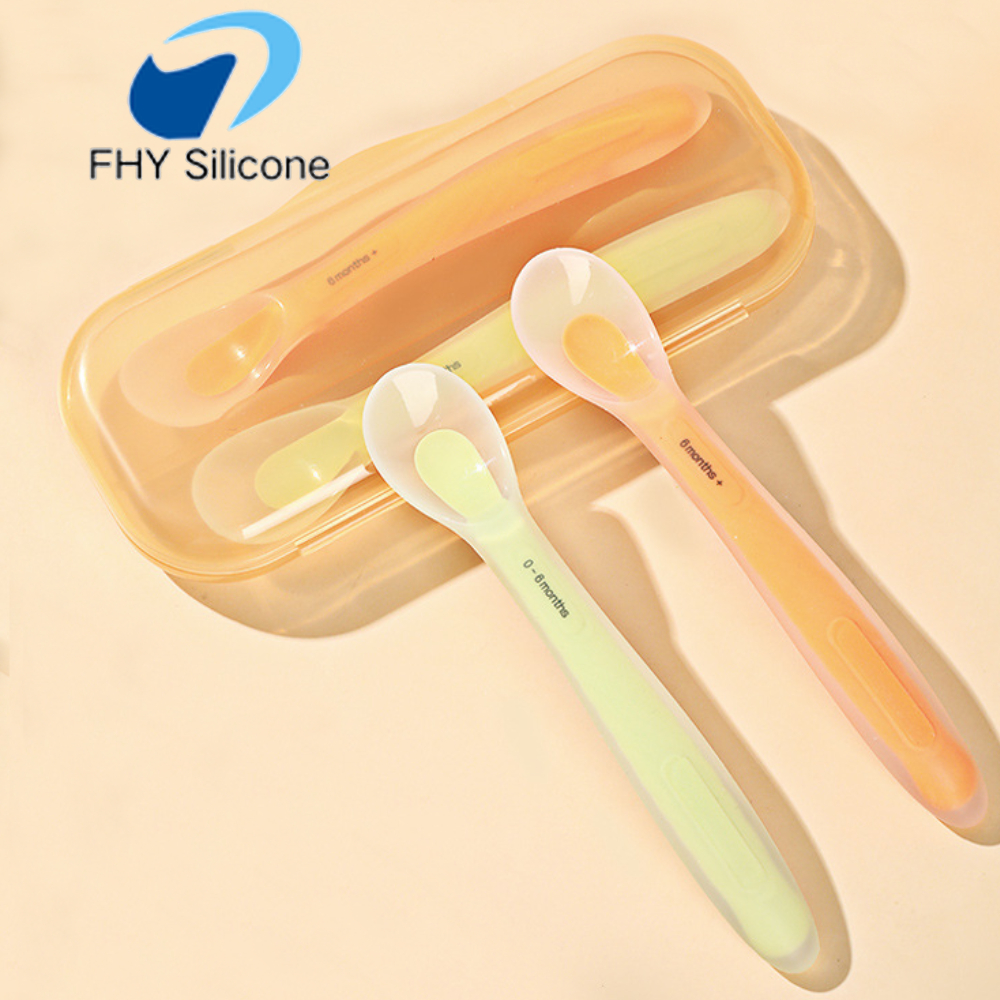
Silicone baby spoons and forks
Silicone baby bowls and plates
Haklappar av silikon
Tandvårdsleksaker av silikon
Silicone pacifier clips and anti-lost straps
Silicone bottle accessories
Silicone straw cup parts
Tätningsringar av silikon
Silicone food storage lids
Silicone training cup parts
Silicone baby toothbrushes
Silicone bath scrubbers
Silicone placemats
Silicone snack cups
Silicone baby tableware gift sets
These products can be developed as single items or complete product collections for private label brands.
Step 1: Confirm the Product Idea
The first step in customization is to confirm the product direction. Buyers should decide what type of baby silicone product they want to develop and what market it will serve.
Viktiga frågor är bland annat:
Who is the target customer?
Is the product for infants, toddlers, or older children?
Will the product be sold online, in supermarkets, or through baby product retailers?
Is the product a standalone item or part of a gift set?
Does the product need a cute design, minimalist style, ocean theme, animal theme, or custom brand style?
A clear product idea helps the factory understand the project quickly and provide better customization suggestions.
Step 2: Choose the Right Material
Material selection is very important for baby silicone products. Food-grade silicone is commonly used because it is soft, flexible, and suitable for baby feeding and care applications.
Depending on the product type, different material options may be considered:
Solid silicone for bibs, teethers, spoons, bowls, and plates
Liquid silicone rubber for high-precision baby products and overmolding parts
Silicone combined with PPSU, PP, glass, stainless steel, PC, or metal parts
Different silicone hardness options for soft-touch or stronger structure requirements
For example, a baby teether may require a soft and flexible material, while a silicone suction bowl may need a more stable structure. A silicone sealing ring for a straw cup may require accurate dimensions and good sealing performance.
Step 3: Develop the Product Structure
Product structure affects usability, comfort, safety, and production cost. For baby products, the structure should be practical, easy to clean, and suitable for daily use.
Till exempel:
A silicone spoon should have a soft feeding head and comfortable handle.
A silicone bib should have an adjustable neck closure and deep food pocket.
A teether should be easy for babies to grip and chew.
A baby bowl may need a suction base for better stability.
A straw cup part may need a leak-resistant valve or sealing ring.
A silicone lid should fit the container tightly and be easy to open.
During OEM and ODM development, the factory can help optimize the structure based on molding feasibility, user experience, and production efficiency.
Step 4: Customize the Color
Color is an important part of baby product branding. Soft pastel colors, natural tones, and clean modern colors are very popular in the baby product market.
Common color styles include:
Soft pink
Cream white
Baby blue
Mint green
Light yellow
Beige
Warm gray
Ocean blue
Earth-tone colors
Custom Pantone colors
For brands, consistent color matching helps create a complete product series. For example, a baby feeding collection can use the same color system across spoons, bowls, bibs, teethers, and food storage lids.
Custom color matching can be produced according to customer samples or Pantone color numbers.
Step 5: Add Logo and Branding
Logo customization helps turn a standard product into a private label product. For silicone baby products, common logo methods include:
Molded logo
Präglad logotyp
Präglad logotyp
Silk screen printing
Pad printing
Laser marking on combined parts
Logo printing on packaging
For baby silicone products, molded logos are often preferred because they are durable and integrated into the product structure. However, the best logo method depends on product shape, surface texture, color, and branding requirements.
Step 6: Design the Mold
If the project requires a new product shape or exclusive design, mold development is needed. Mold design is one of the most important steps in silicone product customization.
The mold development process usually includes:
3D drawing confirmation
Product structure review
Mold flow and production feasibility review
Prototype or sample development
Mold opening
First sample testing
Justering av prov
Final sample approval
A good mold design helps ensure stable product quality, accurate dimensions, smooth surface finish, and efficient mass production.
For OEM projects, customers may provide drawings or samples. For ODM projects, the factory can support design development based on the customer’s product concept.
Step 7: Create Samples for Approval
Before mass production, samples are usually made for customer approval. Sample testing helps confirm the product’s size, color, softness, structure, surface finish, logo effect, and packaging.
For baby silicone products, sample review may include:
Color checking
Hardness checking
Logo position checking
Surface finish checking
Monteringstest
Sealing test
Suction test
Cleaning test
User experience review
Packaging review
Only after the customer approves the sample should mass production begin.
Step 8: Customize the Packaging
Packaging is very important for baby products, especially for retail and e-commerce sales. Good packaging improves product presentation and helps communicate brand value.
Common packaging options include:
OPP bag
PE bag
Color box
Kraft box
Window box
Gift box
Blisterförpackning
Paper card packaging
Skräddarsydda förpackningar för detaljhandeln
Baby tableware set packaging
Packaging can include product instructions, logo, barcode, product images, color information, and other brand elements. For gift sets, packaging design is especially important because it affects the customer’s first impression.
Step 9: Mass Production and Quality Control
After the sample is approved, the factory can start mass production. Quality control is important throughout the production process to ensure stable product performance and appearance.
Common quality control points include:
Material inspection
Färgkonsistens
Product size checking
Surface defect inspection
Logo inspection
Assembly checking
Sealing performance test
Packing inspection
Final shipment inspection
For baby products, stable quality is especially important because end users have high expectations for safety, comfort, and durability.
Step 10: Build a Complete Baby Product Series
For brands, one customized silicone product can often be expanded into a full product line. This helps improve brand recognition and increase sales opportunities.
For example, a baby silicone feeding series may include:
Silicone baby spoon
Silicone fork
Silicone bowl
Silicone plate
Silicone bib
Silicone placemat
Silicone teether
Silicone snack cup
Silicone food storage lid
PPSU cup with silicone accessories
A complete product series can be designed with matching colors, consistent logo placement, and unified packaging style. This is especially useful for private label brands and gift box projects.
Key Benefits of Custom Baby Silicone Products
Custom baby silicone products offer many advantages for brands and buyers.
First, they help create a unique product identity. Instead of selling generic items, brands can develop products with their own shape, color, logo, and packaging.
Second, silicone products offer strong design flexibility. The material can be molded into soft, cute, functional, and ergonomic structures.
Third, custom silicone products can support different market positions, from basic baby feeding products to premium gift sets and exclusive product collections.
Finally, OEM and ODM services help brands reduce product development difficulty by working with an experienced manufacturing partner.
What Information Should Buyers Provide?
To start a custom baby silicone product project, buyers can prepare the following information:
Product type
Målmarknad
Kvantitetskrav
Material preference
Produktstorlek
Krav på färg
Logo file
Krav på förpackning
Reference images or samples
Function requirements
Budget range
Förväntad leveranstid
The more details provided at the beginning, the faster and more accurate the factory can offer a suitable solution.
Slutsats
Customizing baby silicone products with OEM and ODM services is a practical way for brands to develop unique, functional, and marketable baby products. From product concept and material selection to mold development, sample approval, color matching, logo branding, packaging, and mass production, every step affects the final product quality and market performance.
Food-grade silicone is widely used in baby products because it is soft, flexible, durable, easy to clean, and suitable for many feeding and care applications. With the right manufacturing partner, brands can create silicone baby products that meet customer needs and build long-term market value.
Whether you are developing silicone baby tableware, teethers, bibs, bottle accessories, straw cup parts, or a complete baby feeding gift set, OEM and ODM customization can help turn your product idea into a real market-ready solution.
Vanliga frågor
1. What baby silicone products can be customized?
Common customized products include silicone baby spoons, bowls, plates, bibs, teethers, straw cup parts, bottle accessories, sealing rings, training cup parts, and baby tableware gift sets.
2. Can I customize the color and logo?
Yes. Colors can be customized according to Pantone numbers or customer samples. Logos can be made by molded logo, embossed logo, debossed logo, printing, or packaging branding.
3. Do custom silicone baby products need a new mold?
If you need a new shape, exclusive design, or special structure, a new mold is usually required. If you only need color, logo, or packaging changes on an existing product, new mold development may not be necessary.
4. Can silicone be combined with other materials?
Yes. Silicone can be combined with PPSU, PP, glass, stainless steel, PC, PA, metal, and other materials through assembly or overmolding.
5. What is the difference between OEM and ODM customization?
OEM usually means producing according to the customer’s design or specification. ODM means the factory provides product design and development support based on the customer’s idea or market requirement.
 English
  Japanese
  Korean
  German
  French
  Italian
  Spanish
  Dutch
Dutch  Chinese
  Portuguese
  Polish
  Czech
Czech  Hungarian
  Swedish
  Finnish
  Vietnamese
  Thai
Thai  Turkish
  Arabic
  Russian