
Liquid silicone rubber is normally selected for electrical insulation, flexible sealing and resistance to demanding temperatures. By incorporating electrically conductive fillers into the silicone formulation, manufacturers can create conductive LSR components that combine elastomeric flexibility with controlled electrical resistance.
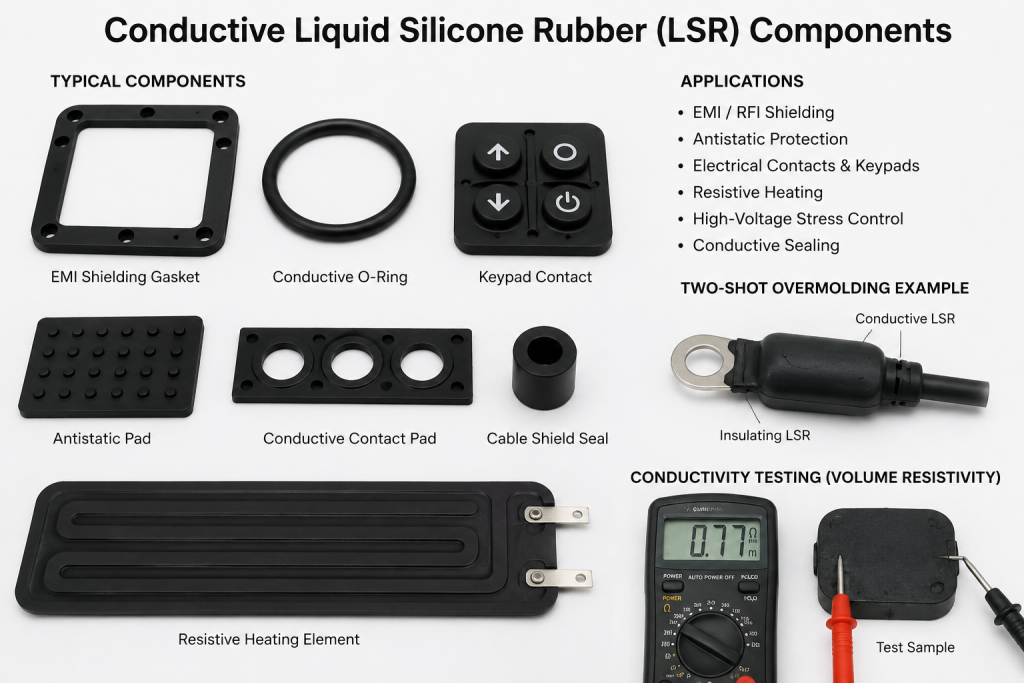
Conductive liquid silicone rubber can be used for electromagnetic shielding, antistatic protection, electrical contacts, resistive heating, high-voltage field control and other electrical or electronic applications. Shin-Etsu lists conductive liquid silicone materials for electromagnetic shielding, antistatic seals and adhesives, while Momentive and Dow offer conductive LSR grades for cable accessories and electrical stress-control components.
However, conductive LSR should not be selected by appearance or hardness alone. Its electrical behavior depends on the filler system, filler concentration, molded geometry, contact pressure, processing conditions and service environment.
A successful custom component must therefore balance conductivity with:
- Flexibility
- Tear strength
- Compression performance
- Точность размеров
- Moldability
- Термостойкость
- Environmental durability
- Adhesion to other materials
This article explains the main properties, applications and manufacturing considerations involved in custom conductive LSR molding.
What Is Conductive Liquid Silicone Rubber?
Liquid silicone rubber, commonly abbreviated as LSR, is generally a two-component, platinum-cured elastomer designed for liquid injection molding. It can support fast curing, automated production and precise molding of thin or complex components. (Momentive)
Standard silicone rubber is usually an electrical insulator. Conductive LSR is modified with carbon or other electrically conductive materials that form conductive paths through the cured elastomer. Shin-Etsu describes conductive silicone products as silicone compounds containing carbon and other conductive materials while retaining the characteristic flexibility and environmental resistance of silicone rubber.
The final compound may be designed for:
- Low electrical resistance
- Static dissipation
- Electromagnetic interference shielding
- Controlled resistive heating
- Electrical field control
- Pressure-dependent contact switching
The term conductive silicone is therefore too broad to function as a complete material specification. A product intended to dissipate static electricity may require a very different resistivity from a gasket intended to carry current or shield sensitive electronics.
How Conductive Fillers Create Electrical Conductivity
The silicone polymer itself remains electrically insulating. Conductivity is created by dispersing conductive particles throughout the formulation.
As filler concentration increases, the particles begin to contact one another and form continuous electrical paths. Below this conductive threshold, resistance may remain extremely high. Near the threshold, a relatively small change in filler concentration or dispersion can produce a large change in resistivity.
Shin-Etsu reports that commercially available conductive silicone rubbers commonly have volume resistivity between approximately 0.01 and 10 Ω·m. It also notes that maintaining consistent resistance in certain intermediate ranges can be difficult because small changes in carbon content may produce substantial resistance changes. (信越硅胶)
This has several practical consequences:
- A customer should specify an acceptable resistance range rather than requesting only “conductive silicone.”
- The manufacturer must maintain consistent filler dispersion and mixing.
- Test specimens should represent the final molded thickness and processing conditions.
- Conductivity should be evaluated across multiple production batches.
- The electrical properties of the finished component should be tested, not inferred only from raw-material data.
Conductive LSR Is Not the Same as Thermally Conductive LSR
Electrical conductivity and thermal conductivity are different material properties.
Electrically conductive LSR is formulated to allow electrical current, control static charge or interact with an electrical field.
Thermally conductive LSR is formulated primarily to transfer heat away from electronic components. It may still be electrically insulating, depending on the filler system.
Momentive separately identifies electrically conductive formulations and thermally conductive injection-moldable LSR products, demonstrating that the two functions require different material-selection criteria. (Momentive)
A project specification should clearly state whether the component requires:
- Electrical conductivity
- Thermal conductivity
- Both properties
- Thermal conductivity with electrical insulation
Confusing these requirements can lead to material failure or electrical safety risks.
Main Electrical Properties to Specify
Volume Resistivity
Volume resistivity measures resistance through the body of a material and is normally expressed in Ω·m or Ω·cm.
Lower volume resistivity generally indicates greater electrical conductivity.
Volume resistivity is important for:
- Conductive seals
- High-voltage field-control parts
- Current-carrying elastomer components
- Resistive heating elements
- Conductive contact components
Dow describes its conductive injection-molding LSR for electrical stress-control applications as having low volume resistivity.
The customer should define:
- Target value
- Minimum acceptable value
- Maximum acceptable value
- Test specimen thickness
- Test temperature
- Conditioning requirements
- Whether measurements are required before and after aging
Surface Resistance
Surface resistance measures how easily current travels across the surface of a component.
It can be particularly relevant for:
- Static-dissipative surfaces
- Equipment-touch interfaces
- Electronic housings
- Dust-sensitive environments
- Flexible antistatic components
Surface resistance may be affected by contamination, moisture, oils and surface finish. Testing should therefore be performed under conditions representative of actual use.
Contact Resistance
Contact resistance describes the electrical resistance where the silicone touches another conductive material.
The result can depend on:
- Contact pressure
- Contact area
- Surface roughness
- Electrode material
- Oxidation
- Твёрдость силикона
- Component thickness
- Contamination
- Repeated compression
A raw-material volume-resistivity value does not automatically predict the contact resistance of a finished keypad, switch or conductive gasket.
Resistance Under Compression
Some conductive silicone components are compressed during assembly. Compression can move conductive particles closer together and increase the effective contact area.
The development team should measure resistance at:
- Minimum assembly compression
- Nominal compression
- Maximum compression
- Repeated compression cycles
- Elevated temperature
- End-of-life conditions
This is especially important for conductive gaskets, contact pads and pressure-sensitive switching components.
EMI Shielding Performance
For electromagnetic interference applications, low resistivity alone may not establish adequate shielding.
Shielding performance can also depend on:
- Filler type
- Component thickness
- Gasket continuity
- Contact pressure
- Enclosure material
- Joint design
- Frequency range
- Surface preparation
- Gaps and fasteners
Shin-Etsu identifies electromagnetic shielding as an application for conductive liquid silicone seals and conductive rubber components. (信越硅胶)
The complete enclosure or assembly should therefore be tested where shielding performance is critical.
Mechanical Properties Still Matter
Adding conductive fillers changes the formulation and may affect the mechanical behavior of the silicone.
Important properties include:
- Твёрдость по шкале Шор А
- Прочность на разрыв
- Удлинение
- Tear strength
- Остаточная деформация при сжатии
- Flex-fatigue resistance
- Resilience
- Abrasion resistance
For example, Dow’s conductive stress-control LSR is described as a 30–35 Shore A material with high elongation and specified tensile strength, showing that electrical performance must coexist with mechanical requirements.
A highly conductive formulation may not automatically provide the best:
- Устойчивость к разрыву
- Dynamic flexibility
- Герметичность
- Demolding strength
- Thin-wall durability
The selected material must satisfy both electrical and physical requirements.
Temperature and Environmental Performance
Silicone elastomers are commonly selected for their ability to remain flexible across changing temperatures. Conductive formulations can also provide the heat, cold and weather resistance associated with silicone rubber, although exact limits depend on the material grade. Shin-Etsu describes conductive silicone products as providing conductivity together with heat resistance, cold resistance and weatherability. (信越硅胶)
Electrical properties should be evaluated after exposure to relevant conditions, including:
- High-temperature aging
- Low-temperature storage
- Thermal cycling
- Влажность
- Вода
- УФ-излучение
- Озон
- Oils or cleaning agents
- Mechanical fatigue
- Long-term compression
Temperature can affect both polymer behavior and electrical resistance. The customer should not assume that room-temperature measurements will remain unchanged throughout the product’s service life.
Major Applications of Conductive LSR
EMI and RFI Shielding Gaskets
Conductive LSR can be molded into flexible gaskets used between electronic housings, covers and access panels.
Potential applications include:
- Communication equipment
- Industrial controllers
- Automotive electronic modules
- Battery-system housings
- Sensors
- Consumer electronics
- Instrumentation enclosures
The silicone provides flexibility and environmental sealing, while the conductive network helps maintain electrical continuity between mating surfaces.
For effective shielding, the design must prevent discontinuities at:
- Corners
- Fastener locations
- Gasket joints
- Cable entries
- Housing transitions
Antistatic and Static-Dissipative Components
Conductive or partially conductive silicone may be used to control electrostatic charge.
К примерам относятся:
- Antistatic seals
- Equipment feet
- Handling pads
- Electronic assembly fixtures
- Защитные чехлы
- Flexible contact surfaces
- Dust-sensitive equipment components
Shin-Etsu specifically identifies antistatic seals, adhesives and protection for electrical or electronic devices as applications for conductive silicone. (信越硅胶)
The target resistance must be carefully controlled. A component designed to dissipate charge does not necessarily need the low resistance required for carrying substantial current.
Conductive Keypads and Switch Contacts
Conductive silicone can be molded into contact pills or integrated switching structures.
When the silicone is pressed, the conductive area connects two circuit-board contacts.
Important design factors include:
- Contact resistance
- Actuation force
- Key travel
- Recovery force
- Contact geometry
- Surface cleanliness
- Cycle life
- Alignment with the circuit board
Shin-Etsu lists keyboard contact points as a common conductive silicone application.
Resistive Heating Components
Because conductive silicone has electrical resistance, current passing through it can generate heat.
Possible applications include:
- Flexible heater elements
- Anti-condensation parts
- Temperature-maintenance components
- Heated pads
- Specialized industrial devices
Shin-Etsu identifies heater components as one use for conductive silicone rubber.
Heating applications require careful control of:
- Resistance uniformity
- Voltage
- Current
- Component thickness
- Heat distribution
- Maximum surface temperature
- Electrical connections
- Thermal aging
- Over-temperature protection
The heater should be evaluated as a complete electrical system rather than only as a molded rubber component.
High-Voltage Cable Accessories
Conductive LSR is used in medium- and high-voltage cable systems for electrical field control.
Applications can include:
- Cable joints
- Cable terminations
- Push-on accessories
- Cold-shrink components
- Stress-control layers
- Switchgear connectors
Momentive states that conductive LSR can be combined with insulating silicone materials to provide electrical field control in push-on joints and cold-shrink cable accessories. (Momentive)
Dow also offers conductive LSR designed for electrical stress-control devices and conductive moldings.
These applications require strict control of:
- Resistivity
- Interface quality
- Layer adhesion
- Geometry
- Air entrapment
- Contamination
- Insulating-material compatibility
- Long-term electrical aging
Conductive Seals and O-Rings
Conductive silicone can combine sealing with electrical continuity.
Potential applications include:
- Conductive enclosure gaskets
- Grounding seals
- Shielded connector seals
- Equipment access-panel seals
- Specialized O-rings
- Conductive packing components
Shin-Etsu lists conductive gaskets, O-rings, seals and packing among typical molded applications.
The designer must balance low electrical resistance with compression set, sealing force and environmental durability.
Flexible Sensors and Electrodes
Specially developed conductive silicone may also be considered for flexible sensing or electrode structures.
The design may use resistance changes caused by:
- Compression
- Bending
- Stretching
- Contact with another surface
These projects generally require application-specific material characterization because the resistance-strain relationship may be nonlinear and sensitive to geometry, loading history and environmental conditions.
Conductive Filler Selection
Conductive silicone formulations may use carbon or other electrically conductive materials. The filler system influences:
- Electrical resistance
- Цвет
- Viscosity
- Твёрдость
- Tear strength
- Cost
- Environmental resistance
- Shielding performance
- Processing behavior
Carbon-filled conductive silicone is commonly black. Shin-Etsu’s conductive rubber examples are black products with different volume-resistivity levels. (信越硅胶)
Where a customer requests a light or custom color, the manufacturer must first confirm whether the required conductivity can be achieved with a suitable non-carbon filler system.
A specific filler should not be chosen only because it provides low resistance. The complete formulation must also meet requirements concerning:
- Corrosion
- Galvanic compatibility
- Particle migration
- Механические характеристики
- Regulatory restrictions
- Long-term stability
- Cost
Custom LSR Molding Considerations
Material Metering and Mixing
LSR is typically supplied as a two-part system. Accurate metering and homogeneous mixing are essential for reliable curing and consistent properties. Momentive describes LSR as a two-component, platinum-cured material designed for liquid injection molding. (Momentive)
For conductive grades, poor material control may also create differences in electrical resistance between parts or production batches.
The molding process should control:
- Part A and Part B ratio
- Pumping pressure
- Mixing quality
- Material temperature
- Время пребывания
- Contamination
- Отслеживаемость партий
Material Viscosity and Cavity Filling
Conductive fillers can change how the LSR flows through the mold.
The mold designer should evaluate:
- Gate size
- Gate location
- Flow length
- Thin-wall sections
- Pressure loss
- Weld lines
- Air traps
- Venting
- Fill balance
A mold designed for an unfilled general-purpose LSR may not perform identically with a highly filled conductive formulation.
Representative mold-flow trials should be completed using the actual production material.
Conductivity Uniformity
The conductive filler must remain properly dispersed throughout the molded component.
Potential problems include:
- Local resistance variation
- Incomplete conductive paths
- High-resistance weld lines
- Differences between thin and thick sections
- Batch-to-batch inconsistency
- Conductivity variation near gates
Electrical measurements should be taken at multiple positions where uniformity is critical.
Gate and Weld-Line Position
When two flow fronts meet, they form a weld or knit line. Although the silicone may appear fully joined, the filler network at the interface may differ from the rest of the component.
Critical conductive paths should not rely on an unvalidated weld line.
The gate should be positioned to:
- Promote balanced filling
- Minimize air entrapment
- Avoid critical contact areas
- Reduce long flow distances
- Control filler orientation
- Prevent visible gate damage
Venting
Trapped air can create:
- Incomplete filling
- Дефекты поверхности
- Следы ожогов
- Weak areas
- Electrical discontinuities
- Poor overmolding interfaces
LSR molds require precise venting because the material can flow into extremely narrow gaps. Vents must release air without generating unacceptable flash.
Flash Control
Conductive flash may cause more than a cosmetic defect.
It can create:
- Unintended electrical paths
- Short-circuit risks
- Interference with connector assembly
- Irregular gasket contact
- Contamination inside electronic housings
Critical areas should have clearly defined flash limits on the drawing.
Demolding
High filler loading may affect flexibility and tear resistance. Thin conductive ribs, contact structures and sealing lips can be damaged during ejection.
The component should include:
- Suitable draft and release geometry
- Rounded transitions
- Adequate wall thickness
- Supported sealing features
- A controlled demolding direction
Reverse tapers and deep undercuts should be reviewed before tooling.
Conductive and Insulating Two-Component Molding
Some applications require conductive and electrically insulating silicone in the same component.
High-voltage cable accessories are one example. A conductive layer may control the electrical field while an insulating silicone layer provides dielectric protection.
Momentive describes conductive Silopren LSR grades designed for combination with insulating LSR in cable joints and terminations. (Momentive)
Two-material LSR molding requires control of:
- Bond strength between layers
- Interface cleanliness
- First-shot curing
- Second-shot adhesion
- Layer thickness
- Conductive-layer position
- Material shrinkage
- Thermal expansion
- Mold alignment
The conductive layer must not extend into areas that require electrical insulation.
Prototype cross-sections and electrical tests should be used to verify the complete interface.
Overmolding Conductive LSR onto Plastic or Metal
Conductive LSR may be overmolded onto:
- Metal terminals
- Busbars
- Cable components
- Plastic housings
- Connector bodies
- Sensor structures
- Electronic inserts
Potential benefits include:
- Integrated sealing
- Fewer assembly steps
- Controlled positioning
- Compact construction
- Improved environmental protection
However, adhesion should never be assumed.
The development team must evaluate:
- Substrate material
- Surface treatment
- Primer requirements
- Insert cleanliness
- Insert temperature
- Mechanical interlocks
- Mold pressure
- Thermal expansion
- Galvanic compatibility
- Electrical contact location
Self-bonding LSR grades are formulated to adhere to particular thermoplastics or metals, not universally to every substrate. (Momentive)
The actual production-grade insert should be used during adhesion trials.
Designing Electrical Connections
A conductive silicone component must connect reliably to another conductor.
Possible methods include:
- Compression against a metal surface
- Molded contact pads
- Embedded metal inserts
- Clamped connections
- Conductive adhesive
- Mechanical fasteners
The design should avoid relying on uncontrolled point contact.
Important factors include:
- Contact area
- Contact pressure
- Metal finish
- Surface oxidation
- Silicone thickness
- Assembly tolerance
- Vibration
- Thermal cycling
- Repeated disassembly
A larger contact area does not always guarantee lower resistance when compression is uneven. The finished assembly should be measured under minimum and maximum tolerance conditions.
Dimensional Design and Tolerances
Conductive LSR components often serve both electrical and mechanical functions.
Critical dimensions may include:
- Contact thickness
- Sealing-bead height
- Compression distance
- Electrode spacing
- Conductive-path width
- Insulating clearance
- Insert location
- Gasket perimeter
The drawing should separate:
- Electrical critical dimensions
- Sealing dimensions
- Assembly dimensions
- Cosmetic dimensions
- Reference dimensions
Applying unnecessarily tight tolerances to every feature can increase tooling and inspection costs without improving electrical performance.
Testing Conductive LSR Components
A custom validation plan may include:
Electrical Testing
- Volume resistivity
- Surface resistance
- Contact resistance
- Resistance under compression
- Resistance during stretching or bending
- Current-carrying capacity
- Shielding effectiveness
- Electrical field-control performance
Mechanical Testing
- Твёрдость
- Прочность на разрыв
- Удлинение
- Tear strength
- Остаточная деформация при сжатии
- Repeated compression
- Flex fatigue
- Adhesion or peel strength
Environmental Testing
- High-temperature aging
- Low-temperature exposure
- Thermal cycling
- Влажность
- Water exposure
- UV and ozone
- Fluid resistance
- Vibration
- Salt or corrosive environments
Electrical measurements should be repeated after environmental and mechanical testing.
A component that meets its initial resistance target may change after prolonged compression, heat aging or repeated movement.
Quality-Control Requirements
For production, conductivity should be managed as a controlled characteristic.
A quality plan may include:
- Incoming raw-material identification
- Отслеживаемость партий
- Metering-ratio control
- First-piece resistance testing
- Контроль размеров
- Визуальный осмотр
- Defined electrode fixtures
- Controlled test pressure
- Periodic aging tests
- Statistical monitoring
- Change control
The test method should define the fixture, electrode geometry and applied pressure. Otherwise, two laboratories may obtain different resistance values from the same component.
Common Conductive LSR Design Mistakes
Requesting “Conductive Silicone” Without a Resistance Range
Conductive, antistatic and shielding materials may have very different electrical properties.
Using Raw-Material Data as the Finished-Part Specification
Molded thickness, geometry, pressure and processing can influence electrical performance.
Ignoring Resistance Under Compression
A gasket or contact pad may behave differently at minimum and maximum assembly compression.
Confusing Thermal and Electrical Conductivity
A thermally conductive silicone can remain electrically insulating.
Assuming Every Conductive Grade Is Suitable for EMI Shielding
Shielding depends on the complete enclosure, gasket design and frequency range.
Allowing Conductive Flash in Insulating Areas
Small flash can create an unintended electrical path.
Placing Weld Lines Across a Critical Conductive Path
The conductivity of a weld-line region should be verified before it is used as part of the primary current path.
Ignoring Filler Effects on Moldability
Conductive grades may require different gate, vent and process settings from standard LSR.
Changing Material Grades Without Revalidation
Similar-looking grades can have different fillers, resistance, hardness and processing behavior.
Testing Only at Room Temperature
Electrical and mechanical properties should be checked after representative aging and environmental exposure.
Information Needed for a Custom Conductive LSR Quotation
To receive an accurate quotation, customers should provide:
- 2D and 3D drawings
- Product application
- Target volume resistivity
- Surface- or contact-resistance requirements
- Required shielding performance
- Operating voltage and current
- Temperature range
- Environmental exposure
- Твёрдость силикона
- Compression conditions
- Пластиковые или металлические вставки
- Required bonding method
- Expected annual quantity
- Inspection requirements
- Applicable testing standards
- Требования к упаковке
For an existing component, a physical sample can also help the manufacturer evaluate:
- Geometry
- Contact areas
- Parting lines
- Твёрдость материала
- Assembly method
- Potential molding process
Practical Development Process
Step 1: Define the Electrical Function
Determine whether the component is intended for static dissipation, current conduction, shielding, switching, heating or field control.
Step 2: Establish the Resistance Target
Define acceptable minimum and maximum values under specific test conditions.
Step 3: Define Mechanical Requirements
Confirm hardness, compression, sealing force, tear strength and expected movement.
Step 4: Select Candidate Materials
Compare electrical, mechanical, environmental and processing properties.
Step 5: Review the Component Geometry
Evaluate conductive-path continuity, wall thickness, gates, weld lines and contact areas.
Step 6: Produce Representative Samples
Use the actual production-grade material and intended molding process.
Step 7: Test the Finished Component
Measure electrical properties using representative fixtures and assembly pressure.
Step 8: Complete Environmental Aging
Repeat testing after heat, humidity, fluids, vibration or mechanical cycling.
Step 9: Conduct Pilot Production
Evaluate batch-to-batch resistance and dimensional consistency.
Step 10: Freeze the Approved Configuration
Control the material grade, supplier, molding process, tool, inserts and test method.
Заключение
Conductive liquid silicone rubber allows manufacturers to combine controlled electrical behavior with the flexibility, temperature performance and design freedom of silicone elastomers.
It can support applications such as:
- EMI shielding
- Antistatic protection
- Electrical contacts
- Flexible heating
- Conductive sealing
- High-voltage field control
- Two-component conductive and insulating assemblies
However, conductive LSR is not a single standardized material.
Successful development requires clearly defined electrical targets, representative finished-part testing and careful control of filler dispersion, mold filling, flash, contact pressure and environmental aging.
The best material is not necessarily the grade with the lowest resistance. It is the grade that provides stable electrical performance while meeting the component’s mechanical, sealing, processing and service-life requirements.
Early cooperation between the product designer, material supplier, mold maker and LSR molding manufacturer can reduce tooling changes and help establish a reliable path from prototype testing to controlled mass production.
Часто задаваемые вопросы
Is ordinary liquid silicone rubber electrically conductive?
No. Standard LSR is generally electrically insulating. Conductive fillers must be incorporated into the formulation to create electrical conductivity.
What fillers are used in conductive silicone?
Carbon and other conductive materials can be added to silicone. The exact filler system depends on the required resistivity, mechanical properties, color and application.
Is conductive silicone always black?
Carbon-filled conductive silicone is normally black. Other filler systems may allow different appearances, but color availability depends on the formulation and required conductivity.
What is the typical resistivity of conductive silicone rubber?
Shin-Etsu reports that many commercial conductive silicone rubbers fall within approximately 0.01–10 Ω·m, although specialized products may be designed outside this range. (信越硅胶)
Can conductive LSR be used for EMI shielding?
Yes. Conductive silicone seals and gaskets can be used in EMI-shielding systems. Shielding performance must be tested in the complete enclosure.
Can conductive LSR also provide environmental sealing?
Yes. A properly designed conductive silicone gasket may provide both electrical continuity and protection against moisture or dust.
Is electrically conductive LSR also thermally conductive?
Not necessarily. Electrical and thermal conductivity are separate properties and must be specified independently.
Can conductive LSR be overmolded onto metal?
Yes, but the insert design, surface condition, adhesion method and electrical contact area must be validated.
Can conductive and insulating silicone be molded together?
Yes. Conductive and insulating LSR layers can be integrated in selected two-component applications, including high-voltage cable accessories. (Momentive)
What is the most important information for a quotation?
The manufacturer needs the drawing, intended electrical function, target resistance range, test conditions, operating environment, hardness, annual quantity and details of any plastic or metal inserts.
 English
  Japanese
  Korean
  German
  French
  Italian
  Spanish
  Dutch
Dutch  Chinese
  Portuguese
  Polish
  Czech
Czech  Hungarian
  Swedish
  Finnish
  Vietnamese
  Thai
Thai  Turkish
  Arabic
  Russian