
When developing a custom silicone product, one of the most important manufacturing decisions is choosing the right molding process.
Two of the most common options are:
- Liquid Silicone Rubber, or LSR
- High Consistency Rubber, or HCR
Both materials are silicone elastomers, but they behave very differently during processing.
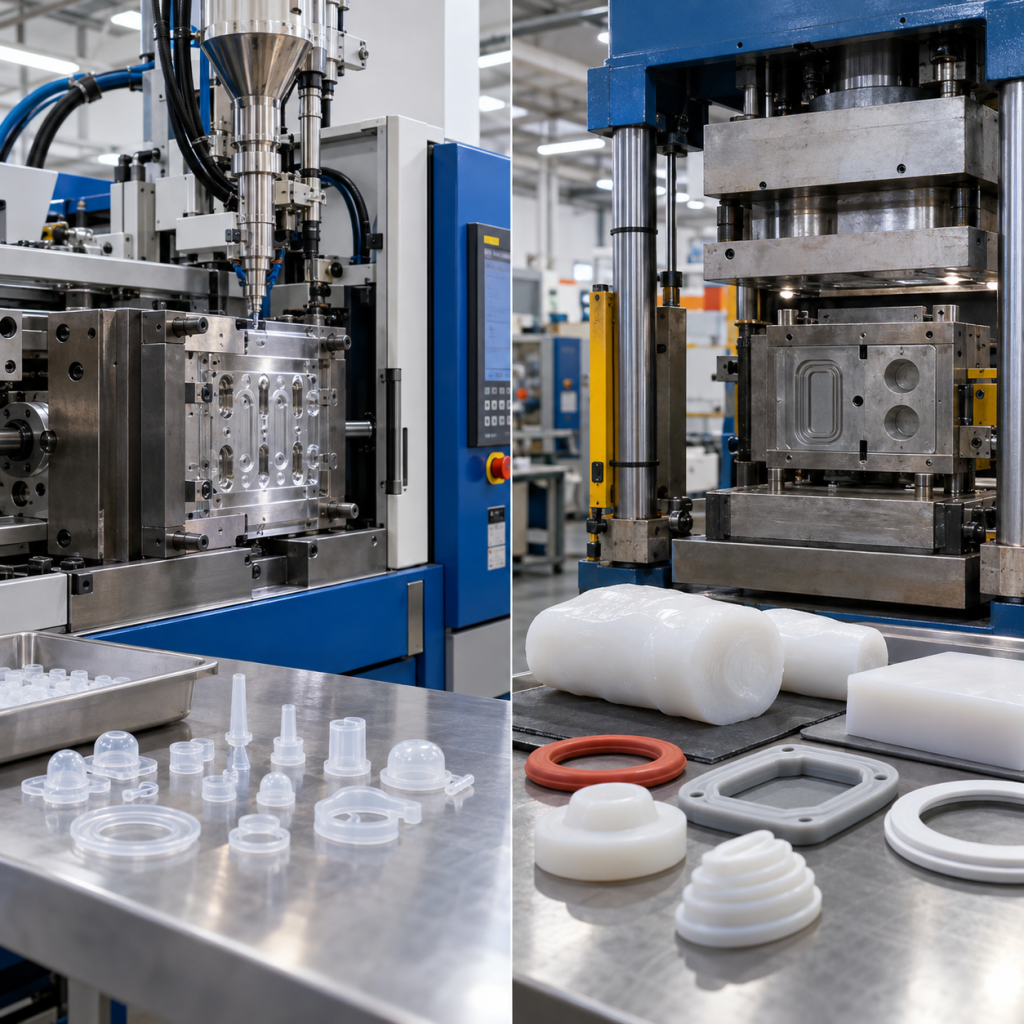
LSR is a low-viscosity liquid material that is usually processed by injection molding.
HCR is a high-viscosity solid silicone rubber that is commonly processed by compression molding, transfer molding, or conventional rubber injection molding.
The right choice depends on the product design, production volume, tolerance, application, material requirements, and total project cost.
This guide compares LSR and HCR from an engineering and purchasing perspective to help you choose the most suitable process for your custom silicone product.
1. What Is LSR?
LSR stands for Liquid Silicone Rubber.
It is normally supplied as a two-part liquid system.
The two components are mixed at a controlled ratio and injected into a heated mold, where the silicone cures into the final part.
Because LSR has very low viscosity, it can flow into small cavities and fine features.
This makes it suitable for precision components with complex geometry.
Typical LSR applications include:
- Medische siliconenonderdelen
- Producten voor babyvoeding
- Siliconenkleppen
- Waterdichte afdichtingen
- Connectoren voor de automobielindustrie
- Elektronische componenten
- Precision gaskets
- Siliconen-overmolding
- Thin-wall silicone parts
LSR is widely used in industries where repeatability, cleanliness, and automated production are important.
2. What Is HCR?
HCR stands for High Consistency Rubber.
It is also commonly called high consistency silicone rubber or solid silicone rubber.
Unlike LSR, HCR has a thick, gum-like consistency before molding.
It usually requires mechanical mixing and preforming before being placed into the mold.
HCR is commonly processed through:
- Compressiegieten
- Transfer molding
- Rubber injection molding
- Extrusion
Typical HCR applications include:
- Silicone gaskets
- Siliconen kussentjes
- Kitchen products
- Industriële afdichtingen
- Silicone covers
- Silicone mats
- Consumer products
- Silicone tubes
- General-purpose molded silicone parts
HCR is widely used because of its flexible processing options and relatively economical tooling.
3. LSR vs HCR: Main Difference
The biggest difference between LSR and HCR is how the material is processed.
LSR is liquid and is generally injected into a closed mold.
HCR is solid or semi-solid and is generally loaded into a mold as a preformed piece of material.
Dit verschil heeft gevolgen voor:
- Tooling design
- Production speed
- Labor cost
- Automatisering
- Part precision
- Product complexity
- Flash-bediening
- Productievolume
- Prijs per eenheid
For this reason, the correct process should be selected during the early design stage.
4. Material Flow and Product Complexity
LSR has very low viscosity.
This allows the material to flow into small channels, thin walls, micro-features, and complex cavities.
LSR is therefore particularly suitable for products that contain:
- Thin walls
- Fine details
- Small holes
- Complex sealing features
- Microstructures
- Narrow flow paths
HCR has higher viscosity.
It does not flow as easily into very small features.
However, HCR performs well for many medium and large silicone products with relatively simple geometry.
If your product has very fine details or complex internal structures, LSR may offer better molding performance.
5. Tooling Cost
Tooling cost is one of the most important differences between LSR and HCR.
LSR Tooling
LSR molds are usually more complex.
Ze kunnen het volgende vereisen:
- Precision mold machining
- Cold runner systems
- Accurate temperature control
- Vacuümsystemen
- Precision venting
- Automated demolding
- Tight mold alignment
As a result, LSR tooling normally requires a higher upfront investment.
HCR Tooling
Compression molds for HCR are generally simpler.
The mold structure may be easier to design and manufacture.
This usually results in a lower initial mold cost.
For small production quantities or simple products, HCR can therefore be more economical.
6. Production Volume
Production volume is another major factor.
LSR is particularly suitable for medium- and high-volume production.
Because LSR molding can be highly automated, the process can achieve:
- Short cycle times
- Automatische materiaaltoevoer
- Automatic molding
- Automatisch ontvormen
- Lower labor requirements
For large-volume projects, the higher tooling cost can often be offset by lower unit production costs.
HCR molding typically requires more manual operations.
These may include:
- Material cutting
- Preforming
- Mold loading
- Demolding
- Flash trimming
For lower-volume projects, this may still be economical because the initial tooling cost is lower.
7. Labor Cost
LSR production can be highly automated.
Once the process is established, operators may only need to monitor the molding system and perform inspection.
This reduces labor cost per piece.
HCR compression molding often requires more manual handling.
Workers may need to:
- Weigh material
- Cut silicone
- Place material into the mold
- Remove molded parts
- Trim flash
As labor costs increase, automation becomes more important.
For high-volume production, LSR often provides better long-term cost efficiency.
8. Precision and Tolerance
LSR injection molding offers excellent process consistency when the mold and process parameters are properly controlled.
It is suitable for precision applications where repeatability is important.
Voorbeelden hiervan zijn:
- Medical valves
- Electronic seals
- Automotive connector seals
- Precision diaphragms
- Small silicone components
HCR can also achieve good dimensional control.
However, because more manual steps may be involved, process variation may be slightly higher.
For products with critical dimensions, the manufacturer should review:
- Silicone shrinkage
- Product geometry
- Wanddikte
- Scheidingslijn
- Schimmelstructuur
- Measurement method
Tolerance should always be defined based on functional requirements rather than applying unnecessarily tight tolerances to every dimension.
9. Flash Control
Flash is excess material that forms around the mold parting line.
LSR molds can achieve very small flash when designed and machined correctly.
Precision mold alignment and controlled injection help reduce flash formation.
This is particularly important for:
- Medical parts
- Small valves
- Sealing products
- Elektronische componenten
HCR compression molding generally produces more visible flash.
Additional trimming may therefore be required.
For products where appearance or sealing performance is critical, flash requirements should be specified during the RFQ stage.
10. Surface Quality
Both LSR and HCR can produce high-quality surfaces.
The final appearance depends mainly on:
- Mold surface finish
- Silicone formulation
- Schimmeltemperatuur
- Uithardingsomstandigheden
- Demolding
- Nabewerking
LSR is often preferred for precision products with smooth or detailed surfaces.
HCR is also suitable for:
- Matte surfaces
- Oppervlakken met structuur
- Glossy surfaces
- Functional industrial surfaces
For consumer products, mold texture can be used to create different visual and tactile effects.
11. Material Purity and Cleanliness
LSR is widely used in applications where cleanliness is important.
Because the material can be processed in a closed system, contamination risk can be reduced.
This makes LSR suitable for:
- Medical products
- Babyartikelen
- Food-contact parts
- Precision electronic components
HCR can also meet food-grade and medical-grade requirements when the correct silicone material and manufacturing controls are used.
The choice should be based on the actual material standard and application requirements.
12. Medical Applications
LSR is commonly used for medical silicone components.
Typische toepassingen zijn onder meer:
- Medische verzegelingen
- Kleponderdelen
- Ademhalingscomponenten
- Draagbare medische apparaten
- Silicone diaphragms
- Precision tubing connectors
LSR is suitable for medical projects because of:
- Hoge herhaalbaarheid
- Clean processing
- Automatisering
- Biocompatible material options
- Precision molding capability
However, not every medical silicone product requires LSR.
HCR may also be used for larger or simpler medical silicone components.
Material certification and process validation are more important than simply choosing one molding method.
13. Baby Care and Food Applications
Both LSR and HCR are widely used in baby care and food-contact products.
LSR is often selected for:
- Fleszuigertjes
- Siliconenkleppen
- Onderdelen van een fopspeen
- Feeding components
- Precision sealing parts
HCR is commonly used for:
- Siliconen bijtringen
- Siliconen kommen
- Baby plates
- Siliconenlepels
- Silicone mats
- Larger molded baby products
For baby care products, important requirements may include:
- Siliconen van voedingskwaliteit
- BPA-free material
- Geurbeheersing
- Kleurconsistentie
- Oppervlaktekwaliteit
- Eenvoudig schoon te maken
The best molding method depends on product structure and production volume.
14. Silicone Overmolding
LSR is especially suitable for automated overmolding.
It can be molded onto compatible substrates such as:
- PC
- PA
- PBT
- PPSU
- Roestvrij staal
- Aluminium
- Other engineered materials
LSR-overmolding wordt toegepast in:
- Medische hulpmiddelen
- Auto-onderdelen
- Electronic housings
- Waterdichte connectoren
- Handheld devices
HCR can also be used for overmolding, but the process is generally less automated.
If the project requires tight bonding control and high production consistency, LSR is often preferred.
15. Thin-Wall Products
Thin-wall silicone components are difficult to mold using high-viscosity materials.
LSR flows easily into thin sections.
Hierdoor is het geschikt voor:
- Dunne membranen
- Flexibele kleppen
- Small sealing lips
- Thin-wall covers
- Precision diaphragms
For very thin products, LSR usually provides better filling performance.
16. Large and Simple Silicone Products
HCR is often more economical for large silicone products with relatively simple structures.
Voorbeelden hiervan zijn:
- Siliconen kussentjes
- Silicone mats
- Grote pakkingen
- Beschermhoezen
- Industrial components
Using LSR for these products may not provide enough benefit to justify the higher tooling investment.
In such cases, HCR compression molding can offer a better balance between tooling cost and production cost.
17. LSR vs HCR Cost Comparison
The total cost should be evaluated based on the complete production program.
LSR
Typically offers:
- Higher tooling cost
- Higher automation
- Lower labor cost
- Shorter cycle time
- Better for high volume
- Good precision
- Good repeatability
HCR
Typically offers:
- Lower tooling cost
- More manual processing
- Higher labor content
- Longer cycle time
- Good for low to medium volume
- Flexible manufacturing
- Good cost performance for simple products
A project with 1,000 parts may favor HCR.
A project requiring hundreds of thousands or millions of parts may benefit more from LSR.
18. Which Process Is Better for Prototypes?
For early-stage development and small production quantities, HCR compression molding is often easier to start with.
The lower tooling investment can reduce development risk.
However, if the final product will definitely use LSR during mass production, it may be better to develop the prototype using a process closer to the final production method.
This can help validate:
- Product shrinkage
- Mold filling
- Oppervlaktekwaliteit
- Scheidingslijn
- Demolding
- Material performance
The prototype strategy should match the final production goal.
19. Which Process Is Better for High-Volume Production?
LSR is generally more suitable for high-volume automated production.
Once the mold and process are validated, production can run with relatively little manual intervention.
This makes LSR attractive for industries such as:
- Medical
- Automotive
- Consumentenelektronica
- Baby care
- Industrial sealing
For very large volumes, the lower labor cost and higher productivity can significantly reduce unit cost.
20. How to Choose Between LSR and HCR
Before choosing the molding process, consider the following questions.
What Is the Estimated Annual Volume?
High-volume projects often favor LSR.
Lower-volume projects may favor HCR.
Is the Product Geometry Complex?
Thin walls, fine details, and microstructures may favor LSR.
Large and simple shapes may favor HCR.
What Is the Tooling Budget?
If the initial tooling budget is limited, HCR may be more practical.
Are Tight Tolerances Required?
Precision components may benefit from LSR.
Is Automation Important?
LSR is better suited to highly automated manufacturing.
Is the Product Used in Medical or Precision Applications?
LSR is commonly selected for these applications.
Is the Product Large?
Large silicone parts are often more economical with HCR.
21. LSR vs HCR Comparison Table
| Factor | LSR | HCR |
|---|---|---|
| Material Form | Vloeistof | Solid / Gum |
| Main Process | Injection Molding | Compression / Transfer Molding |
| Kosten voor gereedschap | Hoger | Lower |
| Automatisering | Hoog | Medium to Low |
| Labor Requirement | Lower | Hoger |
| Productievolume | Medium to High | Low to Medium |
| Thin-Wall Capability | Uitstekend | Moderate |
| Complexe meetkunde | Uitstekend | Goed |
| Nauwkeurigheid | Hoog | Goed |
| Flash-bediening | Very Good | Moderate |
| Overmolding | Uitstekend | Possible |
| Large Simple Parts | Possible | Very Suitable |
| Medical Applications | Very Common | Possible |
| Prototype Cost | Hoger | Usually Lower |
22. Common Mistakes When Selecting LSR or HCR
One common mistake is choosing only based on mold price.
A lower mold price may look attractive at the beginning, but a labor-intensive process can become expensive during long-term production.
Another mistake is selecting LSR simply because it is considered more advanced.
LSR is not automatically the best choice for every product.
A large, simple silicone pad may be produced more economically using HCR.
The correct decision should balance:
- Tooling cost
- Prijs per eenheid
- Annual volume
- Product geometry
- Quality requirements
- Automatisering
- Long-term production plan
Conclusie
Both LSR and HCR are important silicone manufacturing technologies.
Neither process is universally better.
LSR is generally more suitable for precision, complex, thin-wall, high-volume, and automated applications.
HCR is often more suitable for simple, larger, lower-volume, and cost-sensitive products.
For a custom silicone project, the best process should be determined by the complete product requirements rather than material preference alone.
Fuhongying provides custom silicone molding, LSR injection molding, HCR compression molding, and silicone overmolding services for OEM and ODM projects.
We support applications in baby care, medical devices, consumer electronics, automotive components, sealing products, sports products, and industrial silicone components.
Send us your 2D drawing, 3D file, sample, estimated order quantity, and application requirements for a DFM review and quotation.
Veelgestelde vragen
What is the main difference between LSR and HCR?
LSR is a low-viscosity liquid silicone that is normally injection molded. HCR is a high-viscosity solid silicone that is commonly compression molded or transfer molded.
Is LSR more expensive than HCR?
LSR normally requires more expensive tooling, but the automated production process can reduce labor and unit cost for high-volume production.
Which is better for small production quantities?
HCR is often more economical for low-volume or simple custom silicone products because compression tooling is generally less expensive.
Which silicone process is better for medical products?
LSR is widely used for medical components because it supports precision molding, automation, and clean processing. However, HCR can also be suitable depending on the product design and material requirements.
Which process is better for silicone overmolding?
LSR is commonly preferred for precision and automated silicone overmolding, especially for plastic, metal, medical, automotive, and electronic components.
Can both LSR and HCR use food-grade silicone?
Yes. Both LSR and HCR materials can be supplied in food-grade formulations. The correct material should be selected according to the required food-contact regulations and application conditions.
 English
  Japanese
  Korean
  German
  French
  Italian
  Spanish
  Dutch
Dutch  Chinese
  Portuguese
  Polish
  Czech
Czech  Hungarian
  Swedish
  Finnish
  Vietnamese
  Thai
Thai  Turkish
  Arabic
  Russian