
Silicone overmolding is widely used to combine soft silicone with rigid plastic or metal components.
This manufacturing method can improve sealing, grip, waterproofing, shock absorption, insulation, and product integration.
代表的な用途としては、次のようなものがあります:
- 医療機器
- 家電製品
- 自動車部品
- 防水コネクタ
- Handheld tools
- Industrial equipment
- Baby care products
- シール部品
However, silicone overmolding is more complex than standard silicone molding.
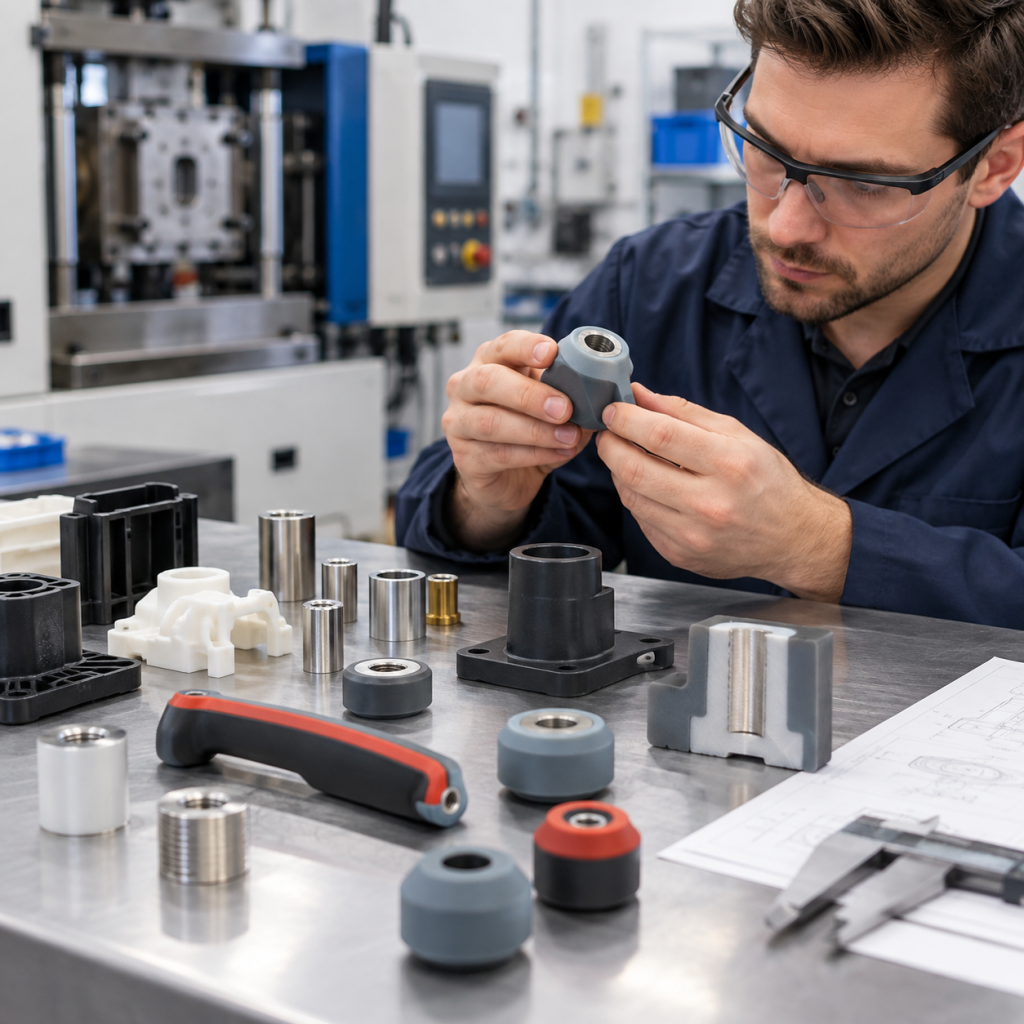
The success of the project depends on material compatibility, insert design, mold structure, surface treatment, bonding method, dimensional tolerance, and process control.
Poor design can lead to common failures such as:
- 層間剥離
- 結合が弱い
- Flash
- 気泡
- 挿入の動き
- Plastic deformation
- 充填が不完全
- シリコーンの破れ
- 漏れ
This guide explains the key design principles for custom silicone overmolding projects.
1. シリコーンオーバーモールドとは何ですか?
Silicone overmolding is a process where silicone rubber is molded directly onto a rigid substrate.
The substrate may be:
- プラスチック
- ステンレス鋼
- アルミニウム
- 真鍮
- Other metals
- Pre-molded components
The rigid insert is placed into the mold first.
Silicone is then molded around or onto the insert.
Depending on the project, the silicone may bond chemically to the substrate or be locked mechanically into the structure.
The result is a single integrated component.
2. Why Use Silicone Overmolding?
Silicone overmolding can replace separate assembly steps.
Instead of manufacturing a rigid component and silicone part separately and assembling them later, both materials can be integrated during molding.
Typical benefits include:
- 部品点数の削減
- Reduced assembly time
- 防水性能の向上
- Better sealing consistency
- Improved grip
- Better vibration absorption
- Reduced risk of loose gaskets
- Cleaner product appearance
- Improved product durability
For high-volume products, integrated overmolding can also reduce long-term assembly cost.
3. Common Silicone Overmolding Materials
Silicone can be overmolded onto many substrate materials, but not every combination provides reliable bonding.
一般的な基板材料には、次のようなものがあります:
プラスチック
- PC
- PA
- PBT
- PPSU
- PEI
- ABS
- Selected engineering plastics
金属
- ステンレス鋼
- アルミニウム
- 真鍮
- Steel
- 銅合金
The correct process depends on the substrate material, surface condition, molding temperature, and required bond strength.
4. LSR Is Commonly Used for Overmolding
Liquid Silicone Rubber, or LSR, is widely used for silicone overmolding.
Its low viscosity allows the material to flow around complex inserts and into small features.
LSR is especially suitable for:
- Precision components
- Thin silicone layers
- Complex sealing structures
- 大量生産
- Automated insert molding
代表的な用途としては、次のようなものがあります:
- Medical device handles
- 電子機器用筐体
- 防水コネクタ
- Automotive seals
- Plastic valve components
- Metal-silicone assemblies
HCR silicone can also be used for overmolding, but LSR is often preferred for precision and automated applications.
5. Chemical Bonding vs Mechanical Bonding
Silicone can be attached to the substrate in two main ways.
Chemical Bonding
Chemical bonding creates adhesion between the silicone and substrate surface.
This may involve:
- 自己接着性LSR
- 入門編
- 表面活性化
- プラズマ処理
- Special substrate preparation
Chemical bonding can provide a clean integrated structure.
However, it is sensitive to:
- 表面汚染
- 離型剤
- 材料のグレード
- 表面エネルギー
- Processing temperature
Mechanical Bonding
Mechanical bonding does not rely only on chemical adhesion.
Instead, the insert contains physical structures that lock the silicone in place.
例としては、次のようなものがあります:
- 穴
- アンダーカット
- グルーヴ
- スロット
- リブ
- Dovetail structures
Mechanical locking is often used when chemical adhesion is uncertain.
In many projects, both chemical and mechanical bonding are combined.
6. Design Mechanical Locking Features
Mechanical retention can greatly improve overmolding reliability.
Useful features include:
- 貫通穴
- Side holes
- Recesses
- グルーヴ
- 保持リブ
- Anchor points
Silicone flows into these features during molding.
After curing, the silicone becomes physically locked to the insert.
This is particularly useful for:
- 金属インサート
- Low-adhesion plastics
- High-load components
- Long-term durability applications
7. Avoid Extremely Thin Silicone Layers
Very thin silicone layers are difficult to mold consistently.
問題としては、次のようなものが挙げられます:
- 充填が不完全
- 引き裂き
- 厚みのばらつき
- 結合不良
- 空気の閉じ込め
The minimum practical thickness depends on:
- LSR viscosity
- 流動長
- 製品の形状
- Injection location
- 金型温度
Thin sections should be reviewed during DFM.
8. Maintain Uniform Wall Thickness
Large changes in silicone thickness can create uneven filling and curing.
Whenever possible, avoid sudden transitions between thick and thin sections.
Smooth transitions can improve:
- 物質の流れ
- 表面品質
- 絆
- 寸法安定性
Uniform wall thickness also helps reduce internal stress.
9. Insert Positioning Is Critical
The insert must remain stable during silicone injection.
If the insert moves, the final product may have:
- シリコーンの厚みのムラ
- Incorrect dimensions
- 露出している基板
- 位置ずれ
- Poor sealing
The mold should support the insert with suitable locating features.
考えられる解決策としては、次のようなものがあります:
- Pins
- グルーヴ
- Fixtures
- Clamping surfaces
- Dedicated insert nests
Insert positioning becomes especially important in high-pressure molding.
10. Consider Injection Pressure
LSR injection can apply pressure to the insert.
Thin plastic parts may deform.
Lightweight inserts may move.
The designer should consider:
- Insert stiffness
- 肉厚
- Support points
- ゲートの位置
- 射出速度
Weak inserts may require additional support in the mold.
11. Plastic Deformation During Overmolding
Some plastics can deform under molding temperature or pressure.
考えられる問題としては、次のようなものがあります:
- Warping
- Shrinkage
- 表面の損傷
- Dimensional changes
The plastic must be compatible with the overmolding process.
High-temperature engineering plastics are generally more suitable than low-temperature plastics.
The manufacturer should review the thermal characteristics before tooling.
12. Surface Preparation for Metal Inserts
Metal surfaces may require cleaning or treatment before overmolding.
Common preparation steps include:
- 脱脂
- Ultrasonic cleaning
- Sandblasting
- プラズマ処理
- 下塗りの施工
Oil, dust, oxidation, or machining residue can reduce adhesion.
Good surface preparation is particularly important for chemical bonding.
13. Surface Preparation for Plastic Inserts
Plastic substrates can also require treatment.
Depending on the material, possible treatments include:
- Plasma activation
- コロナの治療
- 入門編
- Controlled cleaning
The selected method depends on the plastic type and bonding system.
14. Self-Bonding LSR
Self-bonding LSR is formulated to bond directly to certain substrates.
It can reduce the need for separate primer application.
This can improve:
- 自動化
- 生産の一貫性
- 清潔さ
- サイクルタイム
However, self-bonding LSR does not bond equally well to every plastic or metal.
Testing should be completed before mass production.
15. Gate Location
Gate design influences material flow.
Poor gate placement can cause:
- 溶接線
- エアトラップ
- 充填が不完全
- 圧力の不均一
- 変位を入力してください
The gate should allow silicone to flow evenly around the insert.
For complex parts, mold flow analysis may be useful.
16. Venting
Air trapped inside the cavity must escape during injection.
Poor venting can lead to:
- 気泡
- 焼け跡
- 充填が不完全
- 表面欠陥
Vents should be placed in areas where air is likely to accumulate.
17. Parting Line Design
Parting line location is especially important for overmolded sealing components.
A poor parting line can create flash on functional surfaces.
Critical areas should avoid unnecessary flash.
This includes:
- シール面
- 化粧仕上げ面
- Assembly surfaces
- 接触面
The parting line should be defined during mold design.
18. Flash Control
Silicone can flow into extremely small gaps.
This means poor mold fit can cause flash.
Flash is especially problematic around:
- 金属インサート
- プラスチック製インサート
- Sealing interfaces
- Thin edges
Precision mold manufacturing and insert control are essential.
The insert itself must also maintain consistent dimensions.
19. Silicone Leakage Around the Insert
If there is too much clearance around the insert, silicone may flow into unwanted areas.
これにより、次のようなものが生成される可能性があります:
- Excess flash
- 汚染
- Assembly problems
- 外観上の欠陥
The mold must provide a reliable shutoff surface around the insert.
20. Shutoff Surface Design
A shutoff surface prevents silicone from flowing past a controlled boundary.
The shutoff must be strong enough to resist injection pressure.
Poor shutoff design can cause severe flashing.
重要な要素としては、次のようなものがあります:
- 表面平滑度
- Insert tolerance
- Mold tolerance
- クランプ力
- Surface contact area
21. Bonding Area
A very small bonding area may not provide enough adhesion.
Increasing the bonding area can improve mechanical strength.
Possible approaches include:
- Wider silicone contact surfaces
- グルーヴ
- 穴
- リブ
- Wrap-around geometry
The design should distribute load across the bonded area.
22. Avoid Peel Loading
Silicone-to-substrate bonds usually perform better under shear or compression than direct peeling.
If possible, avoid designs where the silicone can be peeled away from the substrate.
Better structures protect the bond edge.
Mechanical locking can also reduce peel stress.
23. Common Failure: Delamination
Delamination is one of the most common overmolding failures.
The silicone separates from the plastic or metal substrate.
考えられる原因としては、次のようなものがあります:
- 互換性のない材料
- 表面汚染
- プライマーが間違っている
- 不十分な表面処理
- Insufficient curing
- Low bonding area
- Excessive peel stress
The solution may require both material and design changes.
24. Common Failure: Air Bubbles
Air bubbles may appear at the interface or inside the silicone.
考えられる原因としては、次のようなものがあります:
- Poor venting
- Trapped moisture
- 汚染されたインサート
- Poor flow path
- Incorrect injection settings
The mold and process must allow trapped air to escape.
25. Common Failure: Incomplete Filling
Incomplete filling occurs when silicone does not completely fill the cavity.
考えられる原因としては、次のようなものがあります:
- 薄い壁
- Long flow distance
- Poor gate location
- Low injection pressure
- Low mold temperature
- 閉じ込められた空気
Design optimization can often solve this problem.
26. Common Failure: Insert Movement
The insert may shift during molding.
考えられる原因としては、次のようなものがあります:
- Insufficient locating features
- High injection pressure
- Poor fixture design
- Insert dimensional variation
Better insert support and mold positioning can improve consistency.
27. Common Failure: Flash
Flash may form around the insert or parting line.
考えられる原因としては、次のようなものがあります:
- Insert tolerance variation
- 金型の摩耗
- Poor shutoff
- Excessive pressure
- Poor mold alignment
Tight tooling control is essential for precision overmolding.
28. Common Failure: Silicone Tearing
Silicone may tear during demolding or use.
考えられる原因としては、次のようなものがあります:
- Thin edges
- 鋭い角
- Poor demolding direction
- High local stress
- Insufficient material thickness
Rounded transitions and adequate wall thickness improve durability.
29. Common Failure: Plastic Warpage
Plastic inserts may deform during molding.
考えられる原因としては、次のようなものがあります:
- Excessive mold temperature
- Thin plastic walls
- High injection pressure
- Poor support
Material selection and mold support should be reviewed.
30. Overmolding for Waterproof Electronics
Silicone overmolding is commonly used for electronic sealing.
主な用途は以下の通りです:
- 防水ボタン
- コネクタ用シール
- ケーブル貫通部
- 保護ハウジング
- センサーカバー
Integrated silicone sealing can reduce the risk of missing or incorrectly installed gaskets.
31. Overmolding for Medical Devices
Medical silicone overmolding may be used for:
- ハンドル
- Seals
- バルブ
- コネクタ
- Flexible interfaces
Medical projects may require additional consideration of:
- 生体適合性
- 材料のトレーサビリティ
- 清潔さ
- 検証
- 滅菌対応性
32. Overmolding for Automotive Components
Automotive overmolding applications include:
- 防水コネクタ
- センサー用シール
- ケーブル部品
- Vibration-resistant parts
- 電子機器用筐体
These components may need to withstand:
- 熱
- Cold
- 振動
- Oil exposure
- 水分
- 熱サイクル
33. Tolerance Stack-Up
Overmolded parts combine tolerances from multiple components.
The final dimension may depend on:
- Insert tolerance
- Mold tolerance
- Silicone shrinkage
- Positioning tolerance
Tolerance stack-up should be reviewed before tooling.
34. Prototype Before Mass Production
For complex overmolding projects, prototype testing is strongly recommended.
Prototypes can help evaluate:
- 接着強度
- 表面品質
- 寸法安定性
- Flash
- アセンブリ
- 防水性能
This can reduce expensive tooling changes later.
35. Bond Strength Testing
Bond strength should be verified when adhesion is critical.
考えられる検査には、次のようなものがあります:
- Peel testing
- Pull testing
- Shear testing
The test method should match the real product load.
36. Environmental Testing
For demanding applications, overmolded components may also require:
- 熱サイクル
- Humidity testing
- 経年劣化試験
- 振動試験
- 水没
- 化学物質への曝露
These tests help evaluate long-term bond reliability.
37. What Information Should You Send for a Silicone Overmolding Quote?
For an accurate quotation, provide:
- 2D図面
- 3D CADファイル
- 素材を挿入
- シリコーン材料の要件
- シリコーンの硬度
- 結合要件
- 表面仕上げ
- 重要寸法
- Estimated annual volume
- 初回注文数量
- 用途
- 環境条件
If the insert already exists, physical samples can also help during engineering review.
結論
Silicone overmolding can provide excellent sealing, grip, protection, and product integration.
However, successful overmolding requires careful coordination between material selection, insert design, bonding method, mold structure, and process control.
最も重要な設計上の要素には、以下のものが挙げられます:
- 基板との適合性
- 機械式ロック
- Bonding area
- 挿入位置の指定
- 肉厚
- ゲートの設計
- 愚痴
- 遮断面
- フラッシュ制御
- Tolerance stack-up
A DFM review before tooling can identify many potential problems and reduce the risk of delamination, flash, air bubbles, insert movement, and poor sealing.
Fuhongying provides custom silicone overmolding and LSR insert molding services for plastic and metal components.
We support OEM and ODM projects for medical devices, consumer electronics, automotive parts, sealing components, baby care products, and industrial applications.
Send us your 2D drawing, 3D file, insert material, application, and estimated quantity for a DFM review and quotation.
よくある質問
Can silicone bond directly to plastic?
Yes, but bonding depends on the plastic type, silicone formulation, surface preparation, and molding conditions. Some projects use self-bonding LSR, while others require primer or mechanical locking.
Can silicone be overmolded onto metal?
Yes. Silicone can be overmolded onto stainless steel, aluminum, brass, and other metals. Surface cleaning and mechanical retention are often important.
What causes silicone overmolding to delaminate?
Common causes include incompatible materials, surface contamination, poor surface treatment, insufficient bonding area, incorrect curing conditions, and excessive peel stress.
Is LSR better than HCR for overmolding?
LSR is often preferred for precision, complex, thin-wall, and high-volume overmolding because it can be highly automated. HCR can also be used depending on product design and volume.
How can flash be reduced in silicone overmolding?
Flash can be reduced through precision mold machining, stable insert dimensions, good shutoff design, proper clamping, and controlled injection parameters.
Should mechanical locking be added if chemical bonding is used?
In many applications, yes. Combining chemical adhesion with mechanical locking can improve long-term reliability, especially in demanding environments.
 English
  Japanese
  Korean
  German
  French
  Italian
  Spanish
  Dutch
Dutch  Chinese
  Portuguese
  Polish
  Czech
Czech  Hungarian
  Swedish
  Finnish
  Vietnamese
  Thai
Thai  Turkish
  Arabic
  Russian