
Developing a custom silicone product involves much more than making a mold and starting production.
A successful project normally goes through several stages:
Concept → Design → DFM Review → Material Selection → Prototype → Tooling → Sampling → Validation → Pilot Production → Mass Production
Each stage helps reduce technical risk, improve product quality, and control cost before large-scale production begins.
For engineers, purchasing teams, and product developers, understanding this process can make communication with a silicone manufacturer much more efficient.
This guide explains how custom silicone products are developed from the first idea to stable mass production.
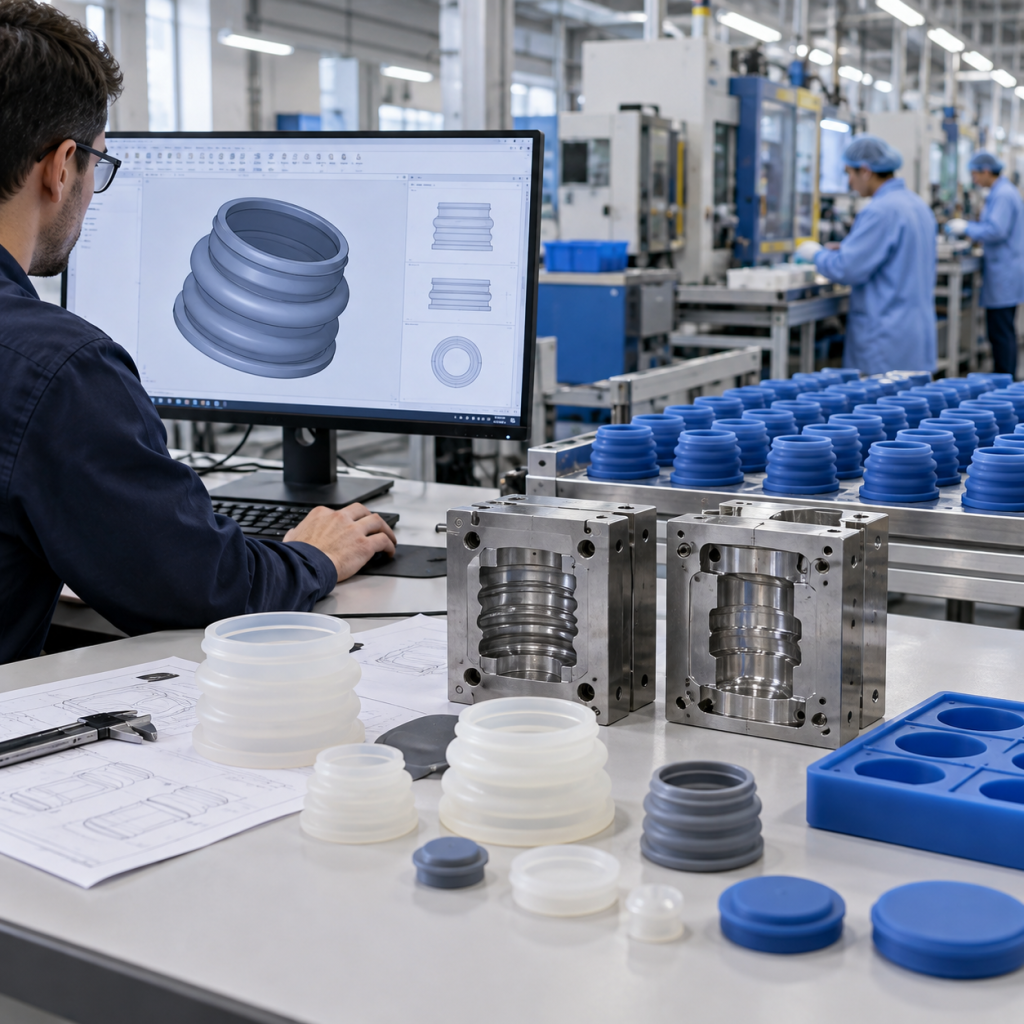
1. Start With the Product Requirement
Every custom silicone project begins with a product requirement.
The customer should define what the component needs to do.
Typical questions include:
- What is the product application?
- Is the silicone used for sealing, protection, grip, insulation, cushioning, or food contact?
- What temperature range will the product experience?
- Will it contact water, oil, chemicals, food, or skin?
- What is the expected service life?
- What is the estimated annual volume?
These requirements affect material selection, part design, tooling, testing, and manufacturing process.
The more information provided at the beginning, the easier it is to recommend the right production solution.
2. Prepare 2D and 3D Drawings
For most custom silicone products, 2D and 3D files are important.
A 3D CAD file helps the manufacturer evaluate:
- 製品の形状
- 肉厚
- アンダーカット
- Draft
- アセンブリ構造
- 成形性
Common file formats include:
- STEP
- STP
- IGES
- X_T
- SLDPRT
A 2D drawing should normally include:
- 寸法
- Tolerances
- 素材
- 硬度
- 色
- 表面仕上げ
- 重要寸法
- Special requirements
If CAD files are not available, a physical sample, sketch, or reference product can also be used during early development.
3. DFM Review
Before tooling, the silicone manufacturer should perform a Design for Manufacturing, or DFM, review.
The purpose is to identify potential manufacturing risks.
Typical DFM items include:
- 肉厚
- パーティングライン
- Draft
- アンダーカット
- 鋭い角
- 薄切片
- ゲートの位置
- 愚痴
- 型抜き
- フラッシュ制御
- 寛容
- Silicone shrinkage
A DFM review can prevent many expensive tooling modifications later.
4. Choose the Right Silicone Material
The correct silicone material depends on the application.
Common options include:
- 汎用シリコーン
- 食品用シリコーン
- 医療用シリコーン
- プラチナ硬化型シリコーン
- 液体シリコーンゴム
- 高粘度ゴム
- 耐熱シリコーン
- 難燃性シリコーン
- 導電性シリコーン
- Thermal conductive silicone
- Low-compression-set silicone
Material selection should consider both performance and regulatory requirements.
For example, a silicone gasket for industrial electronics may need good compression set performance.
A baby care product may require food-contact material.
A medical component may require biocompatibility documentation.
5. Define Silicone Hardness
Silicone hardness is normally measured in Shore A.
Common values include:
- 20 ショアA
- 30 ショアA
- 40 ショアA
- ショアA 50
- ショアA 60
- 70 ショアA
- 80 Shore A
Softer silicone provides more flexibility.
Harder silicone provides greater dimensional stability.
The required hardness depends on:
- 製品の機能
- 圧縮
- 柔軟性
- アセンブリ
- Grip
- シール性能
Hardness should be defined before material approval.
6. Choose the Manufacturing Process
Different silicone products require different molding processes.
圧縮成形
Compression molding is commonly used for:
- Silicone gaskets
- シリコンパッド
- ベビー用品
- Kitchen products
- 大型のシリコーン部品
- 小ロット生産
It usually offers lower tooling cost.
LSR射出成形
Liquid Silicone Rubber injection molding is suitable for:
- Precision components
- Thin-wall products
- 医療用部品
- 電子シール
- 自動車部品
- 大量生産
LSR supports a higher level of automation.
シリコーンオーバーモールド
Silicone overmolding is used when silicone must be molded onto:
- プラスチック
- メタル
- 電子部品
- Structural inserts
The manufacturing process should be selected based on product geometry, volume, and functional requirements.
7. Prototype Development
A prototype helps verify the product before full production tooling.
The prototype may be used to check:
- サイズ
- Fit
- アセンブリ
- 外観
- 硬度
- 機能
- シーリング
- 人間工学
Depending on the product, prototype methods may include:
- ソフトツーリング
- 試作用圧縮成形金型
- CNC-machined molds
- Silicone casting
- Sample molds
Prototype development is especially important for new product designs.
8. Prototype Testing
A prototype should not only be inspected visually.
Functional testing should also be completed.
考えられる検査には、次のようなものがあります:
- 組立検査
- 圧縮試験
- Sealing testing
- Waterproof testing
- 引張試験
- Pull testing
- 硬度試験
- 経年劣化試験
- Temperature testing
Problems found during prototype testing are much less expensive to correct than problems found after mass production begins.
9. Design Modification
Prototype testing often leads to design improvement.
Common changes include:
- Adjusting wall thickness
- Increasing corner radii
- Changing gasket compression
- Improving mechanical locking
- Modifying hole size
- Improving grip
- Changing hardness
This is a normal part of product development.
The goal is to finalize the design before production tooling.
10. Production Tooling
Once the design is confirmed, production tooling can begin.
The tooling process may include:
- 金型設計
- Mold base preparation
- CNC加工
- EDM
- Precision grinding
- Polishing
- 質感
- アセンブリ
- Mold testing
Tooling complexity depends on the product.
A simple silicone gasket may require a relatively simple mold.
A precision multi-cavity LSR component may require a much more complex mold.
11. Mold Cavity Selection
The number of cavities affects both tooling cost and production efficiency.
Possible mold structures include:
- Single cavity
- 2 cavity
- 4 cavity
- 8 cavity
- Multi-cavity
For lower production volumes, fewer cavities may reduce initial tooling cost.
For large production volumes, more cavities can reduce unit cost.
Cavity number should be selected according to expected annual demand.
12. T1 Sample
After the mold is completed, the first mold trial is normally called T1.
T1 samples are used to evaluate:
- 寸法
- Flash
- 表面品質
- 色
- 硬度
- Filling
- 型抜き
- Shrinkage
The first sample may not be perfect.
Small tooling adjustments are common.
13. Sample Approval
The customer should review the sample carefully before mass production.
Approval may include:
- Dimension report
- 目視検査
- 機能テスト
- 組立検査
- Color approval
- Material confirmation
For critical parts, customer approval should be documented.
14. Dimension Inspection
Critical dimensions should be measured after molding.
Possible inspection equipment includes:
- キャリパー
- Micrometers
- Optical measurement systems
- CMM
- Height gauges
- Custom fixtures
Silicone is flexible, so the measurement method should be consistent.
Uncontrolled measurement force can affect results.
15. Material Verification
Material verification may include:
- 硬度
- 色
- 密度
- Cure condition
- 分析証明書
- 材料の認証
For regulated applications, additional documents may be required.
16. Color Matching
Custom silicone products can be manufactured in many colors.
Color can be specified using:
- Pantone reference
- RAL reference
- Physical color sample
A color sample should normally be approved before mass production.
Small color differences may occur between materials and molding batches, so acceptable limits should be defined when appearance is critical.
17. Surface Finish
Silicone surfaces can be:
- 光沢のある
- マット
- Textured
- Smooth
- Fine-grain
Surface finish is mainly created by the mold surface.
If a specific texture is required, it should be defined before final tooling.
18. Pilot Production
Before full mass production, a pilot run is often recommended.
Pilot production helps verify:
- Process stability
- サイクルタイム
- Yield
- Dimension consistency
- 検査方法
- パッケージ
- アセンブリの互換性
The pilot run is especially important for high-volume or precision projects.
19. Production Process Validation
During pilot production, the manufacturer can confirm the stable process window.
Important parameters may include:
- 金型温度
- 硬化時間
- 射出圧力
- 射出速度
- 圧縮圧力
- サイクルタイム
Stable process parameters help improve repeatability.
20. Quality Control Plan
Before mass production, a quality control plan should be established.
The plan may include:
- 入荷品の検査
- 工程内検査
- 最終検査
- Dimension inspection
- 目視検査
- 機能テスト
- 包装検査
Critical dimensions and functional features should receive more attention than non-critical dimensions.
21. Visual Inspection
Common silicone defects include:
- Flash
- ショートショット
- 気泡
- 汚染
- 色のバリエーション
- 涙
- Surface marks
- 変形
Visual standards should be defined according to the product application.
22. Functional Testing
Functional testing depends on the product.
例としては、次のようなものがあります:
- 気密試験
- 圧縮試験
- Pull testing
- 組立検査
- Waterproof testing
- Valve testing
- Button force testing
For functional silicone parts, performance is often more important than cosmetic appearance.
23. Packaging Development
Packaging should be confirmed before mass production.
Options may include:
- バルク包装
- PE bags
- Individual bags
- Plastic trays
- Custom boxes
- Retail packaging
Packaging should protect silicone parts from:
- ほこり
- 変形
- 圧縮
- 表面の損傷
Precision sealing products may require more controlled packaging than general consumer products.
24. Mass Production
After the product, tooling, material, process, quality requirements, and packaging are approved, mass production can begin.
During mass production, the manufacturer should control:
- Material batch
- 成形パラメータ
- 寸法
- 外観
- Yield
- パッケージ
- トレーサビリティ
Stable process control is essential for consistent product quality.
25. Batch Traceability
For some industries, batch traceability is important.
Production records may include:
- 材料ロット
- Production date
- Mold number
- Machine number
- オペレーター
- 点検記録
Traceability helps identify the cause of problems if quality issues occur later.
26. Change Control
Any major change after approval should be controlled.
例としては、次のようなものがあります:
- Material change
- Mold modification
- Process change
- Color change
- Supplier change
For critical applications, customers may require notification before a major change is implemented.
27. Scaling Production Volume
A project may start with a small quantity and later increase significantly.
The manufacturing plan should consider future growth.
For example, an initial 2-cavity mold may be sufficient for low-volume production.
If demand increases, a higher-cavity mold may be required.
Planning for future volume can reduce unnecessary tooling investment.
28. Common Problems During Product Development
Several problems commonly occur during silicone product development.
Incomplete Drawings
Missing tolerance or material information can delay quotation and tooling.
Unrealistic Tolerances
Excessively tight tolerances increase manufacturing difficulty.
Late Design Changes
Changing the product after tooling can be expensive.
Wrong Material Selection
Material performance may not match the application.
No Prototype Testing
Problems may only appear after tooling.
Ignoring Production Volume
The selected mold structure may not match future demand.
29. How to Reduce Development Cost
Development cost can be reduced by:
- Providing complete drawings
- Completing DFM before tooling
- Using standard materials when possible
- Avoiding unnecessary complexity
- Using realistic tolerances
- Testing prototypes early
- Planning annual volume
- Finalizing packaging before production
Early engineering communication usually saves more money than late corrections.
30. How Long Does Custom Silicone Product Development Take?
Development time depends on product complexity.
The process typically includes:
- Engineering review
- DFM
- Material confirmation
- Prototype
- 金型
- Sampling
- Approval
- Pilot production
Simple products can move through development relatively quickly.
Complex LSR, medical, automotive, or overmolded products may require more validation and testing.
The development schedule should therefore be based on project complexity rather than only mold manufacturing time.
31. What Should You Send to Start a Silicone Project?
To start a custom silicone project, provide as much of the following information as possible:
- 2D図面
- 3D CADファイル
- 製品の用途
- Silicone material
- 硬度
- 色
- 表面仕上げ
- 寛容
- 年間取扱量
- 初回注文数量
- Certification requirements
- 包装に関する要件
If drawings are not available, a sample, sketch, or detailed product description can be used for initial evaluation.
結論
Developing a custom silicone product is a step-by-step engineering process.
A successful project normally moves through:
Requirement → Design → DFM → Material Selection → Prototype → Tooling → Sample Approval → Pilot Production → Mass Production
The most important part is not moving as quickly as possible.
It is identifying and solving problems before they become expensive production issues.
Good communication between the customer and silicone manufacturer can improve mold design, material selection, product quality, production efficiency, and total project cost.
Fuhongying provides custom silicone product development services from engineering review and prototyping to tooling and mass production.
Our manufacturing capabilities include custom silicone molding, LSR injection molding, HCR compression molding, silicone overmolding, sealing components, and complex silicone parts.
We support OEM and ODM projects for baby care, medical devices, consumer electronics, automotive components, sports products, sealing applications, and industrial products.
Send us your 2D drawing, 3D file, sample, or product concept for a DFM review and quotation.
よくある質問
Can I develop a custom silicone product without a 3D drawing?
Yes. A physical sample, sketch, or detailed product description can be used for early evaluation. However, 2D and 3D drawings are normally recommended before production tooling.
Should I make a prototype before silicone tooling?
For new or complex products, prototyping is strongly recommended. It can help verify size, assembly, function, sealing, hardness, and ergonomics before investing in production tooling.
What is DFM in silicone product development?
DFM means Design for Manufacturing. It is an engineering review used to identify moldability, tolerance, wall thickness, demolding, parting line, flash, and other manufacturing risks before tooling.
How many samples are required before mass production?
There is no fixed number. Sampling continues until the product dimensions, appearance, material, function, and assembly meet the agreed requirements.
What is a pilot production run?
A pilot run is a smaller production batch completed before full-scale mass production. It is used to verify process stability, yield, inspection methods, packaging, and product consistency.
Can the silicone material be changed after the mold is completed?
Sometimes, but different silicone materials may have different shrinkage, hardness, curing, and processing behavior. Material changes should be reviewed with the manufacturer before implementation.
 English
  Japanese
  Korean
  German
  French
  Italian
  Spanish
  Dutch
Dutch  Chinese
  Portuguese
  Polish
  Czech
Czech  Hungarian
  Swedish
  Finnish
  Vietnamese
  Thai
Thai  Turkish
  Arabic
  Russian