
Pour les start-ups et les nouvelles marques, développer un produit en silicone sur mesure peut être passionnant, mais aussi complexe. Les produits en silicone sont largement utilisés dans les soins pour bébés, les ustensiles de cuisine, les dispositifs médicaux, l'électronique, les pièces automobiles, les produits pour animaux de compagnie, les accessoires de sport et les applications industrielles d'étanchéité. Cependant, de nombreux nouveaux acheteurs ne sont pas familiarisés avec la quantité minimale de commande (MOQ), le coût des moules, le processus d'échantillonnage, les délais de livraison, le choix des matériaux et le contrôle qualité.
Contrairement à l'achat de produits standard disponibles en stock, la fabrication sur mesure de pièces en silicone nécessite une étude de conception du produit, le développement d'un moule, des essais sur échantillons, la planification de la production et un contrôle qualité. Si ces étapes ne sont pas gérées correctement, le projet risque de subir des retards, des coûts supplémentaires, des performances insuffisantes du produit ou des problèmes liés à la modification du moule.
Cet article explique ce que les start-ups doivent savoir avant de se lancer dans un projet de fabrication de silicone sur mesure.
Pourquoi le silicone est-il adapté au développement de produits par les start-ups ?
Le silicone est un matériau souple et résistant qui présente de nombreux avantages pour le développement de nouveaux produits. Il peut être souple, élastique, résistant à la chaleur, imperméable, non toxique et agréable au toucher. Selon l'application, le silicone peut être utilisé pour fabriquer des pièces fonctionnelles, des pièces de protection, des composants d'étanchéité, des produits pour bébés, des composants médicaux, des biens de consommation et des produits industriels.
Pour les start-ups, le silicone présente un intérêt particulier car il permet :
- Formes et couleurs personnalisées
- Conception de produits au toucher doux
- Applications dans le domaine du contact alimentaire et des produits de soins pour bébés
- Fonctions d'étanchéité et d'isolation
- Résistance à la chaleur et au vieillissement
- Surmoulage avec du plastique ou du métal
- Une petite innovation produit dotée de fonctionnalités pratiques
Le caoutchouc de silicone liquide, également appelé LSR, est généralement mis en œuvre par moulage par injection de liquide. Ce procédé utilise des moules spéciaux et des presses à injection pour transformer les matériaux en silicone liquide en composants finis. Le moulage LSR implique généralement un dosage contrôlé du matériau, son mélange, son injection et son durcissement, ce qui le rend adapté à la fabrication de pièces en silicone de précision et à la production en grande série.
1. Comprendre la quantité minimale de commande (MOQ) pour les produits en silicone sur mesure
MOQ signifie « quantité minimale de commande ». C'est l'une des premières questions que se posent les start-ups lorsqu'elles développent des produits en silicone sur mesure.
Pour la fabrication sur mesure de produits en silicone, la quantité minimale de commande (MOQ) dépend de plusieurs facteurs :
- Dimensions du produit
- Poids du produit
- Type de matériau
- Exigences en matière de couleur
- Procédé de moulage
- Numéro de cavité du moule
- Difficulté de production
- Méthode d'emballage
- Si le produit nécessite un assemblage
- Si le produit nécessite des essais spécifiques
Il n'y a pas de quantité minimale de commande (MOQ) fixe pour tous les produits en silicone. Une petite pièce simple en silicone peut avoir une MOQ plus faible, tandis qu'une pièce complexe surmoulée en LSR peut nécessiter une MOQ plus élevée.
Référence type pour la planification des quantités minimales de commande (MOQ)
| Type de produit | Fourchette de quantités minimales de commande (MOQ) possibles | Remarques |
|---|---|---|
| Pièces simples en silicone | 100 à 500 pièces | Convient aux commandes d'essai ou aux petits lots |
| Produits en silicone pour bébés | 500 à 1 000 pièces | Cela dépend du moule, de la couleur et de l'emballage |
| Produits en silicone pour la cuisine | 500 à 2 000 pièces | Les produits de plus grande taille peuvent nécessiter une préparation plus importante des matériaux. |
| Joints et garnitures en silicone | 500 à 3 000 pièces | Depends on size and tolerance |
| LSR injection molded parts | 1,000–5,000 pcs | Higher automation and tooling cost |
| LSR overmolded parts | 1,000+ pcs | Depends on insert material and process stability |
These ranges are only for early planning. The final MOQ should be confirmed after product drawing, material, color, process, and packaging requirements are reviewed.
2. Why MOQ Exists in Custom Silicone Manufacturing
Startups sometimes ask why factories cannot produce only 10 or 20 pieces for custom silicone parts. The reason is that custom manufacturing has setup costs before actual production begins.
MOQ usually exists because of:
- Mold setup time
- Machine setup time
- Raw material preparation
- Color mixing
- Trial production loss
- Labor arrangement
- Quality inspection time
- Préparation des emballages
- Production efficiency requirements
For very small quantities, the unit cost becomes high because the factory still needs to prepare the same mold, machine, material, and inspection process.
3. Mold Cost: What Startups Should Know
Mold cost is one of the biggest upfront costs in custom silicone manufacturing. A custom silicone product usually needs a dedicated mold. The mold determines product shape, size, surface finish, parting line, tolerance, production efficiency, and consistency.
Mold cost depends on:
- Dimensions du produit
- Product complexity
- Number of cavities
- Mold steel material
- Exigence de tolérance
- Texture de surface
- Conception de la ligne de joint
- Insert or overmolding requirement
- LSR injection or compression molding process
- Expected production volume
Typical Mold Cost Planning Reference
| Mold Type | Estimated Cost Range | Convient pour |
| Simple compression mold | USD 500–2,000 | Simple pads, gaskets, basic silicone parts |
| Medium complexity silicone mold | USD 1,500–5,000 | Baby products, kitchen parts, custom covers |
| LSR injection mold | USD 3,000–15,000+ | Precision parts, high-volume production |
| LSR overmolding mold | USD 5,000–20,000+ | Silicone over plastic, metal, or cable assemblies |
| Multi-cavity production mold | Higher investment | Large-volume mass production |
For startups, the cheapest mold is not always the best option. A poorly designed mold may cause high flash, unstable dimensions, difficult demolding, slow production, or high defect rates.
4. How to Reduce Mold Cost Risk
Startups can reduce mold cost risk by preparing product information carefully before tooling.
Recommended actions include:
- Confirm product function before mold development
- Provide 2D and 3D drawings if possible
- Avoid unnecessary complex structures
- Keep wall thickness as uniform as possible
- Confirm assembly dimensions early
- Choose a reasonable tolerance range
- Test prototype samples before mass production
- Discuss parting line and flash position before tooling
- Confirm material and hardness before mold making
- Start with a pilot mold if the market is still uncertain
For new product brands, it is better to spend more time on design review than to modify the mold after it is finished.
5. Lead Time for Custom Silicone Manufacturing
Lead time depends on product complexity, mold type, sample approval, testing requirements, and production quantity.
A typical custom silicone project includes:
- Drawing review
- Quotation
- Conception de moules
- Mold manufacturing
- First sample production
- Sample testing
- Validation d'échantillon
- Production en série
- Final inspection
- Emballage et livraison
Typical Lead Time Planning Reference
| Project Stage | Typical Time |
| Drawing review and quotation | 1–3 working days |
| Mold design confirmation | 2–5 working days |
| Simple mold manufacturing | 10–20 days |
| Complex LSR mold manufacturing | 20–40 days |
| First sample production | 2–5 days after mold completion |
| Sample adjustment | Depends on issue complexity |
| Production en série | 7–30 days depending on quantity |
| Packaging and shipment preparation | 2–7 days |
If the product requires food-contact testing, medical-grade documentation, custom packaging, color matching, or assembly, the total lead time may be longer.
6. Material Selection for Startup Projects
Choosing the right silicone material is critical. Different products require different material grades and performance.
Common material options include:
- Silicone de qualité alimentaire
- Silicone de qualité médicale
- Caoutchouc de silicone liquide
- High Consistency Rubber
- Fluorosilicone
- Silicone résistant aux hautes températures
- Silicone transparent
- Silicone coloré
- Silicone conducteur
- Silicone ignifuge
For food-contact or baby products, buyers may need materials that meet relevant food-contact requirements. In the United States, 21 CFR 177.2600 covers rubber articles intended for repeated food-contact use, subject to the provisions of the regulation.
For medical device applications, silicone material selection may involve biological safety evaluation. ISO 10993-1 is widely used for the biological evaluation of medical devices, and FDA guidance also discusses a risk-based approach to determining biocompatibility testing needs.
7. Shore Hardness Selection
Shore hardness affects product flexibility, sealing performance, user comfort, and assembly force. For startups, choosing hardness only by touch feeling can be risky. The hardness should match the product function.
| Shore A Hardness | Product Feel | Applications courantes |
| 10–30A | Very soft | Baby teethers, soft valves, cushions |
| 30–50A | Soft to medium | Grips, covers, sealing lips, feeding parts |
| 50–70A | Medium firm | Gaskets, industrial parts, protective parts |
| 70A+ | Firm | Structural silicone components, wear-resistant parts |
If the product is used for sealing, the hardness must support compression and recovery. If it is used for baby care or consumer products, comfort and safety are more important.
8. Sampling Before Mass Production
Startups should never skip the sampling stage. First samples help confirm whether the actual product matches the design, function, color, hardness, and assembly requirements.
Sample inspection should include:
- Dimensions du produit
- Aspect
- Couleur
- Dureté
- Texture de surface
- Niveau Flash
- Ajustement à l'assemblage
- Performances d'étanchéité
- Expérience utilisateur
- Packaging fit
If the sample has problems, the factory may need to adjust mold, process, material, or design. Only approved samples should be used as the production standard.
9. Quality Control for Custom Silicone Products
Quality control is essential for startups because early product quality affects brand reputation, customer reviews, and repeat orders.
A reliable silicone manufacturer should control quality in several stages:
Incoming Material Inspection
Raw silicone material, color masterbatch, inserts, and packaging materials should be checked before production.
Contrôle des processus
During production, the factory should control molding temperature, curing time, pressure, material mixing, demolding, trimming, and operator handling.
In-Process Inspection
Workers or QC staff should check product appearance, flash, deformation, color difference, contamination, and obvious defects during production.
Inspection finale
Finished products should be inspected before packaging and shipment.
Les éléments généralement vérifiés sont les suivants :
| Inspection Item | Objectif |
| Appearance check | Detects stains, bubbles, flash, deformation |
| Mesure des dimensions | Confirms tolerance and assembly fit |
| Essai de dureté | Confirms material feel and function |
| Comparaison des couleurs | Confirms color consistency |
| Functional test | Checks sealing, gripping, or protection |
| Test d'assemblage | Confirms fit with other parts |
| Contrôle des emballages | Prevents deformation and shipment damage |
10. Common Defects Startups Should Watch For
Silicone products may have defects if mold design, material, or production process is not well controlled.
Common defects include:
- Flash
- Bulles
- Moulage court
- Color difference
- Surface stains
- Déformation
- Mauvaise adhérence
- Déchirure
- Size deviation
- Sticky surface
- Poor assembly fit
- Weak sealing performance
Many defects can be reduced through better mold design, stable molding parameters, suitable material selection, and strict inspection standards.
11. Packaging Considerations for New Brands
Packaging is not only about appearance. It also affects product protection, shipping cost, storage, and user experience.
For startups, packaging options may include:
- Conditionnement en vrac
- Individual polybag
- Paper box
- Blister packaging
- Retail color box
- Custom logo packaging
- Amazon-ready packaging
Soft silicone products should not be compressed for a long time, otherwise deformation may occur. Transparent silicone products should be protected from dust and scratches.
12. How Startups Can Lower Initial Cost
Startups often need to control the first development budget. The following methods can help reduce unnecessary cost:
- Start with a simple product structure
- Avoid too many colors in the first batch
- Use standard material if special material is not required
- Choose reasonable tolerance instead of over-tight tolerance
- Confirm function before mold making
- Start with a smaller batch for market testing
- Use simple packaging first
- Avoid frequent design changes after mold approval
- Combine similar parts into one project when possible
- Work with a manufacturer that can provide engineering suggestions
The goal is not only to reduce price, but to reduce total project risk.
13. What Information Should Startups Provide for Quotation?
To get an accurate quotation, startups should prepare as much information as possible.
Les informations recommandées comprennent :
- Product name
- Dessin en 2D ou fichier 3D
- Dimensions du produit
- Utilisation du produit
- Exigences relatives au silicone
- Exigences en matière de dureté des berges
- Exigences en matière de couleur
- Quantité estimée de la commande
- Exigence de tolérance
- Exigences relatives à la finition de surface
- Exigences en matière d'essais
- Exigences en matière d'emballage
- Marché cible
- Expected delivery time
- Reference sample or photo if available
If drawings are not ready, a concept sketch or sample photo can also help the manufacturer make an initial evaluation.
14. Choosing the Right Silicone Manufacturer
For startups, choosing the right manufacturing partner is more important than simply finding the lowest price.
A suitable silicone manufacturer should be able to provide:
- Design review
- Recommandation concernant les matériaux
- Développement des moisissures
- Sampling support
- Moulage par injection de LSR
- Moulage par compression
- Surmoulage en silicone
- Contrôle qualité
- Packaging support
- Flexible communication
- Stable repeat production
Startups should look for a supplier that understands both manufacturing and product development. This helps reduce mistakes during the early stage.
Conclusion
Custom silicone manufacturing can help startups turn product ideas into real market-ready products. However, startups need to understand MOQ, mold cost, lead time, material selection, sampling, and quality control before starting the project.
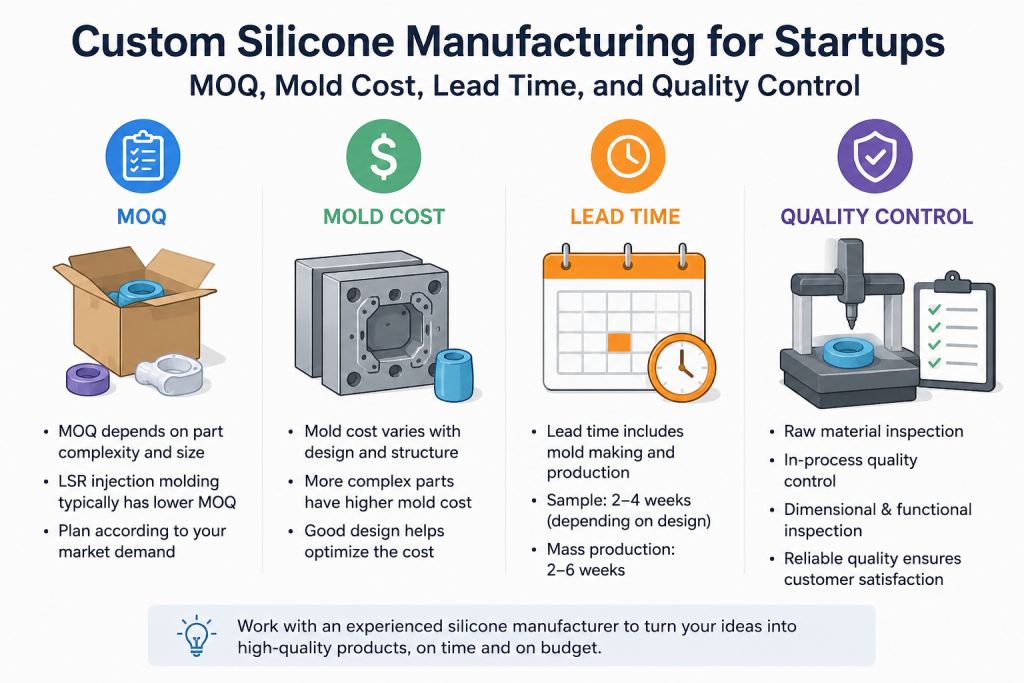
MOQ depends on product size, process, material, and packaging. Mold cost depends on product complexity, mold structure, and production volume. Lead time depends on tooling, sampling, testing, and mass production requirements. Quality control should cover material, process, dimensions, appearance, function, and packaging.
For startups, the best strategy is to begin with a clear design, realistic budget, suitable material, and a reliable silicone manufacturing partner. With proper planning, custom silicone products can move from concept to sample and then to mass production more smoothly.
FAQ
1. What is the MOQ for custom silicone products?
MOQ depends on product size, material, process, and packaging. Simple silicone parts may start from a few hundred pieces, while LSR injection molded or overmolded parts usually require higher quantities.
2. How much does a custom silicone mold cost?
Mold cost depends on product size, complexity, cavity number, tolerance, and molding process. A simple mold may cost hundreds to a few thousand dollars, while complex LSR or overmolding tools can cost much more.
3. How long does custom silicone product development take?
A simple project may take several weeks from mold development to samples. Complex LSR injection molding, overmolding, testing, or custom packaging can require a longer development cycle.
4. Can startups order small batches first?
Yes. Many silicone manufacturers can support trial orders or small-batch production, depending on the product and mold type. However, unit cost is usually higher for small quantities.
5. What should startups prepare before contacting a silicone manufacturer?
Startups should prepare drawings, product size, application, material requirement, hardness, color, quantity, testing needs, and packaging requirements. If drawings are not available, a sample or reference photo can help with the first evaluation.
 English
  Japanese
  Korean
  German
  French
  Italian
  Spanish
  Dutch
Dutch  Chinese
  Portuguese
  Polish
  Czech
Czech  Hungarian
  Swedish
  Finnish
  Vietnamese
  Thai
Thai  Turkish
  Arabic
  Russian