
For startups and new product brands, developing a custom silicone product can be exciting but also challenging. Silicone products are widely used in baby care, kitchenware, medical devices, electronics, automotive parts, pet products, sports accessories, and industrial sealing applications. However, many new buyers are not familiar with MOQ, mold cost, sampling process, lead time, material selection, and quality control.
Unlike buying standard products from stock, custom silicone manufacturing requires product design review, mold development, sample testing, production planning, and quality inspection. If these steps are not managed properly, the project may face delays, extra cost, poor product performance, or mold modification problems.
This article explains what startups should know before starting a custom silicone manufacturing project.
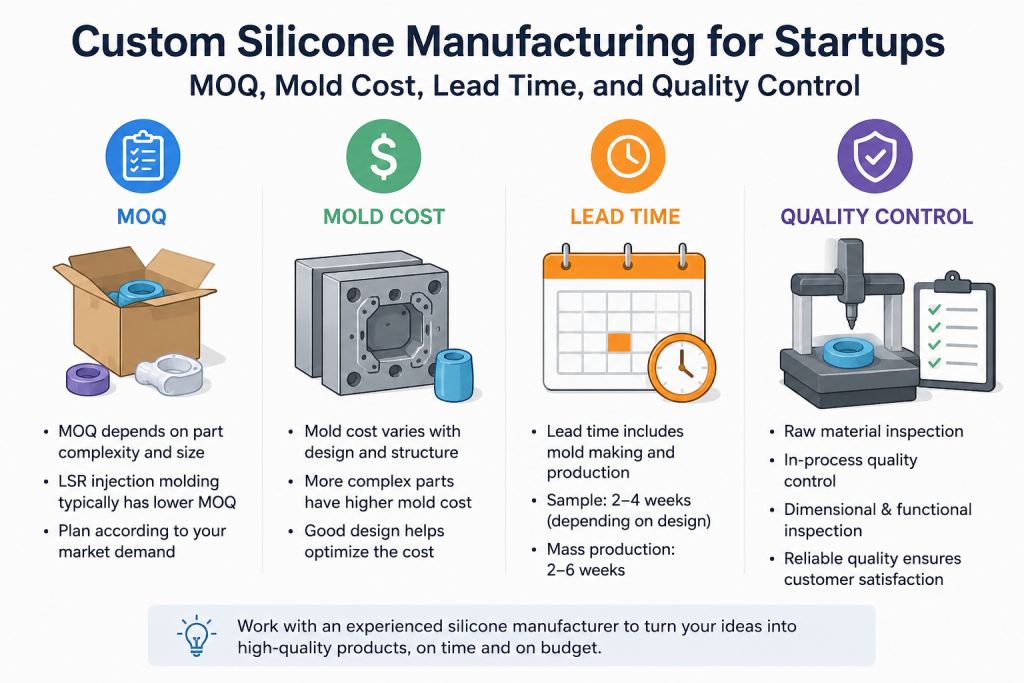
Why Silicone Is Suitable for Startup Product Development
Silicone is a flexible and durable material with many advantages for new product development. It can be soft, elastic, heat-resistant, waterproof, non-toxic, and comfortable to touch. Depending on the application, silicone can be used for functional parts, protective parts, sealing components, baby products, medical components, consumer goods, and industrial products.
For startups, silicone is attractive because it supports:
- Custom shapes and colors
- Soft-touch product design
- Food-contact and baby-care applications
- Waterproof and sealing functions
- Heat and aging resistance
- Overmolding with plastic or metal
- Small product innovation with practical functionality
Liquid Silicone Rubber, also known as LSR, is commonly processed through liquid injection molding. This process uses special molds and injection molding machines to form liquid silicone materials into finished components. LSR molding usually involves controlled material metering, mixing, injection, and curing, making it suitable for precision silicone parts and high-volume production.
1. Understanding MOQ for Custom Silicone Products
MOQ means Minimum Order Quantity. It is one of the first questions startups ask when developing custom silicone products.
For custom silicone manufacturing, MOQ depends on several factors:
- Product size
- Product weight
- Material type
- متطلبات اللون
- Molding process
- Mold cavity number
- Production difficulty
- طريقة التعبئة والتغليف
- Whether the product needs assembly
- Whether the product requires special testing
There is no fixed MOQ for all silicone products. A small simple silicone part may have a lower MOQ, while a complex LSR overmolded part may require a higher MOQ.
Typical MOQ Planning Reference
| نوع المنتج | Possible MOQ Range | Notes |
|---|---|---|
| Simple silicone parts | 100–500 pcs | Suitable for trial orders or small batches |
| Baby silicone products | 500–1,000 pcs | Depends on mold, color, and packaging |
| Kitchen silicone products | 500–2,000 pcs | Larger products may require higher material preparation |
| Silicone seals and gaskets | 500–3,000 pcs | Depends on size and tolerance |
| LSR injection molded parts | 1,000–5,000 pcs | Higher automation and tooling cost |
| LSR overmolded parts | 1,000+ pcs | Depends on insert material and process stability |
These ranges are only for early planning. The final MOQ should be confirmed after product drawing, material, color, process, and packaging requirements are reviewed.
2. Why MOQ Exists in Custom Silicone Manufacturing
Startups sometimes ask why factories cannot produce only 10 or 20 pieces for custom silicone parts. The reason is that custom manufacturing has setup costs before actual production begins.
MOQ usually exists because of:
- Mold setup time
- Machine setup time
- Raw material preparation
- Color mixing
- Trial production loss
- Labor arrangement
- Quality inspection time
- Packaging preparation
- Production efficiency requirements
For very small quantities, the unit cost becomes high because the factory still needs to prepare the same mold, machine, material, and inspection process.
3. Mold Cost: What Startups Should Know
Mold cost is one of the biggest upfront costs in custom silicone manufacturing. A custom silicone product usually needs a dedicated mold. The mold determines product shape, size, surface finish, parting line, tolerance, production efficiency, and consistency.
Mold cost depends on:
- Product size
- Product complexity
- Number of cavities
- Mold steel material
- متطلبات التسامح
- نسيج السطح
- Parting line design
- Insert or overmolding requirement
- LSR injection or compression molding process
- Expected production volume
Typical Mold Cost Planning Reference
| Mold Type | Estimated Cost Range | مناسب لـ |
| Simple compression mold | USD 500–2,000 | Simple pads, gaskets, basic silicone parts |
| Medium complexity silicone mold | USD 1,500–5,000 | Baby products, kitchen parts, custom covers |
| LSR injection mold | USD 3,000–15,000+ | Precision parts, high-volume production |
| LSR overmolding mold | USD 5,000–20,000+ | Silicone over plastic, metal, or cable assemblies |
| Multi-cavity production mold | Higher investment | Large-volume mass production |
For startups, the cheapest mold is not always the best option. A poorly designed mold may cause high flash, unstable dimensions, difficult demolding, slow production, or high defect rates.
4. How to Reduce Mold Cost Risk
Startups can reduce mold cost risk by preparing product information carefully before tooling.
Recommended actions include:
- Confirm product function before mold development
- Provide 2D and 3D drawings if possible
- Avoid unnecessary complex structures
- Keep wall thickness as uniform as possible
- Confirm assembly dimensions early
- Choose a reasonable tolerance range
- Test prototype samples before mass production
- Discuss parting line and flash position before tooling
- Confirm material and hardness before mold making
- Start with a pilot mold if the market is still uncertain
For new product brands, it is better to spend more time on design review than to modify the mold after it is finished.
5. Lead Time for Custom Silicone Manufacturing
Lead time depends on product complexity, mold type, sample approval, testing requirements, and production quantity.
A typical custom silicone project includes:
- Drawing review
- Quotation
- تصميم القوالب
- Mold manufacturing
- First sample production
- Sample testing
- Sample approval
- الإنتاج الضخم
- Final inspection
- التغليف والتسليم
Typical Lead Time Planning Reference
| Project Stage | Typical Time |
| Drawing review and quotation | 1–3 working days |
| Mold design confirmation | 2–5 working days |
| Simple mold manufacturing | 10–20 days |
| Complex LSR mold manufacturing | 20–40 days |
| First sample production | 2–5 days after mold completion |
| Sample adjustment | Depends on issue complexity |
| الإنتاج الضخم | 7–30 days depending on quantity |
| Packaging and shipment preparation | 2–7 days |
If the product requires food-contact testing, medical-grade documentation, custom packaging, color matching, or assembly, the total lead time may be longer.
6. Material Selection for Startup Projects
Choosing the right silicone material is critical. Different products require different material grades and performance.
Common material options include:
- Food grade silicone
- Medical grade silicone
- مطاط السيليكون السائل
- High Consistency Rubber
- Fluorosilicone
- High-temperature resistant silicone
- Transparent silicone
- Colored silicone
- السيليكون الموصّل
- Flame-retardant silicone
For food-contact or baby products, buyers may need materials that meet relevant food-contact requirements. In the United States, 21 CFR 177.2600 covers rubber articles intended for repeated food-contact use, subject to the provisions of the regulation.
For medical device applications, silicone material selection may involve biological safety evaluation. ISO 10993-1 is widely used for the biological evaluation of medical devices, and FDA guidance also discusses a risk-based approach to determining biocompatibility testing needs.
7. Shore Hardness Selection
Shore hardness affects product flexibility, sealing performance, user comfort, and assembly force. For startups, choosing hardness only by touch feeling can be risky. The hardness should match the product function.
| Shore A Hardness | Product Feel | Common Applications |
| 10–30A | Very soft | Baby teethers, soft valves, cushions |
| 30–50A | Soft to medium | Grips, covers, sealing lips, feeding parts |
| 50–70A | Medium firm | Gaskets, industrial parts, protective parts |
| 70A+ | Firm | Structural silicone components, wear-resistant parts |
If the product is used for sealing, the hardness must support compression and recovery. If it is used for baby care or consumer products, comfort and safety are more important.
8. Sampling Before Mass Production
Startups should never skip the sampling stage. First samples help confirm whether the actual product matches the design, function, color, hardness, and assembly requirements.
Sample inspection should include:
- Product size
- Appearance
- اللون
- الصلابة
- نسيج السطح
- Flash level
- Assembly fit
- أداء العزل
- User experience
- Packaging fit
If the sample has problems, the factory may need to adjust mold, process, material, or design. Only approved samples should be used as the production standard.
9. Quality Control for Custom Silicone Products
Quality control is essential for startups because early product quality affects brand reputation, customer reviews, and repeat orders.
A reliable silicone manufacturer should control quality in several stages:
Incoming Material Inspection
Raw silicone material, color masterbatch, inserts, and packaging materials should be checked before production.
Process Control
During production, the factory should control molding temperature, curing time, pressure, material mixing, demolding, trimming, and operator handling.
In-Process Inspection
Workers or QC staff should check product appearance, flash, deformation, color difference, contamination, and obvious defects during production.
الفحص النهائي
Finished products should be inspected before packaging and shipment.
تشمل بنود الفحص الشائعة ما يلي:
| Inspection Item | Purpose |
| Appearance check | Detects stains, bubbles, flash, deformation |
| قياس الأبعاد | Confirms tolerance and assembly fit |
| Hardness test | Confirms material feel and function |
| Color comparison | Confirms color consistency |
| Functional test | Checks sealing, gripping, or protection |
| Assembly test | Confirms fit with other parts |
| فحص العبوات | Prevents deformation and shipment damage |
10. Common Defects Startups Should Watch For
Silicone products may have defects if mold design, material, or production process is not well controlled.
Common defects include:
- Flash
- Bubbles
- Short molding
- Color difference
- Surface stains
- Deformation
- Poor bonding
- التمزق
- Size deviation
- Sticky surface
- Poor assembly fit
- Weak sealing performance
Many defects can be reduced through better mold design, stable molding parameters, suitable material selection, and strict inspection standards.
11. Packaging Considerations for New Brands
Packaging is not only about appearance. It also affects product protection, shipping cost, storage, and user experience.
For startups, packaging options may include:
- التعبئة بالجملة
- Individual polybag
- Paper box
- Blister packaging
- Retail color box
- Custom logo packaging
- Amazon-ready packaging
Soft silicone products should not be compressed for a long time, otherwise deformation may occur. Transparent silicone products should be protected from dust and scratches.
12. How Startups Can Lower Initial Cost
Startups often need to control the first development budget. The following methods can help reduce unnecessary cost:
- Start with a simple product structure
- Avoid too many colors in the first batch
- Use standard material if special material is not required
- Choose reasonable tolerance instead of over-tight tolerance
- Confirm function before mold making
- Start with a smaller batch for market testing
- Use simple packaging first
- Avoid frequent design changes after mold approval
- Combine similar parts into one project when possible
- Work with a manufacturer that can provide engineering suggestions
The goal is not only to reduce price, but to reduce total project risk.
13. What Information Should Startups Provide for Quotation?
To get an accurate quotation, startups should prepare as much information as possible.
Recommended information includes:
- Product name
- 2D drawing or 3D file
- Product size
- Product application
- متطلبات مادة السيليكون
- Shore hardness requirement
- متطلبات اللون
- الكمية التقديرية للطلب
- متطلبات التسامح
- Surface finish requirement
- متطلبات الاختبار
- متطلبات التغليف
- السوق المستهدفة
- Expected delivery time
- Reference sample or photo if available
If drawings are not ready, a concept sketch or sample photo can also help the manufacturer make an initial evaluation.
14. Choosing the Right Silicone Manufacturer
For startups, choosing the right manufacturing partner is more important than simply finding the lowest price.
A suitable silicone manufacturer should be able to provide:
- Design review
- توصيات بشأن المواد
- Mold development
- Sampling support
- القولبة بالحقن باستخدام مادة LSR
- Compression molding
- Silicone overmolding
- فحص الجودة
- Packaging support
- Flexible communication
- Stable repeat production
Startups should look for a supplier that understands both manufacturing and product development. This helps reduce mistakes during the early stage.
الخلاصة
Custom silicone manufacturing can help startups turn product ideas into real market-ready products. However, startups need to understand MOQ, mold cost, lead time, material selection, sampling, and quality control before starting the project.
MOQ depends on product size, process, material, and packaging. Mold cost depends on product complexity, mold structure, and production volume. Lead time depends on tooling, sampling, testing, and mass production requirements. Quality control should cover material, process, dimensions, appearance, function, and packaging.
For startups, the best strategy is to begin with a clear design, realistic budget, suitable material, and a reliable silicone manufacturing partner. With proper planning, custom silicone products can move from concept to sample and then to mass production more smoothly.
الأسئلة الشائعة
1. What is the MOQ for custom silicone products?
MOQ depends on product size, material, process, and packaging. Simple silicone parts may start from a few hundred pieces, while LSR injection molded or overmolded parts usually require higher quantities.
2. How much does a custom silicone mold cost?
Mold cost depends on product size, complexity, cavity number, tolerance, and molding process. A simple mold may cost hundreds to a few thousand dollars, while complex LSR or overmolding tools can cost much more.
3. How long does custom silicone product development take?
A simple project may take several weeks from mold development to samples. Complex LSR injection molding, overmolding, testing, or custom packaging can require a longer development cycle.
4. Can startups order small batches first?
Yes. Many silicone manufacturers can support trial orders or small-batch production, depending on the product and mold type. However, unit cost is usually higher for small quantities.
5. What should startups prepare before contacting a silicone manufacturer?
Startups should prepare drawings, product size, application, material requirement, hardness, color, quantity, testing needs, and packaging requirements. If drawings are not available, a sample or reference photo can help with the first evaluation.
 English
  Japanese
  Korean
  German
  French
  Italian
  Spanish
  Dutch
Dutch  Chinese
  Portuguese
  Polish
  Czech
Czech  Hungarian
  Swedish
  Finnish
  Vietnamese
  Thai
Thai  Turkish
  Arabic
  Russian