
Selecting a pigment for medical liquid silicone rubber is not simply a matter of finding the closest Pantone color.
The selected pigment system can affect the biological evaluation, chemical profile, sterilization stability, appearance and long-term consistency of the finished medical device. A pigment that performs well in a consumer silicone product may not provide the documentation, purity or processing stability required for a medical application.
Medical-device manufacturers must therefore evaluate the complete colored formulation rather than considering the silicone base and pigment as unrelated materials. The final molded component may include the base LSR, pigment carrier, processing additives, mold-release residues and substances created or changed during curing and sterilization.
The appropriate pigment should be selected according to the device application, nature and duration of patient contact, intended sterilization method, target market and required regulatory submission.
This guide explains how to choose pigments for medical LSR while balancing safety, color performance, manufacturing control and regulatory requirements.
Índice
- Why Medical LSR Pigment Selection Matters
- Medical Grade Does Not Mean Universal Approval
- Understanding the Complete Pigment System
- Pigment Types Used in Medical LSR
- Safety and Biocompatibility Considerations
- Caracterización química y sustancias extraíbles
- Sterilization Stability
- Heat and Processing Stability
- Selecting Pigments for Transparent and Opaque LSR
- Color Concentration and Dispersion
- Regulatory Considerations in the United States
- European Medical Device Requirements
- Supplier Documentation Checklist
- Production and Change Control
- Common Pigment Selection Mistakes
- RFQ Checklist
- Preguntas frecuentes
- Conclusión
Why Medical LSR Pigment Selection Matters
Color may serve several functions in a medical device, including:
- Product-size identification
- Connection coding
- Component orientation
- Device-family differentiation
- Hospital inventory management
- Brand recognition
- Procedure or application identification
- Separation of reusable and disposable components
Because color can have a functional role, an unexpected shift, contamination issue or batch inconsistency may be more serious than an ordinary cosmetic defect.
The pigment system can influence:
- Seguridad biológica
- Sustancias extraíbles y lixiviables
- Cytotoxicity test results
- Color stability after sterilization
- Mechanical properties
- Cure behavior
- Aspecto de la superficie
- Transparencia
- Production repeatability
- Regulatory documentation
For this reason, pigment selection should begin during material development rather than after the component design has already been finalized.
Medical Grade Does Not Mean Universal Approval
The phrase “medical-grade pigment” is frequently used in commercial discussions, but it should not be interpreted as automatic approval for every medical device.
A pigment that is suitable for one application may not be appropriate for another because medical-device evaluation depends on factors such as:
- Type of patient contact
- Duración del contacto
- Contacting tissue
- Device geometry
- Pigment concentration
- Método de esterilización
- Processing conditions
- Intended market
- Total chemical exposure
FDA biocompatibility evaluation frameworks categorize devices according to the nature and duration of body contact. Contact duration is commonly considered limited, prolonged or long-term/permanent, and the biological endpoints considered vary by device category.
Therefore, a supplier statement should support—but cannot replace—the device manufacturer’s own risk-based biological evaluation.
Understanding the Complete Pigment System
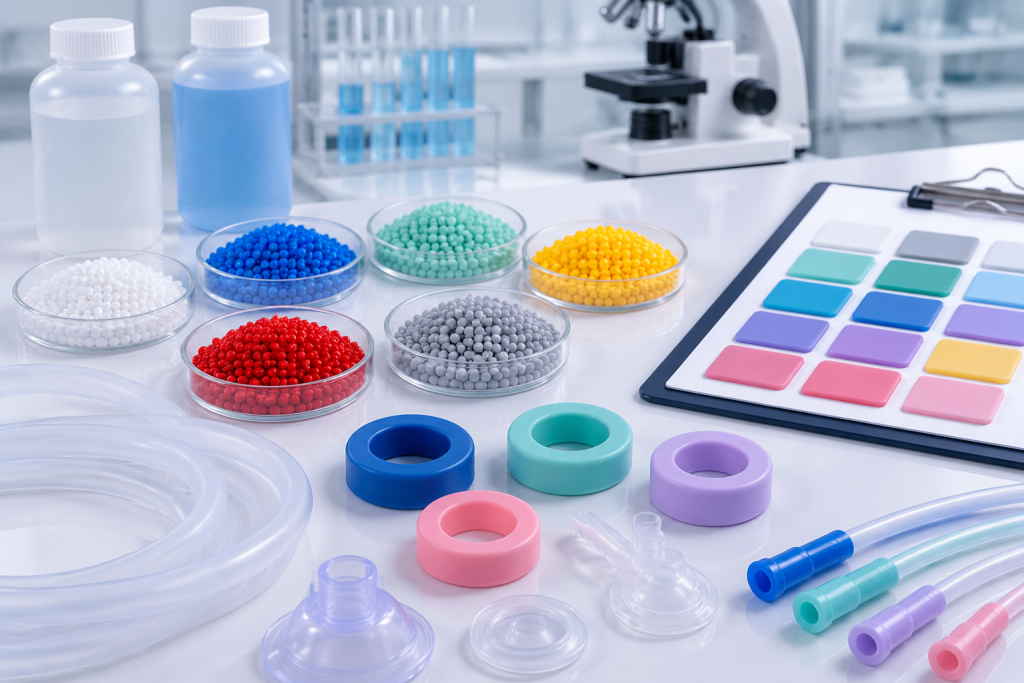
Medical LSR colors are normally produced using a pigment masterbatch or color paste formulated for silicone processing.
A typical color system may contain:
- One or more pigments
- A silicone-compatible carrier
- Dispersion aids
- Stabilizing ingredients
- Trace processing residues
The carrier is important because it helps distribute the pigment evenly throughout the LSR. However, every additional ingredient can potentially change the chemical profile of the molded product.
The manufacturer should therefore evaluate:
- The base LSR
- The pigment itself
- The pigment carrier
- The recommended dosing concentration
- The fully mixed and cured formulation
- The sterilized finished component
The finished colored product—not just the individual raw materials—is usually the most relevant subject for final biological and performance evaluation.
Pigment Types Used in Medical LSR
Medical LSR coloring systems may use inorganic pigments, organic pigments or carefully controlled combinations of both.
Inorganic Pigments
Inorganic pigments are often selected when thermal stability, opacity and long-term color retention are important.
Common examples may include:
- Titanium dioxide
- Iron oxides
- Certain chromium-based pigments
- Ultramarine pigments
- Approved carbon black systems
Typical advantages include:
- Good heat stability
- Strong opacity
- Good light resistance
- Relatively stable sterilization performance
Possible limitations include:
- Less vivid shades
- Higher opacity
- Potential heavy-metal concerns depending on composition and purity
- Limited suitability for transparent products
Specific pigment chemistry and applicable regulations must always be confirmed rather than inferred from the general pigment family.
Organic Pigments
Organic pigments can provide brighter, more saturated colors.
Typical advantages include:
- Vivid reds, blues, greens and yellows
- High tinting strength
- More color-matching flexibility
- Potential suitability for translucent shades
Possible limitations include:
- Greater sensitivity to heat
- Potential fading after radiation
- Greater formulation dependence
- Possible migration or extraction concerns
- More noticeable lot-to-lot variation
An organic pigment should be selected based on documented performance in the actual LSR formulation and intended sterilization process.
Safety and Biocompatibility Considerations
Biocompatibility is not an inherent property of a pigment name or silicone grade alone. It describes the ability of a device material to perform with an appropriate host response in a particular application.
The biological evaluation strategy should consider the complete finished device, including its pigments.
Depending on the device category, potential evaluation endpoints may include:
- Citotoxicidad
- Sensibilización
- Irritation or intracutaneous reactivity
- Acute systemic toxicity
- Material-mediated pyrogenicity
- Subacute or subchronic toxicity
- Genotoxicity
- Implantation
- Hemocompatibility
- Chronic toxicity
- Carcinogenicity
- Reproductive and developmental toxicity
Not every test is required for every device. The evaluation should be risk-based and aligned with the device’s contact type, contact duration, available material information and regulatory pathway.
ISO 10993-1 provides requirements and guidance for biological evaluation within a risk-management process. The 2025 edition emphasizes biological evaluation as part of the broader medical-device risk-management framework.
ISO 10993-5 describes in-vitro cytotoxicity testing methods involving devices or device extracts in contact with cultured cells.
A pigment supplier’s test report can be useful, but the report should be reviewed carefully for:
- Tested formulation
- Pigment loading
- Extraction conditions
- Test method
- Test laboratory
- Report date
- Whether the test covered the pigment, masterbatch or finished product
- Whether the conditions represent the intended device
Caracterización química y sustancias extraíbles
Chemical characterization helps identify substances that may be released from the finished medical component.
Pigment-related substances may include:
- Residual monomers
- Carrier components
- Trace metals
- Coadyuvantes tecnológicos
- Degradation products
- Reaction by-products
- Low-molecular-weight substances
- Impurities introduced during pigment manufacturing
FDA’s September 2024 draft guidance on chemical analysis describes analytical chemistry as one approach that manufacturers may use when developing a medical-device biocompatibility assessment strategy.
Depending on device risk, chemical characterization may involve techniques such as:
- Gas chromatography–mass spectrometry
- Liquid chromatography–mass spectrometry
- Inductively coupled plasma mass spectrometry
- Fourier-transform infrared spectroscopy
- Nonvolatile residue analysis
- Volatile and semivolatile organic analysis
The appropriate extraction conditions should reflect the device materials, clinical exposure and intended use.
For long-term-contact or implant-related applications, a simple statement that the pigment is “non-toxic” is generally insufficient. More detailed chemical composition, impurity and exposure information may be needed.
Heavy Metals and Elemental Impurities
Heavy-metal control is an important consideration when choosing colored materials.
The supplier should be able to provide applicable limits or test information for elements such as:
- Lead
- Cadmium
- Mercury
- Arsenic
- Chromium
- Nickel
- Antimony
- Cobalt
The exact elements and limits should be determined according to:
- Pigment chemistry
- Device application
- Patient exposure
- Mercado objetivo
- Customer specifications
- Chemical risk assessment
A statement of compliance should identify the test method, detection limits and material tested wherever possible.
Manufacturers should avoid assuming that all inorganic pigments contain unsafe metal levels or that all organic pigments are automatically free of elemental impurities. Supplier-specific data is more reliable than broad pigment classifications.
Sterilization Stability
Medical LSR pigments should be evaluated using the actual intended sterilization method.
Common sterilization processes for medical devices include moist heat, radiation and ethylene oxide. FDA also recognizes additional methods used for different device types.
Sterilization may affect:
- Hue
- Ligereza
- Saturation
- Transparencia
- Aspecto de la superficie
- Pigment chemistry
- Silicone base color
- Mechanical performance
EO Sterilization
Ethylene oxide is generally processed at lower temperatures than steam sterilization. Many LSR colors show limited visual change after EO, but testing is still necessary.
Potential concerns include:
- Humidity-related changes
- Packaging interactions
- Residual-related appearance changes
- Temporary color shift before aeration
- Differences after accelerated aging
Evaluation should be completed after the required aeration or stabilization period.
Irradiación gamma
Gamma radiation can create free radicals and change both the pigment and silicone matrix.
Entre los posibles efectos se incluyen:
- Amarilleamiento
- Fading
- Darkening
- Pérdida de saturación
- Transparency changes
- Delayed post-irradiation color development
A formulation that appears acceptable immediately after irradiation may change during storage. Measurements should therefore be taken at defined intervals, not only immediately after exposure.
Steam Sterilization
Steam sterilization exposes the material to heat, moisture and pressure.
Potential effects include:
- Darkening
- Blanqueamiento
- Loss of gloss
- Pigment degradation
- Base-material yellowing
- Progressive changes after repeated cycles
Reusable devices should be evaluated after the maximum claimed number of reprocessing cycles or according to an appropriate validated test plan.
Heat and Processing Stability
LSR is normally cured at elevated mold temperatures. The pigment must tolerate the complete molding and post-curing process.
Important variables include:
- Temperatura del molde
- Tiempo de curado
- Post-curing temperature
- Post-curing duration
- Shear during mixing
- Residence time
- Pigment concentration
An unstable pigment may produce:
- Color drift
- Burn marks
- Dark spots
- Poor dispersion
- Curado desigual
- Surface streaks
- Differences between thick and thin areas
The pigment should be evaluated under worst-case processing conditions, particularly when the product includes:
- Thick sections
- Long cure times
- Extended post-curing
- Multiple cavities
- Hot-runner systems
- High production volumes
A laboratory color plaque molded under ideal conditions may not accurately predict the appearance of the final component.
Selecting Pigments for Transparent and Opaque LSR
Transparent Medical LSR
Transparent or translucent products require pigments with:
- Fine and uniform dispersion
- Low particle agglomeration
- Controlled haze
- Consistent tint strength
- Minimal effect on optical clarity
Very small pigment-concentration differences may be visible in transparent components.
Wall thickness also has a major influence. A transparent blue part may look pale in a 1 mm section but much darker in a 5 mm section.
For this reason, color approval plaques should closely represent the thickness and surface finish of the actual product.
Opaque Medical LSR
Opaque colors generally provide greater visual coverage and can reduce the visibility of small base-material differences.
However, opacity does not eliminate the need to evaluate:
- Pigment dispersion
- Uniformidad del color
- Acabado superficial
- Cure behavior
- Sterilization stability
- Chemical safety
White pigments and pastel formulations can be especially sensitive to contamination, base-material yellowing and radiation-induced color changes.
Color Concentration and Dispersion
Pigment loading should be kept within the validated formulation range.
Too little pigment may cause:
- Weak color
- Excessive transparency
- Visible batch variation
- Inconsistent identification
Too much pigment may cause:
- Unnecessary chemical exposure
- Reduced transparency
- Cure interference
- Mechanical-property changes
- Poor mixing
- Cost increases
The appropriate concentration depends on:
- Pigment strength
- Base LSR transparency
- Product thickness
- Target color
- Textura de la superficie
- Método de esterilización
Production equipment should be capable of accurately controlling the color addition ratio.
Possible mixing methods include:
- Metered pigment dosing
- Pre-compounded colored LSR
- Controlled static mixing
- Validated manual premixing for limited applications
Medical manufacturing generally benefits from closed, controlled dosing systems that reduce contamination and operator variation.
Regulatory Considerations in the United States
Under certain conditions, color additives used in medical devices are subject to the color-additive provisions of the United States Federal Food, Drug, and Cosmetic Act.
FDA states that a device containing a color additive may be considered adulterated unless an applicable regulation is in effect listing that color additive for its intended use.
FDA also maintains a summary of color additives listed for use in foods, drugs, cosmetics and medical devices. The agency notes that color additives used in certain body-contacting medical devices are subject to premarket approval requirements.
Medical-device manufacturers should therefore determine:
- Whether the color additive is subject to listing requirements
- Whether it is listed for the intended device use
- Whether certification requirements apply
- Whether any use restrictions are specified
- Whether the device contact conditions fall within the listing
- Whether additional safety information is required
A pigment being commonly used in the silicone industry does not automatically establish that it is permitted for a particular medical-device application.
The regulatory review should be conducted by personnel familiar with the intended US submission and product classification.
European Medical Device Requirements
Medical devices placed on the European Union market are governed by Regulation (EU) 2017/745, commonly known as the Medical Device Regulation.
The MDR establishes requirements relating to medical-device safety, performance, risk management, technical documentation and market access.
For colored LSR components, the manufacturer should consider:
- Material characterization
- Seguridad biológica
- Chemical risks
- Manufacturing residues
- Degradation products
- Sterilization effects
- Supplier controls
- Gestión del cambio
- Technical-documentation traceability
The pigment should be included in the device’s material and risk-management documentation where relevant.
Compliance declarations such as RoHS or REACH may support supplier qualification, but they should not be treated as substitutes for medical-device biological evaluation.
Supplier Documentation Checklist
A qualified medical LSR pigment supplier should be able to provide an appropriate documentation package.
Depending on the application, useful documents may include:
Material Identification
- Product name and grade
- Pigment or color code
- Carrier description
- Recommended dosing range
- Manufacturing location
- Shelf life
- Storage conditions
Composition and Safety
- Safety Data Sheet
- Technical Data Sheet
- Restricted-substance declaration
- Heavy-metal information
- Applicable color-additive status
- Statement regarding intentionally added substances
- Available chemical-characterization information
Biological Evaluation Support
- ISO 10993 test reports, if available
- Cytotoxicity report
- Sensitization and irritation information
- Test-formulation identification
- Extraction conditions
- Laboratory accreditation information
Regulatory Support
- FDA color-additive information where applicable
- EU regulatory statements
- REACH declaration
- RoHS declaration where relevant
- Conflict-mineral or other customer-requested declarations
- Animal-derived material statement
- Latex statement
- Phthalate statement
- Bisphenol statement
Manufacturing and Quality
- Trazabilidad de los lotes
- Certificate of Analysis
- Política de notificación de cambios
- Quality-management certification
- Batch-consistency controls
- Retention-sample policy
The required documentation should be agreed upon before color validation begins.
Production and Change Control
Once the pigment is approved, the formulation should be controlled as part of the device manufacturing process.
Important controls include:
- Approved supplier
- Approved pigment grade
- Approved color formula
- Defined concentration range
- Material lot traceability
- Mixing instructions
- Molding parameters
- Sterilization conditions
- Color acceptance limits
- Retained golden sample
- Instrumental color measurement
- Documented change approval
Changes that may require assessment or revalidation include:
- Pigment supplier change
- Pigment-manufacturing-site change
- Carrier formulation change
- Base LSR change
- Pigment concentration change
- New sterilization method
- Radiation-dose change
- Molding or post-curing change
- Device geometry change
- New target market
Even when the visible color appears unchanged, a formulation change may affect the chemical or biological profile.
Establishing Color Acceptance Criteria
Color approval should combine visual and instrumental evaluation.
Common control methods include:
- Approved physical golden sample
- L*, a* and b* values
- Delta E tolerance
- D65 light source
- Defined observation angle
- Neutral inspection background
- Surface-finish specification
- Transparency or haze specification
- Pre- and post-sterilization limits
Acceptance criteria should be based on the product’s function.
A decorative external component may allow a wider color tolerance than a color-coded connector used to distinguish device sizes.
The limit should be agreed upon before mass production instead of being decided after variation occurs.
Common Pigment Selection Mistakes
Selecting by Pantone Number Alone
Pantone references are generally printed color standards. Silicone is a three-dimensional material with different gloss, transparency and light-transmission properties.
A Pantone number should be treated as an initial target, followed by approval of a molded sample.
Approving Only the Raw Color Paste
The pigment masterbatch may look different after mixing, molding, curing, post-curing and sterilization.
Approval should be based on representative molded components.
Relying Only on a Supplier’s “Medical Grade” Statement
The term does not replace application-specific risk assessment, biological evaluation or regulatory review.
Ignoring the Pigment Carrier
The carrier is part of the colored formulation and should be included in the material assessment.
Skipping Sterilization Testing
A pre-sterilization match does not guarantee post-sterilization stability.
Changing Suppliers Without Revalidation
Two pigments with the same visual shade may have different chemistries, impurity profiles and sterilization behavior.
Using Consumer-Grade Color Paste for Prototype Samples
Early prototype materials can influence customer expectations. Switching to a medically supported pigment later may make the approved color difficult to reproduce.
Recommended Pigment Selection Workflow
A practical workflow can be divided into nine stages.
Stage 1: Define the Device Application
Confirm:
- Device function
- Patient-contact type
- Duración del contacto
- Target markets
- Sterilization process
- Reusable or single-use status
Stage 2: Define the Color Requirement
Confirm:
- Pantone, RAL or physical standard
- Transparent, translucent or opaque appearance
- Acabado superficial
- Espesor de la pared del producto
- Functional color-coding requirements
Stage 3: Prequalify Pigment Suppliers
Review:
- Medical-use experience
- Documentation availability
- Trazabilidad
- Change-notification practices
- Regulatory support
Stage 4: Review Composition and Risk Information
Evaluate:
- Pigment chemistry
- Carrier system
- Restricted substances
- Heavy-metal data
- Available biological-test information
Stage 5: Develop Laboratory Formulations
Prepare multiple concentration levels and mold representative plaques or components.
Stage 6: Evaluate Processing Performance
Confirm:
- Dispersion
- Cure behavior
- Aspecto de la superficie
- Mechanical properties
- Moldeabilidad
Stage 7: Test Sterilization Stability
Use the intended EO, gamma, steam or other validated sterilization process.
Stage 8: Complete Biological and Chemical Evaluation
Assess the finished colored formulation according to the medical-device risk-management plan.
Stage 9: Approve and Lock the Production Formula
Establish:
- Golden sample
- Formula number
- Supplier and material codes
- Inspection limits
- Requisitos de control de cambios
- Traceability records
Medical LSR Pigment RFQ Checklist
To receive an accurate pigment and molding recommendation, provide the following information:
- Medical-device application
- Part drawing or 3D model
- Type of body contact
- Duración del contacto
- Calidad de la silicona
- Requisitos de dureza
- Transparent, translucent or opaque appearance
- Pantone, RAL or physical color sample
- Espesor de la pared del producto
- Textura de la superficie
- Método de esterilización
- Sterilization dose or cycle
- Number of reusable cycles
- Target markets
- Required biological evaluation
- Restricted-substance requirements
- Annual volume
- Prototype quantity
- Requisitos de embalaje
- Color measurement tolerance
- Required quality documents
A detailed RFQ helps the molding supplier identify pigment risks before tooling and validation expenses are incurred.
Preguntas frecuentes
What is a medical-grade LSR pigment?
It is generally a pigment or color masterbatch formulated and documented for use in medical silicone applications. However, the term alone does not establish suitability for every device. The complete finished formulation must still be evaluated according to its intended use.
Does an ISO 10993 report mean the pigment is approved for all medical devices?
No. The report applies to the tested material, concentration, extraction conditions and endpoints. Device-specific biological evaluation is still required.
Can food-grade silicone pigments be used in medical LSR?
Food-contact documentation does not automatically demonstrate medical-device suitability. Medical applications may require different chemical, biological and regulatory evidence.
Which pigments are best for gamma sterilization?
There is no universal pigment family that performs best in every color and formulation. Candidate pigments should be screened at the intended radiation dose and evaluated immediately and after storage.
Can the same pigment be used for EO and steam sterilization?
Possibly, but performance should be validated under both processes. Steam introduces higher thermal and moisture stress than EO.
Does pigment affect LSR curing?
Certain pigments, carriers, impurities or excessive concentrations can influence cure behavior. Cure testing should be included during formulation development.
Why does the molded color differ from the Pantone card?
Silicone transparency, thickness, surface texture and lighting affect visual appearance. Pantone cards are printed references and cannot perfectly represent molded silicone.
Should transparent medical LSR use less pigment?
Transparent formulations normally require carefully controlled, relatively low pigment levels, but the correct concentration depends on color strength, wall thickness and transparency requirements.
Is a Certificate of Analysis required for every pigment batch?
This depends on the manufacturer’s quality system and risk controls, but lot-specific documentation and traceability are strongly recommended for medical production.
When should a colored LSR formulation be revalidated?
Revalidation or documented assessment may be needed after changes to the pigment, carrier, supplier, silicone grade, concentration, processing conditions, sterilization method or device design.
Conclusión
Choosing pigments for medical LSR requires more than achieving an attractive and accurate color.
The selected pigment system must be compatible with the silicone, stable during molding and sterilization, supported by appropriate safety information and controlled through a documented medical-device quality process.
Successful pigment selection begins with a clear understanding of the device application, patient-contact conditions and intended sterilization method. It continues through supplier qualification, formulation development, chemical and biological assessment, representative molding trials and post-sterilization evaluation.
Manufacturers should avoid relying solely on broad terms such as “medical grade,” “FDA compliant” or “biocompatible.” These statements must be supported by documentation that is relevant to the specific formulation and intended device.
By treating the pigment, carrier, silicone base, molding process and sterilization cycle as one complete material system, medical-device companies can achieve safer products, more consistent colors and a more efficient path from prototype development to validated mass production.
 English
  Japanese
  Korean
  German
  French
  Italian
  Spanish
  Dutch
Dutch  Chinese
  Portuguese
  Polish
  Czech
Czech  Hungarian
  Swedish
  Finnish
  Vietnamese
  Thai
Thai  Turkish
  Arabic
  Russian