
Waterproof silicone seals are widely used in electronic enclosures, outdoor lighting, sensors, battery systems, control panels, appliances, automotive components, medical equipment, and industrial assemblies.
Although silicone offers excellent flexibility, temperature resistance, and weatherability, the material alone does not guarantee waterproof performance. A reliable seal depends on the interaction between the seal profile, groove dimensions, compression level, housing rigidity, surface finish, assembly method, and validation procedure.
For industrial buyers and procurement engineers, waterproof sealing components should therefore be sourced according to the complete application environment rather than only the seal dimensions or material hardness.
This guide explains the key design, compression, material, manufacturing, and leak-testing factors involved in custom waterproof silicone seals.
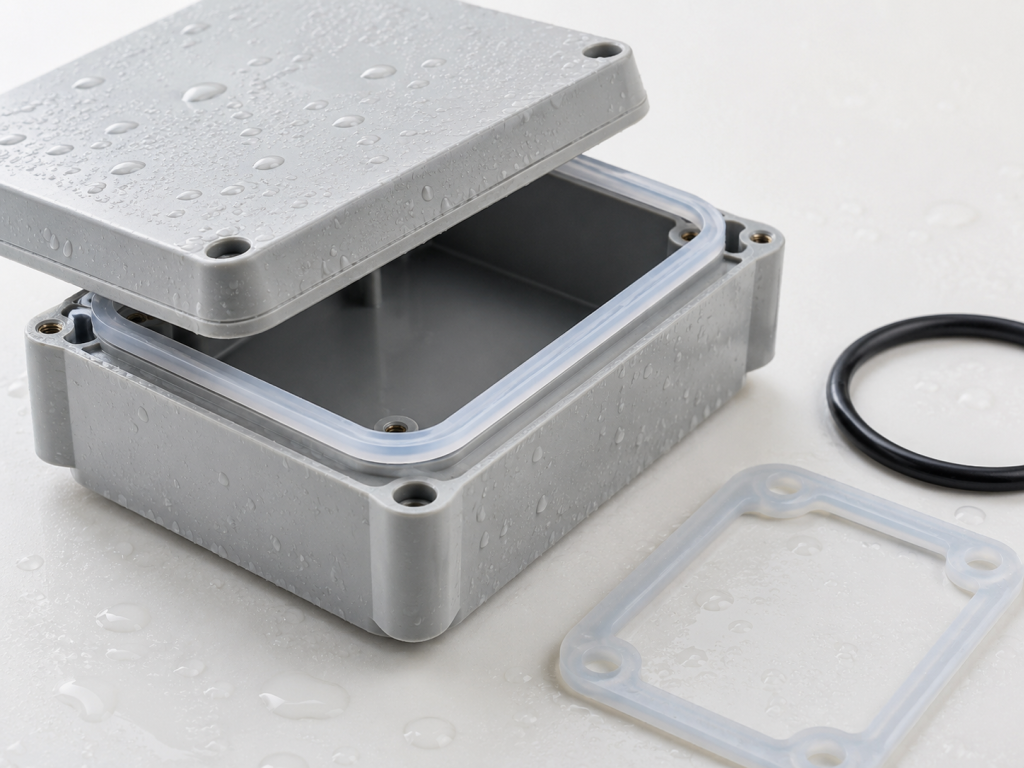
What Is a Waterproof Silicone Seal?
A waterproof silicone seal is an elastomeric component that prevents water or moisture from passing through the interface between two assembled parts.
When properly compressed, the silicone fills small gaps, machining marks, molding variation, and surface irregularities. This creates continuous contact pressure between the seal and the mating surfaces.
Common waterproof silicone sealing components include:
- Silicone O-rings
- Flat silicone gaskets
- Rectangular sealing rings
- D 形密封圈
- 唇形密封圈
- Hollow silicone seals
- Radial shaft seals
- 連接器密封件
- Cable-entry seals
- Button membranes
- Overmolded silicone seals
- Custom molded enclosure gaskets
The correct sealing structure depends on whether the application faces rain, splashing, temporary immersion, continuous immersion, pressure washing, condensation, steam, or internal fluid pressure.
Waterproof Does Not Mean the Same for Every Application
Before selecting a silicone seal, the buyer should define exactly what “waterproof” means for the finished product.
A seal designed only for rain protection may not survive immersion. A gasket that passes a short spray test may still leak after thermal cycling or long-term compression.
Important application conditions include:
- Water spray direction
- Water pressure
- Immersion depth
- Immersion duration
- Exposure frequency
- 工作溫度
- 熱循環
- Internal or external pressure
- Housing movement
- Expected service life
- Cleaning methods
- Chemical exposure
The required protection level should be established before tooling begins.
Common Waterproof Silicone Seal Designs
Silicone O-Rings
O-rings have a round cross-section and are commonly installed inside machined or molded grooves.
They are frequently used for:
- 感測器外殼
- Pipe fittings
- 閥門組件
- Battery covers
- 電氣連接器
- Cylindrical enclosures
- Pump components
An O-ring can provide reliable waterproof sealing when the groove controls compression and prevents excessive movement.
O-rings are especially effective in circular or symmetrical assemblies. However, they may twist, roll, stretch, or become displaced if the groove and installation process are not properly designed.
Flat Silicone Gaskets
Flat silicone gaskets are compressed between two mating surfaces. They are often used in rectangular covers, panels, lids, and enclosures.
常見的應用包括:
- Outdoor electrical boxes
- Industrial control panels
- Lighting housings
- Appliance covers
- Inspection windows
- Equipment doors
Flat gaskets provide a large sealing area and can accommodate irregular housing shapes. However, the fastener positions and clamping force must be distributed evenly.
If screws are too far apart, the housing may bend between fastening points and create local leakage paths.
Rectangular and Square-Section Seals
Rectangular profiles offer a wide, stable contact surface and are less likely to roll during assembly.
These seals are useful for:
- Shallow grooves
- Large enclosure covers
- Plastic housings
- Static industrial assemblies
- Parts requiring controlled positioning
The design should provide enough space for lateral material expansion during compression.
D-Shaped Seals
D-shaped seals have a flat mounting side and a curved compression surface.
They are commonly used for:
- Access doors
- Equipment cabinets
- Outdoor housings
- Vehicle enclosures
- 保護套
The flat base helps stabilize the seal, while the rounded upper surface provides controlled deformation.
D-shaped seals may be molded as closed rings or produced from extruded profiles with bonded joints.
Lip Seals
A lip seal uses one or more thin flexible edges to maintain sealing contact.
Lip seals are useful when:
- Assembly force must remain low
- The mating surface moves
- Radial sealing is required
- A secondary dust barrier is needed
- The housing has limited space
The sealing lip must be protected from folding, tearing, or excessive compression during assembly.
Hollow Silicone Seals
Hollow silicone profiles compress more easily than solid gaskets. They are often used when a large seal is required but the housing cannot withstand high clamping force.
常見的應用包括:
- Large equipment doors
- Thin plastic covers
- Glass panels
- Lightweight enclosures
- Battery compartment covers
The hollow cavity, wall thickness, corner geometry, and joint strength must be carefully controlled.
Overmolded Waterproof Seals
Silicone can be directly molded onto plastic, metal, cable, connector, or electronic components.
Overmolding can reduce assembly steps and eliminate separate gasket installation.
常見的例子包括:
- Waterproof cable connectors
- 感測器外殼
- Electronic buttons
- Cable-entry components
- Plastic covers with integrated gaskets
- Metal inserts with silicone sealing surfaces
The design must consider adhesion, substrate preparation, material compatibility, undercuts, mechanical locking features, and molding temperature.
Selecting the Silicone Material
Silicone materials differ in hardness, tear strength, compression set, chemical resistance, curing system, cleanliness, and regulatory status.
General-Purpose Silicone
General-purpose silicone is suitable for many outdoor and industrial waterproofing applications.
It offers good resistance to:
- 水
- 臭氧
- Ultraviolet exposure
- Weathering
- High and low temperatures
It is commonly used in lighting, electrical housings, appliances, and general equipment.
液態矽膠
Liquid silicone rubber, or LSR, is suitable for precision injection molding and high-volume production.
Advantages include:
- Consistent dimensions
- Stable material mixing
- Complex sealing geometry
- Thin sealing lips
- 自動化成型
- Low-flash tooling
- Plastic or metal overmolding
LSR is often selected for connectors, sensors, medical devices, electronic components, and precision waterproof seals.
High-Consistency Rubber
High-consistency rubber, also called HCR, can be compression molded, transfer molded, or extruded.
適用於:
- 大型墊片
- Thick sealing rings
- Extruded door seals
- Low- to medium-volume projects
- 客製化型材密封條
The best manufacturing method depends on part size, tolerance, annual volume, and profile complexity.
Fluorosilicone
Fluorosilicone provides improved resistance to certain fuels, oils, and solvents.
It may be required for waterproof seals used in:
- 汽車系統
- Aerospace equipment
- Fuel-related assemblies
- Oil-exposed industrial components
However, fluorosilicone is generally more expensive than standard silicone.
Food-Contact or Medical Silicone
Applications involving food, drinking water, or medical devices may require controlled material formulations and supporting documentation.
The buyer should specify:
- Intended contact conditions
- Applicable regulations
- 滅菌方法
- Color restrictions
- Cleanliness requirements
- Traceability requirements
- Required test reports
A general description such as “food-grade” or “medical-grade” is not sufficient without defining the applicable standard and use conditions.
How Silicone Hardness Affects Waterproofing
Silicone hardness is commonly measured using the Shore A scale.
Typical waterproof sealing applications may use materials between approximately 30 and 70 Shore A, although softer or harder materials may be selected for specialized designs.
更柔軟的矽膠
Softer silicone can conform more easily to uneven or low-rigidity mating surfaces.
Possible benefits include:
- Lower assembly force
- Better conformity
- Improved sealing on textured surfaces
- Greater tolerance of housing variation
可能的缺點包括:
- Higher risk of extrusion
- Greater installation distortion
- Lower dimensional stability
- Increased risk of over-compression
- More difficult automated handling
較硬的矽膠
Harder silicone provides better shape retention and may be easier to position during assembly.
Possible benefits include:
- Improved dimensional stability
- Better resistance to extrusion
- Easier automated installation
- More controlled geometry
可能的缺點包括:
- Higher clamping force
- 符合性降低
- Greater sensitivity to housing flatness
- Leakage if compression is insufficient
Hardness should not be selected independently. It must be evaluated together with the seal profile and compression target.
Understanding Seal Compression
Compression is one of the most important factors in waterproof seal design.
When the housing is assembled, the seal must be compressed enough to create continuous contact pressure around the full sealing path.
Insufficient Compression
Insufficient compression may cause:
- Local gaps
- Low sealing pressure
- Water entry
- Dust penetration
- Seal movement
- 振動後發生洩漏
- Failure during thermal cycling
Excessive Compression
Excessive compression may cause:
- High assembly force
- Permanent deformation
- Housing distortion
- Seal extrusion
- Accelerated compression set
- Tearing during assembly
- Reduced service life
The ideal compression percentage depends on:
- Seal profile
- 材料硬度
- Static or dynamic application
- Groove fill
- 溫度
- 壓力
- 表面狀況
- Housing rigidity
- Assembly tolerance
A moderate initial compression target may be used during early design, but final values should be validated using the actual molded parts and housings.
Groove Design Considerations
The groove controls the position, compression, and expansion of the silicone seal.
A properly designed groove should:
- Keep the seal in position
- Prevent twisting or rolling
- Allow lateral expansion
- Control compression
- Minimize assembly damage
- Maintain continuous sealing pressure
- Prevent excessive extrusion
Important groove dimensions include:
- Groove width
- Groove depth
- Corner radius
- Entry chamfer
- 表面處理
- Parting-line position
- Compression stop
- Clearance gap
The groove should not be completely filled by the uncompressed seal. Silicone must have room to deform when the parts are assembled.
Sharp groove corners should generally be avoided because they can damage the seal or create stress concentration.
Housing Flatness and Rigidity
Even a correctly designed gasket can leak if the housing bends or the mating surfaces are not flat.
This problem is common in:
- Large plastic covers
- Thin metal panels
- Long rectangular housings
- Enclosures with widely spaced screws
- Components assembled with inconsistent torque
Engineers should evaluate:
- Housing wall thickness
- Rib design
- Fastener spacing
- Screw torque
- Cover deflection
- Surface flatness
- Warpage after molding
- Thermal expansion
Adding more compression does not always solve housing deformation. Excessive gasket force may make the distortion worse.
Fastener Position and Assembly Force
For flat gaskets, fastener placement directly affects sealing pressure.
If screws are placed only at the corners, the center of a long edge may lift and create a leakage path.
The assembly should provide:
- Even fastener spacing
- Controlled torque
- Adequate housing stiffness
- Compression stops where necessary
- Consistent clamping pressure
Compression stops are rigid features that limit how far the housing can close. They can help prevent gasket over-compression and improve assembly consistency.
Surface Finish and Sealing Interfaces
The mating surface should be smooth enough to prevent continuous leak channels.
Potential problems include:
- Deep machining marks
- Sink marks
- 分型線
- Ejector-pin marks
- 刮痕
- Flash
- 焊縫
- 表面污染
- Housing warpage
The seal should not cross an uncontrolled parting line, sharp edge, or deep surface defect.
For critical applications, the drawing should identify the sealing surface and its required finish.
Corners and Joint Areas
Corners are common failure locations in rectangular waterproof gaskets.
Problems may include:
- Seal thinning
- 填充不完全
- Uneven compression
- Material folding
- Stress concentration
- Bonded-joint weakness
Molded closed-loop gaskets generally provide better corner consistency than cut-and-bonded extruded profiles.
When an extruded gasket is joined into a ring, the buyer should specify:
- Joint position
- Joint strength
- Maximum mismatch
- Joint appearance
- Leak-test requirements
- Minimum cross-sectional consistency
Compression Set and Long-Term Performance
Compression set describes the permanent deformation remaining after silicone has been compressed for a defined time and temperature.
A seal with poor compression-set performance may gradually lose contact pressure.
This is especially important in:
- 戶外裝備
- Hot enclosures
- 汽車系統
- Battery assemblies
- Lighting products
- Long-life industrial equipment
- Products that are rarely serviced
The material should be tested under conditions that reflect the real operating temperature and compression level.
Room-temperature test data alone may not predict long-term sealing performance.
Thermal Cycling
Silicone, plastic, metal, and glass expand and contract at different rates.
During temperature cycling, these dimensional changes can alter gasket compression and housing flatness.
A seal may pass an initial leak test but fail after repeated heating and cooling.
Thermal cycling evaluation should consider:
- Minimum temperature
- 最高溫度
- Heating rate
- Cooling rate
- Number of cycles
- Dwell time
- Assembly condition
- 內部壓力
- Moisture exposure
Leak testing after thermal cycling is often more meaningful than testing only newly assembled parts.
Waterproof Seal Leak-Testing Methods
There is no single leak test suitable for every application. The test method should match the actual risk and product specification.
Visual Water Spray Testing
The assembly is exposed to water spray from specified directions.
This method is suitable for:
- Rain-resistant housings
- Outdoor products
- General splash protection
- Early prototype evaluation
After testing, the enclosure is opened and inspected for water entry.
The procedure should control:
- Spray pressure
- Nozzle distance
- Spray angle
- Duration
- Product orientation
- Water temperature
Immersion Testing
The assembled product is submerged in water for a specified depth and time.
Immersion testing is appropriate for:
- Waterproof sensors
- Battery housings
- Submersible equipment
- Portable electronics
- Sealed connectors
The test specification should define:
- Water depth
- Exposure duration
- Product orientation
- Water temperature
- Internal pressure condition
- Acceptance criteria
Air-Pressure Decay Testing
The sealed assembly is pressurized with air. The system then measures the pressure decrease over time.
Advantages include:
- Clean testing
- Fast production inspection
- Quantitative results
- Easy automation
- No need to dry the product
However, pressure-decay results can be influenced by:
- Internal volume
- Temperature change
- Flexible housing expansion
- Fixture leakage
- Stabilization time
The test limits must be developed using known good and known leaking samples.
Vacuum Decay Testing
Vacuum decay testing removes air from a test chamber or component and measures pressure changes.
It can detect small leaks and may be suitable for sensitive components.
Fixture design and test-volume stability are important for repeatability.
Bubble Leak Testing
The component is pressurized and submerged in water. Escaping air produces visible bubbles.
This method is useful for locating leak positions during development.
It is simple but may be less suitable for automated production testing or very small leaks.
Tracer-Gas Testing
A tracer gas such as helium may be used for highly sensitive leak detection.
This method is generally reserved for applications requiring very low allowable leak rates.
It may be used in:
- Medical systems
- High-reliability electronics
- Aerospace components
- Vacuum systems
- Specialized industrial equipment
Tracer-gas testing requires specialized equipment and controlled procedures.
Dye Penetration Testing
Colored water or fluorescent liquid can help identify the path of water entry.
This is useful during failure analysis but may contaminate the assembly.
Creating a Leak-Test Specification
A useful leak-test requirement should define more than “no leakage.”
It should include:
- 測試方法
- Test pressure
- Water depth
- Test duration
- Product orientation
- Stabilization time
- Allowable pressure loss
- Allowable leak rate
- 檢驗方法
- Sample quantity
- Test frequency
- Environmental conditioning
- Pass/fail criteria
The test method should be agreed upon before mass production.
Prototype Validation
Waterproof sealing performance should be validated using production-intent materials and geometry.
A practical validation sequence may include:
- Dimensional inspection of the seal and groove
- Assembly-force measurement
- Initial leak testing
- 熱循環
- Vibration testing
- Mechanical shock testing
- Chemical exposure
- 老化評估
- Repeat leak testing
- Final visual inspection
Prototype testing should also cover tolerance extremes.
A design that works only with nominal dimensions may fail during mass production.
Manufacturing Quality Requirements
Potential manufacturing defects in waterproof silicone seals include:
- 過度閃光
- Short molding
- 氣泡
- Tears
- 污染
- Surface dents
- Parting-line mismatch
- Incorrect hardness
- Poorly bonded joints
- 尺寸公差
- Distorted profiles
- Damaged sealing lips
Inspection requirements may include:
- 尺寸測量
- Shore A hardness testing
- 目視檢查
- 材料驗證
- Compression-set testing
- Joint-strength testing
- 洩漏測試
- 批次可追溯性
- Color verification
- 包裝檢驗
The sealing surface should be protected from dust, deformation, sharp tools, and unsuitable packaging.
Information to Include in a Waterproof Seal RFQ
To receive an accurate quotation and engineering review, provide:
- Two-dimensional drawing
- Three-dimensional model
- Seal profile
- Critical dimensions
- 溝槽尺寸
- Housing material
- 矽膠硬度
- 所需材料等級
- 工作溫度
- Water exposure conditions
- Internal or external pressure
- Target protection level
- Chemical exposure
- 組裝方法
- Fastener torque
- Annual order quantity
- Sample quantity
- 監管要求
- Leak-test method
- Inspection and packaging requirements
Photos or drawings of the final assembly can help the supplier identify potential sealing risks before tooling.
How to Choose a Waterproof Silicone Seal Supplier
A suitable supplier should be able to support more than part molding.
主要功能包括:
- Seal profile design review
- 材料選用
- Compression analysis
- Groove review
- Tooling development
- Prototype molding
- LSR 注塑成型
- 壓縮成型
- Silicone extrusion
- Overmolding
- 尺寸檢測
- 洩漏測試
- 材料可追溯性
- Failure analysis
Before approving tooling, ask the supplier to review the sealing path, compression ratio, groove fill, parting-line location, corner design, and assembly process.
結論
Reliable waterproof performance is created by the complete sealing system, not by silicone material alone.
The seal profile, hardness, groove geometry, compression, housing stiffness, fastener spacing, surface quality, temperature exposure, and assembly process must work together.
Industrial procurement engineers should define the actual water exposure conditions and required leak-testing method before requesting quotations.
A well-designed silicone seal should be tested after thermal cycling, mechanical stress, aging, and tolerance variation—not only immediately after assembly.
Early engineering review and clear validation requirements can reduce water-ingress failures, shorten development time, and improve long-term product reliability.
常見問題
What silicone hardness is suitable for waterproof seals?
Many waterproof sealing applications use silicone between 30 and 70 Shore A. Softer materials conform more easily, while harder materials provide greater dimensional stability. The final hardness should be validated with the actual groove and housing.
How much should a silicone gasket be compressed?
The required compression depends on the profile, hardness, groove, housing, temperature, and pressure. Too little compression may leak, while excessive compression can damage the seal or distort the housing.
Can silicone seals be used outdoors?
Yes. Silicone generally offers good resistance to ultraviolet exposure, ozone, temperature variation, and weathering. The exact formulation should still be selected according to the operating environment.
Why does a waterproof enclosure leak near the screws?
The housing may be bending between fasteners, or the gasket compression may be uneven. Fastener spacing, torque, housing rigidity, and gasket geometry should be reviewed.
Is an immersion test enough to validate a waterproof seal?
Not always. The product may also need thermal cycling, vibration, aging, pressure testing, and repeat leak testing to confirm long-term reliability.
What is the best leak test for mass production?
Air-pressure decay testing is commonly used because it is clean, fast, quantitative, and suitable for automation. The correct method depends on the product volume, allowable leak rate, and internal geometry.
Are molded gaskets better than bonded extruded gaskets?
Molded closed-loop gaskets generally provide better corner and joint consistency. Extruded and bonded gaskets may be more economical for large sizes, but the joint must be carefully controlled and tested.
Can silicone be overmolded directly onto plastic?
Yes. LSR can be overmolded onto compatible plastics or mechanically locked to the substrate. Adhesion performance depends on the plastic type, silicone formulation, surface preparation, and part design.
 English
  Japanese
  Korean
  German
  French
  Italian
  Spanish
  Dutch
Dutch  Chinese
  Portuguese
  Polish
  Czech
Czech  Hungarian
  Swedish
  Finnish
  Vietnamese
  Thai
Thai  Turkish
  Arabic
  Russian