
When developing custom silicone parts, choosing the right molding process is one of the most important decisions. Two common options are LSR 注塑成型 以及 silicone compression molding. Both processes can produce durable, flexible, and heat-resistant silicone components, but they are suitable for different product designs, order quantities, quality requirements, and budgets.
For buyers, engineers, and product developers, the question is not simply “which process is better?” The better question is: which process is more suitable for your specific silicone product?
This article explains the key differences between LSR injection molding and compression molding, helping you make a more practical decision before starting mold development and mass production.
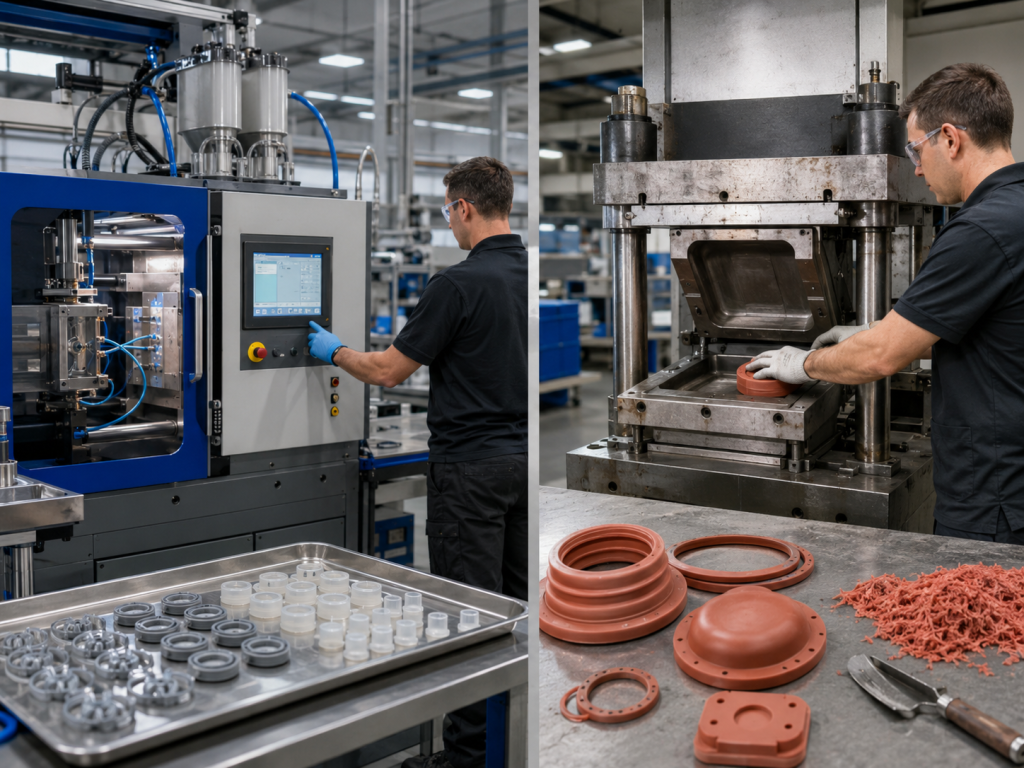
What Is LSR Injection Molding?
LSR injection molding, also called liquid silicone rubber injection molding or LIM, uses two-component liquid silicone rubber. The material is accurately mixed, metered, and injected into a heated mold cavity, where it cures into the final silicone part.
Because LSR has good flowability, it is suitable for small, precise, complex, and thin-wall silicone parts. The process can also support a high level of automation, which helps improve consistency and production efficiency. Industry references commonly describe liquid injection molding as a clean, accurate process suitable for automated production.
LSR injection molding is often used for:
- Baby care silicone products
- Medical silicone components
- 矽膠密封件與墊片
- Electronic waterproof parts
- Automotive connector seals
- LSR overmolded plastic or metal parts
- High-volume custom silicone components
What Is Silicone Compression Molding?
Silicone compression molding is a traditional molding process. A pre-measured silicone material charge is placed into an open heated mold cavity. Then the mold closes, pressure is applied, and the silicone is compressed into shape.
Compression molding is commonly used with solid silicone rubber or HCR silicone materials. It is often selected for simple shapes, larger parts, thicker parts, lower-volume production, or projects where mold cost control is important. Technical references note that compression molding is efficient for simple designs and low-to-medium batch volumes, while injection molding is generally more suitable for complex rubber products.
Compression molding is often used for:
- Large silicone pads
- Simple silicone gaskets
- 厚實的矽膠零件
- Silicone kitchenware
- Prototype silicone parts
- Low-volume custom silicone products
- Products with less strict dimensional requirements
LSR Injection Molding vs Compression Molding: Key Differences
| 項目 | LSR 注塑成型 | 矽膠壓縮成型 |
|---|---|---|
| 材料 | 液態矽膠 | Usually solid silicone / HCR |
| Tooling Cost | 更高 | 較低 |
| Unit Cost | Lower for high-volume production | Better for low-volume production |
| 精確度 | 高 | Medium to good |
| Production Efficiency | High, suitable for automation | Slower, more manual operation |
| Flash Control | Better when mold design is optimized | More flash may occur |
| Part Complexity | Suitable for complex and thin-wall parts | Better for simple or thicker parts |
| Overmolding | Very suitable for plastic or metal overmolding | More limited |
| 整潔 | Better for medical and baby products | Depends on workshop and process control |
| Best For | High-volume, precision, complex parts | Low-volume, large, simple parts |
Advantages of LSR Injection Molding
1. Better for Precision Silicone Parts
LSR injection molding is suitable for products that require tight dimensional control, small details, thin walls, and stable repeatability. The low viscosity of liquid silicone allows the material to flow into small cavities and detailed structures more easily than solid silicone.
This makes it a strong choice for medical silicone parts, baby product components, electronic seals, connector seals, and other functional parts.
2. Suitable for High-Volume Production
Once the mold and process are stable, LSR injection molding can support efficient mass production. The process can be automated, reducing manual handling and improving consistency. This is especially important for export orders, long-term OEM projects, and products that need stable quality across repeated batches.
3. Good for Overmolding Applications
LSR injection molding is widely used for silicone overmolding on plastic, metal, and electronic components. For example, LSR can be molded over PC, PA, PSU, metal inserts, cable assemblies, and connector parts.
常見的應用包括:
- LSR overmolded medical device components
- 矽膠包覆成型線纜組件
- Metal insert silicone sealing parts
- Silicone-covered electronic parts
- Automotive waterproof connector seals
4. Cleaner and More Consistent Process
Compared with more manual processes, LSR injection molding can reduce material handling and improve production cleanliness. This is especially valuable for baby care products, food-contact silicone parts, medical components, and high-quality sealing products.
5. Lower Waste for Large Orders
LSR injection molding uses accurate material dosing. When production volume is high, this can help reduce material waste and lower the average unit cost. Several manufacturing sources describe LSR/LIM as having advantages in automation, cycle time, and material efficiency compared with more traditional molding methods.
Advantages of Silicone Compression Molding
1. Lower Mold Cost
Compression molds are usually simpler than LSR injection molds. For early-stage projects, trial orders, or products with uncertain market demand, compression molding may reduce initial development cost.
This is useful when the buyer wants to test a silicone product before investing in more expensive injection tooling.
2. Suitable for Large or Thick Silicone Parts
Compression molding is often a practical choice for large, flat, or thick silicone parts. Since the material is placed directly into the mold cavity, the process can be easier for some bulky silicone products.
例如:
- Thick silicone pads
- Large silicone mats
- Simple silicone covers
- Large sealing parts
- Basic kitchen or household silicone items
3. Flexible for Small Batch Production
For low-volume custom silicone products, compression molding may be more economical. It is suitable when the buyer does not need extremely high precision, fast cycle time, or fully automated production.
4. Good for Simple Silicone Designs
If the product shape is simple and does not require very tight tolerance, complex geometry, or overmolding, compression molding can be a practical and cost-effective option.
Limitations of LSR Injection Molding
Although LSR injection molding has many advantages, it is not always the best choice for every project.
The main limitations include:
- Higher mold cost
- More complex mold design
- Higher requirements for injection molding equipment
- Not always economical for very small orders
- More preparation needed before production
For simple products with small quantities, the initial investment may be too high.
Limitations of Compression Molding
Compression molding is cost-effective for some projects, but it also has limitations.
Common limitations include:
- Slower production cycle
- More manual operation
- More flash trimming may be required
- Less suitable for complex thin-wall parts
- Less suitable for high-volume precision production
- More difficult for highly automated production
Compression molding may also be less ideal when the product requires strict appearance quality, tight tolerance, or clean production conditions.
Which Process Is Better for Custom Silicone Parts?
There is no single answer. The best process depends on your product design, order quantity, quality requirements, and budget.
Choose LSR Injection Molding If:
- Your product requires high precision
- You need stable mass production
- The part has thin walls or complex details
- The part needs overmolding with plastic or metal
- You need baby-grade, food-grade, or medical-grade production
- You want better consistency between batches
- Your order quantity is medium to high
LSR injection molding is usually better for custom silicone parts with higher technical requirements.
Choose Compression Molding If:
- Your product structure is simple
- Your quantity is small or medium
- You want lower mold cost
- The part is large or thick
- Tolerance requirements are not extremely strict
- You are testing a new product idea
- You want a more economical starting solution
Compression molding is usually better for simple silicone parts, low-volume production, and cost-sensitive projects.
Application Examples
嬰幼兒矽膠產品
For baby teethers, feeding parts, silicone nipples, valves, and soft-touch components, LSR injection molding is often preferred because it supports clean production, smooth surface quality, and stable dimensions.
Medical Silicone Components
For medical device silicone parts, LSR injection molding is usually more suitable due to its precision, repeatability, and compatibility with clean manufacturing requirements.
Automotive Silicone Seals
For automotive connector seals, waterproof plugs, wire harness seals, and metal insert sealing components, LSR injection molding provides better dimensional control and durability.
Kitchen and Household Silicone Products
For simple silicone mats, pads, trays, or thicker household items, compression molding can be a cost-effective choice, especially when the product does not require complex details.
Silicone Overmolded Parts
For silicone overmolding on plastic, metal, or cable assemblies, LSR injection molding is generally the better option because it supports accurate flow, bonding design, and stable production.
Practical Recommendation for Buyers
Before choosing a process, buyers should prepare the following information:
- Product drawing or 3D file
- 矽膠硬度要求
- Product size and tolerance requirement
- 應用環境
- Food-grade, medical-grade, or industrial-grade material requirement
- 預估訂購數量
- Appearance and surface finish requirement
- Whether overmolding is needed
- Target budget and lead time
With this information, a silicone manufacturer can evaluate whether LSR injection molding or compression molding is more suitable.
結論
LSR injection molding and compression molding are both important processes for custom silicone parts. LSR injection molding is better for precision, complex designs, overmolding, clean production, and high-volume orders. Compression molding is better for simple structures, large or thick parts, lower mold cost, and small-batch production.
For custom silicone product development, the right process should be selected based on product structure, quantity, tolerance, material grade, and final application.
If your product requires high precision, stable quality, and long-term production, LSR injection molding is usually the better choice. If your product is simple, large, or still in the testing stage, compression molding may be a more economical option.
Is LSR injection molding more expensive than compression molding?
The mold cost of LSR injection molding is usually higher. However, for high-volume production, the unit cost can become lower because the process is more efficient and automated.
Which process is better for baby silicone products?
LSR injection molding is often better for baby silicone products because it provides good surface quality, stable dimensions, and cleaner production conditions.
Can compression molding produce medical silicone parts?
Yes, compression molding can produce some medical silicone parts, but for high-precision or clean production requirements, LSR injection molding is usually preferred.
 English
  Japanese
  Korean
  German
  French
  Italian
  Spanish
  Dutch
Dutch  Chinese
  Portuguese
  Polish
  Czech
Czech  Hungarian
  Swedish
  Finnish
  Vietnamese
  Thai
Thai  Turkish
  Arabic
  Russian