
Conductive silicone rubber combines the flexibility and environmental sealing capability of silicone with electrical conductivity.
It is widely used in electronic assemblies where a conventional insulating silicone gasket cannot provide the required electrical connection between two conductive surfaces.
常見的應用包括:
- EMI shielding gaskets;
- electronic enclosure seals;
- grounding contacts;
- conductive buttons;
- connector seals;
- telecom equipment;
- automotive electronics;
- radar and RF equipment;
- industrial control systems.
Unlike ordinary silicone rubber, conductive silicone contains electrically conductive fillers distributed throughout the elastomer.
These fillers can create a conductive path through the material while silicone continues to provide:
- elasticity;
- compression;
- environmental sealing;
- vibration accommodation.
However, specifying a conductive silicone part requires more than simply writing:
“Conductive silicone, black.”
Engineers and purchasing teams should understand:
- volume resistivity;
- filler system;
- shielding effectiveness;
- contact resistance;
- compression;
- Shore hardness;
- corrosion compatibility;
- molding method.
This guide explains the most important factors when designing and sourcing custom conductive silicone rubber parts for electronic applications.
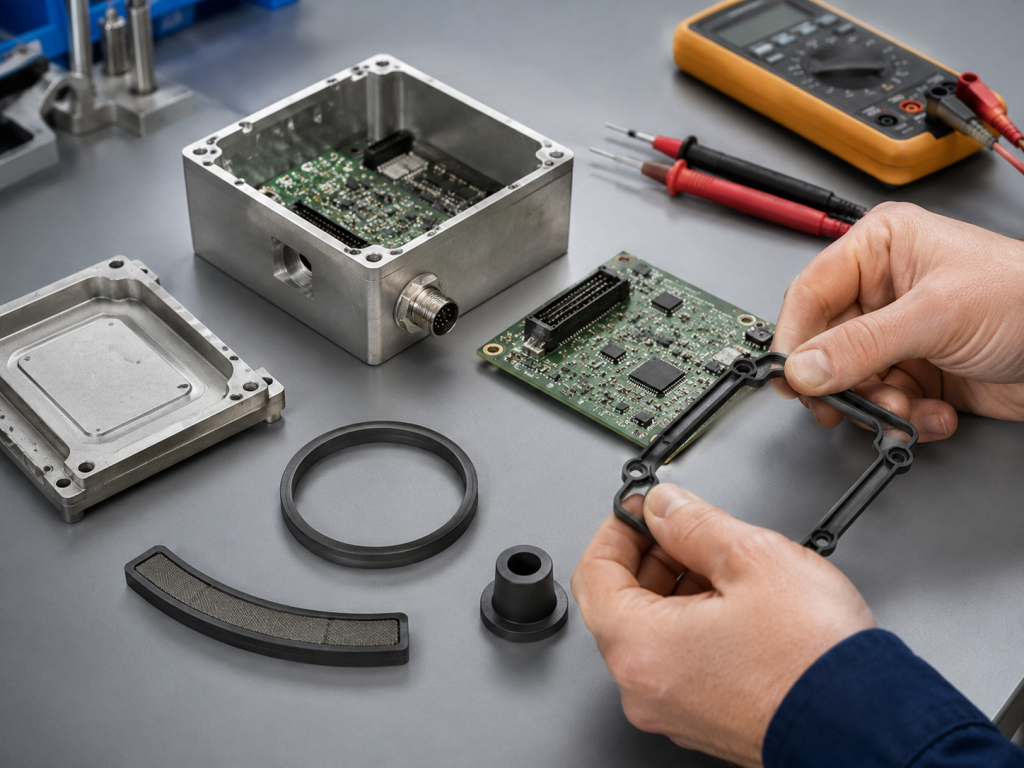
What Is Conductive Silicone Rubber?
Standard silicone rubber is normally an electrical insulator.
To make silicone electrically conductive, conductive particles are mixed into the silicone matrix.
Common filler systems can include:
- carbon;
- nickel/graphite;
- silver-plated particles;
- silver/nickel;
- silver/copper;
- other metallic systems.
These particles create electrical pathways through the cured silicone.
Laird describes electrically conductive elastomers as systems based on conductive particles dispersed through elastomers or other conductive structures, allowing the gasket to provide both EMI shielding and environmental sealing.
The choice of filler has a major effect on:
- conductivity;
- EMI performance;
- density;
- corrosion behavior;
- material price.
Conductive Silicone Is Not Just a Conductive Rubber Gasket
Conductive silicone can be manufactured into many geometries.
例如:
- flat gaskets;
- O-rings;
- rectangular seals;
- connector gaskets;
- conductive pads;
- molded boots;
- conductive keypads;
- waveguide gaskets;
- custom overmolded components.
Commercial conductive elastomer systems are available as molded parts, extrusions, die-cut gaskets and form-in-place materials. Laird, for example, lists molded waveguide gaskets, flat washers, extrusions and co-extruded conductive elastomer products.
The best manufacturing process depends on:
- geometry;
- tolerance;
- quantity;
- EMI requirement;
- compression force.
Why Use Conductive Silicone in Electronics?
Electronic housings frequently contain small mechanical gaps between:
- enclosure and lid;
- connector and housing;
- RF compartment sections.
These gaps can allow electromagnetic energy to enter or escape the enclosure.
A conductive gasket can electrically bridge the surfaces while also filling mechanical irregularities.
This can provide two functions:
EMI/RFI Shielding + Environmental Sealing
Parker Chomerics notes that conductive elastomer gaskets are used across telecommunications, automotive, medical, industrial and other electronic applications and can combine EMI shielding with environmental sealing.
What Is EMI Shielding?
EMI means:
Electromagnetic Interference
Electronic circuits can both generate and receive unwanted electromagnetic energy.
例如:
- RF transmitters;
- switching power supplies;
- processors;
- motors;
- wireless equipment.
A conductive enclosure can help contain this energy.
However, joints and seams in the enclosure create discontinuities.
A conductive elastomer gasket can help maintain electrical continuity across those seams.
Shielding Effectiveness Is Measured in dB
EMI shielding effectiveness is commonly expressed in:
decibels, dB
A higher number generally indicates greater attenuation under the specified test conditions.
Commercial conductive elastomers can achieve very high shielding values, but the actual result depends on:
- material;
- frequency;
- gasket geometry;
- compression;
- enclosure design;
- contact surfaces.
For example, current Laird form-in-place conductive silicone products list shielding performance ranging from more than 80 dB to more than 100 dB depending on formulation.
Do not specify simply:
“EMI shielding required.”
Instead, identify:
- required shielding level;
- frequency range;
- test method.
Conductivity and EMI Shielding Are Not the Same Specification
One of the most important sourcing mistakes is assuming:
Low Electrical Resistance = Guaranteed EMI Shielding Performance
Electrical conductivity is important, but shielding effectiveness also depends on the complete assembly.
Factors include:
- gasket-to-housing contact;
- compression;
- seam geometry;
- frequency;
- enclosure conductivity;
- surface coating.
A conductive silicone compound can have excellent laboratory resistivity and still perform poorly if the gasket does not establish continuous electrical contact with the enclosure.
Therefore, electrical resistivity and shielding effectiveness should be treated as separate specifications.
What Is Volume Resistivity?
Volume resistivity describes resistance to electrical current passing through a material.
It is commonly expressed as:
Ω·cm
Lower volume resistivity means higher conductivity.
ASTM D991-89(2026) is currently an active ASTM test method specifically covering volume resistivity measurements for electrically conductive and antistatic rubber products.
Examples of commercial conductive silicone illustrate how filler systems affect resistivity.
A Laird nickel/graphite-filled silicone product lists typical volume resistivity around:
0.04 Ω·cm
while a silver/nickel-filled silicone formulation lists approximately:
0.01 Ω·cm.
These values are examples of specific products, not universal limits for all conductive silicone.
What Volume Resistivity Should You Specify?
There is no single correct requirement.
Different applications may need very different electrical performance.
A general RFQ might specify:
Volume Resistivity: ≤0.05 Ω·cm
But this value should come from:
- electrical system requirements;
- EMI testing;
- approved material specification.
Do not select an extremely low value simply because it appears technically superior.
More conductive filler systems can increase:
- raw material cost;
- density;
- galvanic corrosion concerns.
Surface Resistance vs Volume Resistance
These terms should not be confused.
Volume Resistivity
Measures conductivity through the bulk material.
Surface Resistance
Relates to current flow along the material surface.
For highly conductive rubber compounds, volume resistivity is often the more useful material specification.
ASTM D991 specifically addresses conductive and antistatic rubber volume resistivity.
For project specifications, always define:
test method + specimen geometry + acceptance value
instead of requesting only “low resistance.”
What Is Contact Resistance?
Even if the silicone itself is highly conductive, electricity must still pass through the interfaces between:
Housing → Conductive Gasket → Cover
This interface introduces contact resistance.
Contact resistance can increase if:
- gasket compression is too low;
- oxide forms on the housing;
- paint covers the contact surface;
- contamination is present;
- the gasket surface is damaged.
Therefore, the enclosure design is part of the electrical system.
Compression Is Critical for Electrical Contact
Conductive silicone normally requires sufficient compression to create reliable contact with mating surfaces.
If compression is too low:
- contact area decreases;
- electrical resistance may increase;
- EMI leakage may increase.
If compression is excessive:
- closure force becomes high;
- gasket can deform permanently;
- long-term compression set can increase.
The correct compression depends on:
- gasket cross-section;
- hardness;
- material;
- enclosure design.
Parker’s conductive elastomer engineering data includes force-deflection measurements at specified compression levels, illustrating why compression behavior needs to be considered together with electrical performance.
Conductive Silicone Hardness
Conductive silicone materials are available in different hardness levels.
Commercial EMI gasket products may be found around:
- 45 Shore A;
- 55 Shore A;
- 65 Shore A.
For example, Laird lists conductive silicone formulations at approximately 45, 55 and 65 Shore A depending on product and filler system.
Hardness affects:
- closure force;
- sealing;
- compression;
- mechanical stability.
A softer material may be preferred for:
- thin enclosure covers;
- low bolt load;
- irregular surfaces.
A harder material may provide:
- greater mechanical stability;
- higher resistance to extrusion.
Conductive Filler Options
Carbon-Filled Silicone
Carbon can provide electrical conductivity at relatively economical material cost.
It may be suitable for:
- static dissipation;
- grounding;
- moderate conductivity requirements.
However, carbon-filled silicone is not always the first choice when extremely high EMI shielding performance is required.
Nickel/Graphite-Filled Silicone
Nickel/graphite systems are widely used in conductive elastomers.
Advantages can include:
- useful conductivity;
- good EMI performance;
- lower cost than precious-metal-filled systems.
A current Laird nickel/graphite conductive silicone example specifies volume resistivity around 0.04 Ω·cm and shielding effectiveness above 80 dB.
They are commonly considered for:
- telecom;
- industrial electronics;
- automotive electronics.
Silver-Based Conductive Silicone
Silver-containing fillers can achieve very low resistivity.
Possible systems include:
- silver/nickel;
- silver/copper;
- silver-coated particles.
A Laird silver/nickel-filled conductive silicone example reports approximately:
0.01 Ω·cm volume resistivity
with average shielding effectiveness above 100 dB.
The trade-off is usually higher material cost.
Fluorosilicone Conductive Elastomers
Some environments contain:
- fuel;
- oils;
- hydraulic fluid;
- aggressive chemicals.
Standard silicone may not provide the required chemical resistance.
Conductive fluorosilicone can be used when both:
EMI Shielding + Fluid Resistance
are required.
Parker’s CHO-SEAL 6750, for example, uses nickel/graphite-filled fluorosilicone and is positioned for EMI shielding plus resistance to oils, hydraulic fluids and fuels.
This can be relevant to:
- aerospace;
- automotive;
- industrial equipment.
Watch for Galvanic Corrosion
Conductive fillers are electrically active materials.
When a conductive gasket contacts a metal enclosure in the presence of moisture, galvanic compatibility can become important.
Possible enclosure materials include:
- aluminum;
- stainless steel;
- plated steel;
- magnesium.
The wrong conductive filler and housing combination may increase corrosion risk.
Parker’s conductive elastomer engineering handbook specifically lists galvanic-corrosion performance against treated aluminum as one of the material-selection properties.
Therefore, EMI gasket selection should consider:
conductivity + corrosion compatibility
not conductivity alone.
Housing Surface Finish Matters
A conductive gasket must electrically contact the housing.
Potential problems include:
- paint;
- anodizing;
- thick oxide;
- contamination.
These can create electrically insulating barriers.
The contact region may therefore require a suitable:
- conductive plating;
- conversion coating;
- exposed conductive surface.
However, corrosion protection must also be maintained.
Electrical and mechanical engineers should review this interface together.
Conductive Silicone Can Also Provide Environmental Sealing
Many conductive silicone gaskets perform two jobs at the same time:
- maintain electrical continuity;
- prevent environmental ingress.
Laird describes conductive elastomers as materials that provide EMI shielding together with sealing against fluids and environmental exposure.
This can reduce the need for two separate gaskets.
Applications may require resistance to:
- water;
- dust;
- humidity.
However, EMI performance does not automatically guarantee an IP rating.
The complete enclosure must be tested.
Common Conductive Silicone Part Shapes
Flat Gaskets
Used between:
- enclosure lids;
- flanges;
- electronic housings.
They may be molded or die-cut from sheet.
O-Rings
Suitable for circular sealing interfaces where electrical continuity is also required.
Connector Gaskets
Used around:
- RF connectors;
- electrical connectors;
- communication ports.
Waveguide Gaskets
Used in microwave and RF assemblies.
Custom Molded Components
Complex conductive parts can incorporate:
- holes;
- locating features;
- sealing lips;
- different thickness zones.
Compression Molding Conductive Silicone Parts
Compression molding is widely used for custom conductive elastomer parts.
It can be suitable for:
- medium production quantities;
- custom gaskets;
- complex molded geometry;
- waveguide seals.
Advantages can include:
- relatively straightforward tooling;
- broad geometry flexibility.
Potential considerations include:
- flash;
- manual trimming;
- cavity consistency.
Laird describes conductive elastomer molding ranging from single-cavity prototype molds to multi-cavity production and compression molding processes.
Die-Cut Conductive Silicone Gaskets
If the part is essentially flat with constant thickness, molding may not be necessary.
Conductive silicone sheet can be converted through:
- die cutting;
- digital cutting;
- punching.
Suitable products include:
- flat enclosure seals;
- washers;
- simple frame gaskets.
This can reduce tooling investment for relatively simple 2D geometries.
Form-in-Place Conductive Silicone
For small electronic enclosures, a conductive elastomer bead can sometimes be dispensed directly onto the housing.
This process is commonly called:
Form-in-Place, FIP
It is useful for:
- small flange widths;
- complex gasket paths;
- high-volume electronics.
Laird lists FIP conductive elastomer applications in telecom, automotive, radar and data communications and reports shielding capability in the 85–100 dB class for certain products.
FIP is a different manufacturing strategy from separately molded silicone parts and should be evaluated based on assembly design and production volume.
Conductive Silicone Overmolding
Conductive silicone may also be molded around:
- metal frames;
- inserts;
- conductive substrates.
This can integrate:
- mechanical sealing;
- electrical contact;
- positioning.
However, conductive fillers can affect:
- flow behavior;
- shrinkage;
- mold wear.
A DFM review should be completed before tooling.
Dimensional Tolerance
Conductive silicone remains an elastomer.
Adding conductive fillers does not turn it into a rigid material.
Dimensional capability is still affected by:
- geometry;
- hardness;
- mold design;
- shrinkage;
- parting line.
Avoid applying machining tolerances to every dimension.
Identify critical areas such as:
- sealing height;
- contact thickness;
- mounting-hole position.
Flash Can Affect Electrical and Mechanical Performance
Flash is especially important for conductive gasket applications.
Excessive flash may:
- interfere with assembly;
- extend into electrical areas;
- create unpredictable contact.
But overly aggressive trimming can also damage the gasket.
Drawings should identify:
- functional electrical contact areas;
- sealing surfaces;
- acceptable flash zones.
Conductive Silicone Compression Set
The gasket must continue exerting contact force after long-term compression.
If compression set becomes excessive, the gasket may lose:
- sealing pressure;
- electrical contact.
Commercial conductive elastomer datasheets therefore commonly report compression-set performance along with hardness and electrical resistivity.
Long-life applications should consider:
- temperature;
- compression;
- aging.
工作溫度
Conductive silicone can provide useful temperature performance, but limits depend on the exact compound.
Examples of current Laird conductive silicone FIP grades specify operating ranges around:
-50°C to +125°C.
Other conductive elastomer formulations may have different ranges.
Never assume standard silicone temperature capability automatically applies after conductive fillers are added.
Use the actual material datasheet.
EMI Testing
For critical electronics, final validation should test the complete enclosure.
Testing only a material coupon does not capture:
- joint geometry;
- fastener spacing;
- enclosure surface;
- gasket compression.
Shielding requirements may be defined against recognized standards or customer-specific test methods.
For defense applications, MIL-DTL-83528 is an active U.S. detail specification covering electrically conductive elastomeric EMI/RFI shielding gaskets. The DLA ASSIST database currently lists the specification as active.
If military compliance is required, specify the exact material type and qualification requirement rather than simply stating “MIL grade.”
Resistance Testing
For electrically conductive rubber, ASTM D991 is particularly relevant.
As of 2026, the active revision is:
ASTM D991-89(2026)
covering volume resistivity of conductive and antistatic rubber products.
For a production RFQ, consider specifying:
- test method;
- resistivity limit;
- measurement frequency;
- lot sampling requirement.
Do Not Specify Conductivity Without a Test Method
A drawing that says:
Resistance < 1 Ω
may be incomplete.
Resistance depends on:
- part dimensions;
- electrode spacing;
- compression;
- measurement method.
A better material requirement may specify:
Volume Resistivity ≤ X Ω·cm, tested according to ASTM D991
with separate finished-part contact-resistance requirements if required.
Example Conductive Silicone RFQ
A useful RFQ could look like:
Product: Conductive Silicone Enclosure Gasket
應用: RF Electronic Housing
材質: Nickel/Graphite-Filled Silicone
硬度: 50 ±5 Shore A
Volume Resistivity: ≤0.05 Ω·cm
Test Method: ASTM D991
Shielding Requirement: ≥80 dB over specified frequency range
Operating Temperature: -40°C to +120°C
Housing: 鋁
Surface Treatment: Customer to specify
Compression: Defined by enclosure design
Critical Dimension: Gasket height ±0.10 mm
Flash: No loose flash on electrical contact area
Quantity: 50,000 pcs/year
This gives the manufacturer enough information to recommend a realistic material and molding process.
Important Information to Send the Manufacturer
For an accurate quotation, provide:
- 3D CAD;
- 2D drawing;
- gasket geometry;
- resistivity requirement;
- EMI shielding requirement;
- frequency range;
- silicone or fluorosilicone preference;
- conductive filler preference if specified;
- hardness;
- enclosure metal;
- enclosure plating/coating;
- compression;
- operating temperature;
- fluid exposure;
- annual quantity;
- testing requirement.
Conductive silicone projects require closer cooperation between mechanical and electrical design than ordinary silicone seals.
Common Design Mistakes
Selecting Material Only by Resistivity
Very low resistivity may add unnecessary material cost.
Ignoring Contact Surfaces
Paint or oxide can destroy the intended electrical path.
Too Little Compression
The gasket may not establish reliable electrical contact.
Excessive Compression
Can increase compression set and enclosure force.
Ignoring Corrosion
Conductive filler and housing metal may create galvanic problems.
Specifying EMI Performance Without Frequency
Shielding performance varies with frequency and test setup.
Testing Material Only
Final enclosure performance can differ significantly from a laboratory material sample.
Conductive Silicone Selection Checklist
Before specifying a custom conductive silicone part, confirm:
- EMI shielding required?
- grounding only or full shielding?
- target frequency range?
- required shielding effectiveness?
- maximum volume resistivity?
- ASTM D991 required?
- silicone or fluorosilicone?
- filler system?
- Shore hardness?
- gasket compression?
- housing material?
- housing coating?
- corrosion exposure?
- temperature range?
- water or chemical exposure?
- expected compression set?
- dimensional tolerance?
- molding or die cutting?
- annual quantity?
- final enclosure testing?
These questions should be answered before the production mold is released.
結論
Conductive silicone rubber is a useful material when an electronic enclosure requires both:
mechanical sealing and electrical continuity.
However, successful design requires more than simply choosing a conductive rubber grade.
工程師必須考慮:
resistivity + EMI shielding + compression + contact surfaces + filler chemistry + environmental conditions.
Volume resistivity defines the electrical conductivity of the material.
Shielding effectiveness describes how well the complete shielding system reduces electromagnetic energy.
Compression determines whether reliable electrical contact is maintained.
And filler chemistry can influence both cost and corrosion behavior.
For custom molded conductive silicone parts, the most reliable development process is:
define electrical requirements → select filler/material → design compression → review enclosure compatibility → manufacture samples → test the complete assembly.
This helps avoid over-specifying an expensive material while ensuring the finished electronic enclosure meets its actual EMI, grounding and environmental-sealing requirements.
常見問題
What makes silicone rubber electrically conductive?
Conductive particles such as carbon, nickel/graphite or silver-containing fillers are dispersed through the silicone matrix to create conductive pathways.
What is a typical volume resistivity for conductive silicone?
It depends strongly on the filler system. Current commercial nickel/graphite silicone examples may be around 0.03–0.04 Ω·cm, while some silver-containing systems can reach around 0.01 Ω·cm. These are product examples rather than universal specifications.
Does lower resistance always mean better EMI shielding?
No. EMI shielding also depends on gasket compression, enclosure design, frequency, surface conductivity and continuity across the entire joint.
Can conductive silicone provide waterproof sealing?
Yes, conductive elastomers can provide environmental sealing as well as EMI shielding, but the complete enclosure must be designed and tested for the required ingress-protection level.
What standard is used to measure conductive rubber resistivity?
ASTM D991 is specifically intended for measuring volume resistivity of electrically conductive and antistatic rubber products; ASTM lists D991-89(2026) as the active revision.
Can conductive silicone parts be custom molded?
Yes. Conductive silicone elastomers can be compression molded into custom gaskets, connector seals, waveguide gaskets and other complex parts, while flat designs can also be die-cut and certain electronic assemblies can use form-in-place gasketing.
 English
  Japanese
  Korean
  German
  French
  Italian
  Spanish
  Dutch
Dutch  Chinese
  Portuguese
  Polish
  Czech
Czech  Hungarian
  Swedish
  Finnish
  Vietnamese
  Thai
Thai  Turkish
  Arabic
  Russian