
Developing a custom silicone product is not only about making a mold and starting production. A successful project requires clear product design, suitable silicone material, accurate tooling, stable molding process, functional testing, and strict quality control.
For buyers, engineers, product developers, and brand owners, understanding the full development process can help reduce mistakes, shorten lead time, control cost, and improve final product quality.
This article explains how a custom silicone product is developed from drawing to mass production, step by step.
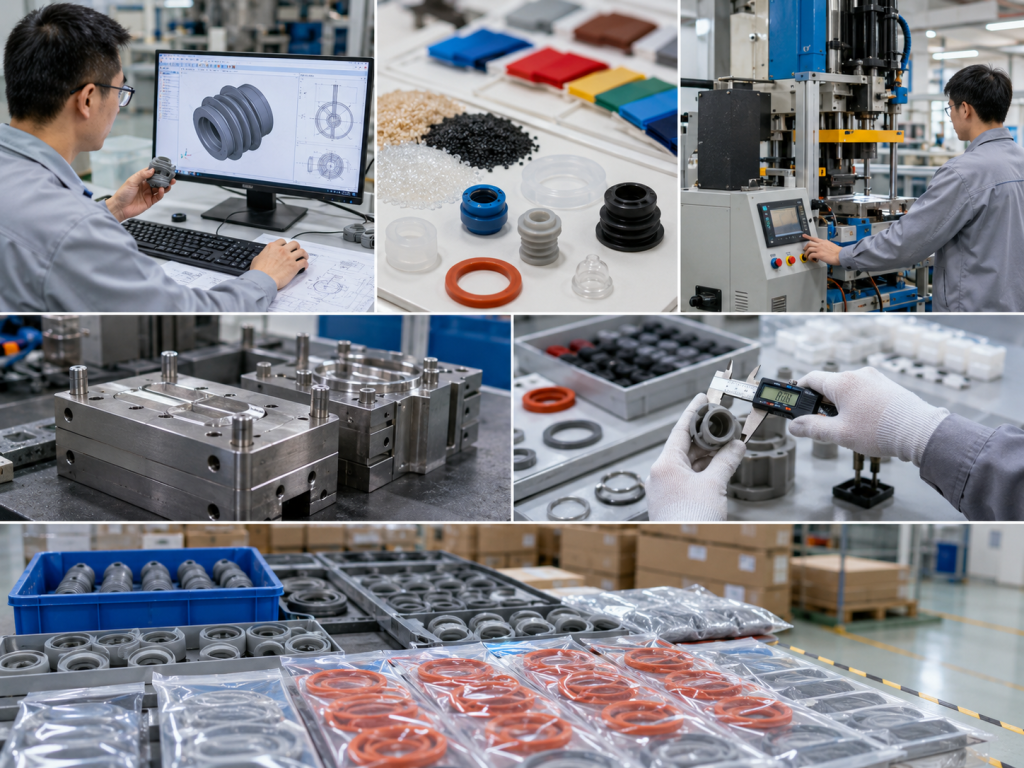
1. Product Idea and Application Requirement
Every custom silicone project starts with a product idea or application requirement. Before mold development, the manufacturer needs to understand how the silicone part will be used.
Important questions include:
- Is the product used for baby care, medical devices, electronics, automotive, kitchenware, or industrial sealing?
- Does the product need to contact food, skin, water, chemicals, or high temperature?
- Is the silicone part used for sealing, protection, cushioning, insulation, gripping, or decoration?
- Will the part be assembled with plastic, metal, glass, or electronic components?
- Is the product for one-time use, repeated use, or long-term outdoor use?
The application determines the material grade, hardness, structure, tolerance, surface finish, and testing requirements.
2. Drawing, 3D File, or Sample Review
After the basic requirement is clear, the next step is design review. Buyers usually provide one or more of the following files:
- Bản vẽ 2D
- Tệp 3D
- Product sample
- Concept sketch
- Assembly drawing
- Material specification
- Reference photo
A professional silicone manufacturer will review the design from a manufacturing point of view. This step is very important because some designs may look good on paper but may not be easy to mold or assemble.
During design review, engineers usually check:
| Review Item | Why It Matters |
|---|---|
| Product size | Affects mold design, material flow, and production cost |
| Độ dày thành | Uneven thickness may cause deformation or curing problems |
| Parting line | Affects appearance and flash control |
| Tolerance | Determines mold precision and inspection method |
| Undercut structure | May require special mold design |
| Assembly area | Must match plastic, metal, or other parts |
| Kết cấu bề mặt | Affects appearance, touch feeling, and demolding |
| Functional area | Must meet sealing, gripping, or protection requirements |
If the design needs improvement, the manufacturer may provide DFM suggestions before tooling.
3. Material Selection
Material selection is one of the most important steps in custom silicone product development. Different applications require different silicone materials.
Common silicone material options include:
- Liquid Silicone Rubber, also called LSR
- High Consistency Rubber, also called HCR
- Food grade silicone
- Medical grade silicone
- Fluorosilicone
- Silicone dẫn điện
- High-temperature resistant silicone
- Transparent silicone
- Colored silicone
For baby products, kitchenware, and drinkware components, food grade silicone is commonly used. For medical device components, medical grade silicone may be required. For automotive and industrial sealing parts, heat resistance, oil resistance, compression set, and aging resistance should be considered.
4. Shore Hardness Confirmation
Silicone hardness is usually measured by Shore A. The correct hardness affects product flexibility, touch feeling, sealing performance, and assembly force.
Typical hardness ranges include:
| Shore Hardness | Typical Feeling | Common Applications |
| 10–30 Shore A | Very soft and flexible | Baby products, soft valves, cushions |
| 30–50 Shore A | Medium soft | Seals, covers, grips, feeding products |
| 50–70 Shore A | Firmer | Industrial parts, gaskets, protective components |
| 70+ Shore A | Harder silicone | Structural silicone parts, wear-resistant parts |
If the hardness is too soft, the part may deform easily. If it is too hard, assembly or sealing performance may be affected. For custom projects, sample testing is often recommended before final confirmation.
5. Mold Design and Tooling Development
Once the product design and material are confirmed, the mold design can begin. Silicone mold design affects production efficiency, product appearance, tolerance control, flash level, and mold lifetime.
The mold engineer needs to consider:
- Bố trí khoang
- Gate position
- Venting design
- Parting line
- Shrinkage rate
- Demolding method
- Insert positioning
- Flash control
- Kết cấu bề mặt
- Mold steel selection
For LSR injection molding, the mold design is usually more complex because it may require cold runner systems, accurate material flow control, and automatic demolding design. For compression molding, the mold structure is usually simpler, but flash control and manual operation must still be considered.
6. Prototype or First Sample Production
After the mold is finished, the first sample production begins. This stage is used to check whether the actual molded product matches the drawing and functional requirements.
The first samples are usually checked for:
- Kích thước
- Appearance
- Màu sắc
- Độ cứng
- Flash level
- Bề mặt hoàn thiện
- Assembly fit
- Hiệu suất làm kín
- Phục hồi đàn hồi
- Functional performance
If the sample does not meet the requirement, adjustments may be needed. These adjustments may include mold modification, material change, process parameter optimization, or product design improvement.
7. Sample Testing and Approval
Sample approval is a critical step before mass production. Buyers should not approve a silicone product only by appearance. Functional testing is more important, especially for sealing parts, baby products, medical components, and electronic protection parts.
Common testing items include:
| Test Item | Purpose |
| Kiểm tra kích thước | Confirms size and tolerance |
| Hardness test | Checks silicone flexibility |
| Tensile and elongation test | Evaluates mechanical performance |
| Compression set test | Important for sealing parts |
| Aging test | Checks long-term durability |
| Heat resistance test | Important for automotive and industrial use |
| Food-contact test | Important for baby and kitchen products |
| Assembly test | Confirms fit with other components |
| Leakage test | Important for seals, valves, and waterproof parts |
Only after sample approval should the project move to mass production.
8. Pre-Production Preparation
Before bulk production, the manufacturer needs to prepare materials, production documents, inspection standards, packaging requirements, and production schedule.
Pre-production preparation usually includes:
- Confirming final drawing version
- Confirming approved sample
- Preparing raw silicone material
- Preparing color masterbatch if needed
- Setting molding parameters
- Preparing inspection tools
- Creating quality control documents
- Confirming packaging method
- Confirming label and carton information
- Arranging production timeline
This step helps avoid confusion during mass production.
9. Mass Production
During mass production, stable process control is essential. Silicone molding requires control of material mixing, temperature, pressure, curing time, mold condition, and operator handling.
For LSR injection molding, important process factors include:
- Mixing ratio of two-component LSR
- Áp suất phun
- Nhiệt độ khuôn
- Curing time
- Material flow
- Demolding stability
- Automatic trimming if applicable
For compression molding, important process factors include:
- Material charge weight
- Nhiệt độ khuôn
- Compression pressure
- Curing time
- Manual placement accuracy
- Flash trimming quality
A reliable manufacturer should monitor production quality throughout the process, not only inspect products after production is finished.
10. Quality Inspection
Quality inspection ensures that the final silicone parts meet the approved standard. Inspection can be done during production and after production.
Common inspection methods include:
- Kiểm tra ngoại quan
- Đo kích thước
- Thử nghiệm độ cứng
- Color comparison
- Flash inspection
- Kiểm thử chức năng
- Kiểm tra lắp ráp
- Random sampling inspection
- Kiểm tra bao bì
For critical silicone components, a quality report can be provided according to customer requirements.
11. Surface Treatment, Post-Processing, and Assembly
Some silicone products require post-processing after molding. Depending on product requirements, post-processing may include:
- Flash trimming
- Secondary curing
- Surface cleaning
- Printing
- Laser marking
- Surface coating
- Assembly with plastic or metal parts
- Packaging into retail or industrial packaging
For baby products, medical components, and food-contact silicone products, cleanliness during post-processing and packaging is especially important.
12. Packaging and Delivery
Packaging should protect the silicone parts from dust, deformation, contamination, and damage during transportation.
Packaging options may include:
- Đóng gói số lượng lớn
- Individual polybag packaging
- Tray packaging
- Bao bì bán lẻ theo yêu cầu
- Carton packaging
- Export packaging
For soft silicone parts, packaging design should avoid long-term compression or deformation. For transparent silicone parts, dust and scratch protection should also be considered.
Key Factors That Affect Custom Silicone Product Cost
The cost of a custom silicone product is influenced by many factors, including:
- Product size
- Product weight
- Silicone material grade
- Product structure complexity
- Mold cavity number
- Yêu cầu về dung sai
- Surface finish requirement
- Production quantity
- Yêu cầu kiểm thử
- Phương pháp đóng gói
- Whether overmolding is required
A simple silicone part may have a low mold and production cost. A complex LSR overmolded component with tight tolerance and high cleanliness requirements will usually cost more.
Information Buyers Should Provide Before Quotation
To get a more accurate quotation, buyers should provide as much information as possible.
Recommended information includes:
- Product drawing or 3D file
- Product sample or reference photo
- Yêu cầu về vật liệu
- Shore hardness requirement
- Yêu cầu về màu sắc
- Quantity requirement
- Môi trường ứng dụng
- Yêu cầu về dung sai
- Tiêu chuẩn thử nghiệm
- Yêu cầu về bao bì
- Target delivery time
- Whether food grade or medical grade material is needed
The more complete the information, the faster and more accurate the project evaluation will be.
Common Mistakes in Custom Silicone Product Development
Many project delays happen because important details are not confirmed early enough. Common mistakes include:
- Starting mold development before confirming product function
- Choosing hardness only by feeling instead of application requirement
- Ignoring tolerance and assembly fit
- Using ordinary silicone for food-contact or baby products
- Not considering shrinkage during design
- Ignoring flash and parting line location
- Approving samples without functional testing
- Not confirming packaging before mass production
Avoiding these mistakes can save time and reduce unnecessary mold modification costs.
Kết luận
Developing a custom silicone product from drawing to mass production requires more than simple molding. It involves product design review, material selection, hardness confirmation, mold development, sampling, testing, production control, inspection, packaging, and delivery.
For buyers, a clear development process helps reduce risk and improve product success. For manufacturers, good communication and engineering support are essential to deliver stable, high-quality silicone products.
Whether you are developing baby silicone products, medical silicone components, automotive connector seals, electronic protection parts, or silicone overmolded assemblies, working with an experienced silicone manufacturer can make the project smoother from concept to mass production.
Câu hỏi thường gặp
1. What files are needed to develop a custom silicone product?
A 2D drawing, 3D file, product sample, or reference photo can be used. For accurate quotation and mold development, 2D and 3D drawings are recommended.
2. How long does it take to develop a custom silicone mold?
The lead time depends on product complexity, mold structure, and production process. Simple molds may be faster, while complex LSR injection molds or overmolding molds usually need more time.
3. Can silicone products be customized in different colors?
Yes. Silicone products can be customized in different colors according to customer requirements. Color matching can be done based on Pantone number or physical sample.
4. What is the best silicone material for baby products?
Food grade silicone or suitable baby-safe silicone material is commonly used for baby products such as teethers, feeding parts, and soft-touch components.
5. Can silicone be molded over plastic or metal parts?
Yes. LSR overmolding can be used to mold silicone over plastic, metal, cable assemblies, and other components. The bonding design, material compatibility, and mold structure must be evaluated carefully.
 English
  Japanese
  Korean
  German
  French
  Italian
  Spanish
  Dutch
Dutch  Chinese
  Portuguese
  Polish
  Czech
Czech  Hungarian
  Swedish
  Finnish
  Vietnamese
  Thai
Thai  Turkish
  Arabic
  Russian