
For startups developing new products, choosing the right manufacturing partner is often one of the most critical decisions during the product development journey. Whether developing a medical device, wearable product, consumer electronics accessory, baby care product, or industrial component, silicone materials are increasingly becoming a preferred solution because of their flexibility, durability, safety, and excellent environmental resistance.
However, transforming an innovative idea into a commercially successful silicone product requires more than simply selecting a silicone material. Startups need to understand the complete manufacturing process, including material selection, prototype development, mold design, testing, and mass production.
This article provides a comprehensive guide to custom silicone manufacturing for startups, explaining how products move from initial concepts to full-scale production.
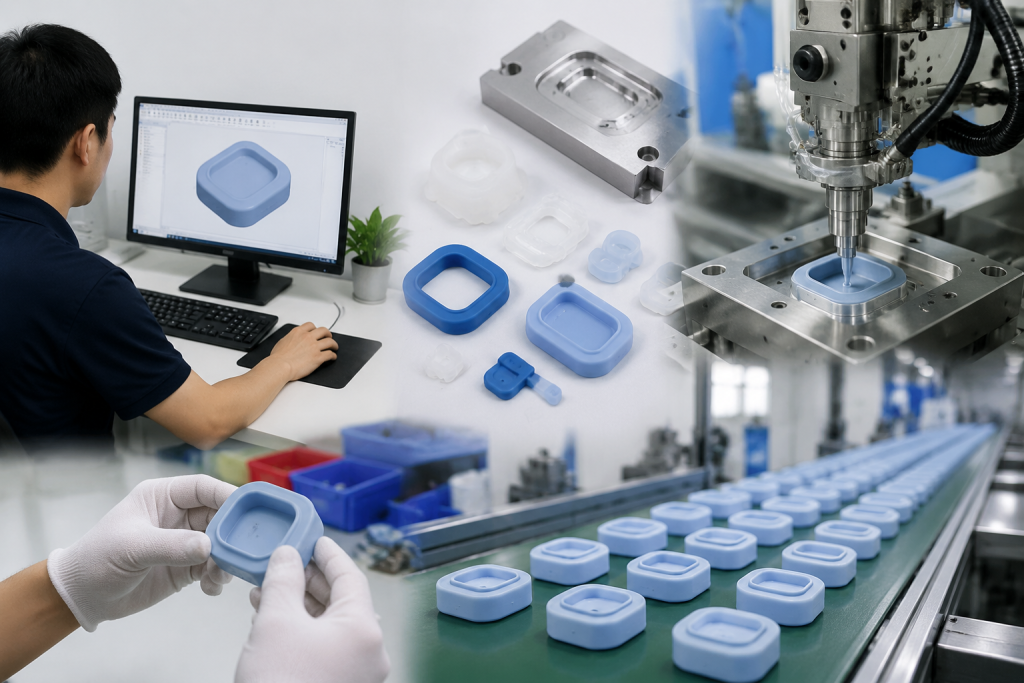
1. Why Startups Choose Custom Silicone Products
Silicone is a highly versatile elastomer used across many industries because it combines excellent physical properties with manufacturing flexibility.
Compared with traditional plastic or rubber materials, silicone provides several advantages:
1.1 Excellent Flexibility and Elasticity
Silicone can repeatedly deform and return to its original shape without permanent damage.
This makes it suitable for:
- Wearable devices
- Medical components
- Sealing products
- Flexible consumer products
1.2 Temperature Resistance
Silicone maintains stable performance under extreme temperatures.
Typical silicone working range:
- Khoảng từ -50°C đến +200°C
Special silicone formulations can withstand even higher temperatures.
Các ứng dụng bao gồm:
- Automotive components
- Industrial seals
- Semiconductor equipment parts
1.3 Safety and Biocompatibility
Medical-grade and food-grade silicone materials can meet strict safety requirements.
Common applications:
- Sản phẩm dành cho trẻ sơ sinh
- Ống y tế
- Healthcare components
- Food-contact products
Important certifications may include:
- FDA compliance
- ISO 10993
- USP Class VI
1.4 Custom Design Possibilities
Silicone manufacturing allows startups to create unique products with:
- Custom shapes
- Different hardness levels
- Multiple colors
- Textured surfaces
- Integrated functions
This flexibility helps startups create differentiated products in competitive markets.
2. The Complete Process of Custom Silicone Manufacturing
A professional silicone manufacturing process usually includes several key stages.
Stage 1: Product Concept and Design
Every silicone product starts with an idea.
At this stage, startups usually provide:
- Product sketches
- 3D models
- Reference samples
- Functional requirements
Manufacturers evaluate:
- Material feasibility
- Production method
- Mold structure
- Estimated cost
Early communication between designers and manufacturers helps avoid expensive design changes later.
Stage 2: Material Selection
Choosing the correct silicone material is essential because different applications require different performance characteristics.
Liquid Silicone Rubber (LSR)
LSR is widely used for precision manufacturing.
Ưu điểm:
- High consistency
- Excellent dimensional accuracy
- Clean production
- Suitable for automation
Ứng dụng:
- Medical parts
- Sản phẩm dành cho trẻ sơ sinh
- Linh kiện điện tử
High Consistency Rubber (HCR)
HCR silicone is supplied in solid form.
Ưu điểm:
- Good mechanical strength
- Suitable for larger parts
- Cost-effective for certain applications
Ứng dụng:
- Industrial seals
- Large silicone components
Silicone Hardness Selection
Silicone hardness is generally measured by Shore A.
Typical choices:
| Độ cứng | Ứng dụng |
|---|---|
| Shore A 10-30 | Soft baby products, flexible parts |
| Shore A 30-60 | General consumer products |
| Shore A 60-80 | Industrial components |
Selecting the correct hardness affects:
- Cảm giác khi sử dụng sản phẩm
- Độ bền
- Hiệu suất làm kín
3. Prototype Development: Turning Ideas into Real Products
Before investing in mass production tooling, startups usually need prototypes.
Prototype development helps verify:
- Product appearance
- User experience
- Functionality
- Hiệu suất lắp ráp
Common prototype methods include:
3D Printed Models
Used for:
- Shape verification
- Design evaluation
Ưu điểm:
- Fast
- Low cost
Limitations:
- Usually cannot fully represent silicone properties
Silicone Prototype Molding
For functional testing, silicone prototypes are preferred.
They can evaluate:
- Softness
- Elasticity
- Grip feeling
- Hiệu suất làm kín
This step is especially important for:
- Medical devices
- Wearable products
- Consumer products
4. Mold Design and Tooling
The mold is one of the most important investments in silicone manufacturing.
A well-designed mold determines:
- Product quality
- Hiệu quả sản xuất
- Manufacturing cost
Important mold design considerations include:
Parting Line Design
The mold separation line should minimize:
- Flash
- Visible marks
- Post-processing requirements
Venting System
Proper ventilation allows trapped air to escape during molding.
Poor venting may cause:
- Air bubbles
- Điền thông tin chưa đầy đủ
- Các khuyết tật bề mặt
Gate Design
The injection gate controls how silicone flows into the mold cavity.
Correct gate design improves:
- Material distribution
- Chất lượng bề mặt
- Độ chính xác về kích thước
5. Low Volume Production for Startup Testing
Many startups do not immediately require thousands of pieces.
A flexible silicone manufacturer should support:
- Prototype quantities
- Small batch production
- Market testing orders
Ưu điểm:
- Lower initial investment
- Faster product validation
- Reduced inventory risk
This approach allows startups to collect customer feedback before large-scale production.
6. Transition from Prototype to Mass Production
Once the product design is validated, production can move to the next stage.
Mass production requires:
Production Process Optimization
Manufacturers improve:
- Cycle time
- Material usage
- Quality consistency
Quality Control System
Professional silicone manufacturers inspect:
Dimensional Accuracy
Using:
- Calipers
- Optical measurement equipment
- CMM systems
Material Performance
Testing includes:
- Độ cứng
- Độ bền kéo
- Độ biến dạng vĩnh viễn do nén
- Aging resistance
Appearance Inspection
Checking:
- Các khuyết tật bề mặt
- Độ đồng nhất về màu sắc
- Flash control
7. Common Challenges Startups Face in Silicone Manufacturing
Challenge 1: High Initial Mold Cost
Silicone molds require precision machining.
Solutions:
- Optimize product design early
- Start with prototype validation
- Choose experienced manufacturers
Challenge 2: Selecting the Wrong Silicone Material
Different applications require different silicone formulations.
Ví dụ:
Medical products require:
- Tính tương thích sinh học
- Khả năng kháng tiệt trùng
Consumer products require:
- Soft touch
- Color appearance
Challenge 3: Maintaining Quality During Scaling
A prototype may work perfectly, but mass production introduces new challenges.
Important factors:
- Process control
- Material consistency
- Operator training
8. How Startups Should Choose a Custom Silicone Manufacturer
When evaluating suppliers, startups should consider:
8.1 Engineering Support
A good supplier should provide:
- Design suggestions
- Material recommendations
- Mold optimization
8.2 Manufacturing Capability
Check whether the manufacturer has:
- Thiết bị ép phun LSR
- Silicone compression molding capability
- In-house tooling capability
8.3 Industry Experience
Experience matters, especially for regulated industries.
Ví dụ:
Medical silicone suppliers should understand:
- Clean production requirements
- Documentation
- Traceability
8.4 Flexible Production Support
Startup-friendly manufacturers should support:
- Phát triển nguyên mẫu
- Small batch production
- Large-scale manufacturing
9. Applications of Custom Silicone Manufacturing
Custom silicone products are widely used in:
Medical Industry
Ví dụ:
- Đầu nối y tế
- Van silicon
- Cable overmolding components
Baby Products
Ví dụ:
- Đồ chơi cho trẻ mọc răng
- Phụ kiện cho ăn
- Silicone nipples
Electronics
Ví dụ:
- Vỏ bảo vệ
- Miếng đệm chống thấm nước
- Wearable components
Automotive
Ví dụ:
- Sealing parts
- Bảo vệ cảm biến
- Cable protection components
Sports and Consumer Products
Ví dụ:
- Fitness accessories
- Massage products
- Ergonomic grips
Kết luận
Custom silicone manufacturing provides startups with the opportunity to transform innovative ideas into reliable commercial products. From material selection and prototype development to mold design and mass production, every stage directly influences product quality, cost, and market success.
Choosing an experienced silicone manufacturing partner allows startups to reduce development risks, shorten time-to-market, and create products with competitive advantages.
With the increasing demand for safer, more durable, and highly customized products, silicone manufacturing will continue to play an important role in the future of product innovation.
 English
  Japanese
  Korean
  German
  French
  Italian
  Spanish
  Dutch
Dutch  Chinese
  Portuguese
  Polish
  Czech
Czech  Hungarian
  Swedish
  Finnish
  Vietnamese
  Thai
Thai  Turkish
  Arabic
  Russian