
1. Giới thiệu
Complex silicone parts are widely used in industries such as medical devices, automotive systems, consumer electronics, and industrial sealing applications. Unlike standard silicone products, complex silicone components often involve:
- Tích hợp đa vật liệu
- Overmolding structures
- Tight dimensional tolerances
- Functional sealing or mechanical performance requirements
Manufacturing such parts requires a combination of material science, precision engineering, mold design, and process control.
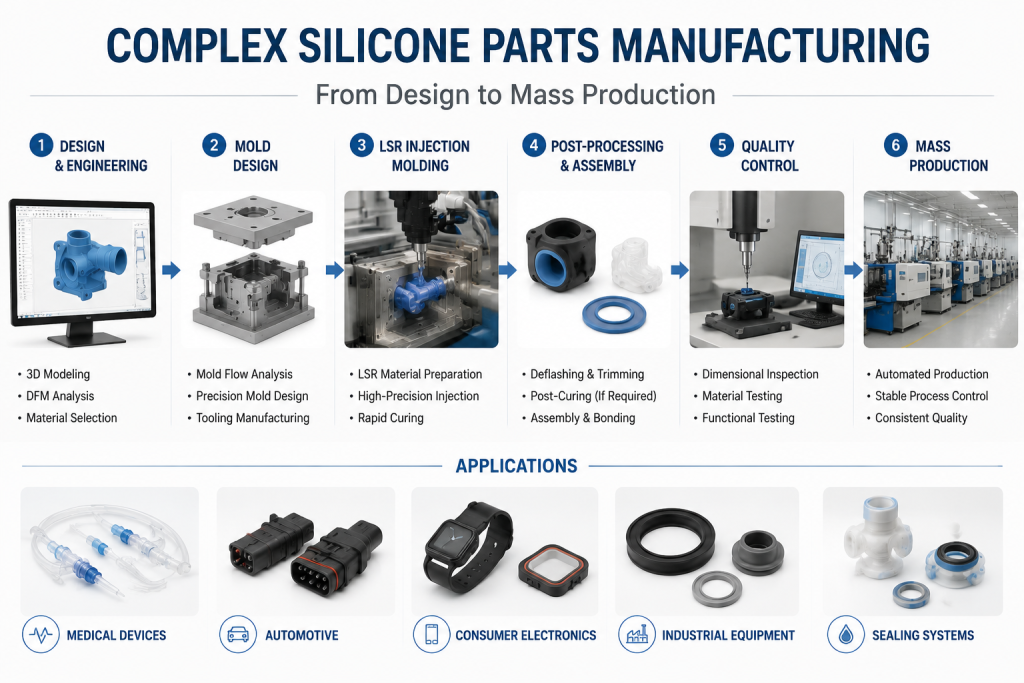
2. What Are Complex Silicone Parts?
Complex silicone parts refer to silicone components that include:
- Multi-cavity or multi-functional structures
- Embedded metal or plastic inserts
- High-precision sealing geometries
- Thin-wall or micro-scale features
- Multi-material bonding (LSR + PC/PA/metal)
Typical examples include:
- Medical sealing assemblies
- Automotive sensor connectors
- Electronic waterproof housings
- Precision valve systems
- Wearable device components
3. Design Stage: Engineering for Manufacturability (DFM)
3.1 Functional Design
At the design stage, engineers must clearly define:
- Mechanical function (seal, buffer, support, insulation)
- Environmental requirements (temperature, pressure, chemicals)
- Life cycle expectations
3.2 Geometry Optimization
Key design rules include:
- Uniform wall thickness to avoid shrinkage deformation
- Rounded corners to reduce stress concentration
- Proper draft angles for demolding
- Controlled undercut structures for sealing performance
3.3 Material Selection
Common silicone materials:
- LSR (Liquid Silicone Rubber) – high precision injection molding
- HCR (High Consistency Rubber) – compression molding
- Platinum-cured silicone – medical and high-purity applications
4. Mold Design and Tooling
Mold design is the core of complex silicone manufacturing.
4.1 Key Mold Features
- Multi-cavity precision molds
- Hot runner LSR injection systems
- Venting channels for air release
- High-precision alignment systems
4.2 Overmolding Tool Design
For silicone + insert structures:
- Metal or plastic inserts must be precisely positioned
- Surface treatment may be required for bonding
- Mold must support chemical or mechanical adhesion zones
5. LSR Injection Molding Process
LSR injection molding is the most widely used process for complex silicone parts.
Bước 1: Chuẩn bị nguyên liệu
- Two-component LSR mixing
- Pigment dosing (if required)
- Degassing to remove air bubbles
Step 2: Injection
- High-precision metering system
- Controlled temperature injection into mold cavity
Step 3: Curing
- Rapid crosslinking at elevated temperature
- Cycle time typically 30–120 seconds
Step 4: Demolding
- Automated or semi-automated removal
- Minimal deformation due to elastic recovery
6. Post-Processing and Secondary Operations
Depending on application, additional steps may include:
- Post-curing (medical or low-odor requirements)
- Surface treatment (plasma, coating)
- Assembly with metal or plastic components
- Kiểm thử chức năng
7. Quality Control in Mass Production
High-quality complex silicone parts require strict QC systems:
7.1 Dimensional Inspection
- CMM measurement
- Optical scanning systems
7.2 Material Testing
- Hardness (Shore A)
- Độ bền kéo
- Khả năng chống rách
7.3 Functional Testing
- Leakage test
- Pressure resistance
- Fatigue cycling
8. Common Manufacturing Challenges
8.1 Flash Defects
Caused by:
- Poor mold sealing
- Excess injection pressure
8.2 Bonding Failure (Overmolding)
- Ô nhiễm bề mặt
- Incompatible materials
- Insufficient surface activation
8.3 Shrinkage and Deformation
- Uneven wall thickness
- Improper curing parameters
9. Applications of Complex Silicone Parts
Complex silicone components are widely used in:
Medical Industry
- Catheter assemblies
- Sealing systems
- Drug delivery components
Automotive Industry
- Waterproof connectors
- Sensor sealing systems
- Vibration damping components
Electronics Industry
- Waterproof housings
- Flexible sealing interfaces
- Wearable device components
Industrial Equipment
- Valve systems
- High-pressure seals
- Chemical-resistant components
10. Future Trends
The industry is moving toward:
- Micro-precision LSR molding
- Multi-material integration (silicone + metal + plastic)
- Smart manufacturing (automated inspection systems)
- High-performance sealing systems for EV and medical sectors
11. Conclusion
Complex silicone parts manufacturing requires full-chain engineering capability—from design optimization and mold development to LSR injection molding and precision quality control.
Manufacturers with strong tooling capability, material expertise, and process control systems can achieve high reliability and scalable mass production for demanding industries.
 English
  Japanese
  Korean
  German
  French
  Italian
  Spanish
  Dutch
Dutch  Chinese
  Portuguese
  Polish
  Czech
Czech  Hungarian
  Swedish
  Finnish
  Vietnamese
  Thai
Thai  Turkish
  Arabic
  Russian