
1. Giriş
Custom silicone baby products have become a key category in global infant care markets. Products such as teethers, feeding accessories, suction bowls, and training cups rely heavily on silicone due to its non-toxic, flexible, and heat-resistant properties.
However, developing high-quality OEM silicone baby products requires more than material selection. It involves engineering design, regulatory compliance, mold development, and controlled manufacturing processes.
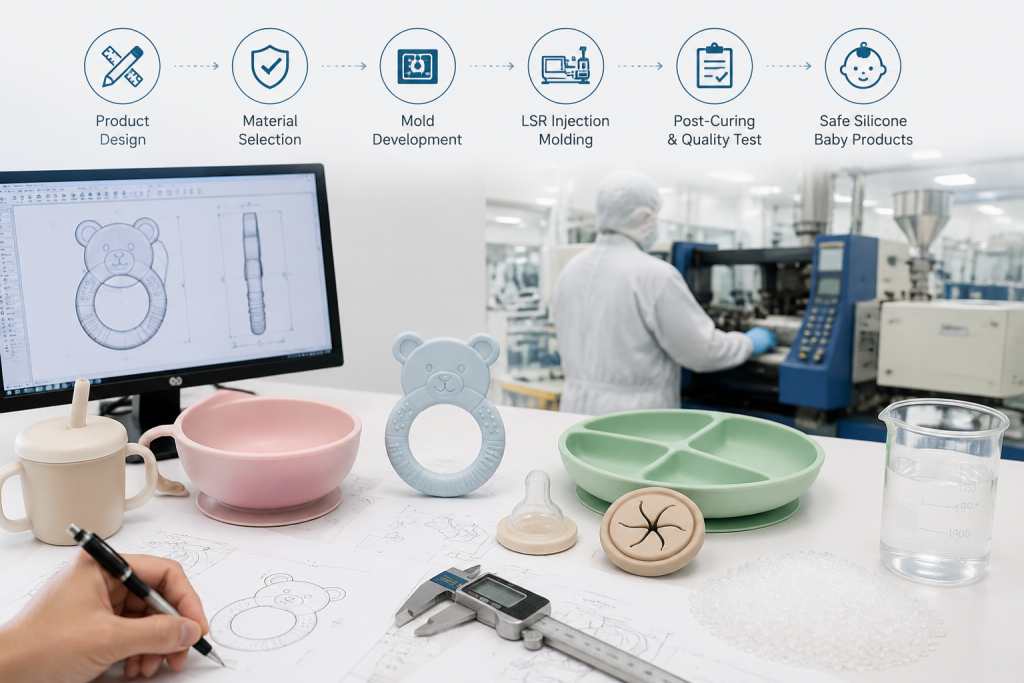
This guide provides a structured overview of how silicone baby products are designed and manufactured for safe and scalable OEM production.
2. Why Silicone Is Ideal for Baby Products
Silicone is widely used in infant applications due to its unique material properties:
- Zehirli değildir ve BPA içermez
- High temperature resistance (-40°C to 200°C)
- Excellent flexibility and tear resistance
- Odorless and chemically stable
- Long-term durability
Among silicone types, platinum-cured liquid silicone rubber (LSR) is preferred for baby products because it offers higher purity and lower extractables compared to peroxide-cured systems.
3. Product Design Considerations
3.1 Safety-Oriented Geometry
Baby products must follow strict anti-risk design principles:
- No sharp edges or burrs
- Anti-choking dimensions
- Rounded transitions
- Flexible deformation zones
For example, teething products must ensure that no detachable small parts exist.
3.2 Ergonomics and Functionality
Design should consider infant usability:
- Easy grip for small hands
- Soft bite resistance for teething comfort
- Hafif yapı
- Multi-texture surfaces for sensory development
3.3 Mold Design Engineering
High-quality silicone products depend on precise mold engineering:
- Uniform wall thickness to prevent deformation
- Proper venting to avoid air traps
- Optimized gate location for LSR flow
- Multi-cavity mold design for mass production
4. Safety Standards and Compliance
Silicone baby products must comply with international regulations.
4.1 FDA (United States)
- Food Contact Material Regulation (21 CFR 177.2600)
- Ensures material safety for repeated food contact
4.2 LFGB (Germany / EU)
- More stringent than FDA
- Includes sensory testing (odor & taste neutrality)
4.3 EN 14350
- Applies to baby drinking equipment
- Focuses on mechanical safety and migration limits
4.4 REACH Compliance
- Restricts hazardous chemical substances in production
A qualified OEM supplier should provide full material traceability and test reports.
5. Üretim Sürecine Genel Bakış
5.1 Raw Material Preparation
- Selection of food-grade platinum silicone
- Mixing with certified pigments (if required)
- Degassing to remove air bubbles
5.2 LSR Enjeksiyon Kalıplama
Liquid Silicone Rubber (LSR) injection molding is the most advanced process:
- High precision cavity filling
- Short curing cycle
- Stable mass production capability
- Minimal material waste
5.3 Son Kürleme Süreci
Post-curing is essential to:
- Remove volatile compounds
- Improve odor neutrality
- Enhance long-term stability
5.4 Quality Control
Typical QC checks include:
- Boyutsal kontrol
- Tensile and tear strength testing
- Migration and safety testing
- Visual surface inspection
6. Common OEM Product Categories
Silicone baby OEM products include:
- Baby teethers
- Feeding bowls and plates
- Training cups
- Bottle nipples and valves
- Silicone bibs
- Bath accessories
Each category requires different hardness, geometry, and structural design.
7. Key Challenges in OEM Development
7.1 Material Inconsistency
Low-grade silicone may lead to:
- Odor issues
- Surface oiling
- Color instability
7.2 Mold Precision
Poor mold design may result in:
- Flashing
- Uneven thickness
- Deformation after curing
7.3 Regulatory Compliance Risks
Failure to meet FDA/LFGB requirements may block market entry.
8. Future Trends in Silicone Baby Products
The industry is moving toward:
- Multi-material overmolding (PP + silicone)
- Smart baby products integration
- Eco-friendly recyclable silicone
- Higher precision LSR automation
OEM manufacturers with engineering capability will have stronger global competitiveness.
9. Conclusion
Custom silicone baby products require a combination of material science, engineering design, regulatory compliance, and controlled manufacturing processes.
For brands and distributors, choosing a reliable OEM partner with LSR molding capability and international certifications is critical to ensuring product safety and market success.
 English
  Japanese
  Korean
  German
  French
  Italian
  Spanish
  Dutch
Dutch  Chinese
  Portuguese
  Polish
  Czech
Czech  Hungarian
  Swedish
  Finnish
  Vietnamese
  Thai
Thai  Turkish
  Arabic
  Russian