
One of the first questions buyers ask when developing a custom silicone rubber product is:
“How much will the mold cost?”
Unfortunately, there is no single standard price.
A simple silicone gasket may require relatively basic tooling, while a precision multi-cavity Liquid Silicone Rubber (LSR) mold for a medical, electronic or automotive component can cost many times more.
Two silicone parts with similar dimensions may even receive dramatically different tooling quotations.
Why?
Because mold cost is determined less by the weight of the silicone part and more by:
- part geometry;
- molding process;
- number of cavities;
- tolerance requirements;
- mold material;
- undercuts;
- inserts;
- surface finish;
- gate and venting design;
- expected production volume;
- automation requirements;
- mold life.
Understanding these factors helps purchasing teams compare quotations more accurately and avoid paying for tooling features that the project does not actually need.
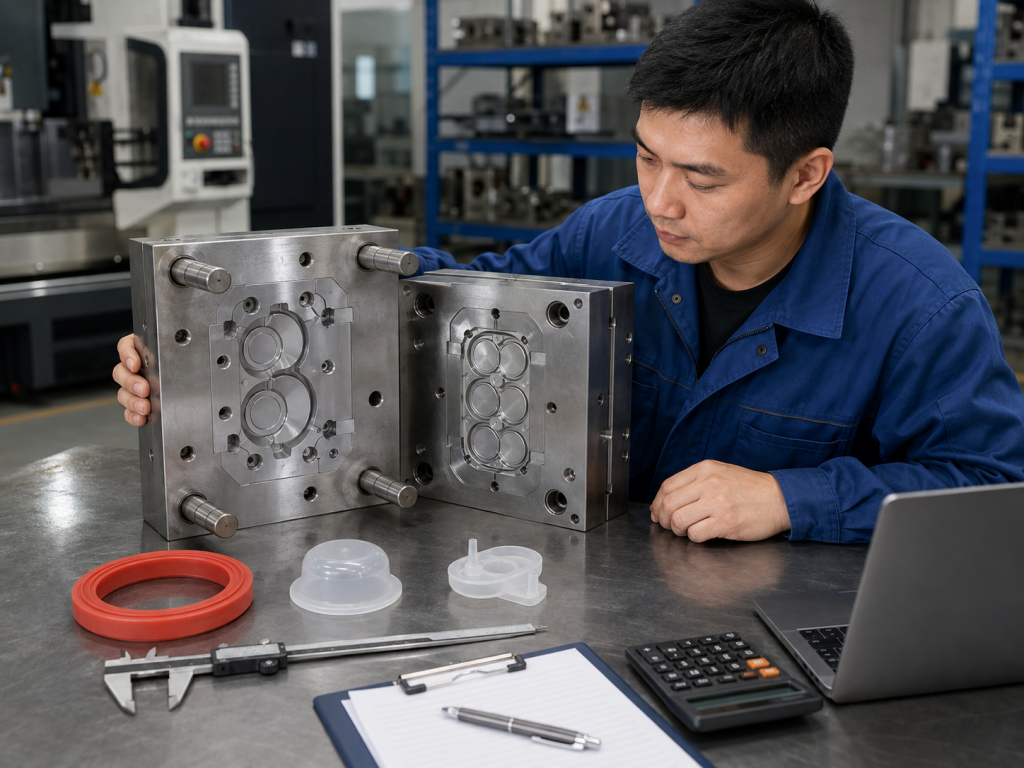
What Is Included in a Silicone Mold Cost?
When a supplier quotes a custom silicone mold, the price normally includes more than a block of machined steel.
Tooling development may involve:
- DFM review;
- mold structure design;
- shrinkage compensation;
- CNC machining;
- EDM machining;
- mold inserts;
- core pins;
- mold polishing;
- vent design;
- gate design;
- mold assembly;
- trial molding;
- initial dimensional inspection;
- mold adjustment.
For complex projects, tooling may also require:
- sliders;
- removable inserts;
- vacuum systems;
- cold-runner systems;
- automated demolding;
- precision temperature control;
- multi-cavity balancing.
This is why asking only for the mold dimensions is not enough to estimate tooling cost.
How Much Does a Custom Silicone Mold Typically Cost?
There is no universal price table, but buyers can think about silicone tooling in several broad categories.
| Tooling Type | Relative Cost |
|---|---|
| Simple prototype compression mold | Low |
| Single-cavity production compression mold | Low to moderate |
| Multi-cavity compression mold | Moderate |
| Simple LSR injection mold | Moderate |
| Precision multi-cavity LSR mold | Elevado |
| LSR mold with cold runner and automation | High to very high |
| Silicone overmolding tool with complex inserts | Moderate to high |
| Medical or high-volume precision production tool | Elevado |
As a general sourcing principle:
simple geometry + single cavity + moderate tolerance = lower tooling cost
while:
complex geometry + multiple cavities + tight tolerance + automation = higher tooling cost.
Published commercial molding services also show how wide this range can become. Tooling can begin in the low-thousands-of-dollars range for relatively straightforward projects, while more complex production injection molds may cost many thousands or substantially more depending on production requirements.
The only reliable way to determine the final cost is to review the actual CAD model and drawing.
1. Compression Molding vs LSR Injection Molding
The molding process is one of the biggest factors affecting tooling cost.
Moldagem por compressão
Compression molding commonly uses a relatively simple mold construction.
Uncured silicone material is placed into the mold cavity, the mold closes under pressure, and the material cures under heat.
It is frequently suitable for:
- silicone gaskets;
- seals;
- industrial rubber parts;
- larger silicone components;
- lower production volumes;
- simple custom products.
Because the tooling architecture can be simpler, compression molds are often less expensive than sophisticated LSR injection molds.
However, this does not mean every compression mold is cheap.
Complex shapes, high cavity counts and tight flash requirements can still make compression tooling expensive.
Moldagem por injeção de LSR
Liquid Silicone Rubber injection molding requires a more controlled tooling system.
Typical tooling considerations include:
- precision cavity machining;
- controlled gating;
- very precise mold shut-offs;
- venting;
- material feed design;
- temperature management;
- automated demolding.
For higher production requirements, molds may use cold-runner systems.
LSR has very low viscosity before curing and can flow into extremely small mold gaps.
This means tooling surfaces and shut-offs often require excellent precision to prevent unwanted flash.
As a result, an LSR mold will frequently cost more than a simple compression mold for the same basic component.
However, LSR can provide significant advantages for:
- automation;
- high-volume production;
- repeatability;
- complex small components;
- medical parts;
- electronic seals;
- precision molded components.
The correct comparison should therefore not be based only on tooling cost.
Buyers should compare:
tooling cost + part cost + production volume + quality requirements.
2. Part Size
Larger silicone parts generally require larger molds.
A larger mold means:
- more mold steel;
- longer CNC machining time;
- larger molding equipment;
- greater clamping requirements;
- more complicated temperature management.
For example, tooling for a small silicone valve may be significantly cheaper than tooling for a large:
- enclosure gasket;
- industrial membrane;
- silicone protective cover;
- large molded sheet.
However, size alone does not determine cost.
A small medical silicone component with extremely tight tolerances may require much more sophisticated tooling than a large simple gasket.
3. Part Geometry
Geometry is one of the most important tooling cost drivers.
A simple flat gasket with basic through-holes may be relatively easy to mold.
A component containing:
- deep cavities;
- thin membranes;
- complex ribs;
- internal channels;
- multiple sealing lips;
- varying wall thickness;
- difficult demolding features
requires more tooling engineering.
More complicated geometry generally means:
- more machining;
- more inserts;
- more EDM work;
- more mold fitting;
- more trial adjustments.
Therefore, simplifying the part geometry during DFM can directly reduce tooling investment.
4. Undercuts Increase Mold Cost
Undercuts prevent the component from being removed directly from the mold.
Entre os exemplos típicos contam-se:
- internal hooks;
- reverse grooves;
- side holes;
- locking features;
- internal retention lips.
These features may require:
- sliders;
- side actions;
- collapsible cores;
- removable inserts;
- manual demolding.
Every additional mold mechanism adds:
- machining cost;
- assembly complexity;
- maintenance requirements;
- cycle time.
Published injection molding design guidance similarly identifies undercuts and additional side actions as significant contributors to tooling cost.
Before approving an undercut, ask:
Does this feature really need to be molded into the silicone part?
Sometimes a small design modification can eliminate an expensive mold mechanism.
5. Number of Mold Cavities
Cavity count has a major impact on tooling cost.
Single-Cavity Mold
One molding cycle produces one component.
Vantagens:
- lower initial tooling cost;
- easier mold development;
- easier dimensional correction;
- suitable for prototypes and lower volumes.
Disadvantage:
- higher unit manufacturing cost at large volumes.
Multi-Cavity Mold
A four-cavity mold produces four components during one cycle.
An eight-cavity mold produces eight.
This increases mold productivity and can reduce unit cost.
However, multi-cavity tooling requires:
- additional cavity machining;
- cavity-to-cavity consistency;
- balanced material flow;
- more complex runner design;
- larger tooling;
- more inspection.
Therefore:
higher cavity count normally means higher mold cost but lower unit cost.
This is a classic tooling trade-off.
Example: 1-Cavity vs 8-Cavity Mold
Imagine a buyer needs a small silicone seal.
Option A
1-cavity mold
Lower mold investment
Higher piece price
Suitable for 5,000 pieces/year
Option B
8-cavity mold
Higher mold investment
Much higher productivity
Lower piece price
Potentially better for 500,000 pieces/year
Choosing the cheapest mold in this situation may actually increase the total purchasing cost over the life of the project.
6. Expected Production Volume
Buyers should tell the supplier the expected annual quantity before tooling is designed.
Por exemplo:
5,000 pieces/year
and:
5,000,000 pieces/year
should probably not use the same tooling strategy.
Low-volume projects may prioritize:
- lower mold cost;
- fewer cavities;
- simpler tooling.
High-volume projects may justify:
- hardened mold materials;
- additional cavities;
- automation;
- cold-runner systems;
- higher mold-life requirements.
A more expensive mold can therefore produce a lower total cost of ownership.
7. Mold Material
The mold itself can be manufactured from different materials or steel grades.
The appropriate choice depends on:
- production quantity;
- precision;
- mold life;
- surface requirement;
- molding temperature;
- maintenance strategy.
Prototype tooling may prioritize speed and lower cost.
Long-term production tooling may prioritize:
- hardness;
- wear resistance;
- dimensional stability;
- repairability.
Higher-quality mold materials increase initial investment but can reduce long-term maintenance and replacement costs.
8. Silicone Shrinkage Compensation
Silicone changes dimension during:
- curing;
- cooling;
- post-curing.
Therefore, the mold cavity cannot always simply copy the finished CAD dimensions.
Tool designers must account for silicone shrinkage.
Actual shrinkage depends on:
- silicone formulation;
- hardness;
- filler system;
- curing process;
- temperature;
- geometry;
- post-curing.
For ordinary components, standard shrinkage compensation may be sufficient.
For highly precise silicone products, manufacturers may need to:
- manufacture the initial mold;
- mold trial samples;
- measure critical dimensions;
- adjust inserts;
- mold another sample batch.
This additional engineering work increases tooling cost.
9. Dimensional Tolerance
Tighter tolerances usually mean more expensive tooling.
For example, a drawing with general tolerances such as:
±0.30 mm
may be easier to manufacture than a drawing where every dimension is specified as:
±0.05 mm.
Tight-tolerance molds may require:
- higher machining precision;
- additional EDM;
- precision inserts;
- additional mold fitting;
- more trial runs;
- cavity correction;
- more detailed inspection.
This is why buyers should avoid applying extremely tight tolerances to every dimension.
Identify only the dimensions that actually affect:
- assembly;
- sealing;
- positioning;
- product performance.
Use normal molded silicone tolerances for other features.
10. Flash Tolerance
Flash requirements also influence tooling cost.
A general industrial silicone component may tolerate a small amount of residual flash around non-critical edges.
A precision valve or medical silicone component may require much tighter flash control.
Low-viscosity LSR can enter extremely small gaps between mold surfaces.
Achieving very low flash therefore requires:
- extremely precise mold shut-offs;
- excellent mold flatness;
- controlled vent design;
- accurate clamping;
- good mold maintenance.
A drawing that specifies:
“NO FLASH ANYWHERE”
can substantially increase tooling difficulty.
A better approach is to identify:
- sealing surfaces;
- cosmetic surfaces;
- functional edges.
Then apply tighter flash requirements only where necessary.
11. Surface Finish
Surface finish also affects mold price.
Possible silicone surface requirements include:
- standard machined finish;
- matte finish;
- polished finish;
- high-gloss finish;
- textured finish;
- custom texture.
The finished silicone surface normally reproduces the mold surface.
Therefore, a highly polished silicone component requires a highly finished mold cavity.
Additional:
- polishing;
- texturing;
- surface treatment
adds cost.
If the product will be hidden inside an industrial assembly, paying for a premium cosmetic finish may provide no functional benefit.
12. Cosmetic Requirements
Consumer-facing silicone parts often require much stricter appearance standards than industrial components.
Entre os exemplos contam-se:
- wearable electronics;
- consumer accessories;
- silicone buttons;
- appliance components.
Requirements may include:
- invisible or minimized parting lines;
- hidden gate location;
- uniform texture;
- controlled gate marks;
- strict color consistency.
These requirements influence mold design before machining begins.
Moving the gate or parting line to a hidden area may require a more complicated mold structure.
13. Gate Design
In LSR molding, the gate controls how silicone enters the cavity.
Gate design affects:
- filling;
- appearance;
- flow pattern;
- cycle time;
- gate vestige.
A simple gate may be inexpensive.
A sophisticated runner and gating system may significantly increase mold complexity.
For cosmetic silicone parts, the buyer should clearly identify surfaces where gate marks are prohibited.
14. Cold-Runner Systems
High-volume LSR production may use a cold-runner system.
The purpose is to control the LSR before it enters the heated mold cavities and reduce unnecessary cured material in the runner system.
Os benefícios podem incluir:
- reduced material waste;
- automation;
- improved production efficiency;
- better high-volume economics.
However, cold-runner tooling is significantly more complex than basic mold construction.
It can involve:
- precision nozzles;
- temperature-control systems;
- balancing;
- additional mold components.
For low-volume production, the additional tooling investment may not be economical.
15. Mold Inserts
Sometimes part geometry is best produced using replaceable mold inserts.
This can be useful for:
- critical dimensions;
- different product versions;
- interchangeable features;
- easier mold repair.
Although inserts increase initial mold construction complexity, they can sometimes reduce future modification costs.
For example, if a critical diameter may change after testing, designing that feature into a replaceable insert may be cheaper than modifying the entire mold cavity.
16. Silicone Overmolding
Overmolding silicone onto another component creates additional tooling requirements.
Substrates may include:
- metal;
- stainless steel;
- aluminum;
- thermoplastic;
- electronic components.
The mold must accurately locate the insert while preventing silicone from flowing into unwanted areas.
This may require:
- insert fixtures;
- precision shut-off surfaces;
- additional mold inserts;
- manual loading;
- robotic loading.
Therefore, an overmolding tool generally requires more engineering than a simple standalone silicone component.
17. Insert Position Tolerance
If a metal insert is placed inside the silicone component, its position may be critical.
Por exemplo:
Insert center position ±0.10 mm
may require accurate mold locating features.
Tighter requirements can increase:
- fixture precision;
- tool machining accuracy;
- inspection requirements.
Buyers should include insert tolerances during RFQ rather than adding them after the mold has already been built.
18. Automatic Demolding
Some silicone components naturally release from the mold.
Others require:
- ejector systems;
- air blow;
- robotic handling;
- stripping mechanisms;
- manual removal.
Automation increases initial tooling investment but can substantially reduce production labor for high-volume projects.
The correct choice depends on annual volume.
19. Mold Life
Another important question is:
How many parts must the mold produce?
A prototype tool intended for several thousand components does not necessarily need the same construction as a tool expected to produce millions of components.
Higher mold-life requirements may involve:
- higher-grade steel;
- hardened inserts;
- more durable wear surfaces;
- replaceable components;
- stronger mold construction.
This increases upfront cost but supports longer production life.
20. First Article Inspection and Mold Validation
Tooling quotes may also include different levels of validation.
A basic project may require only sample approval.
A precision project may require:
- dimensional inspection report;
- First Article Inspection;
- cavity-by-cavity inspection;
- material certificate;
- process capability studies;
- PPAP documentation.
These activities are not simply “mold machining.”
They represent additional engineering and quality-control work and may therefore appear as separate charges.
Why Two Suppliers Can Quote Very Different Mold Prices
Suppose Supplier A quotes:
$2,000
while Supplier B quotes:
$6,000
It does not automatically mean Supplier B is overpriced.
The quotations may contain different assumptions.
Supplier A may be offering:
- one cavity;
- simple mold steel;
- manual demolding;
- shorter mold life.
Supplier B may be quoting:
- four cavities;
- higher-grade steel;
- automated demolding;
- tighter flash control;
- longer production life.
Therefore, buyers should compare the tooling specification, not only the tooling price.
Questions Buyers Should Ask When Comparing Mold Quotations
Before selecting a silicone tooling supplier, ask:
What molding process is being quoted?
- compression molding;
- transfer molding;
- LSR injection molding.
How many cavities?
1, 2, 4, 8 or more?
What mold material is used?
Ask whether the tool is designed for prototype or long-term production.
What is the expected mold life?
Understand the expected production quantity.
Is the runner system included?
Especially important for LSR molds.
Is trial molding included?
Clarify how many sample rounds are covered.
Are mold modifications included?
Understand what happens if the first samples require adjustment.
Is dimensional inspection included?
Ask whether an inspection report is included.
Who owns the mold?
The quotation or purchase agreement should state tooling ownership.
Is there a mold maintenance fee?
Some suppliers include routine maintenance while others charge separately.
Where will the mold be stored?
This becomes important for long-term programs.
Mold Ownership Should Be Clear
This is an important commercial issue.
If the buyer pays the full tooling cost, the purchase agreement should clearly define:
- mold ownership;
- storage;
- maintenance;
- repair;
- expected mold life;
- whether the mold can be transferred.
Do not assume these terms are identical between suppliers.
A very inexpensive mold quotation may have different ownership conditions from a higher-priced quotation.
Prototype Mold or Production Mold?
Not every project needs a full production tool immediately.
For early product development, a prototype mold can sometimes be used to validate:
- geometry;
- assembly;
- hardness;
- function;
- sealing;
- customer acceptance.
Once the design is frozen, production tooling can be built.
This approach can reduce the risk of spending heavily on a mold before the product design is finalized.
However, prototype tooling is not always the cheapest option overall.
If the design is mature and high-volume demand is confirmed, going directly to production tooling may be more economical.
How to Reduce Custom Silicone Mold Cost
Several design decisions can significantly reduce tooling investment.
1. Remove Unnecessary Undercuts
Avoid sliders or removable cores whenever possible.
2. Simplify Geometry
Complex internal features increase machining and mold assembly.
3. Use Reasonable Tolerances
Do not specify ±0.05 mm everywhere unless function requires it.
4. Relax Cosmetic Requirements on Hidden Areas
A hidden industrial surface usually does not require premium polishing.
5. Allow Flexible Gate Locations
Let the mold designer choose a practical gate location where appearance is not critical.
6. Avoid Parting-Line Restrictions Everywhere
Specify critical surfaces instead of prohibiting the parting line across the entire component.
7. Choose the Correct Cavity Count
Do not build eight cavities for a project requiring only 2,000 parts.
Likewise, do not select one cavity for a program requiring millions of components without evaluating total production cost.
8. Complete DFM Before Tooling
Design changes are inexpensive in CAD.
They become expensive after steel has been cut.
Cheap Mold vs Low Total Cost
The cheapest mold is not necessarily the least expensive manufacturing solution.
Consider two options.
| Artigo | Tool A | Tool B |
| Tooling investment | Lower | Higher |
| Cavities | 1 | 4 |
| Production speed | Lower | Higher |
| Unit price | Higher | Lower |
| Suitable annual volume | Low | Medium/High |
| Automação | Limited | Better |
If annual demand is very small, Tool A may be the better investment.
If annual demand is several hundred thousand pieces, Tool B may quickly become less expensive overall.
This is why professional sourcing should evaluate:
Total Cost = Tooling Cost + Unit Part Cost × Production Quantity
rather than selecting tooling based only on the lowest initial price.
Example Tooling Decision
Consider a silicone sealing component with projected demand of:
300,000 pieces per year
Two tooling options are offered.
Option 1
Lower-cost 1-cavity tool
Lower initial investment
Higher part cost
Option 2
Higher-cost 4-cavity tool
Higher initial investment
Lower unit cost
For such a project, the additional tooling investment may be recovered through lower production cost.
Now consider the same component with expected demand of:
3,000 pieces per year
The simpler tool may make much more financial sense.
The correct tooling strategy depends on production economics.
What Information Is Needed for an Accurate Silicone Mold Quote?
If you want an accurate quotation, provide:
3D CAD
Preferred formats may include:
- STEP;
- STP;
- IGS;
- X_T.
2D Drawing
Include:
- critical dimensions;
- tolerances;
- surface requirements.
Silicone Material
Specify:
- LSR or HCR;
- food-grade;
- medical-grade;
- industrial silicone;
- flame-retardant requirements if applicable.
Shore Hardness
Por exemplo:
50 ±5 Shore A
Cor
Provide Pantone or physical sample if required.
Quantity
Include:
- prototype quantity;
- first production quantity;
- estimated annual quantity.
Expected Mold Life
Especially for high-volume programs.
Critical Surfaces
Identify:
- sealing areas;
- cosmetic surfaces;
- assembly interfaces.
Flash Requirement
Mark areas requiring strict flash control.
Gate Restrictions
Identify surfaces where gate marks are prohibited.
Overmolding Information
Provide insert drawings and materials.
Example RFQ Information
A useful silicone RFQ might look like this:
Product: Custom Silicone Connector Seal
Material: Platinum-Cured LSR
Dureza: 50 ±5 Shore A
Cor: Preto
Part Weight: 8 g
Critical Tolerance: ±0.10 mm on sealing diameter
General Tolerance: Standard molded silicone tolerance
Annual Quantity: 200,000 pcs
Initial Order: 20,000 pcs
Cosmetic Requirement: Standard industrial
Flash Requirement: No loose flash on sealing surface
Gate: Not permitted on sealing surface
Tooling: Production mold
Inspection: First Article dimensional report required
This information allows the supplier to design an appropriate tooling solution instead of simply estimating from a product photograph.
Red Flags When Comparing Very Cheap Mold Quotations
A very low mold price is not automatically a problem.
But buyers should investigate when important information is missing.
Ask whether the quotation clearly defines:
- mold material;
- cavity count;
- mold life;
- ownership;
- sampling;
- modifications;
- maintenance;
- dimensional inspection.
A low tooling price followed by repeated:
- modification fees;
- maintenance fees;
- sampling charges;
- short mold life
may ultimately cost more than a well-defined production mold.
Silicone Mold Cost Checklist for Buyers
Before approving tooling, confirm:
- Which molding process will be used?
- How many cavities are included?
- What mold material is specified?
- What is the estimated mold life?
- Are sliders or removable inserts required?
- Is a cold-runner system required?
- What is the expected annual volume?
- Are the tolerances realistic?
- Which dimensions are critical?
- What flash tolerance is required?
- Where is the parting line?
- Where is the gate?
- Are cosmetic finishes required?
- Is automatic demolding required?
- Are inserts being overmolded?
- Is first article inspection included?
- How many sample revisions are included?
- Who owns the mold?
- Who pays for future mold maintenance?
- Can the mold be modified if the design changes?
Answering these questions makes tooling quotations much easier to compare.
Conclusão
The cost of a custom silicone mold depends on much more than the size of the finished silicone product.
The main cost drivers include:
molding process, geometry, cavity count, undercuts, tolerance, surface finish, flash requirements, mold material, automation and expected production volume.
For a low-volume industrial silicone component, a relatively simple mold may be the most economical solution.
For a high-volume precision LSR component, investing in a more sophisticated multi-cavity production mold can significantly reduce unit cost and improve production consistency.
The best sourcing strategy is therefore not:
“Find the cheapest silicone mold.”
It is:
“Choose the simplest mold that can reliably meet the required quality and production volume.”
Providing complete CAD files, realistic tolerances and estimated annual quantities during the RFQ stage allows the manufacturer to recommend the most appropriate tooling structure—and prevents expensive mold redesigns later.
Perguntas frequentes
How much does a custom silicone mold cost?
There is no fixed price. Simple silicone tooling may fall into the low-thousands-of-dollars range in some commercial manufacturing programs, while precision multi-cavity LSR production tooling can cost several thousand dollars or substantially more. Geometry, cavity count, tolerance, mold material and production volume determine the final quotation.
Why is an LSR injection mold more expensive?
LSR tooling usually requires precision shut-off surfaces, carefully designed gates and vents, controlled thermal management and, for some production tools, cold-runner or automated systems. This makes the tooling more sophisticated than many basic compression molds.
Is a multi-cavity silicone mold worth the extra cost?
For high-volume production, often yes. More cavities increase initial tooling cost but can significantly increase output and reduce unit manufacturing cost. For low-volume projects, a single-cavity tool may be more economical.
Can I reduce the mold price by relaxing tolerances?
Often yes. Extremely tight tolerances require higher machining precision, additional inspection and sometimes mold corrections after sampling. Applying tight tolerances only to critical functional features can reduce tooling difficulty and cost.
Who owns the silicone mold after I pay for it?
This depends on the supplier agreement. Mold ownership, storage, maintenance, modification rights and transfer conditions should be confirmed before placing the tooling order.
Should I use a prototype mold before production tooling?
For new or unvalidated designs, prototype tooling can reduce development risk. If geometry, sealing performance or assembly may still change, validating these factors before investing in sophisticated high-volume tooling can be beneficial.
 English
  Japanese
  Korean
  German
  French
  Italian
  Spanish
  Dutch
Dutch  Chinese
  Portuguese
  Polish
  Czech
Czech  Hungarian
  Swedish
  Finnish
  Vietnamese
  Thai
Thai  Turkish
  Arabic
  Russian