
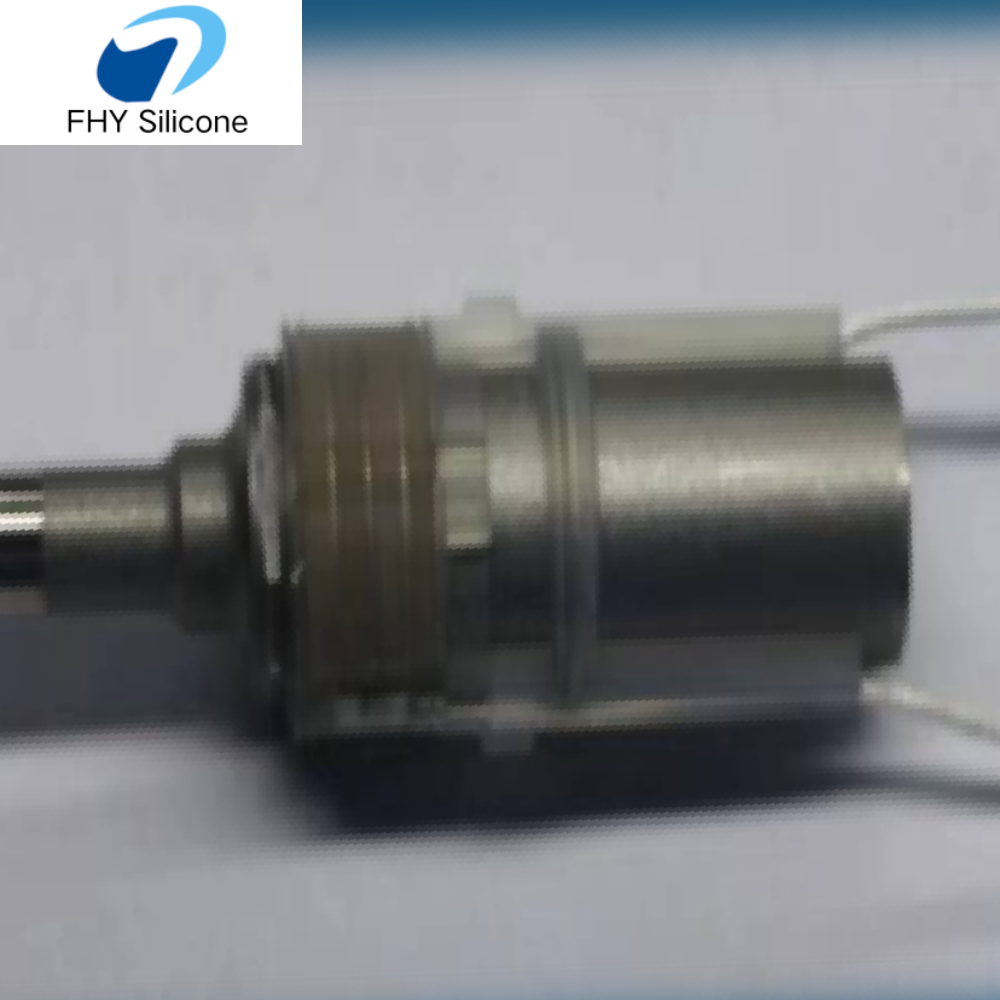
This product is a high-performance ultrasonic transducer assembly encapsulated with LSR (Liquid Silicone Rubber) overmolding technology.
It is designed to provide stable ultrasonic signal transmission and reception while offering excellent environmental protection, including waterproofing, dust resistance, chemical resistance, and mechanical shock resistance.
By encapsulating the transducer with medical/industrial-grade liquid silicone rubber, the structure ensures long-term reliability in harsh operating conditions without compromising acoustic performance.
Key Advantages of LSR Encapsulated Ultrasonic Transducer
Excellent Waterproof and Sealing Performance
The LSR overmolding process forms a seamless protective layer around the transducer.
- IP67 to IP68 waterproof capability
- Fully sealed structure against dust and moisture
- Suitable for submerged and outdoor environments
Stable Acoustic Transmission Performance
Special silicone formulations ensure minimal interference with ultrasonic signal transmission.
- High acoustic permeability silicone material
- Low signal attenuation design
- Stable frequency response over long-term use
Superior Mechanical Protection
The silicone encapsulation protects fragile piezoelectric components.
- Shock and vibration resistance
- Protection against mechanical impact
- Improved reliability in industrial environments
Wide Temperature and Environmental Resistance
LSR material ensures stable performance in extreme conditions.
- Operating temperature: -40°C to 200°C
- Resistant to UV, ozone, and aging
- Suitable for outdoor and industrial applications
Chemical and Corrosion Resistance
The silicone layer protects the transducer from harsh chemical exposure.
- Resistant to moisture and salt spray
- Suitable for marine and industrial fluid environments
- Long-term stability in corrosive conditions
Manufacturing Process
The product is manufactured using precision injection molding and sensor assembly technology:
- Ultrasonic Transducer Assembly
Piezoelectric ceramic elements are assembled with electrodes and housing. - Functional Testing
Electrical and acoustic performance is tested before encapsulation. - LSR Overmolding Encapsulation
Liquid silicone rubber is injected to fully or partially encapsulate the transducer. - Thermal Curing
Silicone is cured to form a stable protective sealing layer. - Final Calibration
Signal performance and waterproof integrity are verified.
Technical Specifications
| Item | Description |
|---|---|
| Product Name | LSR Overmolded Ultrasonic Transducer |
| Core Component | Piezoelectric Ultrasonic Sensor |
| Encapsulation Material | Liquid Silicone Rubber (LSR) |
| Process | LSR Injection Overmolding |
| Waterproof Rating | IP67 / IP68 (design dependent) |
| Operating Temperature | -40°C to 200°C |
| Signal Type | Ultrasonic frequency transmission |
| Chemical Resistance | High |
| Application Type | Industrial / Medical / Automotive |
Applications
- Ultrasonic distance measurement sensors
- Medical ultrasound equipment components
- Automotive parking and detection systems
- Industrial liquid level sensors
- Smart home ultrasonic devices
- Water quality monitoring systems
- Marine detection and sonar systems
Engineering Considerations
Acoustic Performance Balance
LSR formulation must be optimized to ensure:
- Minimal ultrasonic signal loss
- Stable frequency transmission
- No resonance distortion caused by encapsulation layer
Adhesion and Encapsulation Control
Proper bonding between silicone and sensor housing is critical to prevent delamination under vibration or thermal cycling.
Thermal and Environmental Stability
The system must maintain performance under:
- Wide temperature fluctuations
- Continuous moisture exposure
- Long-term outdoor use
Frequently Asked Questions
Does LSR affect ultrasonic signal performance?
Special acoustic-grade LSR is used to minimize attenuation and maintain stable signal transmission.
Can the transducer be used underwater?
Yes, with proper design, LSR encapsulated transducers can achieve IP68 waterproof performance suitable for submerged applications.
Is customization available?
Yes, frequency range, shape, housing design, and encapsulation structure can all be customized.
What industries use this product?
It is widely used in industrial sensing, automotive systems, medical devices, and smart electronics.
 English
  Japanese
  Korean
  German
  French
  Italian
  Spanish
  Dutch
Dutch  Chinese
  Portuguese
  Polish
  Czech
Czech  Hungarian
  Swedish
  Finnish
  Vietnamese
  Thai
Thai  Turkish
  Arabic
  Russian
Reviews
There are no reviews yet.