
With the continuous development of modern healthcare technology, medical devices are becoming increasingly sophisticated, requiring materials that provide excellent safety, reliability, durability, and precision. Medical Grade Liquid Silicone Rubber (LSR) has emerged as one of the most important elastomer materials for advanced medical applications due to its outstanding biocompatibility, chemical stability, sterilization resistance, and flexible design capabilities.
From minimally invasive devices and diagnostic equipment to drug delivery systems and wearable healthcare products, medical-grade LSR components play a critical role in improving patient safety and device performance.
For medical product designers, engineers, and procurement professionals, understanding the characteristics, regulatory requirements, manufacturing process, and application areas of LSR is essential when developing reliable medical products.
This article provides a comprehensive overview of medical-grade LSR components, including material properties, manufacturing processes, quality requirements, and industry applications.
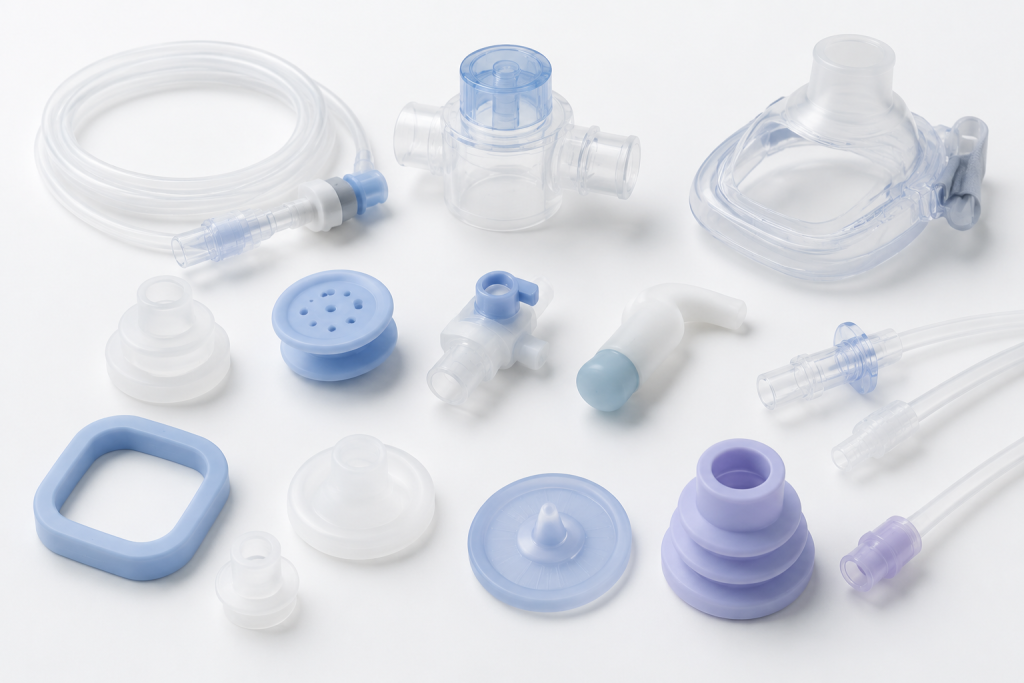
1. What Is Medical Grade LSR?
Medical Grade Liquid Silicone Rubber (LSR) is a high-purity silicone elastomer specifically formulated for medical and healthcare applications.
Unlike conventional industrial silicone materials, medical-grade LSR is manufactured under stricter requirements regarding:
- Material purity
- Bezpieczeństwo biologiczne
- Stabilność chemiczna
- Czystość w procesie produkcyjnym
- Traceability
LSR is typically a two-component platinum-cured silicone system:
- Component A: Silicone polymer base
- Component B: Cross-linking agent with platinum catalyst
During injection molding, the two components are mixed precisely and injected into a heated mold. The material then undergoes a cross-linking reaction, forming a flexible and durable silicone component.
2. Why Medical Devices Use LSR Materials
Medical applications require materials that can maintain performance under demanding conditions.
Medical-grade LSR provides several important advantages.
2.1 Excellent Biocompatibility
One of the most important characteristics of medical LSR is its compatibility with the human body.
Depending on the formulation and application, medical silicone materials may comply with:
- ISO 10993 biological evaluation standards
- USP Class VI requirements
- Medical device material regulations
This makes LSR suitable for components that may contact:
- Skin
- Body fluids
- Mucous membranes
- Tissues
Zastosowania obejmują:
- Elementy cewnika
- Plomby medyczne
- Drug delivery parts
2.2 Sterilization Resistance
Medical devices often require repeated sterilization.
Medical-grade LSR can withstand common sterilization methods:
Steam Sterilization (Autoclave)
Typowe warunki:
- 121°C–134°C
Gamma Radiation
Zastosowanie:
- Jednorazowe wyroby medyczne
- Sterile packaging systems
Ethylene Oxide (EtO)
Najczęściej stosowane w:
- Heat-sensitive medical devices
LSR maintains:
- Elastyczność
- Wytrzymałość mechaniczna
- Stabilność chemiczna
after sterilization processes.
2.3 Chemical and Aging Resistance
Medical devices may be exposed to:
- Disinfectants
- Środki czyszczące
- Body fluids
- Temperature changes
LSR offers excellent resistance against:
- Utlenianie
- Promieniowanie UV
- Wilgotność
- Wiele substancji chemicznych
This improves long-term product reliability.
2.4 Softness and Patient Comfort
Many medical products require comfortable contact with the human body.
LSR provides:
- Miękki w dotyku
- Flexible deformation
- Low compression stress
Zastosowania:
- Wearable medical devices
- Patient interfaces
- Respiratory masks
3. Main Applications of Medical Grade LSR Components
Medical-grade LSR is used across many healthcare sectors.
3.1 Medical Connectors and Fittings
LSR components are widely used in medical fluid systems.
Przykłady:
- Tube connectors
- Valve components
- Pierścienie uszczelniające
- Fluid control parts
Zalety:
- Reliable sealing
- Odporność chemiczna
- Flexible connection
3.2 Silicone Valves for Medical Devices
Silicone valves are critical components in many healthcare systems.
Zastosowania:
- Drug delivery devices
- Infusion systems
- Respiratory equipment
LSR valves provide:
- Precise flow control
- Repeated deformation capability
- Odporność na wycieki
3.3 Catheter Components
Catheter systems require materials that combine flexibility and safety.
LSR is used for:
- Catheter tips
- Soft connectors
- Elementy uszczelniające
Key requirements:
- Smooth surface
- Biokompatybilność
- Odporność na sterylizację
3.4 Medical Cable Overmolding Components
Modern medical devices often contain electronic systems.
LSR overmolding technology protects electrical components by creating:
- Waterproof barriers
- Strain relief structures
- Flexible protective layers
Zastosowania:
- Patient monitoring equipment
- Diagnostic devices
- Wearable medical sensors
3.5 Respiratory Medical Components
LSR is widely used in respiratory healthcare products.
Przykłady:
- Mask seals
- Breathing interfaces
- Ventilator components
Korzyści:
- Comfortable contact
- Air-tight sealing
- Long-term flexibility
4. Medical Grade LSR Manufacturing Process
Manufacturing medical LSR components requires precise control throughout the entire production process.
Step 1: Product Design and Engineering Review
Before manufacturing, engineers evaluate:
- Struktura produktu
- Material requirements
- Projekt formy
- Manufacturing feasibility
Important design factors include:
- Grubość ścianki
- Tolerance requirements
- Demolding structure
- Skuteczność uszczelnienia
Step 2: Mold Design and Tool Manufacturing
LSR molds require high precision.
Medical molds typically use:
- Hardened steel
- Precision machining
- Polished cavity surfaces
Important mold features include:
Precision Venting
Prevents:
- Air traps
- Wady powierzchniowe
Accurate Gate Design
Ensures:
- Uniform filling
- Stała jakość
Surface Finishing
Controls:
- Product appearance
- Cleaning performance
Step 3: LSR Injection Molding
The LSR molding process includes:
Material Mixing
Two liquid components are mixed at a controlled ratio.
Usually:
Component A : Component B = 1 : 1
Injection
The mixed silicone material enters the heated mold cavity.
Curing
Heat activates the platinum catalyst.
The liquid silicone transforms into an elastic solid.
Typical molding temperature:
- 150°C–200°C
Step 4: Post-Processing
After molding:
Components may require:
- Flash removal
- Czyszczenie
- Obróbka powierzchni
- Assembly
For medical products, contamination control is extremely important.
Step 5: Quality Inspection
Medical LSR manufacturing requires strict inspection procedures.
Do typowych badań należą:
Dimensional Inspection
Verification of:
- Rozmiar
- Grubość
- Tolerance
Mechanical Testing
Including:
- Wytrzymałość na rozciąganie
- Wydłużenie
- Odkształcenie trwałe po ściskaniu
- Odporność na rozdarcie
Material Testing
Including:
- Twardość
- Odporność chemiczna
- Aging performance
Cleanliness Control
Medical components may require:
- Particle control
- Cleanroom manufacturing
- Controlled packaging
5. Medical LSR Overmolding Technology
LSR overmolding is an advanced manufacturing technology combining silicone with other materials.
Common combinations:
- Silicone + Plastic
- Silicone + Metal
- Silicone + Electronic components
Zastosowania:
- Medical cable assemblies
- Sensor protection
- Injection device components
Zalety:
Improved Sealing
Creates integrated protection against:
- Wilgotność
- Zanieczyszczenie
- Fluid leakage
Reduced Assembly Steps
Integrated molding reduces:
- Component numbers
- Assembly costs
- Failure points
Enhanced User Experience
Provides:
- Soft-touch surfaces
- Ergonomic designs
6. Key Requirements for Medical LSR Suppliers
Choosing the right manufacturing partner is critical for medical product development.
Important supplier capabilities include:
6.1 Medical Manufacturing Experience
A qualified supplier should understand:
- Medical industry requirements
- Dokumentacja materiałowa
- Traceability systems
6.2 Advanced Production Equipment
Do najważniejszego sprzętu należą:
- Wtryskarki do tworzyw LSR
- Formy precyzyjne
- Automated dispensing systems
6.3 Quality Management System
Medical suppliers often require:
- ISO 13485 quality management system
- Strict production documentation
- Walidacja procesu
6.4 Wsparcie techniczne
Experienced manufacturers can assist with:
- Wybór materiałów
- Product optimization
- Projekt formy
- Cost reduction
7. Future Trends of Medical Grade LSR
The demand for medical silicone components continues to grow due to several trends.
Urządzenia medyczne do noszenia na ciele
Increasing use of:
- Smart sensors
- Health monitoring devices
- Flexible medical electronics
Minimally Invasive Medical Equipment
Growing demand for:
- Mniejsze elementy
- Higher precision
- Better patient comfort
Smart Medical Products
Integration of:
- Electronics
- Sensors
- Silicone protection systems
will further expand LSR applications.
Wnioski
Medical Grade Liquid Silicone Rubber (LSR) has become a key material solution for modern healthcare products due to its excellent biocompatibility, sterilization resistance, flexibility, and manufacturing precision.
From medical connectors and valves to wearable devices and electronic overmolded assemblies, LSR components enable safer, more reliable, and more comfortable medical products.
For medical device developers and startups, selecting an experienced medical silicone manufacturer with strong engineering capabilities and quality systems is essential for successful product commercialization.
As healthcare technology continues to advance, medical-grade LSR will remain an important material driving innovation in next-generation medical devices.
 English
  Japanese
  Korean
  German
  French
  Italian
  Spanish
  Dutch
Dutch  Chinese
  Portuguese
  Polish
  Czech
Czech  Hungarian
  Swedish
  Finnish
  Vietnamese
  Thai
Thai  Turkish
  Arabic
  Russian