
Modern medical devices are becoming increasingly compact, intelligent, and multifunctional. As healthcare equipment continues to integrate electronics, sensors, fluid systems, and precision components, manufacturers face growing challenges in achieving reliable sealing, patient comfort, sterilization resistance, and long-term durability.
Liquid Silicone Rubber (LSR) overmolding technology has emerged as an advanced manufacturing solution that enables silicone to be directly molded over plastics, metals, electronic components, and other substrates.
In medical applications, LSR overmolding provides significant advantages, including improved protection, enhanced ergonomics, reduced assembly complexity, and increased product reliability.
This article explores the principles of LSR overmolding, its benefits for medical devices, key design considerations, manufacturing processes, and common applications.
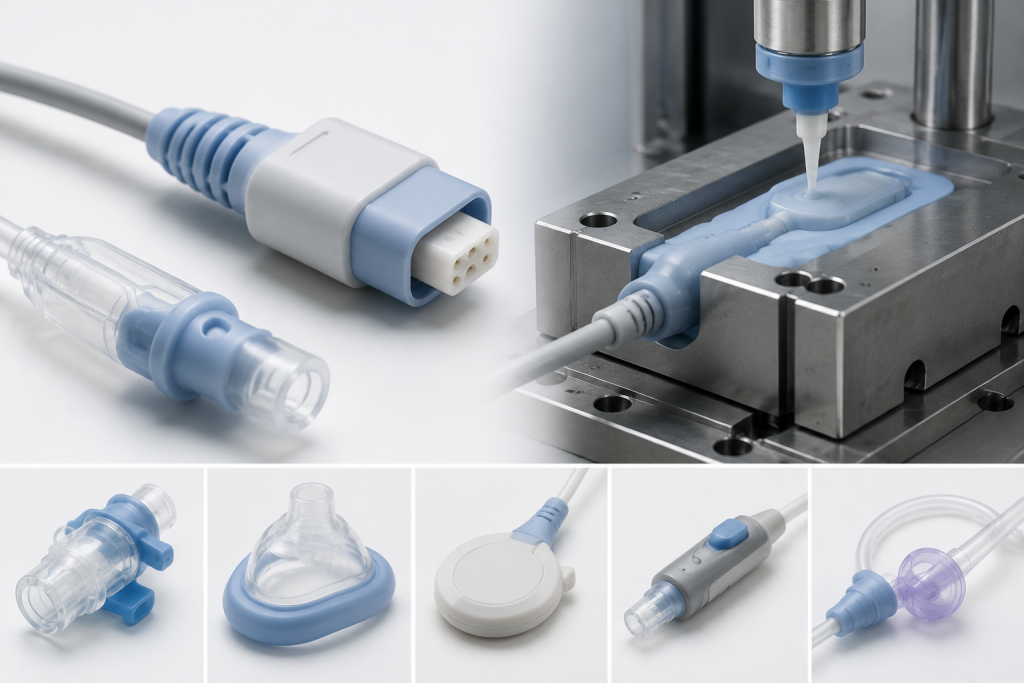
1. What Is LSR Overmolding?
LSR overmolding is a manufacturing process in which Liquid Silicone Rubber is molded directly onto another component or substrate to create an integrated multi-material structure.
The substrate may include:
- Engineering plastics
- Metal components
- Electronic assemblies
- Glass parts
- Obudowy urządzeń medycznych
During production, liquid silicone is injected around the pre-existing component and cured to form a strong mechanical or chemical bond.
The basic process:
Substrate preparation → LSR injection → Silicone curing → Integrated medical component
Unlike traditional assembly methods that require adhesives, mechanical fastening, or manual installation, LSR overmolding creates a seamless connection between silicone and the underlying material.
2. Why LSR Overmolding Is Important for Medical Devices
Medical devices often operate in demanding environments where failure is unacceptable.
Components must provide:
- Reliable sealing
- Odporność na sterylizację
- Biokompatybilność
- Mechanical durability
- Patient comfort
LSR overmolding helps manufacturers achieve these requirements through integrated product design.
3. Key Benefits of LSR Overmolding in Medical Applications
3.1 Improved Sealing Performance
One of the most important advantages of LSR overmolding is its ability to create highly reliable seals.
Traditional assembly methods may create weak points at:
- Mechanical joints
- Adhesive interfaces
- Connection areas
LSR overmolding creates continuous silicone protection around components.
Korzyści obejmują:
- Waterproof protection
- Air-tight sealing
- Fluid resistance
- Mniejsze ryzyko wycieku
Zastosowania:
- Złącza medyczne
- Obudowy czujników
- Fluid control devices
3.2 Enhanced Patient Comfort
Medical devices often require direct contact with human skin.
Compared with hard plastic surfaces, silicone provides:
- Miękki w dotyku
- Flexible contact
- Reduced pressure points
- Better ergonomic performance
Przykłady:
- Wearable medical sensors
- Respiratory masks
- Patient monitoring devices
LSR overmolding allows designers to combine rigid structures with soft silicone surfaces.
3.3 Improved Device Durability
Medical products may experience:
- Repeated cleaning
- Sterilization cycles
- Mechanical stress
- Environmental exposure
LSR provides excellent resistance against:
- Aging
- Promieniowanie UV
- Wilgotność
- Temperature changes
The silicone layer protects sensitive components and extends product lifespan.
3.4 Reduced Assembly Complexity
Traditional medical products may require multiple manufacturing steps:
- Component assembly
- Adhesive bonding
- Manual installation
- Additional sealing processes
LSR overmolding combines multiple functions into one manufacturing process.
Zalety:
- Fewer components
- Lower assembly cost
- Reduced production errors
- Improved consistency
3.5 Protection of Electronic Components
Modern medical devices increasingly contain:
- Sensors
- Circuit boards
- Connection cables
- Battery systems
LSR overmolding provides:
- Electrical insulation
- Moisture protection
- Mechanical protection
Zastosowania:
- Wearable health monitoring devices
- Diagnostic equipment
- Smart medical instruments
4. Common Medical Applications of LSR Overmolding
4.1 Medical Cable Assemblies
Medical cable systems require protection against:
- Bending stress
- Liquid exposure
- Frequent handling
LSR overmolding provides:
- Flexible strain relief
- Waterproof sealing
- Wygodne prowadzenie
Zastosowania:
- Patient monitoring cables
- Ultrasound equipment
- Diagnostic systems
4.2 Medical Connectors
Connectors are critical components in healthcare equipment.
LSR overmolding improves:
- Sealing reliability
- Właściwości chwytne
- Protection against contamination
Zastosowania:
- Złącza do płynów
- Złącza elektryczne
- Disposable medical devices
4.3 Wearable Medical Devices
Wearable healthcare products require lightweight and comfortable materials.
LSR overmolding enables:
- Soft skin-contact surfaces
- Flexible designs
- Water-resistant structures
Przykłady:
- Opaski do monitorowania stanu zdrowia
- Smart patches
- Biosensors
4.4 Respiratory Equipment
Respiratory devices require reliable patient interfaces.
Zastosowania:
- Mask cushions
- Breathing interfaces
- Ventilator components
LSR provides:
- Comfortable sealing
- Long-term flexibility
- Biokompatybilność
4.5 Drug Delivery Devices
LSR overmolding is used in:
- Injection devices
- Drug pumps
- Systemy zaworowe
Korzyści:
- Accurate fluid control
- Odporność chemiczna
- Reliable operation
5. LSR Overmolding Manufacturing Process
Step 1: Substrate Design and Preparation
Before molding, engineers evaluate:
- Substrate material compatibility
- Surface structure
- Bonding requirements
Common substrates:
- ABS
- PC
- PEEK
- Stainless steel
- Aluminum
Step 2: Surface Treatment
To improve bonding performance, substrates may require:
- Plasma treatment
- Primer coating
- Surface cleaning
- Mechanical texturing
The correct surface preparation improves adhesion strength.
Step 3: Mold Design
Medical LSR molds require high precision.
Do najważniejszych kwestii, które należy wziąć pod uwagę, należą:
Parting Line Control
Reduces:
- Flash
- Wady powierzchniowe
Venting Design
Prevents:
- Air traps
- Niekompletne wypełnienie
Silicone Flow Control
Ensures:
- Uniform thickness
- Stable product quality
Step 4: LSR Injection and Curing
During molding:
- Liquid silicone components are mixed
- Material is injected into the mold
- Silicone flows around the substrate
- Heat activates curing
- The integrated part is removed
Typical curing temperature:
150°C–200°C
Step 5: Inspection and Validation
Medical LSR components require strict testing.
Common inspections include:
Dimensional Testing
Checks:
- Size accuracy
- Kontrola tolerancji
Bond Strength Testing
Evaluates:
- Silicone-substrate adhesion
Testy funkcjonalne
Includes:
- Badanie szczelności
- Badania ciśnieniowe
- Mechanical cycling
Biological Testing
Medical products may require:
- Badania cytotoksyczności
- Badania na uczulenie
- Badania podrażnieniowe
6. Design Considerations for Medical LSR Overmolding
6.1 Material Compatibility
Not all materials bond naturally with silicone.
Engineers must consider:
- Chemical compatibility
- Surface energy
- Operating environment
6.2 Wall Thickness Design
Uniform silicone thickness helps prevent:
- Uneven curing
- Internal stress
- Deformation
Avoid:
- Sudden thickness changes
- Sharp corners
6.3 Molded-In Features
Designers can integrate:
- Sealing lips
- Flexible hinges
- Soft grips
- Pokrowce ochronne
This reduces secondary assembly operations.
6.4 Cleanliness Requirements
Medical production environments require:
- Controlled contamination
- Proper material handling
- Clean packaging
For advanced medical applications, cleanroom manufacturing may be necessary.
7. Quality Requirements for Medical LSR Manufacturers
A reliable medical silicone supplier should have:
Quality Management Systems
Including:
- ISO 13485
- Walidacja procesu
- Traceability systems
Możliwości produkcyjne
Including:
- Precision LSR molding machines
- Zautomatyzowane systemy produkcyjne
- Sprzęt kontrolny
Wsparcie techniczne
Including:
- Design optimization
- Rozwój pleśni
- Wybór materiałów
8. Future Trends of LSR Overmolding in Healthcare
The demand for LSR overmolding continues to grow due to:
Miniaturized Medical Devices
Smaller devices require:
- Higher precision
- Better sealing
- More compact structures
Smart Healthcare Products
Integration of:
- Sensors
- Flexible electronics
- Wireless systems
requires advanced silicone protection solutions.
Disposable Medical Products
The need for safe and cost-effective disposable devices continues to increase.
LSR provides:
- High production efficiency
- Consistent quality
- Reliable performance
Wnioski
LSR overmolding has become an essential manufacturing technology for modern medical devices. By combining the flexibility and biocompatibility of silicone with the strength of plastics, metals, and electronic components, manufacturers can create safer, more reliable, and more comfortable healthcare products.
For medical device developers, selecting the right LSR overmolding partner is critical. A qualified manufacturer can support the entire product development process, from material selection and mold design to validation and mass production.
As healthcare technology continues to evolve, LSR overmolding will remain a key solution for next-generation medical device innovation.
 English
  Japanese
  Korean
  German
  French
  Italian
  Spanish
  Dutch
Dutch  Chinese
  Portuguese
  Polish
  Czech
Czech  Hungarian
  Swedish
  Finnish
  Vietnamese
  Thai
Thai  Turkish
  Arabic
  Russian