
For companies developing silicone products, controlling manufacturing costs is one of the most important factors affecting market competitiveness. Whether producing medical components, baby products, electronic accessories, automotive parts, or consumer silicone products, manufacturers need to balance cost efficiency with product quality.
However, reducing silicone manufacturing costs does not simply mean choosing cheaper materials or lowering production standards. Poor cost-cutting decisions can lead to:
- Higher defect rates
- Product recalls
- Customer complaints
- Increased long-term expenses
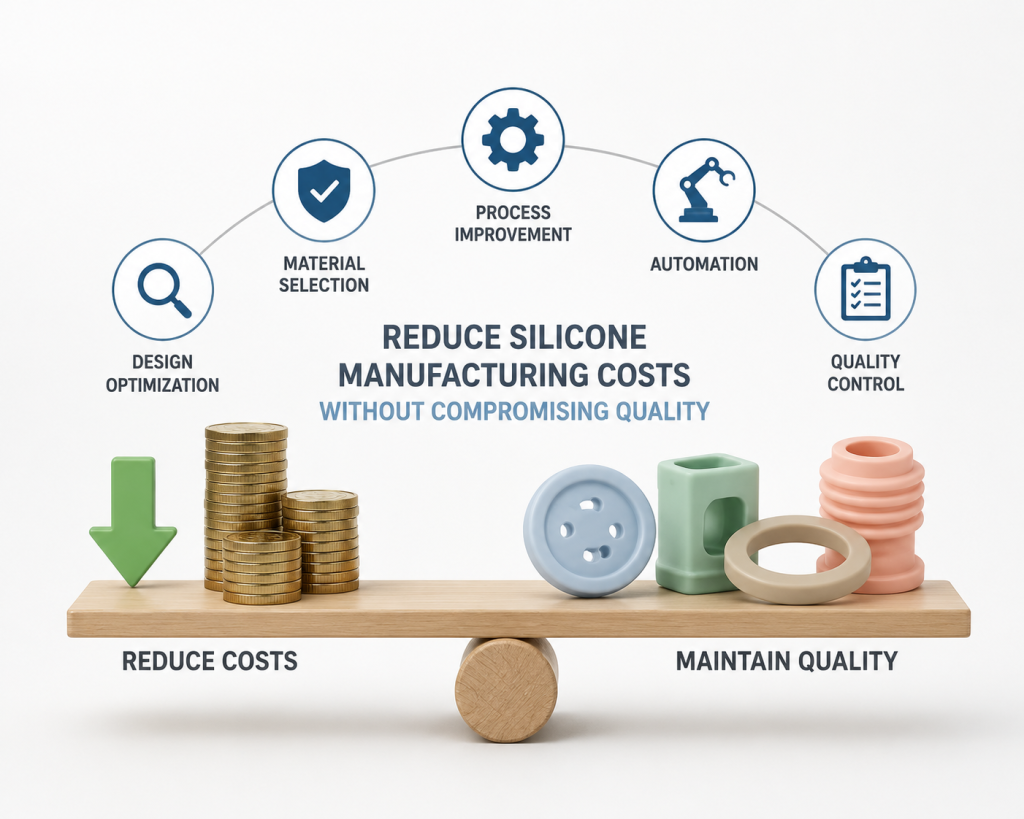
The best approach is to optimize the entire manufacturing process, including product design, material selection, tooling, production methods, and supply chain management.
This article explains how companies can reduce silicone product manufacturing costs while maintaining consistent quality, reliability, and performance.
1. Understand the Main Factors Affecting Silicone Manufacturing Costs
Before reducing costs, it is important to understand where expenses come from.
The total cost of a silicone product usually includes:
- Raw silicone material
- Mold and tooling costs
- Manufacturing process costs
- Labor costs
- Quality inspection costs
- Packaging and logistics costs
- Production waste
Each factor provides opportunities for optimization.
A professional silicone manufacturer can help identify areas where costs can be reduced without affecting product performance.
2. Optimize Product Design Before Manufacturing
One of the most effective ways to reduce silicone manufacturing costs is improving the product design at the early development stage.
Many unnecessary costs are caused by poor initial designs, including:
- Excessive material usage
- Complex mold structures
- Difficult manufacturing processes
- High scrap rates
Early design optimization can significantly reduce production expenses.
2.1 Reduce Unnecessary Material Usage
Silicone material is a major cost factor, especially for large production volumes.
Engineers should consider:
- Optimizing wall thickness
- Removing unnecessary structures
- Reducing excessive silicone volume
Na przykład:
A silicone cover designed with uniform thickness may require less material while maintaining the same protection performance.
Korzyści:
- Lower material cost
- Faster curing time
- Improved production efficiency
2.2 Design for Manufacturing (DFM)
Design for Manufacturing (DFM) means creating products that are easier and more economical to produce.
Good silicone product designs should consider:
- Mold structure
- Linie podziału
- Demolding requirements
- Production cycle time
Zalety:
- Lower tooling complexity
- Reduced manufacturing defects
- Faster production
Working with an experienced silicone manufacturer during the design stage can prevent costly redesigns.
3. Choose the Right Silicone Material
Selecting the correct silicone material is essential for cost optimization.
Using an unnecessarily high-grade material can increase costs without providing additional value.
Common silicone options include:
Płynna guma silikonowa (LSR)
Zalety:
- High precision
- Excellent consistency
- Nadaje się do produkcji zautomatyzowanej
Zastosowania:
- Medical components
- Artykuły dla niemowląt
- Electronics
LSR is usually more suitable for high-volume production.
High Consistency Rubber (HCR)
Zalety:
- Good mechanical performance
- Suitable for larger parts
- Flexible processing options
Zastosowania:
- Industrial seals
- Large silicone components
Choosing between LSR and HCR depends on:
- Product requirements
- Production volume
- Precision requirements
4. Optimize Mold Design and Tooling Costs
The mold is one of the largest initial investments in silicone manufacturing.
A poorly designed mold can increase:
- Production time
- Maintenance costs
- Defect rates
4.1 Simplify Mold Structure
A simpler mold design can reduce:
- Machining costs
- Maintenance requirements
- Production difficulties
However, simplification should not reduce product quality.
The goal is:
Simple structure + reliable performance
4.2 Improve Mold Life
High-quality molds may have higher initial costs but provide better long-term value.
A durable mold reduces:
- Replacement frequency
- Production interruptions
- Maintenance costs
For large production runs, investing in better tooling often reduces total manufacturing costs.
5. Reduce Production Waste
Material waste directly increases manufacturing costs.
Common causes include:
- Incorrect molding parameters
- Poor mold design
- Nadmierny błysk
- Incorrect material handling
Manufacturers can reduce waste through:
- Process optimization
- Automated material control
- Regular equipment maintenance
Korzyści:
- Lower material consumption
- Higher production efficiency
- Improved environmental performance
6. Increase Production Automation
Automation is an effective way to improve cost efficiency.
Modern silicone manufacturing can use:
- Automatic material dispensing systems
- Robotic handling
- Automated inspection equipment
Zalety:
Lower Labor Costs
Automation reduces repetitive manual operations.
Better Quality Consistency
Machines provide more stable processing conditions.
Higher Production Efficiency
Automated production allows:
- Faster cycle times
- Continuous operation
- Reduced human error
For high-volume silicone products, automation can significantly reduce unit costs.
7. Improve Quality Control to Reduce Hidden Costs
Reducing inspection or quality standards may appear to lower costs, but it often creates higher expenses later.
Poor quality can result in:
- Returns
- Rework
- Customer complaints
- Production delays
A strong quality control system helps reduce these hidden costs.
Important quality controls include:
Material Inspection
Checking:
- Silicone grade
- Twardość
- Certyfikacja
Production Inspection
Monitoring:
- Temperatura formy
- Injection parameters
- Curing conditions
Final Product Testing
Including:
- Kontrola wymiarowa
- Kontrola wizualna
- Testy wydajnościowe
8. Choose the Right Production Volume Strategy
Production volume has a major impact on silicone product costs.
Prototype Stage
Suitable methods:
- Prototype molds
- Small-batch production
Purpose:
- Design validation
- Market testing
Mass Production Stage
Suitable methods:
- Formy precyzyjne
- Automated LSR injection molding
Zalety:
- Lower unit cost
- Higher efficiency
- Stała jakość
Companies should avoid investing heavily in mass production before confirming product demand.
9. Work With an Experienced Silicone Manufacturer
Choosing the right manufacturing partner can significantly reduce costs.
An experienced supplier can provide:
Wsparcie techniczne
Including:
- Design optimization
- Wybór materiałów
- Manufacturing recommendations
Tooling Experience
Helping reduce:
- Mold problems
- Production delays
- Redesign costs
Production Optimization
Improving:
- Cycle time
- Material usage
- Quality consistency
A reliable manufacturer is not only a production supplier but also a technical partner.
10. Avoid Common Cost Reduction Mistakes
Some cost-cutting methods may create bigger problems.
Using Low-Quality Silicone Materials
Potential issues:
- Poor durability
- Odor problems
- Safety risks
Reducing Quality Inspection
Potential results:
- Higher defect rates
- Customer complaints
Choosing the Cheapest Supplier
Possible problems:
- Lack of engineering support
- Poor production control
- Unstable quality
The goal should be:
Optimize cost, not simply reduce price.
11. Future Trends in Silicone Manufacturing Cost Optimization
The silicone industry is moving toward smarter and more efficient manufacturing.
Future developments include:
Digital Manufacturing Management
Using:
- Production data analysis
- Real-time monitoring
- Process optimization
Advanced Automation
Including:
- Smart injection molding
- Automated inspection
- Robotic production
Sustainable Manufacturing
Companies are focusing on:
- Reduced material waste
- Energy-efficient production
- Longer product lifespan
These technologies will help manufacturers achieve better cost performance while maintaining quality.
Wnioski
Reducing silicone product manufacturing costs without compromising quality requires a systematic approach. The most effective strategies include optimizing product design, selecting the correct silicone material, improving mold design, reducing waste, increasing automation, and working with experienced manufacturing partners.
The lowest production price does not always represent the lowest total cost. A reliable silicone manufacturer helps companies achieve the best balance between:
- Product quality
- Manufacturing efficiency
- Long-term reliability
- Overall cost control
For startups, product brands, and industrial companies, smart manufacturing optimization is the key to creating competitive silicone products in today’s global market.
 English
  Japanese
  Korean
  German
  French
  Italian
  Spanish
  Dutch
Dutch  Chinese
  Portuguese
  Polish
  Czech
Czech  Hungarian
  Swedish
  Finnish
  Vietnamese
  Thai
Thai  Turkish
  Arabic
  Russian