
1. Introduction
OEM/ODM silicone custom parts are widely used in industries such as medical devices, automotive systems, consumer electronics, industrial sealing, and wearable devices.
Compared with standard silicone products, high-precision custom silicone components require strict control over:
- Material formulation
- Mold design accuracy
- Dimensional tolerances
- Production process stability
This article explains how to develop high-precision silicone parts from engineering and manufacturing perspectives.
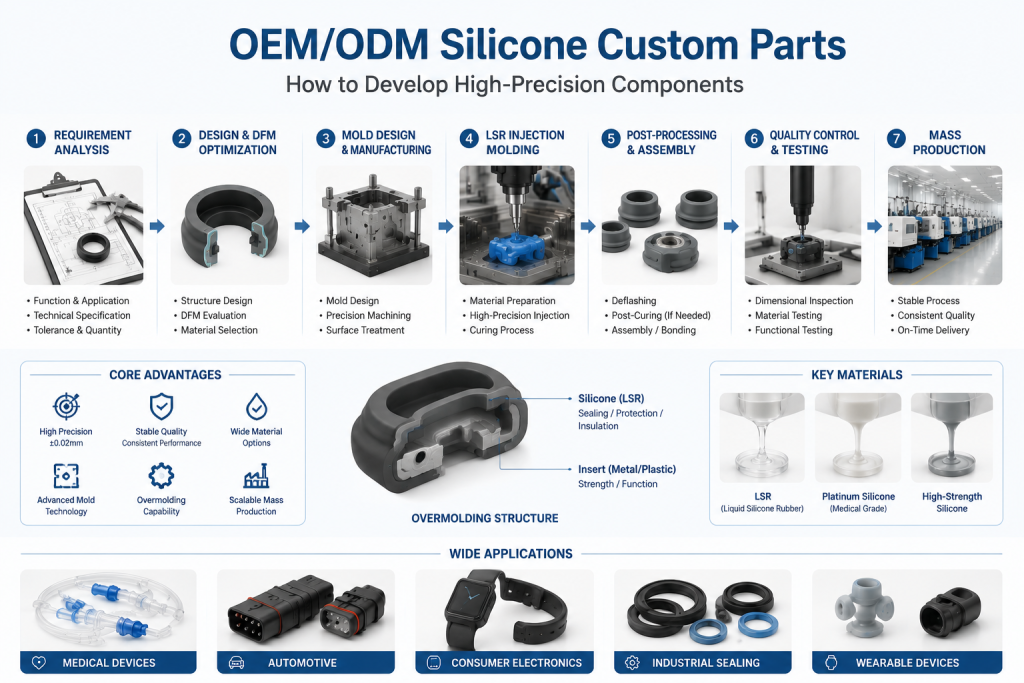
2. What Are OEM/ODM Silicone Custom Parts?
OEM (Original Equipment Manufacturing)
Manufacturing based strictly on customer drawings and specifications.
ODM (Original Design Manufacturing)
Manufacturer participates in:
- Product design
- Structural optimization
- Material selection
- Mold development
3. Key Requirements for High-Precision Silicone Components
3.1 Dimensional Accuracy
High-precision silicone parts typically require:
- Tolerance: ±0.02 mm to ±0.1 mm
- Stable shrinkage control
- Repeatable cavity consistency
Dimensional deviation often leads to sealing failure or assembly issues.
3.2 Material Stability
Common materials include:
- LSR (Liquid Silicone Rubber)
- Medical-grade platinum silicone
- High-strength industrial silicone
Key material requirements:
- Low shrinkage rate
- High thermal stability
- Consistent viscosity
3.3 Mechanical Performance
Depending on application, silicone parts may require:
- High tear resistance
- Compression set resistance
- Long-term elasticity retention
- Chemical resistance
4. Mold Design for High-Precision Production
Mold design is the core of precision silicone manufacturing.
4.1 Key Design Factors
- Uniform wall thickness
- Proper venting system
- Balanced flow channels
- Multi-cavity alignment accuracy
4.2 Precision Mold Machining
Advanced molds require:
- CNC high-precision machining
- EDM (Electrical Discharge Machining)
- Mirror polishing for cavity surfaces
4.3 Shrinkage Compensation
Silicone materials shrink during curing. Engineers must:
- Pre-calculate shrinkage rate
- Adjust mold cavity dimensions
- Validate through prototype testing
5. LSR Injection Molding Process
LSR injection molding is the most widely used process for high-precision silicone parts.
Process Flow:
- Material mixing (A/B components)
- Metering and degassing
- High-pressure injection
- Thermal curing in mold
- Automatic demolding
Advantages of LSR:
- High repeatability
- Short cycle time
- Suitable for micro and complex structures
- Clean and automated production
6. Overmolding in OEM/ODM Silicone Parts
Overmolding is often used to combine silicone with:
- Plastic (PC, PA, ABS, PEEK)
- Metal inserts (stainless steel, aluminum)
Benefits:
- Improved sealing performance
- Better structural strength
- Integrated multi-function design
7. Quality Control in Precision Manufacturing
High-precision silicone components require strict QC systems:
7.1 Incoming Material Inspection
- Raw silicone viscosity
- Batch consistency
- Certification verification
7.2 In-Process Control
- Injection pressure monitoring
- Mold temperature control
- Cycle time stability
7.3 Final Inspection
- Dimensional measurement (CMM)
- Visual defect inspection
- Functional testing
8. Common Challenges in OEM/ODM Silicone Development
8.1 Shrinkage Variation
Caused by:
- Temperature instability
- Material inconsistency
8.2 Mold Wear and Precision Loss
Long production cycles may reduce mold accuracy.
8.3 Bonding Failure (Overmolding)
Often caused by:
- Surface contamination
- Poor material compatibility
9. Applications of High-Precision Silicone Parts
OEM/ODM silicone components are widely used in:
Medical Industry
- Sealing valves
- Catheter components
- Drug delivery systems
Automotive Industry
- Waterproof connectors
- Sensor sealing systems
- Vibration damping parts
Electronics Industry
- Waterproof housings
- Wearable device components
- Precision sealing rings
10. Future Development Trends
The silicone OEM/ODM industry is moving toward:
- Micro-precision LSR molding
- Multi-material integration
- Automated smart manufacturing
- High-performance sealing systems for EV and medical devices
11. Conclusion
Developing high-precision silicone custom parts requires a systematic approach combining:
- Engineering design (DFM)
- Precision mold manufacturing
- LSR injection process control
- Strict quality management
Manufacturers with strong OEM/ODM engineering capabilities can significantly improve product reliability and support global industrial applications.
 English
  Japanese
  Korean
  German
  French
  Italian
  Spanish
  Dutch
Dutch  Chinese
  Portuguese
  Polish
  Czech
Czech  Hungarian
  Swedish
  Finnish
  Vietnamese
  Thai
Thai  Turkish
  Arabic
  Russian