
Silicone rubber has become one of the most widely used elastomer materials in modern manufacturing due to its excellent temperature resistance, chemical stability, flexibility, and durability. However, when engineers and product developers select silicone materials, they often encounter two major categories:
- Liquid Silicone Rubber (LSR)
- High Consistency Rubber (HCR) Silicone Rubber
Although both materials are based on silicone polymers and share many similar properties, they differ significantly in material form, processing methods, manufacturing efficiency, application areas, and cost considerations.
Understanding the differences between LSR and traditional silicone rubber is essential for engineers, product designers, and procurement teams when selecting the right material for medical devices, electronics, automotive parts, baby products, and industrial components.
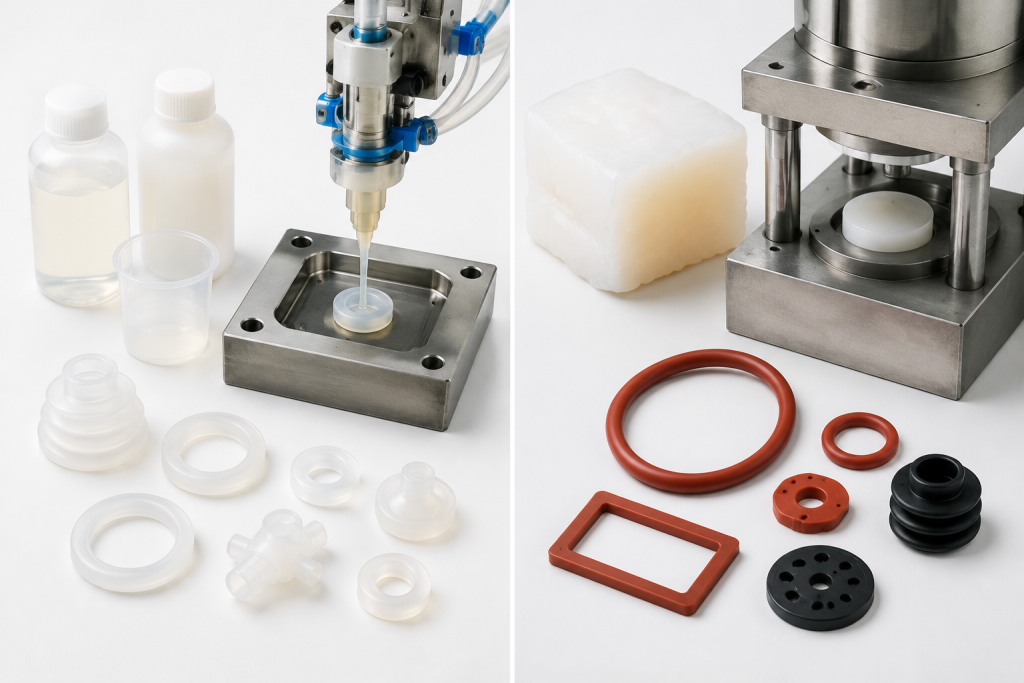
1. What Is Liquid Silicone Rubber (LSR)?
Liquid Silicone Rubber (LSR) is a two-component platinum-cured silicone elastomer supplied in liquid form.
The material consists of:
- Component A: Silicone polymer base
- Component B: Cross-linking agent containing platinum catalyst
During manufacturing, the two components are mixed at a precise ratio and injected into a heated mold.
The curing reaction transforms the liquid silicone into a flexible, durable rubber component.
Typical LSR manufacturing process:
Liquid silicone → Mixing → Injection molding → Heat curing → Finished silicone part
LSR is widely recognized for:
- High precision
- Excellent consistency
- Clean production
- Automated manufacturing capability
2. What Is Traditional Silicone Rubber (HCR)?
Traditional silicone rubber is usually classified as High Consistency Rubber (HCR), also known as solid silicone rubber.
Unlike LSR, HCR is supplied as a solid silicone gum material.
The manufacturing process typically includes:
- Silicone gum preparation
- Addition of pigments and additives
- Mechanical mixing
- Compression molding or transfer molding
- Heat curing
HCR has been used for decades and remains an important silicone manufacturing method, especially for larger industrial components.
Common applications include:
- Industrial seals
- Gaskets
- Large silicone tubes
- Electrical insulation components
3. Key Differences Between LSR and Silicone Rubber
3.1 Material Form
The biggest difference between LSR and HCR is the physical form of the raw material.
| Feature | LSR | HCR Silicone |
|---|---|---|
| Material state | Liquid | Solid gum |
| Components | Two-component system | Single solid material |
| Mixing method | Automatic mixing system | Mechanical mixing |
| Processing method | Injection molding | Compression molding |
LSR is designed for automated precision production, while HCR is more traditional and flexible for various applications.
4. Processing Technology Differences
LSR Injection Molding
LSR uses a fully automated injection molding process.
Main steps:
- Two liquid components are pumped into a mixing unit
- Material is injected into a heated mold
- Silicone cures inside the mold
- Finished parts are removed automatically
Advantages:
- Fast production cycle
- Low labor requirements
- High repeatability
- Minimal material waste
HCR Compression Molding
HCR usually requires more manual processing.
Process:
- Silicone material preparation
- Cutting and weighing
- Mold filling
- Heat compression
- Demolding
Advantages:
- Suitable for large parts
- Lower tooling complexity
- Good mechanical properties
5. Precision and Product Complexity
LSR Advantages
LSR provides excellent dimensional accuracy because the material flow is highly controlled.
It is suitable for:
- Thin-wall components
- Micro parts
- Complex geometries
- Multi-cavity molds
Examples:
- Medical connectors
- Silicone valves
- Electronic seals
- Baby product components
HCR Advantages
HCR is better suited for:
- Large components
- Simple structures
- Thick silicone parts
Examples:
- Industrial gaskets
- Large seals
- Silicone sheets
6. Production Efficiency Comparison
For high-volume production, LSR generally provides better efficiency.
| Factor | LSR | HCR |
|---|---|---|
| Automation level | High | Medium |
| Production speed | Faster | Slower |
| Labor requirement | Lower | Higher |
| Material waste | Low | Higher |
| Consistency | Excellent | Good |
LSR is especially suitable for companies requiring millions of identical components with stable quality.
7. Material Performance Comparison
Although processing methods differ, both LSR and HCR silicone share many silicone characteristics.
Temperature Resistance
Both materials provide excellent thermal stability.
Typical range:
- Approximately -50°C to +200°C
Chemical Resistance
Both resist:
- Moisture
- UV radiation
- Ozone
- Many chemicals
Aging Resistance
Both materials maintain performance over long periods.
However, LSR often provides better consistency due to controlled automated processing.
8. Medical Applications: Why LSR Is Preferred
Medical industries increasingly choose LSR because of its purity and manufacturing advantages.
Applications:
- Medical connectors
- Catheter components
- Silicone valves
- Respiratory components
- Drug delivery devices
Advantages:
Biocompatibility
Medical-grade LSR can meet:
- ISO 10993 requirements
- USP Class VI standards
Sterilization Resistance
LSR can withstand:
- Autoclave sterilization
- Gamma radiation
- Ethylene oxide sterilization
Clean Manufacturing
LSR production supports:
- Automated molding
- Controlled environments
- Reduced contamination risk
9. Electronics and Consumer Product Applications
LSR is increasingly used in modern electronics.
Examples:
- Smartwatch straps
- Waterproof seals
- Sensor covers
- Protective components
Reasons:
- Soft touch
- Excellent sealing
- Electrical insulation
- Weather resistance
HCR remains common in:
- Cable insulation
- Large electrical seals
- Industrial protective parts
10. Cost Comparison
Material selection is not only about performance but also economics.
LSR Cost Factors
Higher initial investment due to:
- Precision molds
- Injection equipment
However:
- Lower labor cost
- Faster production
- Lower waste
For large production volumes, LSR can become more cost-effective.
HCR Cost Factors
Advantages:
- Lower equipment investment
- Suitable for small production runs
However:
- More manual processing
- Higher labor requirements
11. How to Choose Between LSR and Silicone Rubber?
The correct material depends on product requirements.
Choose LSR When:
✔ High production volume is required
✔ Complex geometry is needed
✔ Medical or food-grade requirements exist
✔ High precision is important
✔ Automated production is preferred
Typical products:
- Medical devices
- Baby products
- Wearable electronics
- Precision seals
Choose HCR When:
✔ Large components are required
✔ Production volume is smaller
✔ Simple shapes are acceptable
✔ Lower tooling investment is preferred
Typical products:
- Industrial seals
- Large gaskets
- Silicone sheets
12. Future Development Trends
The demand for LSR continues to increase due to:
Medical Technology Growth
More advanced healthcare devices require:
- Smaller silicone components
- Higher precision
- Better safety
Wearable Electronics
Flexible materials are needed for:
- Smart watches
- Health monitoring devices
- Sensor systems
Smart Manufacturing
Automation and Industry 4.0 technologies are accelerating LSR adoption through:
- Intelligent injection systems
- Automated inspection
- Digital production management
Conclusion
Liquid Silicone Rubber (LSR) and traditional silicone rubber (HCR) are both valuable silicone materials, but they serve different manufacturing needs.
LSR provides advantages in:
- Precision
- Automation
- Clean production
- Complex designs
- High-volume manufacturing
HCR remains an excellent choice for:
- Large components
- Traditional silicone products
- Cost-sensitive applications
For product designers and engineers, selecting between LSR and HCR depends on factors such as product complexity, production volume, regulatory requirements, and manufacturing goals.
As industries continue to demand safer, smarter, and more reliable silicone components, both LSR and traditional silicone rubber will continue to play important roles in modern manufacturing.
 English
  Japanese
  Korean
  German
  French
  Italian
  Spanish
  Dutch
Dutch  Chinese
  Portuguese
  Polish
  Czech
Czech  Hungarian
  Swedish
  Finnish
  Vietnamese
  Thai
Thai  Turkish
  Arabic
  Russian