
Getting an accurate quotation for a custom silicone part depends heavily on the information provided during the RFQ stage.
A buyer may send only a product photo and ask:
“How much is this silicone part?”
In many cases, the manufacturer cannot provide a reliable production price from a photograph alone.
Two silicone components that look almost identical may require completely different:
- materials;
- hardness;
- molding processes;
- tolerances;
- tooling;
- inspection;
- post-curing;
- packaging.
These differences can significantly affect both tooling cost and unit price.
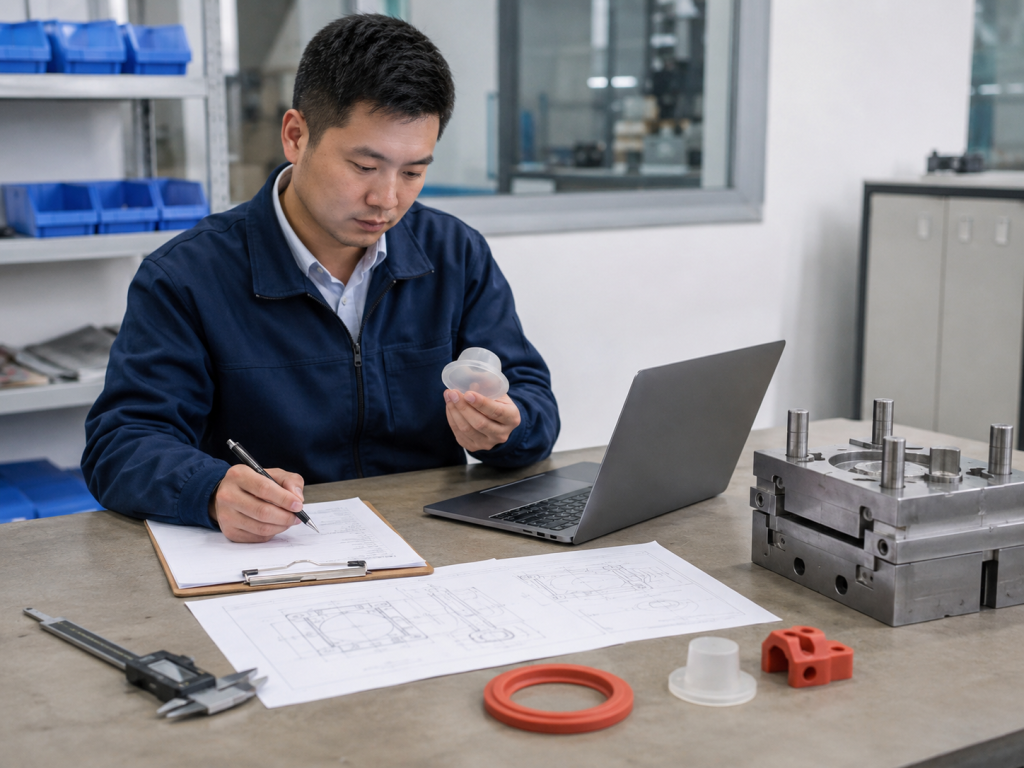
If you want faster, more accurate quotations with fewer follow-up questions, your RFQ should provide enough technical and commercial information for the manufacturer to understand exactly what must be produced.
This guide explains what buyers should send a silicone manufacturer before requesting a quote.
Why Accurate RFQ Information Matters
A silicone manufacturer normally calculates a quotation based on several elements:
Tooling Cost + Material Cost + Molding Cost + Labor + Secondary Processing + Inspection + Packaging
If important information is missing, the supplier must make assumptions.
For example, the supplier may assume:
- standard industrial silicone;
- 50 Shore A hardness;
- normal molded tolerance;
- standard color;
- bulk packaging;
- no special certification.
But the actual project may later require:
- medical-grade LSR;
- 30 Shore A;
- ±0.10 mm critical dimensions;
- custom Pantone color;
- post-curing;
- individual clean packaging.
The original quotation may then become invalid.
Providing complete RFQ information helps avoid these price changes.
1. Send a 3D CAD File
For custom molded silicone parts, the 3D CAD model is usually the most useful document for tooling evaluation.
Common file formats include:
- STEP;
- STP;
- IGES;
- IGS;
- X_T;
- Parasolid.
A 3D model allows the manufacturer to analyze:
- overall geometry;
- wall thickness;
- cavities;
- ribs;
- undercuts;
- holes;
- sealing lips;
- demolding direction;
- potential parting-line locations.
This information is difficult to determine accurately from photographs.
Why STEP Files Are Better Than Photos
Suppose you send a photograph of a silicone cover.
The manufacturer may see its overall shape but cannot reliably determine:
- whether the wall is 1 mm or 2 mm thick;
- how deep internal grooves are;
- whether there are hidden undercuts;
- the exact diameter of mounting holes;
- the internal geometry.
These features can significantly affect tooling complexity.
A STEP file allows the tooling engineer to examine the full part before quoting.
Can You Get a Quote Without a 3D File?
Yes, especially during early product development.
You may provide:
- dimensioned drawings;
- hand sketches;
- reference samples;
- product photos.
However, the quotation should normally be considered preliminary until the final geometry is available.
For production tooling, a complete CAD model is strongly recommended.
2. Provide a 2D Technical Drawing
The 3D CAD file defines geometry.
The 2D drawing should define the engineering requirements.
This distinction is important.
A CAD model may show that a diameter is:
25.00 mm
but it does not necessarily tell the manufacturer whether the acceptable tolerance is:
±0.50 mm
or:
±0.05 mm.
Those two tolerance requirements can create very different tooling and inspection costs.
What Should Be on the 2D Drawing?
Include information such as:
- critical dimensions;
- dimensional tolerances;
- hole diameters;
- hole-position tolerances;
- thickness;
- flatness where required;
- critical sealing surfaces;
- cosmetic surfaces;
- parting-line restrictions;
- flash limits;
- gate restrictions.
The manufacturer can then separate normal molded dimensions from high-precision features.
3. Identify Critical Dimensions
Do not simply apply the tightest tolerance to every dimension.
Instead, tell the supplier which dimensions directly affect:
- assembly;
- sealing;
- positioning;
- movement;
- connector fit.
예를 들어:
| 주요 기능 | Requirement |
|---|---|
| Sealing OD | 30.00 ±0.10 mm |
| Mounting Hole | Ø3.00 ±0.10 mm |
| Hole Position | ±0.15 mm |
| Overall Length | ±0.30 mm |
| Other Dimensions | General molded tolerance |
This gives the manufacturer a much clearer understanding of the true production requirements.
Why Tolerance Information Affects Price
A component with general commercial tolerances may be relatively straightforward to mold.
A component requiring several dimensions at:
±0.05 mm
may require:
- more accurate tooling;
- additional mold fitting;
- trial mold adjustments;
- more frequent measurement;
- tighter process control.
If tolerance requirements are not provided during RFQ, the supplier cannot reliably calculate the manufacturing cost.
4. Specify the Silicone Material
“Silicone” is not a complete material specification.
There are many silicone formulations.
예를 들면 다음과 같습니다:
- general-purpose silicone rubber;
- Liquid Silicone Rubber, LSR;
- High Consistency Rubber, HCR;
- platinum-cured silicone;
- peroxide-cured silicone;
- food-contact silicone;
- medical-grade silicone;
- high-temperature silicone;
- conductive silicone;
- flame-retardant silicone;
- fluorosilicone.
Different formulations have different prices and processing requirements.
Tell the Manufacturer the Application
If you do not know the exact silicone grade, explain how the part will be used.
예를 들어:
Application: sealing component inside an electronic device
or:
Application: silicone component contacting food
or:
Application: medical device component
The manufacturer can then recommend an appropriate material.
Application information can be more useful than simply writing:
“Use good-quality silicone.”
5. Specify Silicone Hardness
Silicone hardness is commonly specified using Shore A.
예를 들면 다음과 같습니다:
- 20 Shore A;
- 30 Shore A;
- 40 Shore A;
- 50 Shore A;
- 60 Shore A;
- 70 Shore A.
A typical drawing may specify:
50 ±5 Shore A
경도는 다음 사항에 영향을 미칩니다:
- flexibility;
- sealing performance;
- compression;
- tactile feel;
- demolding;
- material selection.
Therefore, it should be included in the quotation request.
What If You Don’t Know the Hardness?
Tell the manufacturer what the product must do.
예를 들어:
The seal should be soft enough to compress approximately 20% during assembly.
or:
We need a flexible silicone cover similar to this physical sample.
A supplier may then recommend several hardness options for testing.
6. Specify Color
Silicone components can be manufactured in:
- translucent;
- white;
- black;
- standard colors;
- custom colors.
If the project requires an exact custom color, provide:
- Pantone number;
- RAL number where appropriate;
- approved physical sample.
예를 들어:
Color: Pantone 286 C
Custom color matching may affect:
- material preparation;
- MOQ;
- sampling;
- unit cost.
Therefore, it should be mentioned during quotation.
7. Provide Initial Order Quantity
Always tell the supplier how many parts you need.
Example:
Initial Order: 5,000 pcs
Order quantity affects the quotation because every production run includes fixed activities such as:
- mold installation;
- machine setup;
- material preparation;
- first-piece inspection;
- production scheduling.
Producing 100 parts and producing 100,000 parts will not normally have the same piece price.
8. Provide Estimated Annual Quantity
This is one of the most valuable pieces of information in a B2B silicone RFQ.
예를 들어:
Initial order: 10,000 pcs
Estimated annual demand: 300,000 pcs
Annual demand helps the supplier determine:
- mold cavity count;
- tooling material;
- automation level;
- production process.
For a low-volume project, a single-cavity compression mold may be sufficient.
For a high-volume project, a multi-cavity LSR mold may provide lower long-term unit cost.
Without annual-volume information, the supplier cannot optimize the tooling strategy.
9. Specify Whether You Need Prototype or Mass Production
Tell the supplier your current project stage.
Possible stages include:
Prototype
Main objective:
- test geometry;
- verify assembly;
- confirm silicone hardness.
Pilot Production
Main objective:
- validate tooling;
- confirm process stability;
- conduct customer testing.
Mass Production
Main objective:
- stable quality;
- high productivity;
- lower unit cost.
Different stages may require different tooling solutions.
10. Explain the Product Application
Application information helps the manufacturer understand the true technical requirements.
Useful examples include:
- automotive connector seal;
- battery enclosure gasket;
- medical equipment valve;
- electronic waterproof seal;
- industrial machine gasket;
- silicone overmolded cable;
- sensor protective cover.
This allows the manufacturer to evaluate:
- temperature requirements;
- chemical exposure;
- sealing conditions;
- regulatory requirements.
11. Specify Operating Temperature
If the silicone component will experience high or low temperatures, include the operating range.
예를 들어:
Operating Temperature: -40°C to +180°C
Do not assume every silicone formulation has identical long-term temperature performance.
Temperature requirements can influence material selection and therefore pricing.
12. Describe the Working Environment
Tell the manufacturer if the part will contact:
- water;
- oil;
- fuel;
- chemicals;
- steam;
- UV;
- outdoor environments.
For chemically aggressive applications, standard silicone may not be the best material.
For example, some fuel-related applications may require a specialized elastomer such as fluorosilicone.
Providing environmental information early prevents incorrect material quotations.
13. Specify Regulatory or Certification Requirements
이는 특히 다음의 경우에 중요합니다:
- food;
- medical;
- consumer;
- automotive;
- electrical applications.
Possible requirements may include:
- FDA-related food-contact requirements;
- LFGB;
- USP Class VI;
- ISO 10993 testing;
- UL requirements;
- RoHS;
- REACH.
Only specify requirements that your application actually needs.
Certificates, material qualification and testing requirements can affect both material availability and price.
14. Tell the Manufacturer About Surface Finish
The silicone surface normally reproduces the mold cavity finish.
Possible requirements include:
- smooth;
- polished;
- matte;
- textured;
- high gloss;
- custom texture.
If the component has different cosmetic zones, mark them clearly.
예를 들어:
Surface A: matte cosmetic surface
Surface B: standard molded finish
This prevents unnecessary polishing of hidden areas.
15. Identify Cosmetic Surfaces
For appearance-sensitive products, divide surfaces according to importance.
예를 들어:
Surface A
Primary customer-facing surface.
Strict appearance requirements.
Surface B
Secondary visible surface.
Minor molding witness acceptable.
Surface C
Hidden after assembly.
Standard industrial appearance acceptable.
This allows the manufacturer to design:
- parting lines;
- gates;
- surface textures
more effectively.
16. Specify Flash Requirements
Flash is a normal consideration in silicone molding.
If certain areas require tight flash control, identify them.
Example:
Sealing Surface A: residual flash ≤0.10 mm
Non-critical Edge B: standard molded flash acceptable
No loose flash permitted
This is much more useful than writing:
“NO FLASH ANYWHERE.”
Extremely strict flash limits can significantly affect mold cost and production yield.
17. Specify Gate Restrictions
Injection-molded silicone requires a gate.
A small gate witness may remain after molding.
If certain areas cannot contain a gate, mark them on the drawing.
예를 들어:
No gate permitted on Surface A
Gate permitted on hidden Surface C
This should be decided before mold machining begins.
18. Identify Parting-Line Restrictions
The parting line is where mold sections meet.
If a parting line cannot cross an important surface, tell the manufacturer during RFQ.
This is particularly important for:
- sealing surfaces;
- cosmetic faces;
- valve edges;
- tactile surfaces.
Changing the parting line after tooling is complete may require substantial mold modification.
19. Provide Insert Information for Overmolding
If silicone will be molded onto another component, provide complete information about the insert.
Possible inserts include:
- stainless steel;
- aluminum;
- brass;
- plastic;
- cable;
- electronic components.
Send:
- insert CAD model;
- insert drawing;
- insert material;
- insert tolerance.
Also clarify who will supply the insert:
Buyer-supplied
or:
Manufacturer-supplied
This can significantly affect the final quotation.
20. State Whether Chemical Bonding Is Required
Silicone overmolding can sometimes rely on mechanical locking.
Other applications require strong chemical adhesion between:
- silicone and metal;
- silicone and plastic.
If permanent bonding is required, specify it.
The process may need:
- plasma treatment;
- primer;
- adhesive promoter;
- surface cleaning.
These additional processes affect cost.
21. Specify Post-Curing Requirements
Some silicone materials or applications require post-curing.
If you have a specific requirement, include:
- temperature;
- duration;
- relevant standard.
If you are unsure, ask the manufacturer whether post-curing is recommended for the selected material and application.
Post-curing adds:
- processing time;
- energy;
- handling.
Therefore, it should be included in the original quotation assumptions.
22. Specify Secondary Operations
Tell the supplier if the finished component requires additional work after molding.
예를 들면 다음과 같습니다:
- trimming;
- punching;
- cutting;
- printing;
- laser marking;
- bonding;
- assembly;
- adhesive application;
- surface treatment.
Every secondary operation adds manufacturing cost.
A quotation for “molded parts only” should not be compared directly with a quotation including complete assembly.
23. Specify Inspection Requirements
Different projects require different levels of quality control.
Basic production may require:
- visual inspection;
- dimensional sampling.
Precision projects may require:
- First Article Inspection;
- 100% dimensional inspection;
- optical inspection;
- functional testing;
- leak testing;
- automated vision inspection.
If inspection requirements are not provided, suppliers may quote different quality levels.
24. Identify Critical-to-Quality Dimensions
On the drawing, identify CTQ features.
These may include:
- sealing diameter;
- insert position;
- mounting-hole position;
- membrane thickness.
The supplier can then focus inspection resources on the features that actually affect product function.
This can also help reduce unnecessary inspection costs.
25. Specify Documentation Requirements
Some industrial buyers require quality documentation with every shipment.
Possible documents include:
- Certificate of Conformance;
- Certificate of Analysis;
- dimensional report;
- First Article Inspection report;
- PPAP;
- material certificate;
- lot traceability;
- CPK report.
Tell the manufacturer before quotation.
Additional documentation requires engineering and quality-control resources.
26. Specify Packaging
Packaging can significantly affect the final unit price.
Possible packaging options include:
- bulk bag;
- PE bag;
- individual bag;
- tray packaging;
- double bag;
- clean packaging;
- custom box.
예를 들어:
100 pcs per PE bag, 1,000 pcs per carton
is much easier to quote than:
“Normal packaging.”
27. Mention Cleanliness Requirements
Certain silicone components require special cleanliness.
예를 들면 다음과 같습니다:
- medical silicone parts;
- semiconductor equipment components;
- fluid-contact parts;
- optical equipment.
Possible requirements may involve:
- controlled cleaning;
- cleanroom packaging;
- particle limits;
- double bagging.
These requirements should be stated during RFQ.
28. Provide Your Expected Delivery Schedule
Tell the supplier:
- target sample date;
- target mass-production date;
- expected repeat-order schedule.
예를 들어:
T1 Samples Required: October
Mass Production: December
A very short tooling lead time may require:
- expedited machining;
- additional labor;
- priority scheduling.
This may affect the quotation.
29. Provide a Physical Sample When Available
For existing products, a physical sample can be extremely useful.
A sample helps the manufacturer understand:
- hardness;
- texture;
- flexibility;
- color;
- appearance;
- assembly behavior.
However, a sample alone is not a substitute for a technical drawing if precise dimensions and tolerances are required.
The best combination is often:
CAD + Drawing + Physical Sample
30. Explain the Current Problem if Replacing an Existing Supplier
If you are sourcing because an existing component has problems, tell the new manufacturer what needs improvement.
예시:
- flash is too large;
- seal leaks;
- silicone tears during assembly;
- color varies between batches;
- tolerance is unstable;
- gate mark is unacceptable;
- part is too soft.
This information can help the manufacturer avoid repeating the same problem.
Minimum Information Needed for a Preliminary Quote
If your design is still early, try to provide at least:
| Information | Example |
| Product Drawing | STEP file |
| 자료 | LSR |
| 경도 | 50 쇼어 A |
| 색상 | 검정 |
| 수량 | 10,000 pcs |
| Annual Volume | 200,000 pcs |
| 신청 | Electronic seal |
| Critical Tolerance | ±0.10 mm |
| Special Requirement | No flash on sealing surface |
This is often enough for an initial manufacturing evaluation.
Recommended Information for a Production Quote
For a reliable production quotation, provide:
- 3D CAD;
- 2D drawing;
- critical tolerances;
- silicone grade;
- hardness;
- color;
- regulatory requirements;
- surface finish;
- flash limits;
- gate restrictions;
- parting-line restrictions;
- post-cure requirements;
- secondary processing;
- initial quantity;
- annual quantity;
- inspection standard;
- documentation;
- packaging;
- target schedule.
The more complete the information, the fewer quotation revisions are likely to occur later.
Example of a Good Silicone RFQ
제품명: Custom Silicone Connector Seal
적용 분야: Waterproof electronic connector
소재: 백금 경화형 LSR
경도: 50 ±5 Shore A
색상: 검정
Operating Temperature: -40°C to +150°C
3D File: STEP supplied
Drawing: PDF supplied
Critical Dimension: Seal OD 18.00 ±0.10 mm
General Tolerance: Standard molded silicone tolerance
Flash Requirement: No loose flash on sealing surface
Gate: Not permitted on primary sealing surface
표면 마감: Standard matte molded finish
Initial Quantity: 10,000 pcs
Annual Quantity: Approximately 300,000 pcs
Inspection: First Article dimensional report and production sampling
포장: 500 pcs per PE bag
Project Stage: New production tooling
With information like this, a silicone manufacturer can provide a much more accurate quotation.
Example of a Poor RFQ
Compare that with:
“Please quote this silicone part. We need good quality. Please give best price.”
Attached:
One photograph.
This leaves unanswered questions about:
- dimensions;
- silicone material;
- hardness;
- quantity;
- tolerance;
- color;
- application;
- packaging.
Any price provided under these conditions is likely to be only an estimate.
Why Suppliers Ask So Many Questions Before Quoting
Buyers sometimes feel that a manufacturer is making the RFQ process unnecessarily complicated.
In reality, these questions help avoid later price changes.
For example, asking:
“What is the annual quantity?”
helps determine cavity count.
Asking:
“Which dimension is critical?”
helps determine mold precision.
Asking:
“Is this food contact?”
helps determine material requirements.
Each answer affects production cost.
A supplier providing a detailed technical questionnaire may therefore be giving a more realistic quotation than one immediately providing a price based only on a photograph.
How to Compare Silicone Quotes Correctly
Before comparing quotations, verify that each supplier has quoted the same specification.
비교해 보세요:
| 항목 | Supplier A | Supplier B |
| 실리콘 등급 | ||
| 경도 | ||
| Mold Cavities | ||
| Tooling Material | ||
| 금형 비용 | ||
| Unit Price | ||
| 관용 | ||
| Flash Requirement | ||
| Post-Cure | ||
| 검사 | ||
| 포장 | ||
| 최소 주문 수량(MOQ) | ||
| Lead Time |
A cheaper quotation may simply be based on a different assumption.
Silicone RFQ Checklist
Before sending your next quotation request, confirm whether you have provided:
- 3D CAD file;
- 2D technical drawing;
- critical dimensions;
- tolerances;
- silicone material;
- Shore hardness;
- color;
- product application;
- operating temperature;
- chemical exposure;
- certification requirements;
- cosmetic surfaces;
- surface finish;
- flash limits;
- gate restrictions;
- parting-line restrictions;
- insert information;
- bonding requirements;
- post-curing;
- secondary processing;
- first-order quantity;
- annual quantity;
- inspection requirements;
- documentation;
- packaging;
- sample requirements;
- target production date.
You may not need every item for every project.
But every relevant detail you provide makes the quotation more accurate.
결론
An accurate silicone molding quotation starts with an accurate RFQ.
The most important information is usually:
CAD + Drawing + Material + Hardness + Tolerance + Quantity + Application
For more demanding projects, buyers should also define:
flash, gates, cosmetic surfaces, inspection, certification, secondary processing and packaging.
Providing this information allows the silicone manufacturer to determine:
- the correct material;
- the appropriate molding process;
- mold cavity count;
- tooling structure;
- inspection method;
- realistic production cost.
Instead of asking only:
“What is your lowest price?”
a better sourcing question is:
“What information do you need to quote this part accurately for stable mass production?”
A complete RFQ reduces misunderstandings, prevents unexpected tooling modifications and makes supplier quotations much easier to compare.
자주 묻는 질문
Can a silicone manufacturer quote from a photo?
A preliminary estimate may be possible, but a reliable production quotation normally requires dimensions or a CAD model. A photograph does not show wall thickness, internal geometry, tolerances or material requirements.
What CAD file should I send for a silicone molding quote?
STEP or STP files are commonly useful because they provide a complete 3D solid model that the tooling engineer can review for moldability.
Do I need both a 3D model and a 2D drawing?
For precision projects, yes. The 3D model defines geometry, while the 2D drawing defines tolerances, material, critical dimensions and other technical requirements.
Why does a silicone manufacturer need annual quantity?
Annual quantity helps determine the most economical tooling strategy. Higher volumes may justify more cavities, automation or LSR injection molding, while low-volume projects may use simpler tooling.
Should I specify every silicone dimension with a tight tolerance?
No. Tight tolerances should normally be limited to critical functional, sealing and assembly dimensions. Non-critical features can use general molded tolerances to reduce tooling and inspection cost.
What information is most important for getting a quick silicone quote?
At minimum, provide the product drawing or CAD file, silicone type, hardness, quantity, color, application and any critical tolerance or special quality requirement.
 English
  Japanese
  Korean
  German
  French
  Italian
  Spanish
  Dutch
Dutch  Chinese
  Portuguese
  Polish
  Czech
Czech  Hungarian
  Swedish
  Finnish
  Vietnamese
  Thai
Thai  Turkish
  Arabic
  Russian