
When buyers start a custom silicone product project, one of the first questions is usually:
How much does custom silicone molding cost?
Unfortunately, there is no universal price per piece.
The final cost of a custom silicone component depends on several factors, including the molding process, mold structure, silicone material, product size, tolerance, order quantity, secondary operations, inspection requirements, and packaging.
For a simple silicone part, the tooling and production cost may be relatively low. For a precision LSR component used in medical, automotive, electronics, or sealing applications, the cost can be significantly higher because of tighter tolerances, more complex tooling, and stricter quality control.
This guide explains the main cost factors so purchasing teams, engineers, and product developers can prepare a more accurate RFQ and reduce unnecessary development costs.
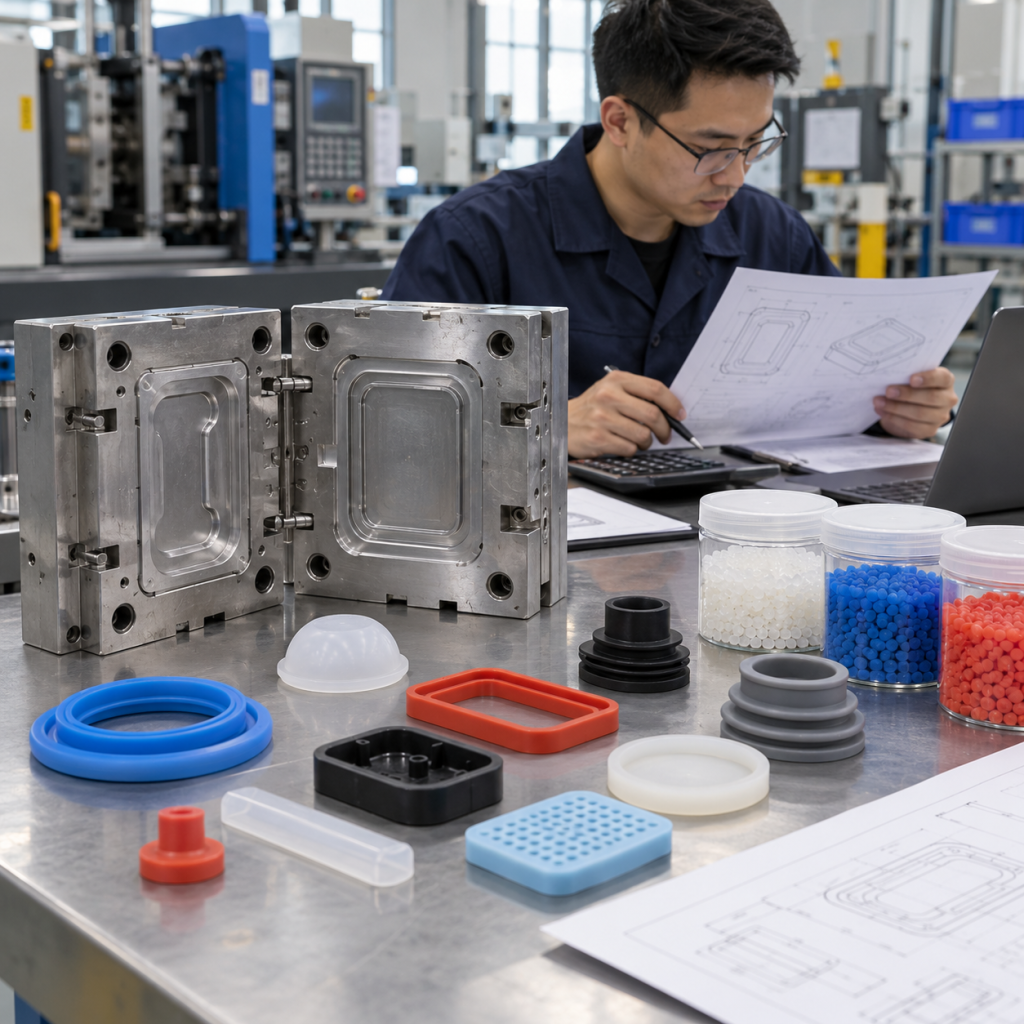
1. What Costs Are Included in Custom Silicone Molding?
A typical custom silicone molding quotation may include several cost elements:
- Mold or tooling cost
- Silicone raw material cost
- Molding production cost
- Labor cost
- Secondary processing
- Surface treatment or printing
- Controllo qualità
- Confezione
- Shipping
- Testing or certification if required
For most projects, buyers should separate the cost into two main categories:
One-time development cost
This normally includes mold design, tooling, sampling, and sometimes prototype development.
Recurring production cost
This includes silicone material, molding, labor, inspection, packaging, and other production-related costs for every order.
Understanding this difference is important when comparing quotations from different silicone manufacturers.
2. How Much Does Silicone Tooling Cost?
Tooling is often the largest upfront investment in a custom silicone molding project.
The cost depends mainly on the molding process and mold complexity.
A simple compression mold usually costs less than a precision liquid silicone rubber injection mold.
Several factors influence tooling cost.
Mold Size
Larger silicone products require larger mold bases and more material.
A small silicone button or sealing component generally requires a smaller mold than a large silicone housing or industrial gasket.
Number of Cavities
A mold can contain one cavity or multiple cavities.
More cavities usually increase the initial tooling cost, but they can significantly reduce the unit production cost for larger orders.
For example, a four-cavity or eight-cavity mold can produce several components during each molding cycle.
For high-volume production, a higher-cavity mold may therefore provide better long-term economics.
Geometria del prodotto
Complex structures increase mold design and machining difficulty.
Tra gli esempi figurano:
- Sottosquadri profondi
- Thin walls
- Complex sealing structures
- Internal grooves
- Fine textures
- Precision holes
- Multiple thickness transitions
- Overmolded inserts
Complex parts may require sliders, inserts, special demolding structures, or additional mold components.
Finitura superficiale
Different product surfaces require different mold finishes.
Tra gli esempi figurano:
- High-gloss surface
- Matte surface
- Fine texture
- Optical surface
- Functional sealing surface
Higher surface requirements generally increase mold machining and polishing costs.
Mold Material
Prototype molds and production molds may use different materials.
For high-volume programs, stronger tooling materials are normally selected to increase mold life and maintain dimensional stability.
3. LSR Molding vs Compression Molding Cost
The molding process has a major influence on both tooling investment and unit cost.
Stampaggio a compressione
Lo stampaggio a compressione è comunemente utilizzato per i prodotti in gomma siliconica solida.
Tra le applicazioni tipiche figurano:
- Silicone gaskets
- Cuscinetti in silicone
- Prodotti per l'infanzia
- Accessori da cucina
- Silicone covers
- Componenti industriali
- Guarnizioni in silicone
Compression molds are generally simpler and may require a lower initial tooling investment.
This makes compression molding suitable for small and medium production volumes.
However, the process may involve more manual operations and longer molding cycles.
Liquid Silicone Rubber Injection Molding
Liquid silicone rubber, or LSR, injection molding is often used for precision and high-volume products.
Tra le applicazioni tipiche figurano:
- Componenti in silicone medico
- Sigilli elettronici
- Connettori per il settore automobilistico
- Prodotti per l'alimentazione dei neonati
- Precision valves
- Waterproof components
- Silicone overmolded parts
LSR tooling is usually more complex.
The mold may require:
- Precise temperature control
- Cold runner systems
- Iniezione automatizzata
- Tight cavity tolerances
- Accurate venting
- Automated demolding
As a result, LSR tooling cost is normally higher.
However, for large-volume orders, LSR can provide better automation, shorter cycle times, better repeatability, and lower labor cost per part.
Therefore, buyers should not compare only the mold price.
The correct comparison is:
Total project cost over the expected production volume.
4. How Does MOQ Affect Silicone Product Cost?
MOQ, or minimum order quantity, has a major influence on silicone product pricing.
Silicone molding involves fixed costs such as:
- Mold setup
- Preparazione del materiale
- Configurazione della macchina
- Controllo qualità
- Preparazione dell'imballaggio
- Production scheduling
These costs must be distributed across the total number of parts produced.
If the order quantity is very small, the fixed cost per piece becomes relatively high.
As production volume increases, the unit cost usually decreases.
For example, a buyer may request quotations for:
- 500 pieces
- 1,000 pieces
- 5,000 pieces
- 10,000 pieces
- 50,000 pieces
This allows the buyer to understand how production volume affects unit pricing.
For new product development, starting with a smaller pilot order can reduce inventory risk.
After the design and market demand are confirmed, the production volume can be increased.
5. How Silicone Material Affects the Cost
Silicone is available in many grades and formulations.
The required material specification can significantly affect the final cost.
Common silicone materials include:
- General-purpose silicone rubber
- Silicone per uso alimentare
- Silicone per uso medico
- Silicone vulcanizzato al platino
- Gomma siliconica liquida
- Silicone resistente alle alte temperature
- Silicone ignifugo
- Silicone elettricamente conduttivo
- Thermal conductive silicone
- Low-compression-set silicone
Standard silicone materials are generally more economical.
Specialty materials usually cost more because they require specific formulations, performance properties, or certifications.
For example, a silicone component used in a household product may have very different material requirements from a silicone component used in a medical device.
Buyers should clearly specify required standards when requesting a quotation.
6. Does Silicone Hardness Affect Price?
Silicone hardness is normally measured using Shore A.
Common hardness ranges may include:
- 20 Shore A
- 30 Shore A
- 40 Shore A
- 50 Shore A
- 60 Shore A
- 70 Shore A
- 80 Shore A
Standard hardness ranges usually have limited impact on price.
However, extremely soft or extremely hard silicone can make molding more difficult.
Very soft silicone may cause deformation during demolding.
High-hardness silicone may require more pressure or different processing conditions.
Therefore, unusual hardness requirements may increase manufacturing difficulty and production cost.
7. Product Size and Weight
Silicone material consumption directly affects the unit price.
A large silicone component uses more raw material than a small sealing ring or silicone valve.
Manufacturers typically evaluate:
- Dimensioni del prodotto
- Part volume
- Silicone weight
- Runner material
- Scrap rate
For high-volume projects, even a small reduction in product weight can produce significant cost savings.
This is why Design for Manufacturing, or DFM, is important before tooling.
A manufacturer may recommend reducing unnecessary wall thickness while maintaining product strength and functionality.
8. How Tolerance Affects Silicone Molding Cost
Tighter tolerances usually increase manufacturing cost.
Silicone is flexible and can shrink after molding.
The dimensional accuracy of a silicone product can be affected by:
- Formulazione dei materiali
- Temperatura dello stampo
- Condizioni di cura
- Product geometry
- Spessore della parete
- Post-indurimento
- Measurement method
If a drawing contains unnecessarily tight tolerances on every dimension, mold manufacturing and quality control become more difficult.
It is therefore recommended to define:
Critical dimensions
These directly affect assembly, sealing, or product function.
Non-critical dimensions
These can normally use standard silicone molding tolerances.
Using reasonable tolerances can reduce tooling complexity and production cost without affecting product performance.
9. Silicone Overmolding Cost
Overmolding projects usually cost more than standard silicone molding.
Silicone can be overmolded onto materials such as:
- Acciaio inossidabile
- Alluminio
- PC
- PA
- PBT
- PPSU
- Other compatible plastics
The total cost may include:
- Insert manufacturing
- Posizionamento dell'inserto
- Trattamento superficiale
- Adhesion testing
- Additional mold structures
- Manual or automated loading
- Bonding process control
For silicone-to-plastic or silicone-to-metal applications, the manufacturer must also evaluate bonding compatibility.
Some products rely on chemical adhesion, while others use mechanical locking structures.
Good overmolding design can reduce the risk of delamination, leakage, flashing, and assembly failure.
10. Secondary Processes That Increase Cost
Some silicone products require additional processing after molding.
Common secondary operations include:
- Stampa del logo
- Laser marking
- Surface coating
- Trattamento al plasma
- Post curing
- Adhesive backing
- Assemblaggio
- Rifinitura
- Confezione
- Test funzionali
Each additional operation increases labor, processing time, and inspection requirements.
If possible, buyers should communicate all secondary processing requirements before mold development.
This helps avoid design changes after the mold has already been manufactured.
11. Quality Inspection and Testing Costs
Quality requirements vary significantly between industries.
A basic consumer silicone product may require:
- Ispezione visiva
- Dimension inspection
- Prove di durezza
More demanding applications may require:
- CMM inspection
- Prove di compressione
- Prove di tenuta
- Pull testing
- Prove di invecchiamento
- Biocompatibility testing
- Certificazione dei materiali
- Food-contact testing
- Tracciabilità dei lotti
Medical, automotive, and industrial customers may also require detailed inspection reports and production records.
Higher quality requirements increase manufacturing cost, but they also reduce the risk of field failures.
12. Packaging Can Also Affect the Final Price
Packaging is often underestimated during early product development.
Different packaging options may include:
- Confezionamento all'ingrosso
- PE bags
- Individual bags
- Custom boxes
- Retail packaging
- Blister packaging
- Tray packaging
- Imballaggio pulito
For B2B industrial components, bulk packaging is usually the most economical option.
For consumer products, custom retail packaging can represent a noticeable percentage of the total product cost.
It is therefore better to include packaging requirements in the original RFQ.
13. How to Reduce Custom Silicone Molding Cost
Buyers can reduce project costs without sacrificing quality by improving the design and purchasing strategy.
Simplify the Product Structure
Avoid unnecessary undercuts, extremely thin walls, and complex features.
Use Standard Silicone Materials
Unless special performance is required, standard grades can provide better cost efficiency.
Use Reasonable Tolerances
Only apply tight tolerances to functional dimensions.
Optimize Mold Cavities
For larger production volumes, multi-cavity tooling can reduce unit cost.
Reduce Unnecessary Secondary Operations
Printing, coatings, assembly, and special packaging should only be added when they provide real product value.
Provide Complete RFQ Information
A complete RFQ allows the manufacturer to calculate costs more accurately.
Missing information often results in inaccurate quotations or repeated communication.
14. What Information Should You Send for a Silicone Molding Quote?
For an accurate quotation, it is recommended to provide:
- Disegno 2D
- File CAD 3D
- Dimensioni del prodotto
- Durezza del silicone
- Requisiti relativi ai materiali
- Colore
- Finitura superficiale
- Tolleranza
- Estimated annual volume
- Quantità iniziale dell'ordine
- Applicazione
- Certification requirements
- Requisiti di imballaggio
If drawings are not available, clear product photos, dimensions, and application information can also help during the early evaluation stage.
15. Should You Choose the Cheapest Silicone Manufacturer?
The lowest unit price does not always mean the lowest total project cost.
A silicone component with poor dimensional control, unstable material, flash, bonding failure, or inconsistent hardness can cause problems during assembly and mass production.
For OEM and ODM projects, buyers should evaluate:
- Engineering support
- Mold design capability
- Material experience
- Quality control
- Production capacity
- Communication
- Lead time
- Tracciabilità
- Experience with similar applications
A manufacturer that provides strong DFM support may help reduce both tooling risk and long-term production cost.
Conclusione
The cost of custom silicone molding depends on much more than the weight of the silicone material.
Tooling structure, molding process, material grade, order quantity, tolerance, secondary processing, inspection, and packaging all influence the final price.
For low-volume products, reducing tooling investment may be the priority.
For high-volume programs, investing in a more efficient multi-cavity or automated LSR mold may significantly reduce the long-term unit cost.
The best way to receive an accurate quotation is to provide complete product drawings, material requirements, estimated quantities, and application information.
Fuhongying provides custom silicone rubber and liquid silicone rubber molding services for OEM and ODM projects, including silicone parts for baby care, consumer electronics, medical devices, sealing applications, industrial products, and custom overmolded components.
Send us your drawing, sample, or project requirements for a manufacturing review and quotation.
Domande frequenti
Quanto costa uno stampo in silicone su misura?
The cost depends on product size, cavity number, mold material, molding process, surface finish, tolerance, and mold complexity. Compression molds are generally simpler, while precision LSR injection molds usually require a higher initial investment.
What is the MOQ for custom silicone molding?
MOQ depends on the product and manufacturing process. Small pilot runs are possible for some projects, while high-volume LSR production normally provides better unit pricing.
Is LSR molding more expensive than compression molding?
LSR tooling is usually more expensive because the mold and injection system are more complex. However, LSR can provide lower labor costs, faster automated production, and better consistency for high-volume projects.
Why does the unit price decrease when the order quantity increases?
Fixed costs such as machine setup, material preparation, inspection, and production scheduling can be distributed across more parts, reducing the average cost per piece.
What files should I send for a silicone molding quotation?
3D CAD files such as STEP or STP are very useful. A 2D drawing should also include dimensions, tolerances, material, hardness, color, surface requirements, and estimated order quantities.
 English
  Japanese
  Korean
  German
  French
  Italian
  Spanish
  Dutch
Dutch  Chinese
  Portuguese
  Polish
  Czech
Czech  Hungarian
  Swedish
  Finnish
  Vietnamese
  Thai
Thai  Turkish
  Arabic
  Russian