
Color plays a far more important role in medical silicone products than aesthetics alone. In medical devices, color is often used for product identification, size differentiation, procedure management, inventory control, and brand recognition. A consistent and validated color system also helps reduce clinical errors while improving manufacturing traceability.
Unlike consumer products, medical silicone color matching requires careful consideration of biocompatibility, sterilization stability, regulatory compliance, and manufacturing consistency. A color that appears perfect in the laboratory may change after gamma irradiation or repeated steam sterilization, making proper validation essential.
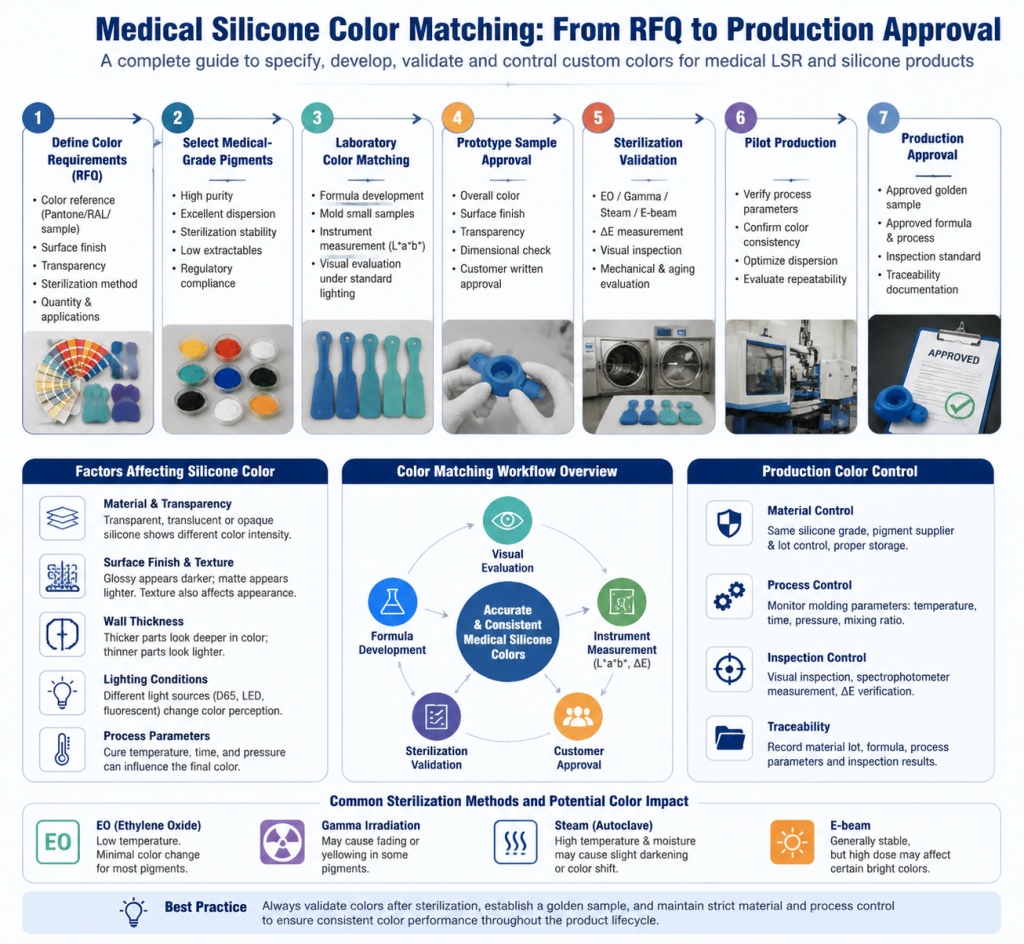
This guide explains the complete workflow of medical silicone color matching—from the initial RFQ to final production approval—helping medical device manufacturers shorten development cycles while ensuring reliable production quality.
Tartalomjegyzék
- Why Color Matters in Medical Silicone
- Common Medical Silicone Materials
- Defining Color Requirements in an RFQ
- Choosing the Right Pigments
- Color Matching Process
- Sample Evaluation and Approval
- Sterilization Validation
- Production Color Control
- Common Challenges
- RFQ Checklist
- Gyakran feltett kérdések
- Következtetés
Why Color Matters in Medical Silicone
Medical silicone colors are rarely chosen simply because they look attractive. They often serve important functional purposes.
A tipikus alkalmazások közé tartoznak:
- Size identification
- Product family differentiation
- Surgical procedure coding
- Left/right component identification
- Pediatric versus adult products
- OEM branding
- Hospital inventory management
Examples include:
| Device | Typical Color Function |
|---|---|
| Catheter | Size identification |
| Valve | Flow direction |
| Respiratory mask | Product series |
| Orvosi csövek | Fluid identification |
| Injection port | Connection type |
| Surgical handle | Brand identification |
Proper color planning reduces the possibility of operator mistakes while improving manufacturing efficiency.
Common Medical Silicone Materials
Color behavior depends heavily on the silicone formulation.
Typical materials include:
| Anyag | Jellemző felhasználás |
|---|---|
| Medical LSR | Fröccsöntés |
| HCR Silicone | Tömörítőformázás |
| Platinum-cured Silicone | Beültethető eszközök |
| Medical-grade VMQ | General medical products |
Material transparency also influences final color appearance.
Például:
- Transparent LSR produces brighter colors.
- Translucent silicone softens color intensity.
- Filled silicone may appear slightly lighter.
- High-hardness silicone often reflects light differently.
Understanding the base material helps achieve accurate color matching.
Step 1: Defining Color Requirements in the RFQ
A detailed RFQ greatly improves first-pass color accuracy.
Customers should ideally provide:
Preferred Color Standard
Examples include:
- Pantone
- RAL
- Physical color chip
- Existing production sample
Physical samples generally provide the highest accuracy because silicone behaves differently from printed color cards.
Felületi kivitel
Surface texture significantly affects perceived color.
Példák:
- Glossy
- Matte
- Fine texture
- Sandblast texture
- Mold texture
A matte surface usually appears lighter than a glossy finish.
Transparency Requirement
Specify whether the product should be:
- Átlátszó
- Semi-transparent
- Opaque
The same pigment concentration can produce very different visual effects depending on transparency.
Viewing Conditions
Color approval should specify:
- Light source (D65 recommended)
- Viewing angle
- Background color
- Inspection distance
Without standardized viewing conditions, two acceptable samples may appear different.
Step 2: Selecting Medical-Grade Pigments
Not every silicone pigment is suitable for medical applications.
Medical pigments should provide:
- High purity
- Excellent dispersion
- Sterilizálásállóság
- Low extractables
- Hosszú távú stabilitás
- A jogszabályok betartása
Common pigment types include:
| Pigment Type | Typical Characteristics |
|---|---|
| Inorganic pigments | Excellent heat stability |
| Organic pigments | Bright colors |
| Titanium dioxide | White opacity |
| Iron oxide | Stable earth tones |
| Carbon black | Deep black |
The pigment supplier should provide documentation supporting medical use where required.
Step 3: Laboratory Color Matching
Color development normally follows these stages.
Initial Formula Development
Engineers prepare several pigment concentrations.
Például:
- Formula A
- Formula B
- Formula C
Each formula is molded under controlled processing conditions.
Instrument Measurement
Most manufacturers use spectrophotometers to measure color.
Typical measurements include:
- L*
- a*
- b*
- Delta E
Objective measurement reduces visual disagreement.
Visual Comparison
Human evaluation remains important.
Samples are inspected under:
- D65 daylight
- Warm lighting
- Hospital lighting
- LED lighting
This confirms real-world appearance.
Step 4: Prototype Sample Approval
Before production, customers typically receive molded samples.
Evaluation usually includes:
- Overall color
- Felületi kivitel
- Átláthatóság
- Textúra
- Méretpontosság
- Flash
- Gate appearance
Many manufacturers require written sample approval before mass production begins.
Step 5: Sterilization Validation
Medical colors must remain stable after sterilization.
Common sterilization methods include:
| Method | Typical Temperature |
|---|---|
| EO | Low temperature |
| Gamma | Ambient |
| Steam | 121–134 °C |
| E-beam | Ambient |
Validation may include:
- Delta E measurement
- Szemrevételezés
- Mechanical property testing
- Aging evaluation
Some pigments perform well before sterilization but shift noticeably afterward.
Step 6: Pilot Production
Before mass production, manufacturers often conduct pilot runs.
Objectives include:
- Verify molding parameters
- Confirm color consistency
- Optimize pigment dispersion
- Evaluate production repeatability
Typical pilot quantities range from hundreds to several thousand parts depending on project requirements.
Step 7: Production Approval
Final approval generally includes:
- Approved golden sample
- Approved color formula
- Production process parameters
- Inspection standards
- Batch records
- Traceability documentation
These documents become the reference for future production.
Production Color Control
Consistent production requires control of multiple variables.
Material Control
Maintain:
- Same silicone grade
- Same pigment supplier
- Same pigment lot whenever possible
- Proper storage conditions
Process Control
Monitor:
- Injection temperature
- Mold temperature
- Cure time
- Mixing ratio
- Injection pressure
Process variations can influence final appearance.
Inspection Control
Typical inspections include:
- Szemrevételezés
- Spectrophotometer testing
- Delta E verification
- Sample retention
- First article inspection
Many medical manufacturers retain approved samples for future comparison.
Common Color Matching Challenges
Batch Variation
Possible causes:
- Pigment variation
- Mixing inconsistency
- Material changes
- Temperature fluctuations
Sterilization Color Shift
Some pigments:
- Fade
- Yellow
- Darken
- Become less saturated
Pre-validation helps avoid production issues.
Transparency Differences
Small differences in wall thickness can change perceived color intensity.
Design engineers should consider this during product development.
Lighting Differences
Colors may appear different under:
- Factory lighting
- Hospital lighting
- Natural daylight
Using standardized inspection lighting minimizes disagreement.
RFQ Checklist
A complete RFQ should include:
✓ Medical device application
✓ Silicone material grade
✓ Hardness requirement
✓ Color reference (Pantone, RAL, or sample)
✓ Surface finish
✓ Transparency requirement
✓ Sterilization method
✓ Regulatory requirements
✓ Annual quantity
✓ Production volume
✓ Packaging requirements
✓ Inspection requirements
Providing complete information enables faster quotation, more accurate color development, and fewer engineering revisions.
Bevált gyakorlatok
- Use physical samples whenever possible.
- Define inspection lighting conditions.
- Validate colors after sterilization.
- Establish a golden sample before production.
- Maintain pigment lot traceability.
- Use spectrophotometer measurements together with visual evaluation.
- Keep processing conditions stable during mass production.
- Retain production samples for future comparison.
Gyakran feltett kérdések
Can Pantone colors be matched exactly in silicone?
Not always. Pantone standards are printed colors, while silicone has different optical properties. Manufacturers typically achieve a close visual match rather than an exact printed equivalent.
Why does silicone look different after molding?
Surface finish, wall thickness, transparency, and curing conditions all influence the final appearance.
Should color be approved before sterilization?
No. Medical products should be evaluated both before and after the intended sterilization process.
Which sterilization method causes the largest color changes?
Gamma irradiation and repeated steam sterilization may cause noticeable color shifts in certain pigments, depending on the formulation.
Is Delta E alone sufficient for approval?
No. Instrument measurements should be combined with visual inspection under standardized lighting conditions.
Can transparent silicone achieve dark colors?
Yes, but transparency decreases as pigment concentration increases. Designers should balance color intensity with optical clarity.
How are production batches kept consistent?
Through controlled raw materials, standardized processing, spectrophotometer measurements, approved golden samples, and documented quality procedures.
What documents should accompany a medical silicone color approval?
Typical documentation includes the approved color standard, sample approval records, inspection criteria, process parameters, material traceability, and validation reports.
Következtetés
Medical silicone color matching is a multidisciplinary process involving materials science, pigment technology, molding expertise, quality assurance, and regulatory compliance. Successful projects begin with a well-defined RFQ, continue through systematic laboratory development and sterilization validation, and conclude with robust production controls supported by traceability and documented approval standards.
By establishing clear color specifications, validating performance under real sterilization conditions, and implementing consistent manufacturing controls, medical device manufacturers can achieve reliable, repeatable color quality throughout the product lifecycle while reducing development risk and ensuring consistent clinical performance.
 English
  Japanese
  Korean
  German
  French
  Italian
  Spanish
  Dutch
Dutch  Chinese
  Portuguese
  Polish
  Czech
Czech  Hungarian
  Swedish
  Finnish
  Vietnamese
  Thai
Thai  Turkish
  Arabic
  Russian