
1. Bevezetés
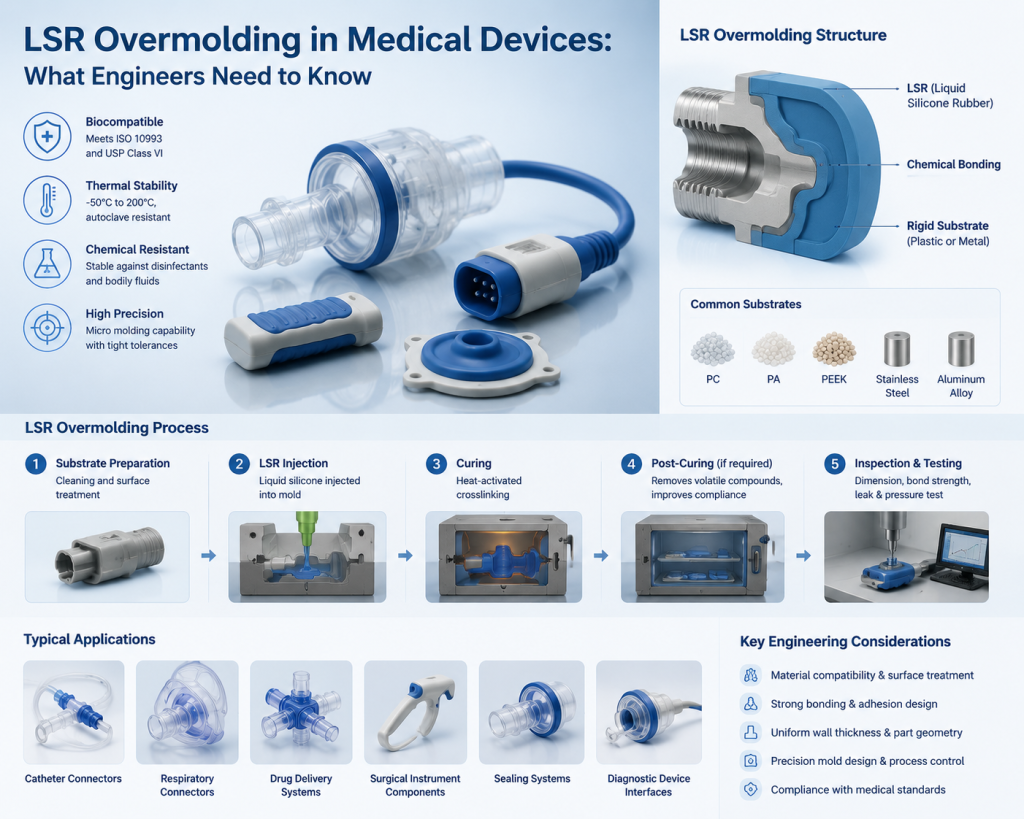
Liquid Silicone Rubber (LSR) overmolding has become one of the most important manufacturing technologies in modern medical device engineering. It enables the combination of rigid substrates (plastic or metal) with soft silicone sealing or functional layers, creating components that meet strict requirements for biocompatibility, sealing performance, and long-term durability.
Alkalmazási területek:
- Catheter connectors
- Sealing diaphragms
- Respiratory device interfaces
- Drug delivery systems
- Surgical instrument components
For engineers, understanding LSR overmolding is essential for designing reliable, scalable medical devices.
2. What Is LSR Overmolding?
LSR overmolding is a manufacturing process where liquid silicone rubber is injected onto a pre-formed substrate such as:
- Polycarbonate (PC)
- Polyamide (PA)
- PEEK
- Stainless steel
- Aluminum alloys
After curing, the silicone becomes permanently bonded to the substrate, forming a single integrated functional component.
3. Why LSR Is Ideal for Medical Devices
LSR offers unique advantages compared to traditional elastomers:
3.1 High Biocompatibility
- Suitable for skin contact and internal medical use
- Complies with ISO 10993 and USP Class VI
3.2 Excellent Thermal Stability
- Resistant from -50°C to 200°C
- Compatible with autoclave sterilization
3.3 Chemical Resistance
- Stable against disinfectants and bodily fluids
- Low extractables and leachables
3.4 Precision Molding Capability
- Suitable for micro-scale medical components
- High repeatability in mass production
4. Key Engineering Design Considerations
4.1 Material Compatibility
Not all plastics bond well with LSR. Engineers must consider:
- Surface energy of substrate
- Use of primers or plasma treatment
- Thermal expansion mismatch
4.2 Bonding Mechanism
LSR bonding occurs via:
- Chemical bonding (preferred)
- Mechanical interlocking (secondary structure)
Strong bonding is critical for preventing delamination in medical environments.
4.3 Wall Thickness Control
Uniform silicone thickness ensures:
- Stable curing behavior
- Reduced shrinkage variation
- Consistent sealing performance
Typical medical LSR wall thickness: 0.3 mm – 3.0 mm
4.4 Mold Design Complexity
LSR overmolding molds require:
- Precision alignment systems
- Venting for air evacuation
- Temperature-controlled cavities
- Multi-shot injection capability
5. A gyártási folyamat áttekintése
Step 1: Substrate Preparation
- Injection molded plastic or machined metal part
- Cleaning and surface treatment
Step 2: LSR Injection
- Liquid silicone injected into mold cavity
- Controlled temperature and pressure
Step 3: Curing Process
- Heat-activated crosslinking
- Rapid cycle time (typically 30–90 seconds)
Step 4: Post-Curing (if required)
- Eltávolítja az illékony vegyületeket
- Improves medical compliance
Step 5: Inspection & Testing
- Méretpontosság
- Bond strength testing
- Leak and pressure tests
6. Common Challenges in Medical LSR Overmolding
6.1 Delamination Issues
Ok:
- Poor surface treatment
- Incompatible substrate materials
6.2 Flashing Defects
- A penész elleni tömítés nem megfelelő
- Túlzott befecskendezési nyomás
6.3 Inconsistent Bond Strength
- Variations in surface chemistry
- Contamination during molding
7. Applications in Medical Devices
LSR overmolding is widely used in:
- Drug delivery systems
- Infusion pumps
- Respiratory masks and connectors
- Surgical instrument grips
- Catheter sealing systems
- Diagnostic device interfaces
8. Future Trends
The medical LSR industry is evolving toward:
- Micro-precision overmolding (<100 μm structures)
- Multi-material integration (silicone + electronics)
- Smart medical device interfaces
- Fully automated cleanroom production lines
9. Következtetés
LSR overmolding is a critical enabling technology in modern medical device manufacturing. Engineers must carefully consider material compatibility, mold design, bonding mechanisms, and regulatory compliance to ensure high-performance and safe medical components.
With increasing demand for minimally invasive and high-reliability devices, LSR overmolding will continue to play a central role in the future of healthcare engineering.
 English
  Japanese
  Korean
  German
  French
  Italian
  Spanish
  Dutch
Dutch  Chinese
  Portuguese
  Polish
  Czech
Czech  Hungarian
  Swedish
  Finnish
  Vietnamese
  Thai
Thai  Turkish
  Arabic
  Russian